Wall Street Giants Vie for GPU Futures, Crypto Market Already in Early Skirmish

marsbitОпубліковано о 2026-05-22Востаннє оновлено о 2026-05-22

Анотація

Wall Street giants CME and ICE are racing to launch GPU futures, marking a pivotal shift as computing power transforms from a critical IT resource into a tradable financial asset. In mid-May, both exchanges announced plans for futures contracts tied to GPU compute pricing indices, aiming to establish a benchmark and provide hedging tools for the volatile, trillion-dollar AI compute market. ICE partnered with data provider Ornn for a broad index covering enterprise and consumer GPUs, while CME teamed with Silicon Data to focus on an H100 leasing index with cash settlement. This push for financialization addresses a key industry pain point: the lack of risk management tools in a market dominated by a few cloud providers, where prices are opaque and highly unstable. Proponents argue futures will help large cloud operators and AI labs lock in costs and manage investment risk. However, challenges remain, including the intangible nature of compute, high market concentration, and the potential for leveraged speculation to exacerbate price swings and resource inequality. Notably, the crypto market has moved faster. Platforms like Architect Financial have already launched perpetual contracts tied to compute indices, leveraging DeFi's agility to create a parallel, global market. As Wall Street awaits regulatory approval, the race to define and control the pricing of "21st-century oil" is accelerating both in traditional and decentralized finance.

Author: Jae, PANews

Computing power has become the "new oil of the 21st century" fueling global AI operations. The computing power arms race driven by AI is transcending the physical boundaries of information technology and deeply penetrating the veins of modern financial infrastructure.

Larry Fink, the head of global asset management giant BlackRock, once pointed out that in the context of scarce AI ecosystem resources, a futures market linked to computing power might emerge. This prophecy found concrete evidence in May.

Within just one week, two leading players in the traditional financial market, CME Group and Intercontinental Exchange (ICE), the parent company of the New York Stock Exchange, announced plans to develop GPU computing power futures markets one after another.

Computing power is transforming from an intangible technological resource into a standardized financial asset that can be speculated on, traded, and hedged. The fierce competition among Wall Street giants for the pricing power of this new macro commodity also marks the official opening of the era of computing power asset financialization.

GPU Futures Become New Wall Street Battleground: ICE Aims for Universal Coverage, CME Seeks First-Mover Advantage

In this beachhead landing war for the financialization of computing power assets, the two Wall Street titans have chosen different entry paths.

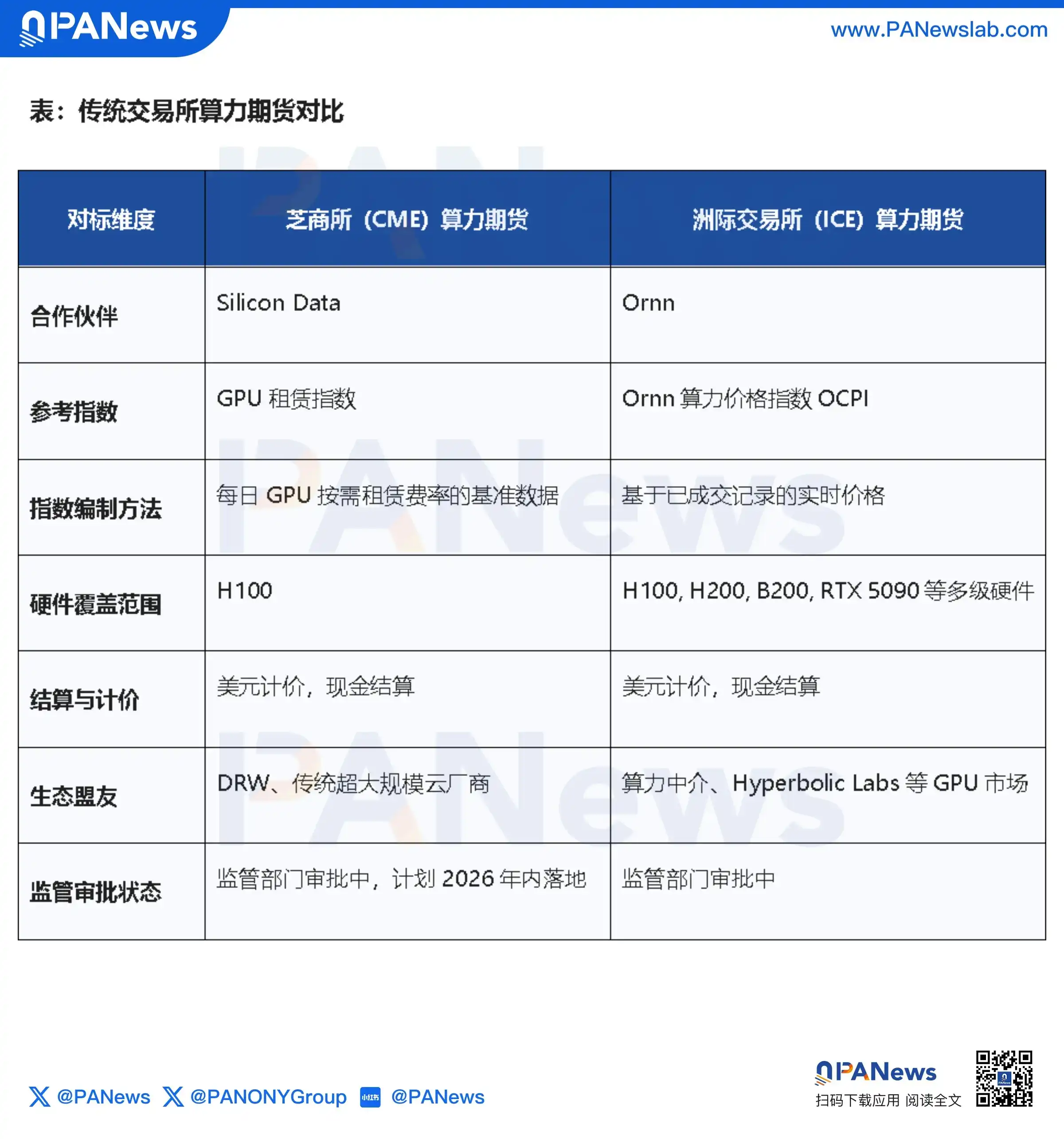
On May 19th, ICE, in collaboration with data provider Ornn, entered the fray, planning to launch a series of GPU computing power futures contracts based on the Ornn Computing Price Index (OCPI).

The OCPI introduced by ICE is the world's first computing power index constructed from real transaction records. Ornn ensures the transparency of this pricing data by distributing the index in real-time to Bloomberg Terminals through its subsidiary Ornn Data, thereby avoiding the issue of "listed price distortion."

Ornn co-founder and CEO Kush Bavaria believes computing power has grown into a trillion-dollar market, and ICE's futures listing will provide a risk transfer layer for institutional buyers and computing power operators.

ICE's computing power futures contracts cover not only mainstream enterprise-grade high-end GPUs like H100, H200, and B200 but also include high-end consumer-grade graphics cards like the RTX 5090, offering refined hedging options for computing power needs across different scenarios. This means ICE is attempting to seize pricing power for computing power across the entire spectrum, from cloud to edge, and from training to inference.

To further solidify the index's industrial foundation, Ornn has also brought in Hyperbolic Labs, one of the world's largest GPU marketplaces, as an ally. Its co-founder and CEO, Jasper Zhang, pointed out that the current GPU market is increasingly resembling the global commodity market, and ICE's move precisely addresses the risk management pain points of new computing power service providers (Neoclouds) and AI labs.

Rather than saying ICE is actively entering the computing power futures market, it's more accurate to say it is rushing to catch up. In fact, CME had already made the first move a week earlier.

On May 12th, CME announced it would partner with GPU market intelligence and benchmark data provider Silicon Data, backed by trading giant DRW, to launch the world's first computing power futures contracts. As a benchmark in the global derivatives market, CME's entry signifies that computing power has officially been included in the sequence of "macro commodities" recognized by Wall Street.

Unlike ICE's broad approach, CME's computing power futures are anchored to Silicon Data's compiled "H100 Lease Index." By providing daily standardized tracking of real-time on-demand leasing rates across major cloud service providers and new GPU cloud platforms, it establishes a unified pricing benchmark for a highly fragmented and opaque spot market.

To avoid depreciation and transportation losses associated with physical hardware delivery, CME's GPU futures contracts will adopt a cash settlement model. The underlying asset being traded is not the physical chip but expectations for future H100 leasing prices.

For large-scale cloud service providers, this provides a much-needed hedging tool. When a cloud service provider invests billions in procuring H100s, it only needs to establish a short position in the CME computing power futures market to lock in a minimum return on investment (ROI) for its servers, thereby mitigating the risk of asset devaluation caused by plummeting computing power prices.

This approach closely mirrors the logic that once turned crude oil, natural gas, and electricity into commodities.
Computing Power Futures Ignite Pricing Power Battle, Financialization Brings Both Opportunities and Tests

Since the wave of large language models swept the globe, computing power has leapt from an "IT resource" to a "strategic material" contested by the AI triumvirate (OpenAI, Anthropic, Google) and Silicon Valley giants like Meta. Simply put, whoever hoards more GPUs holds the entry ticket to the AI era.

But problems have also emerged: the computing power market is too expensive and too unpredictable.

The four cloud giants—Amazon AWS, Microsoft Azure, Oracle, and Google GCP—control about 78% of global IT power capacity and 69% of H100 supply. Spot leasing prices sometimes surge severalfold, only to plummet during chip generation updates. If an AI lab wants to lock in computing power a year in advance, it may have to pay a significant premium; if not, it faces the risk of supply disruption.

What's more troublesome is that the computing power market lacks hedging instruments.

DRW founder Don Wilson frankly stated: The explosive growth of capital-intensive investments like data centers has historically been constrained by the lack of effective risk management tools. The launch of a computing power futures market is a solution to this pain point.

One could argue that whoever masters the pricing power of computing power masters the Bretton Woods system of the AI era.

The battle for computing power pricing rights between the two Wall Street giants reveals that this emerging factor of production is at a historical intersection of "financialization" and "commoditization." This evolution is underpinned by industry cycles but also accompanied by non-negligible potential risks.

From a supply-demand cycle perspective, the global computing power market is entering a new phase of rebalancing. Although early-stage explosive growth in AI applications led to extreme supply-demand mismatch for high-end GPUs and leasing prices soared multiple times, with the large-scale completion of data center construction and chip generation iterations, spot prices will exhibit high volatility. The market urgently needs forward pricing tools to smooth out risks.

However, the "intangible nature" of computing power means it cannot replicate the delivery logic of traditional commodities. Physical chips have a short lifecycle, typically facing technological obsolescence or depreciation within 18 to 24 months, rendering physical delivery forward contracts invalid. Therefore, using a "standard computing unit," such as converting to a benchmark unit like 1 hour of H100 runtime, supplemented by cash settlement, has become the industry's recognized optimal solution. However, this also increases the complexity of pricing models.

Furthermore, the supply side of computing power is highly concentrated, and the spot market is essentially an oligopoly. Building a derivatives market on such a structure creates an inherent fragility in the price discovery mechanism, making futures prices susceptible to indirect manipulation via spot prices.

More importantly, once the computing power derivatives market fully opens, its leverage attributes might amplify price volatility in the spot market. Inflows of leveraged capital and speculative fervor could drive up procurement costs for computing power, turning small and medium-sized AI enterprises into the "harvested," potentially evolving into a "financial hunt" that further exacerbates the uneven distribution of computing resources.

Wall Street Awaits Approval, Crypto Players Already Charging Ahead

While Wall Street's two major exchanges still await regulatory approval, players in the crypto market have already taken the lead.

As early as January this year, Architect Financial Technologies, founded by the former president of FTX US, partnered with Ornn to launch perpetual contracts linked to the OCPI-H100 index through its AX platform.

As more platforms follow suit, it's not impossible that centralized exchanges (CEX) will successively list related computing power futures markets. Additionally, they might launch structured wealth management products for ordinary users or fixed investment products tied to GPU leasing rates, further achieving seamless integration between the crypto market and traditional financial macro assets.

Compared to the heavily regulated CME and ICE facing lengthy approval processes, perpetual decentralized exchanges (Perp DEX) operating on smart contracts possess higher agility and the institutional advantage of permissionless innovation.

Perp DEXs also don't need to go through the lengthy listing procedures of CEXs. For instance, developers only need to stake 500,000 HYPE tokens (or potentially lower thresholds in the future) to list computing power perpetual contracts linked to GPU indices on Hyperliquid's HIP-3 market. This product development capability will allow DeFi to establish a global computing power speculation market unrestricted by geography or barriers, operating even outside Wall Street's regular trading hours.

However, computing power futures is, after all, a nascent asset class with relatively high risk coefficients in its early stages. The computing power market is predominantly over-the-counter (OTC), making data sources susceptible to manipulation. In more extreme cases, such as facing black swan events like technological breakthroughs or chip embargoes, computing power indices might experience non-continuous, sharp price fluctuations. Both scenarios can lead to price distortion, triggering large-scale liquidations of highly leveraged contracts.

Regardless, the Wall Street giants' scramble for computing power futures marks an inflection point in the convergence of AI infrastructure and modern finance.

GPU computing power, once viewed more as an IT resource, is being experimented with as a quantifiable, tradable, hedgeable standardized asset, embedding the logic of technological resource allocation into the global financial system.

With the commoditization of computing power assets, its resource allocation logic may also shift from relying solely on spot procurement to being increasingly influenced by financial market price signals. In the future, computing power might gradually form more mature price discovery mechanisms and capital allocation systems, much like foundational factors of production such as energy and electricity.


Пов'язані питання

QWhich two major Wall Street exchanges are competing to launch GPU computing power futures, and what are the key features of their respective proposed contracts?

AChicago Mercantile Exchange Group (CME Group) and Intercontinental Exchange (ICE) are competing. CME, partnering with Silicon Data, plans to offer cash-settled futures contracts based on the 'H100 rental index' to hedge against price fluctuations for large cloud providers. ICE, partnering with data provider Ornn, aims to offer a broader range of futures based on the Ornn Computing Power Index (OCPI), covering both enterprise-grade (e.g., H100, H200) and high-end consumer-grade GPUs (e.g., RTX 5090) to establish pricing power across the entire computing spectrum.

QAccording to the article, what is the primary problem or pain point in the current AI computing power market that these futures contracts aim to solve?

AThe primary problem is the extreme volatility and unpredictability of computing power prices in a fragmented and opaque market. Prices can surge or plummet dramatically due to supply-demand imbalances and rapid hardware iteration. Major AI companies and cloud providers lack effective risk management tools to hedge against these price swings, making long-term planning and investment difficult.

QWhat potential risks does the article associate with the financialization of computing power through futures markets?

AKey risks include: 1) Price manipulation due to the highly concentrated, oligopolistic nature of the underlying spot market (controlled by major cloud providers). 2) Amplified price volatility as leverage and speculative capital enter the derivatives market. 3) Increased procurement costs for smaller AI firms, potentially exacerbating resource inequality. 4) The inherent complexity of creating a pricing model for an 'intangible' asset like computing power that faces rapid technological obsolescence.

QHow have cryptocurrency market players reacted to the trend of computing power financialization, compared to traditional Wall Street institutions?

ACryptocurrency market players have moved faster and with more agility. For example, Architect Financial Technologies launched a perpetual contract tied to the OCPI-H100 index as early as January. The article suggests that decentralized perpetual contract exchanges (Perp DEXs) could create permissionless, global markets for computing power speculation, operating outside traditional trading hours and with lower listing barriers than heavily regulated Wall Street exchanges or even centralized crypto exchanges (CEX).

QWhat is the core 'commodity' being traded in proposed computing power futures contracts like CME's, and how is it settled to avoid physical hardware issues?

AThe core commodity is the future price expectation for standardized computing power units, specifically the rental/lease rate for GPU runtime (e.g., one hour of H100 computing time). To avoid issues related to the physical depreciation, transportation, and rapid obsolescence of hardware chips, these contracts are designed to be cash-settled. The contracts are settled financially based on the difference between the contracted price and the benchmark index price at expiration, rather than requiring the physical delivery of GPUs.

Пов'язані матеріали

After Three Consecutive Quarters of Decline, Can the Crypto Market Find a Window for Stabilization in Q3?

The cryptocurrency market has just concluded its worst-performing quarter since 2022, with total capitalization dropping 12.6% to $2.1 trillion. All core metrics indicate capital is leaving the sector, not just rotating within it. Bitcoin fell 14.2% and Ethereum dropped 25.4% in Q2, breaking their previous correlation with US tech stocks. A key driver is the reversal in US spot Bitcoin ETF flows, which saw a net outflow of approximately $4.67 billion in Q2, including a record monthly outflow near $4.5 billion in June. While recent data suggests long-term holders are accumulating again, sustained ETF outflows mean continued selling pressure. Market focus is now singularly on the Federal Reserve. The upcoming July FOMC meeting is seen as the most critical event for Q3. A dovish signal could support Bitcoin reclaiming a $68,000-$84,000 range, while a hawkish stance might establish a new trading band around $50,000-$56,000. Additionally, regulatory uncertainty persists, with the progress of the crucial *CLARITY Act* stalling in the Senate, reducing its perceived 2026 passage probability to 40-45%. Despite the broad downturn, a few sectors showed growth. Prediction markets saw nominal volume surge 48.7% year-over-year to $113.8 billion, and tokenized collectibles transaction volume rose 143% quarterly to $1.4 billion. The Real-World Asset (RWA) tokenization sector also continued steady growth, now representing ~$28.1 billion in on-chain value. The market's foundation for an extreme crash appears limited, with Bitcoin price hovering near its 200-week moving average. However, the trading paradigm has shifted from narrative-driven speculation to decisions based on price action, policy developments, and interest rate expectations, making a broad sentiment-driven rally unlikely in the near term.

marsbit3 год тому

After Three Consecutive Quarters of Decline, Can the Crypto Market Find a Window for Stabilization in Q3?

marsbit3 год тому

BIT Trading Moment: BTC Still Suppressed by Weekly 200 EMA, Rejection May Restart Decline; Storage and Semiconductors that Surged Last Night Begin Falling in Evening Trading

**Crypto & Stock Market Wrap: Bitcoin Tests Resistance, Stocks Retreat After AI Surge** Bitcoin consolidates around $66,000, facing key resistance near $68,000—an area seen as a major psychological and technical hurdle where previous rallies have failed. Analysts note the cryptocurrency is caught between its 200-week moving average (~$63,333) and 200-week EMA (~$68,328). A clear break above $68k is needed to signal a stronger bullish trend, while a rejection could lead to a retest of $63k support. Market sentiment remains cautious, with low futures open interest pointing to a low-liquidity rebound rather than a full bull market. Bitcoin spot ETFs saw another $203 million inflow. US stock futures pointed lower after a strong Tuesday session led by a massive rebound in semiconductors and memory stocks. The rally was fueled by renewed optimism about AI-driven hardware demand, with Micron, SanDisk, and SK Hynix surging. However, those gains reversed in pre-market trading. Super Micro Computer (SMCI) soared over 20% after hours on strong guidance and a record backlog. Other standouts included Rocket Lab and nuclear energy plays Oklo and X-Energy. Rising oil prices (Brent above $91) and climbing Treasury yields (10-year near 4.64%), however, are reigniting inflation concerns and acting as a headwind for equities. In Asia, markets were mixed. South Korea's KOSPI pared early gains to close slightly higher as semiconductor stocks like SK Hynix gave back initial surges. Japan's Nikkei edged lower as the yen hit a fresh 38-year low against the dollar, raising fears of potential market intervention. Key events to watch include the Samsung Galaxy launch, AMD's AI event, and a slew of major tech earnings from Alphabet, Tesla, and IBM after the close on Wednesday, followed by the ECB meeting and Intel's earnings on Thursday.

marsbit3 год тому

BIT Trading Moment: BTC Still Suppressed by Weekly 200 EMA, Rejection May Restart Decline; Storage and Semiconductors that Surged Last Night Begin Falling in Evening Trading

marsbit3 год тому

Former CFTC Chairman, Circle President Tarbert: Preaching Long-Termism While Cashing Out $30 Million Himself

Former CFTC Chairman and Circle President Heath Tarbert has consistently advocated for a long-term vision in public, urging patience from investors as Circle’s stock price has fallen significantly from its peak. However, it has been revealed that since Circle’s IPO, Tarbert has continuously sold his CRCL shares through pre-arranged trading plans, cashing out approximately $30 million, without making any public market purchases. This contrast between his public messaging and personal actions has drawn criticism. Tarbert joined Circle in July 2023 as Chief Legal Officer, leveraging his regulatory experience to help guide the company through its IPO and expansion. Despite promoting stablecoins as long-term infrastructure, he established a 10b5-1 trading plan just before Circle went public, leading to substantial stock sales over the following year. In March 2026, he initiated another plan to sell more shares. His career trajectory highlights a pattern of moving between high-level regulatory roles and influential positions in the financial sector. After resigning as CFTC Chairman in early 2021, he joined Citadel Securities as Chief Legal Officer just 27 days later, during a period of intense regulatory scrutiny for the firm. He later joined Circle, aiding its efforts to navigate regulatory challenges for its public listing. While Tarbert's expertise in policy and compliance is valuable to companies like Circle, his actions—advocating long-term confidence while personally divesting—raise questions about the alignment between his public statements and his private financial decisions, leaving investors who followed his advice to bear the market risks.

marsbit3 год тому

Former CFTC Chairman, Circle President Tarbert: Preaching Long-Termism While Cashing Out $30 Million Himself

marsbit3 год тому

Gate Research Institute: The 'Wall Street-ization' Wave of Crypto Financial Products – Competition or Integration?

The article titled "Gate Research Institute: Are Crypto Financial Products Sparking a 'Wall Street' Wave—Competition or Convergence?" explores the evolving relationship between the crypto ecosystem and traditional finance (TradFi). The piece begins by reflecting on Bitcoin's original 2009 vision of decentralization, disintermediation, and moving away from banks. It then contrasts this with the 2024 landscape, where key crypto assets like Bitcoin are increasingly held through Wall Street products like ETFs issued by giants like BlackRock. The article questions whether this signifies that TradFi is systematically taking over the rights to issue, price, custody, and distribute crypto financial assets. The core argument is that this is not a zero-sum takeover but rather a bidirectional convergence where each side addresses the other's weaknesses. Crypto offers 24/7 global markets, programmable settlement, and open access but lacks compliant channels, institutional-grade custody, deep fiat liquidity, and mainstream distribution. TradFi possesses these but is constrained by legacy systems, limited operating hours, and slow settlement. Two primary convergence paths are highlighted: * **Path A (CEX to TradFi):** Exemplified by Gate, which has progressed from offering tokenized stocks and CFDs to providing direct, real stock trading (US, Hong Kong, South Korea) within its platform, using USDT. * **Path B (TradFi to Crypto):** Exemplified by Robinhood, which has integrated crypto trading, acquired exchanges like Bitstamp, and is moving traditional assets like stocks onto the blockchain via tokenization and its own Layer 2. Both paths are ultimately competing to become the next-generation, unified financial account—a "super account" where users can seamlessly trade cryptocurrencies, stocks, ETFs, RWA (Real World Assets), and tokenized treasury products in one interface. The growth of RWA and tokenized treasuries (e.g., BlackRock's BUIDL) is presented as the asset-layer fusion, providing stable, yield-bearing assets on-chain and acting as a bridge between the two worlds. In conclusion, the "Wall Street-ization" of crypto is framed as a mutual transformation. Decentralized ideals persist in the protocol layer, while at the application layer, a more efficient, global, and accessible unified capital market is emerging from this convergence. The future competition lies not between crypto exchanges and stockbrokers, but between platforms vying to offer the most comprehensive asset coverage, liquidity, and user experience within a single account.

marsbit3 год тому

Gate Research Institute: The 'Wall Street-ization' Wave of Crypto Financial Products – Competition or Integration?

marsbit3 год тому

Торгівля

Спот
活动图片




