Wall Street Collectively Pessimistic About 2026: Could an Oil Crisis Trigger an Economic Recession?

marsbitОпубліковано о 2026-03-26Востаннє оновлено о 2026-03-26

Анотація

In late March, multiple major financial institutions—Moody's Analytics, Goldman Sachs, J.P. Morgan, and EY-Parthenon—raised their 12-month recession probability forecasts for the U.S. to over 30%. Moody’s gave the highest estimate at 48.6%, followed by EY-Parthenon at 40%, J.P. Morgan at 35%, and Goldman Sachs at 30%. A key common factor is the sharp rise in oil prices, with Brent crude surpassing $100 per barrel in early March—the first time in four years—due to supply disruptions in the Strait of Hormuz, a critical global oil transit route. Historical data indicates that four out of the five major oil price shocks since the 1970s led to economic recessions. Although the current price increase of around 80% is the smallest among them, the scale of supply disruption is described by the IEA as the largest since the 1970s energy crises. J.P. Morgan estimates that every sustained 10% increase in oil prices reduces U.S. GDP growth by 15–20 basis points. Larry Fink, CEO of BlackRock, outlined two extreme outcomes: either geopolitical resolution leads to oil prices falling to $40 and global growth, or prolonged conflict keeps prices above $100—possibly near $150—triggering a global recession. He ruled out a 2008-style systemic financial meltdown, citing stronger bank buffers. Beyond oil, declining consumer confidence and weak employment data are amplifying concerns. The convergence of pessimistic forecasts from different methodological approaches may itself influence economic be...

During the week of March 25, four institutions—Moody's Analytics, Goldman Sachs, J.P. Morgan, and EY-Parthenon—using different methodologies, simultaneously raised their probabilities of a U.S. recession within the next 12 months to over 30%. Moody's gave 48.6%, EY-Parthenon 40%, J.P. Morgan 35%, and Goldman Sachs 30%.

This fact itself is more significant than any specific number.

Four Lines Rising Simultaneously

Moody's Analytics' machine learning model provided the highest reading. According to a Fortune report on March 25, Mark Zandi, Chief Economist at Moody's, stated that this figure was only 15% in December 2024, rose to 42% by the end of 2025, jumped to 49% in February this year, and the latest calculation result is 48.6%. Zandi expects that the next round of data will likely push this number above 50%. The baseline recession probability is usually between 15% and 20%; the current reading is nearly three times the normal level.
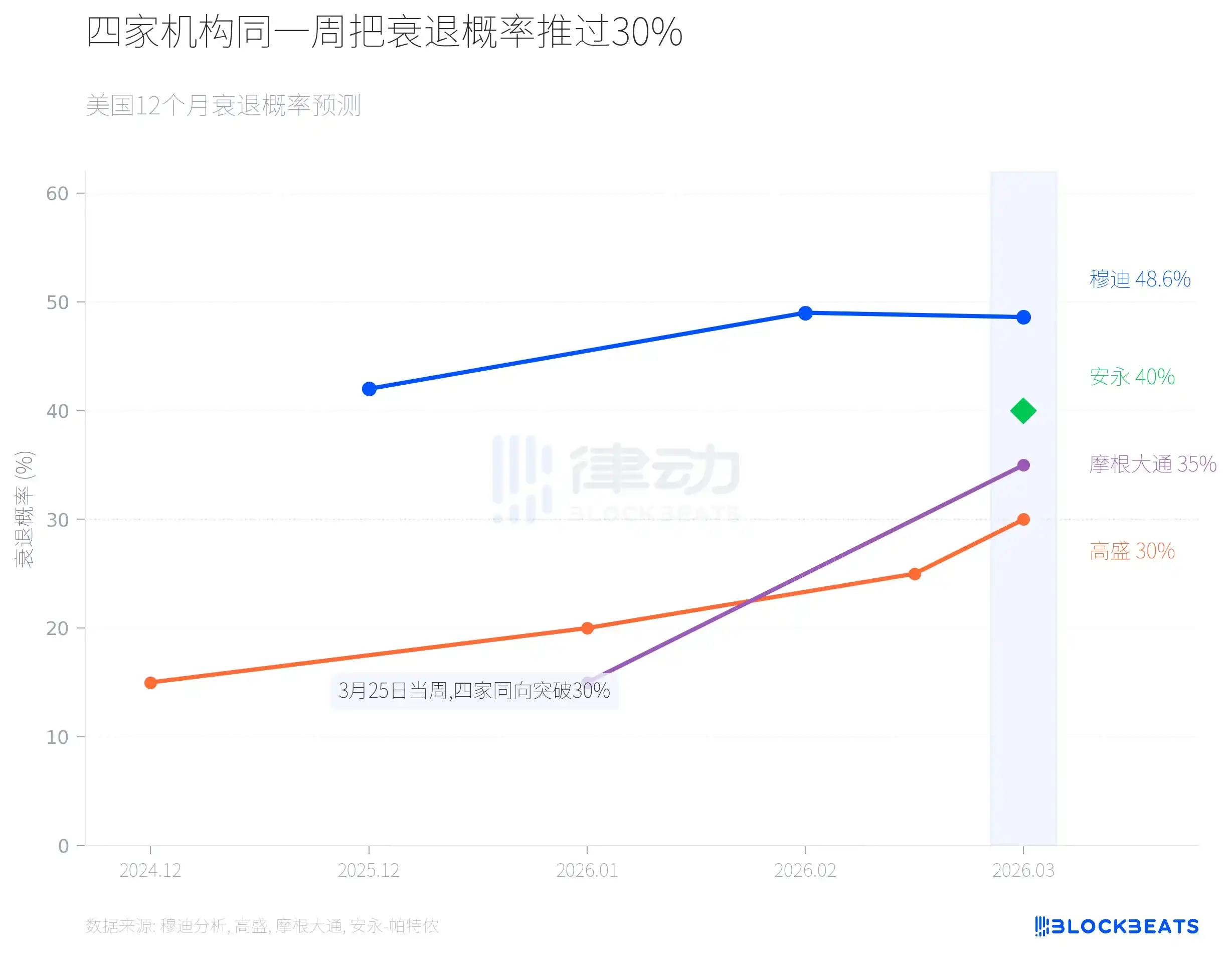
Goldman Sachs' trajectory is equally steep. According to the Fortune report, Goldman Sachs' prediction in December 2024 was 15%, slightly adjusted to 20% in January this year, raised to 25% on March 12, and reached 30% by March 25. A pace of doubling every two weeks is rare in Goldman Sachs' historical forecasts. Goldman Sachs also raised its PCE inflation forecast by 0.2 percentage points to 3.1%, lowered its full-year GDP growth forecast to 2.1%, and postponed its expectation for the first interest rate cut from June to September.

J.P. Morgan Global Research gave 35%. According to a CNBC report on March 19, J.P. Morgan economists simultaneously lowered their year-end target for the S&P 500 from 7500 points to 7200 points, with an extreme scenario possibly dropping to 6000 points.

EY-Parthenon was the last of the four to speak, but its 40% probability came with an interesting qualifier. According to a World Oil report on March 24, Gregory Daco, Chief Economist at EY-Parthenon, defined the current situation as a "multi-dimensional disturbance," reasoning that the impact is not limited to crude oil supply but also affects the refining system, LNG infrastructure, and fertilizer supply chains. This means that even if oil prices fall, inflationary pressures will not subside simultaneously.

Historical Win Rate of Oil Price Shocks

The core assumptions of the four institutions share a common variable: oil prices. Since the U.S.-Israel strike on Iran on February 28, Brent crude has climbed from about $70 per barrel, breaking through $100 on March 8 (the first time in four years), and touching $115 last week. As of March 25, it closed at $102.22.

According to the IEA's March report, the Strait of Hormuz previously saw about 20 million barrels of crude oil passing through daily, accounting for approximately 20% of global seaborne oil trade. After the conflict erupted, Gulf countries' crude oil production was cut by at least 10 million barrels per day. Zandi estimated in an interview with Fortune that about one-third of the global fertilizer supply also passes through this route.

Energy shocks of this magnitude have occurred four times in history.
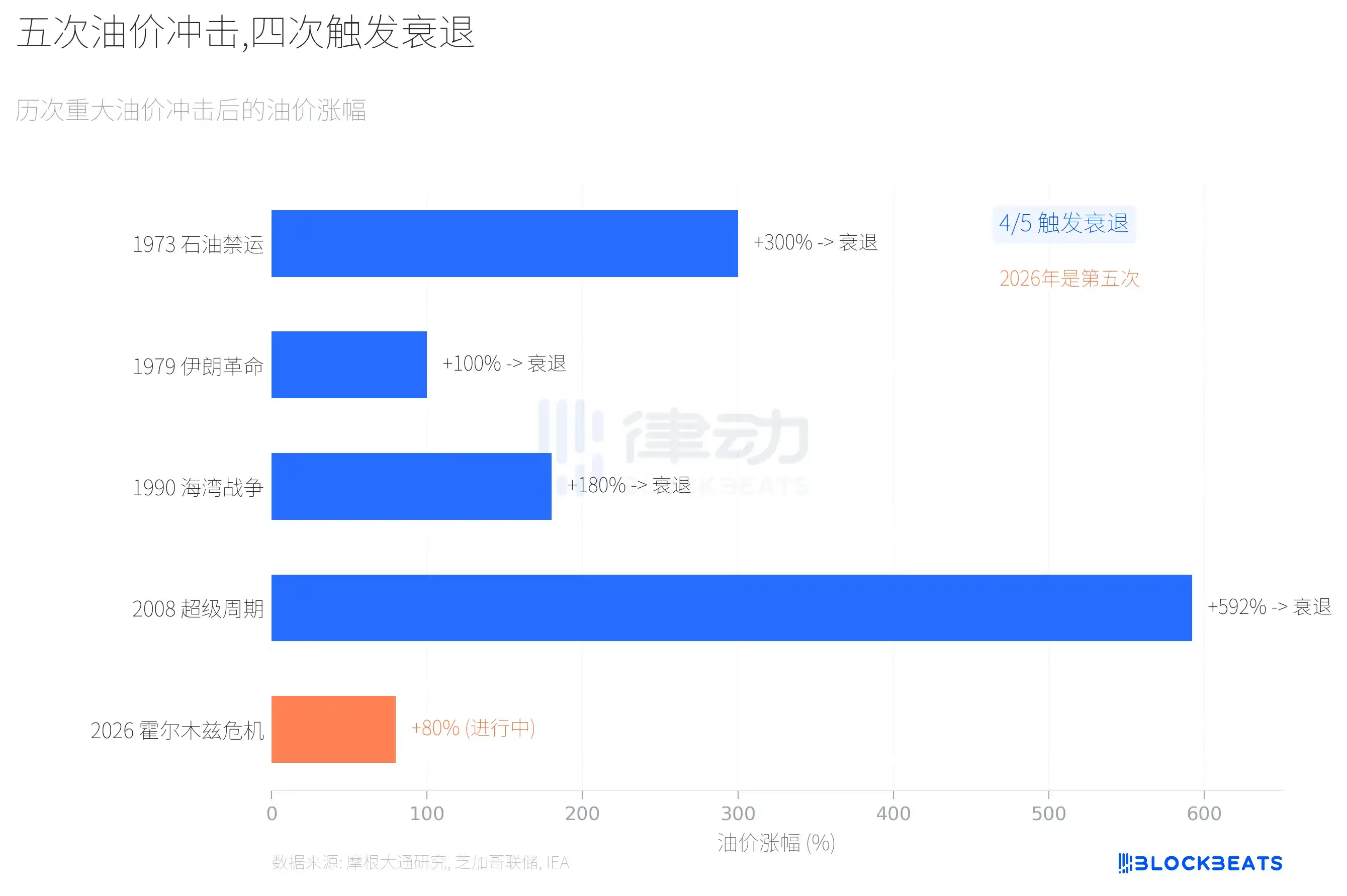
According to J.P. Morgan research, among the five major oil price shocks since the 1970s, four triggered recessions afterward. The 1973 Yom Kippur War caused oil prices to surge by 300%, and the U.S. entered a recession in November that year. The 1979 Iranian Revolution doubled oil prices, and a recession began in January 1980. The 1990 Gulf War pushed oil prices up by 180%, and the recession started almost simultaneously. The supercycle from 2002 to 2008 saw a cumulative oil price increase of 592%, ultimately ending with the global financial crisis.

The current increase from the 2026 Strait of Hormuz crisis is about 80%, the smallest among the five. But there is a key difference: the scale of this supply disruption is larger than any previous one. The IEA describes it as "the largest disturbance to energy supply since the 1970s energy crisis."

J.P. Morgan economists provided a quantitative estimate: every sustained 10% increase in oil prices drags U.S. GDP down by about 15 to 20 basis points.

Fink's Dichotomy

On March 25, Larry Fink, CEO of BlackRock, which manages over $10 trillion in assets, provided a more direct framework than numbers in an interview with the BBC.

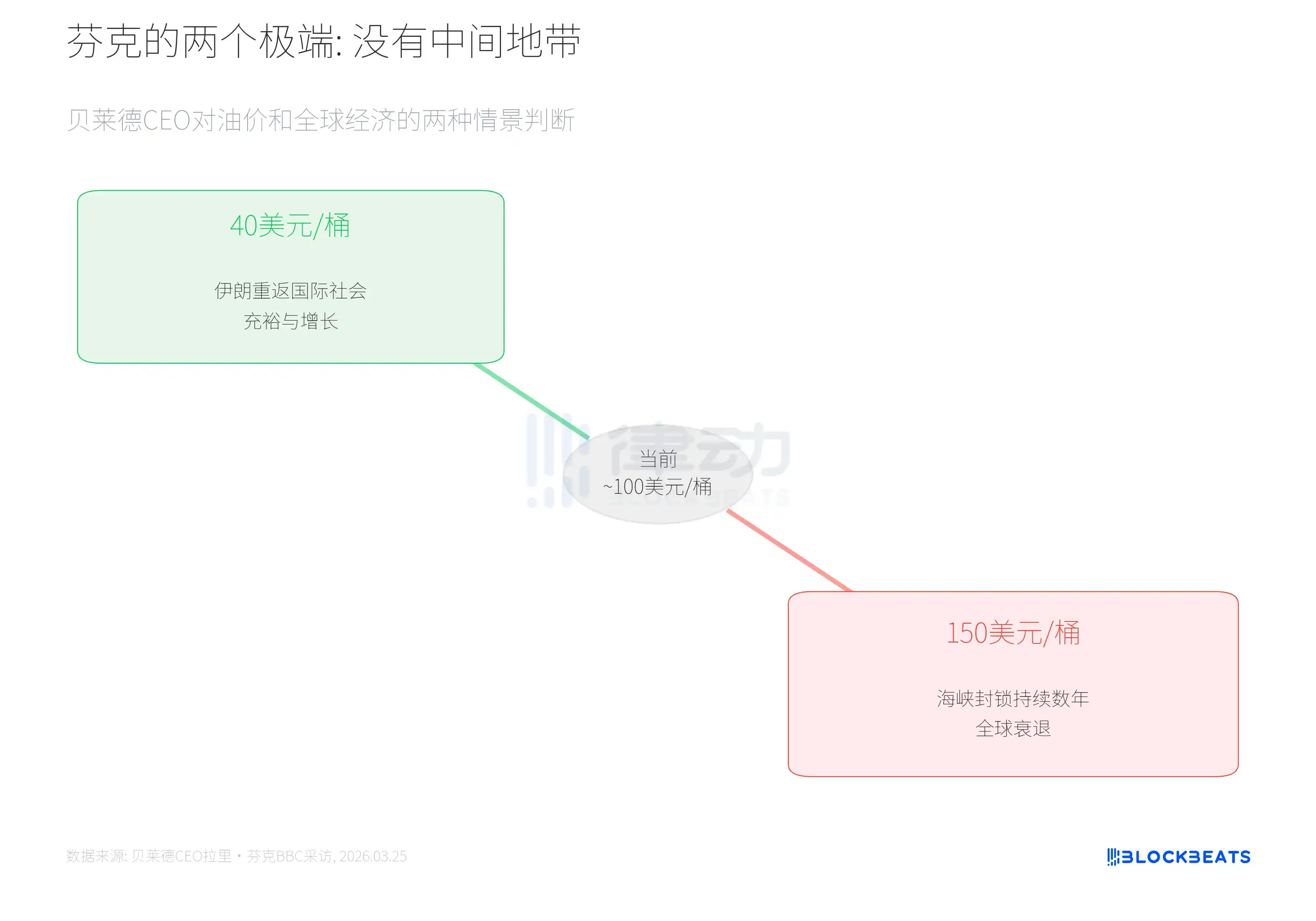
According to the Fortune report, Fink said: "There will be no middle ground; the outcome will definitely be one of two extremes."

The first scenario: Iran is accepted by the international community, re-engages in global trade, oil supply recovers, oil prices fall to $40 per barrel, and the world welcomes growth. The second scenario: the conflict continues, the strait remains blocked for years, oil prices stay above $100 or even approach $150, and the world enters a recession. Fink specifically pointed out that the ripple effects of high oil prices would extend to agricultural products and fertilizers, as these are byproducts of natural gas.
However, Fink also ruled out one possibility, clearly stating that there would not be a systemic financial crisis like 2008, as financial institutions' capital adequacy ratios are much higher now than back then.

Consensus Itself Is a Variable

Returning to the initial question. Moody's uses a machine learning model, Goldman Sachs uses a macroeconomic forecasting framework, J.P. Morgan tracks a five-factor indicator, and EY-Parthenon approaches from the supply chain dimension. Four different methodologies converged in the same direction in the same week.

According to the University of Michigan's March survey, the Consumer Confidence Index fell to 55.5, at the 2nd historical percentile. According to BLS data, U.S. nonfarm payrolls decreased by 92,000 in February, the opposite of the market expectation of an increase of 60,000. Leisure and hospitality lost 27,000, healthcare lost 28,000, manufacturing lost 12,000, and the federal government lost 10,000. According to BLS statistics, since the peak in October 2024, federal government employment has cumulatively shrunk by 330,000, a drop of 11%.

Zandi said in the interview that if oil prices average around $125 per barrel in the second quarter, "that would push us into a recession." At Brent's current level of about $102, it is $23 away from that line.

These four institutions' predictions may not be accurate. But when four institutions arrive at similar conclusions using different methods in the same week, its impact is more than just a probability number. Businesses may delay investment plans because of it, consumers may tighten their spending, and these behaviors themselves will, in turn, depress economic data, causing the numbers in the next round of predictions to continue rising.


Пов'язані питання

QWhat are the recession probability forecasts for the next 12 months from Moody's Analytics, Goldman Sachs, J.P. Morgan, and EY-Parthenon, as mentioned in the article?

AMoody's Analytics forecasts a 48.6% probability, EY-Parthenon 40%, J.P. Morgan 35%, and Goldman Sachs 30%.

QAccording to the article, what is the key common variable in the core assumptions of the four institutions that is driving the increased recession risk?

AThe key common variable is the price of oil, which has surged due to disruptions in the Strait of Hormuz.

QWhat historical precedent does the J.P. Morgan research cite regarding oil price shocks and recessions?

AJ.P. Morgan research states that out of five major oil price shocks since the 1970s, four triggered recessions: following the 1973 Yom Kippur War, the 1979 Iranian Revolution, the 1990 Gulf War, and the 2002-2008 supercycle that ended with the global financial crisis.

QWhat are the two extreme scenarios for the global economy outlined by BlackRock CEO Larry Fink in his interview?

AThe first scenario is Iran being reintegrated into global trade, oil supply recovering, and oil prices falling to $40/barrel, leading to global growth. The second scenario is a prolonged conflict and blockade of the Strait of Hormuz, with oil prices staying above $100 or even nearing $150/barrel, triggering a global recession.

QWhat specific level of oil prices does Moody's chief economist, Mark Zandi, say would 'push us into a recession'?

AMark Zandi stated that if oil prices average around $125 per barrel in the second quarter, it would push the economy into a recession.

Пов'язані матеріали

In Conversation with Ray Dalio: We Are Currently in an AI Bubble, with 1% of My Portfolio in Bitcoin

Ray Dalio, founder of Bridgewater Associates, warns in an interview that the current AI boom shows classic bubble characteristics, which could lead to significant economic downturns as seen in past cycles like 1929 or 2000. He explains that speculative enthusiasm, fueled by debt and overvaluation, often precedes a crash when rising rates or taxation force asset sales, causing widespread losses and recession. Dalio also outlines his "Big Cycle" theory, describing an approximate 80-year pattern where widening wealth gaps, massive government deficits, and shifting geopolitical power (like China's rise) create internal conflict and global instability. He emphasizes that we are in a late-cycle, transitional phase where traditional powers like the US and UK face decline. For personal wealth protection, Dalio advises diversification beyond cash into assets like stocks, bonds, real estate, and particularly gold, which he prefers over Bitcoin. While he holds about 1% of his portfolio in Bitcoin as a non-printable hard asset, he views gold as more secure from technological or governmental threats. Regarding AI's impact, Dalio believes it will disproportionately benefit capital owners, worsening inequality by replacing both physical and cognitive labor. He suggests that human intuition and emotional intelligence, combined with AI, will be key for future workers. On taxation, Dalio argues that wealth taxes are impractical and risk triggering asset sell-offs, reducing productive investment. He points to the UK as a cautionary example of debt, low productivity, and political strife. Geopolitically, Dalio foresees a more regionalized world, with the US showing weakness in prolonged conflicts like with Iran, akin to past imperial declines. The ideal outcome, he suggests, is coexisting powerful blocs (e.g., Americas, China-Asia Pacific) without major war.

marsbit43 хв тому

In Conversation with Ray Dalio: We Are Currently in an AI Bubble, with 1% of My Portfolio in Bitcoin

marsbit43 хв тому

Daily 7.2 Trillion KRW: Foreign Capital's Record Net Buying on Friday! Wall Street Says Headwinds for Korean Stock Fund Flows Have Subsided

South Korean stock market sees a dramatic shift in fund flows. On July 31, foreign investors made a record net purchase of approximately KRW 7.2 trillion in KOSPI stocks, marking a fundamental reversal from the persistent large-scale net outflows seen in previous months. This contributed to a significant narrowing of foreign net selling in July to KRW 9.8 trillion, down sharply from KRW 48.4 trillion in June and KRW 44.5 trillion in May. Simultaneously, domestic institutional pressure eased. South Korean pension funds and asset managers turned to a net buying position in July, purchasing KRW 1.0 trillion worth of KOSPI shares, contrasting with net sales in May and June. Market volatility is expected to be dampened by new financial regulations. Effective July 31, the Financial Services Commission tightened access for retail investors to single-stock leveraged ETFs by raising the minimum cash deposit requirement. Trading volumes for these products subsequently dropped to about 50% of their monthly average. Citigroup Research maintains its year-end KOSPI target of 10,000 points. The firm cites several supportive factors: the substantial easing of headwinds from capital outflows, a robust fundamental outlook for the semiconductor sector, historically low market valuations, strong economic fundamentals, and the potential for policy support from financial authorities if needed.

marsbit43 хв тому

Daily 7.2 Trillion KRW: Foreign Capital's Record Net Buying on Friday! Wall Street Says Headwinds for Korean Stock Fund Flows Have Subsided

marsbit43 хв тому

Thanks to Dice Rolls, Bitcoin Keys Are Stored Offline, But Not Everyone Will Do It

The article discusses using dice rolls to generate secure Bitcoin wallet seeds, providing entropy independent of potentially flawed hardware random number generators. It explains that each fair dice roll offers about 2.585 bits of entropy, with around 50 rolls needed for a standard 12-word seed phrase and 99+ recommended for higher security. This method gained attention after a vulnerability was revealed in some Coldcard hardware wallets, where a faulty firmware RNG (dating back to 2021) compromised generated keys. The analysis notes that while a dice-generated main seed was safe from this specific flaw, other Coldcard functions (like creating paper wallets, backup keys, or passwords) could still be vulnerable if they used the defective RNG. The piece argues that while dice-based entropy is technically robust, the manual process is error-prone, tedious, and unrealistic for most new users, who might make mistakes in recording or inputting rolls. It concludes that while manual entropy generation should remain an option for advanced users, the long-term goal is to develop reliable, user-friendly hardware and software that securely generates randomness without requiring specialized knowledge. Coldcard users are advised to check their firmware version and replace any secondary secrets (like paper wallet keys) created with vulnerable devices, while also considering multi-signature setups with devices from different manufacturers for added security.

cryptonews.ru5 год тому

Thanks to Dice Rolls, Bitcoin Keys Are Stored Offline, But Not Everyone Will Do It

cryptonews.ru5 год тому

Торгівля

Спот
活动图片




