Vitalik's Algorithmic Stablecoin Vision: Interpreting the Mechanism and Challenges from an Options Perspective

marsbitОпубліковано о 2026-06-21Востаннє оновлено о 2026-06-21

Анотація

Vitalik Buterin's recent algorithmic stablecoin proposal envisions using an option-like mechanism to create a stablecoin without the liquidation risks inherent in traditional collateralized debt position (CDP) models. The design splits one unit of ETH into two components: a 'stable' leg (P) that maintains value up to a certain strike price, and an 'upside' leg (N) that captures any appreciation above that price. Together, they always sum to one ETH, eliminating the need for debt or liquidation mechanisms. From an options perspective, the stable leg essentially functions as a synthetic, covered call position. However, significant challenges exist. For the stable asset to maintain its peg, it must continuously roll deep in-the-money call options, leading to potential rollover slippage, predictable trading paths vulnerable to front-running, and liquidity issues. Crucially, the system's scalability depends on a constant demand for the upside leg—a form of leveraged ETH long position without funding rates or liquidation risk. It's unclear if such persistent, specific demand will materialize from speculators or market makers who have simpler alternatives like perpetual swaps. The author, drawing from experience with Rysk, argues that DeFi options have struggled as standalone trading products due to complexity and fragmented liquidity. Their potential lies instead as foundational infrastructure underpinning more complex financial primitives like stablecoins, structured yields, or ...

Author: Dan Rysk

Translation: Peggy, BlockBeats

Editor's Note: For a long time, DeFi options have not become a mainstream trading category. Compared to perpetual contracts, they are more complex, have more fragmented liquidity, and struggle to form stable natural demand.

However, the algorithmic stablecoin vision recently proposed by Vitalik opens up another possibility for options: they are no longer treated as an independent trading product but become the underlying financial building blocks for stablecoins, yield products, and structured assets.

The author of this article interprets this scheme from an options perspective. He believes that the stable-side asset in Vitalik's design is essentially similar to a synthetic covered call: users split 1 ETH into two parts, one part obtains 'stable value' below a certain strike price, and the other part obtains upside gains above the strike price. Since these two parts always sum to 1 ETH, the system does not need to introduce debt, margin, or liquidation mechanisms, thus avoiding the core liquidation risk of traditional CDP stablecoins.

But the challenges of this design are also evident. To make the stable-side asset approximate a stablecoin, it needs to continuously roll deep in-the-money call options, which brings issues like rollover slippage, front-running of fixed trading paths, and insufficient liquidity. More importantly, behind each unit of stable asset, someone must continuously hold the corresponding upside-side asset, which is a leveraged ETH long position with no funding rates and no liquidation risk. Whether this demand can exist long-term determines whether the system can truly scale.

Finally, drawing on Rysk's experience, the author points out that DeFi options have been difficult to scale in the past because they are too complex as direct trading products, and user demand is not natural enough. However, if their position is changed—placing options at the bottom layer of more complex assets like stablecoins, structured yields, and index products—they might be more suitable as infrastructure for DeFi. In other words, the opportunity for options in DeFi may not be to become the next perpetual contract, but to become the pricing and risk distribution engine behind the next generation of on-chain financial products.

Below is the original text:

For years, I've heard the same phrase: 'Options don't work in DeFi.'

After building Rysk, I admit there's some truth to that. Most DeFi options products struggle to grow. Liquidity is fragmented, attracting natural trading flow is difficult, and traders consistently opt for simpler products. Perpetual contracts became the default tool for expressing directional views, while prediction markets became the easier way to trade event outcomes.

That's exactly why Vitalik's recent proposal caught my attention. He suggested that an option-like rights structure could be used to build an algorithmic stablecoin without a liquidation mechanism.
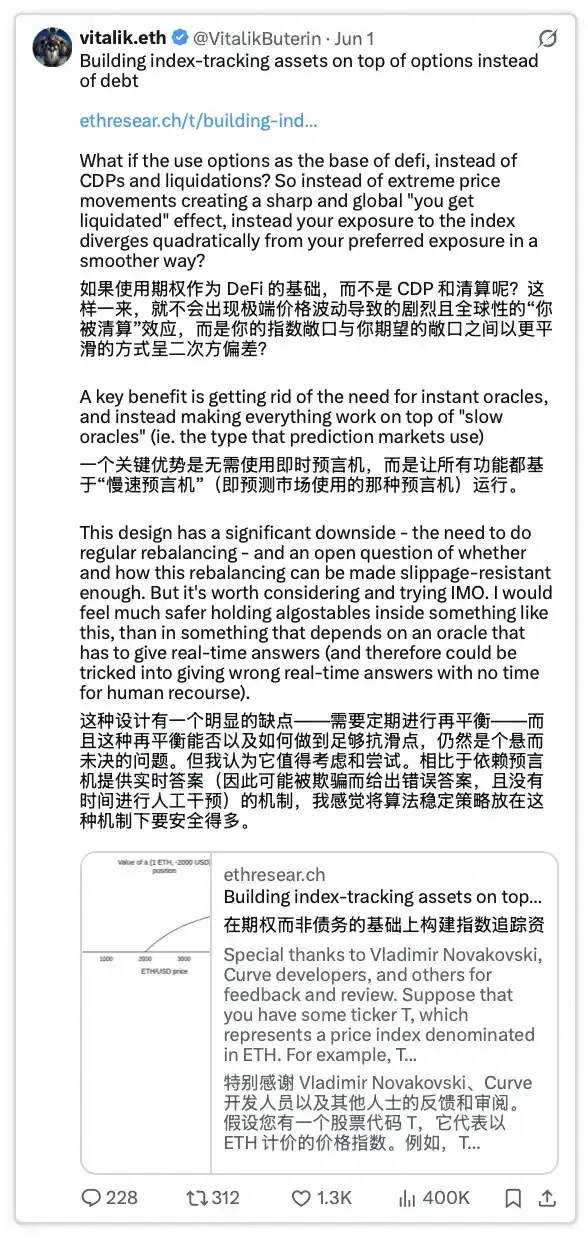
What really intrigued me was the perspective: options not as a product to be traded, but as underlying infrastructure for a product.

This is the view I've been advocating for the past few years and is the core idea behind our construction of Rysk V12. For us, the product is yield; for Vitalik, the product is stability. The more I think about it, the more familiar this design feels.

The stable side he describes is essentially a covered call.

Why It Is a Covered Call

His design splits one unit of ETH into two types of rights. One side is P, which holds the value up to a certain strike price; the other side is N, which receives all gains above that strike price. Together they always equal one unit of ETH, so there is no debt, no margin, and nothing to liquidate.

Assume the current ETH price is $2,500 and the strike price is $1,500. As long as ETH stays above $1,500, P behaves like an asset stable at $1,500; P only starts bearing downside risk if ETH falls below $1,500. N receives all the upside gains above $1,500.

This is precisely the payoff structure of a covered call.

The holder retains the asset itself, sells the upside above a certain strike price, and collects the option premium. P replicates exactly this covered call payoff. N corresponds to the long call option held by the buyer.

More accurately, it's a synthetic covered call. No one is selling an option externally; instead, the same payoff is reconstructed by splitting the rights.

This is the same thesis behind Rysk V12. Users hold ETH, BTC, or HYPE and obtain upfront yield by selling covered calls. Vitalik applies the same foundational module to stability.

Same engine, different product.

The Problem: It Is Deep In-the-Money and Must Be Continuously Rolled

Today, most Rysk users sell out-of-the-money covered calls. The holder owns ETH, then selects a strike price above the current price: either betting the price won't reach there, or being willing to sell and take profits at a higher price if it does, while keeping the premium regardless.

But the stable side in Vitalik's vision requires a different structure. To behave like a stable amount, the strike price must be far below the spot price, making this call deep in-the-money, with most of its value being intrinsic value.

With a spot price of $2,500 and a strike of $1,500, $1,000 of that is intrinsic value the buyer must pay upfront. This makes the transaction much more capital intensive.

But a call option can only stay stable for an instant. Once ETH moves down towards the strike, it starts bearing ETH's downside risk, so it must be continuously adjusted to a lower strike price, rolled over again and again.

Therefore, this stable asset is essentially a continuously rolling covered call program.

Vitalik himself pointed out this risk. The slippage from repeated rollovers is the biggest threat to the entire design, and how to execute the rollover is the truly difficult part.

And any mechanism that trades on a fixed, public schedule is easily front-run. This was exactly the problem faced by DeFi Options Vaults (DOVs): they sold options with the same tenor and same strikes every week at the same time, so the market knew exactly what was coming and positioned ahead, extracting value from that trade flow.

Regardless, each rollover requires a buyer. The question is: Who buys? At what price?

The Hardest Part Is Who Provides the Funding

In Vitalik's model, someone must deposit a full unit of ETH, split it, sell the stable side, and hold the upside side. This depositor is the person the entire system relies on to function.

The most obvious candidates are market makers.

But the position they end up holding is actually a leveraged ETH long. And anyone wanting leveraged long ETH exposure could just buy a call option or go long a perpetual contract. That's simpler, more efficient, and more familiar. This depositor is taking a more difficult path to get a position they could obtain more easily elsewhere.

The upside side does have one genuine advantage: it offers real leverage with no funding rates and no liquidation risk, something perpetuals cannot provide.

But it still needs to find buyers, and not just once. For every unit of stable asset that exists, someone must be holding the corresponding upside side.

To scale, this model needs a persistent group of people willing to hold ETH leveraged longs in this specific form, consistently, in any market environment.

Market makers are essentially resource optimizers. Without a clear reason, they won't readily adopt something new, capital intensive, and with heavy integration costs. 'Speculators and market makers will provide liquidity' is the assumption the entire design relies on. But that behavior doesn't just happen spontaneously.

What We Learned at Rysk

At Rysk, we learned this the hard way. Earlier versions of the protocol struggled to scale, lacked natural demand, and never found product-market fit.

In the current protocol, Rysk V12, both sides of the trade have strong reasons to participate. Therefore, Rysk starts with two groups of people who already want to be involved. Holders want yield from assets they already hold, and their assets themselves are the collateral.

Market makers compete to buy this trade flow via an RFQ (Request for Quote) mechanism. They only pay the option premium, don't need to provide collateral, and ultimately get the option risk exposure they actually want, which they can price and hedge on their own books. This is the more capital-efficient side of the trade, which is why trading teams integrate spontaneously.

No party is required to hold a position they could more easily obtain elsewhere.

The system also doesn't rely on incentives or token emissions.

Worth Building

I'm glad to see this design being seriously explored. The challenges are real, but they are the interesting kind. This is exactly the design space DeFi should explore.

What feels validating is that this proposal further reinforces the same choices we made at Rysk: fully collateralized, no liquidation, no counterparty risk, and physical settlement at expiry only requiring an oracle.

Use case differs, foundation is the same. This foundation is live and proven on HyperEVM, with market makers competing for flow. We've also deployed to Ethereum mainnet and will soon open to the public.

If you are exploring stablecoins, structured products, index products, or anything with an optionality profile underneath, feel free to reach out.

Options are building blocks. What's truly interesting is what gets built on top.

Пов'язані питання

QWhat is the core mechanism of the stable-side asset in Vitalik's algorithmic stablecoin proposal, and how is it compared to an option?

AThe stable-side asset in Vitalik's proposal is a mechanism that splits one unit of ETH into two parts: a 'stable side' (P) and an 'upside side' (N). P provides stable value up to a certain strike price, while N captures all gains above that price. The sum of P and N always equals one ETH, eliminating the need for debt, margin, or liquidation. From an options perspective, the stable side (P) essentially replicates the payoff structure of a synthetic covered call. The holder effectively sells the upside potential above the strike price, similar to writing a covered call option, while the upside side (N) holds the corresponding long call option.

QWhat are the main operational challenges for Vitalik's algorithmic stablecoin design, according to the author?

AThe main challenges are related to the need for the stable-side asset to behave like a stablecoin. It requires continuously rolling deep in-the-money covered calls, which introduces several problems: 1. Rollover slippage from frequently adjusting the position to a lower strike price. 2. The risk of being front-run if the rollover follows a fixed, predictable schedule. 3. Liquidity constraints, as each rollover needs a willing buyer for the new upside side (N). The most critical challenge is ensuring there is a sustainable demand for the upside side asset—a leveraged ETH long position without funding rates or liquidation risk—to support the expansion of the entire system.

QHow does the author's experience with Rysk inform their view on the role of options in DeFi?

AThe author's experience with Rysk shows that DeFi options have struggled to scale when positioned as a direct trading product for end-users, due to complexity and lack of natural demand compared to instruments like perpetuals. However, the author believes the real opportunity for options lies in becoming a foundational financial primitive or infrastructure layer underneath more complex products. This is exemplified by Rysk V12, where options are the engine for yield products, and by Vitalik's proposal, where they are the engine for stability. The author concludes that options are better suited as a risk distribution and pricing engine for next-generation on-chain financial products like stablecoins, structured yields, and indices.

QWhat is the key difference between the typical covered call sold on Rysk and the one required for Vitalik's stable asset?

AThe key difference lies in the moneyness and purpose. On Rysk, users typically sell out-of-the-money (OTM) covered calls, choosing a strike price above the current asset price to earn premium, betting the price won't reach that level, or being willing to sell at a profit if it does. For Vitalik's stable asset to mimic a stable value, it requires selling deep in-the-money (ITM) covered calls, with a strike price significantly below the current price. This structure has high intrinsic value, making it more capital-intensive. Furthermore, this ITM call must be continuously rolled over to a lower strike price to maintain its 'stable' characteristic as the underlying asset price fluctuates.

QWho does the author identify as the potential provider of liquidity (the 'depositor') for Vitalik's system, and what is the challenge in attracting them?

AThe author identifies market makers as the most obvious potential providers of liquidity (the 'depositors'). They would deposit the full unit of ETH, sell the stable side (P), and hold the upside side (N). However, the challenge is that the upside side (N) represents a leveraged long ETH position. Market makers or speculators can obtain similar exposure more simply and efficiently through direct long calls or perpetual contracts. While the N position offers the advantage of real leverage without funding rates or liquidation risk, it is a more complex and capital-intensive path. The system's scalability depends on finding a persistent group willing to hold this specific form of ETH leveraged long across various market conditions, which is not a given.

Пов'язані матеріали

The Verdict in Choi Tae-won's Divorce Case: Revealing the Inheritance Undercurrent Behind SK Hynix's Trillion-Won Empire

SK Group Chairman Chey Tae-won's high-profile divorce case, involving a record 1.38 trillion won settlement, has drawn attention to the succession plans for Korea's second-largest conglomerate, especially its crown jewel, SK hynix. Unlike traditional chaebol scripts centered on the eldest son, Chey's three children from his marriage to former President Roh Tae-woo's daughter, Roh Soh-yeong, are carving distinct, non-traditional paths. Eldest daughter Chey Yun-jung (b. 1989) is seen as the most evident successor. With a scientific and consulting background, she holds executive roles at SK bioscience and SK Inc.'s growth support department, focusing on future strategy and biopharma. Her marriage is to an AI infrastructure entrepreneur, not a traditional business alliance. Second daughter Chey Min-jung (b. 1991) took a unique route, voluntarily serving as a South Korean naval officer, including an anti-piracy deployment. She later worked on policy and strategy for SK hynix in Washington D.C. before co-founding an AI-driven healthcare startup. She married a former U.S. Marine Corps officer, connecting her to U.S. defense and policy circles—networks crucial for a global semiconductor giant. The only son, Chey In-geun (b. 1995), who studied physics like his father, worked briefly at SK E&S before joining McKinsey. Despite fitting the traditional "heir" profile as the eldest son, he remains silent and holds no public position or shares in SK, suggesting the old succession playbook is obsolete. As SK hynix's valuation soars, becoming a geopolitical asset in the AI era, the heirs' legitimacy is no longer automatic. They must prove themselves in fields like AI biotech, global policy, and strategic consulting. Their marriages also reflect new elite networks in tech and defense, not old political alliances. Their inheritance is the complex challenge of navigating a globalized, tech-driven world, not just a corporate throne.

marsbitВчора 09:06

The Verdict in Choi Tae-won's Divorce Case: Revealing the Inheritance Undercurrent Behind SK Hynix's Trillion-Won Empire

marsbitВчора 09:06

From OpenSea to OpenRouter: Is Alex Atallah Repeating His 'Exit at the Peak' Playbook?

From OpenSea to OpenRouter: Is Alex Atallah Repeating His "Exit at the Peak" Playbook? According to the Wall Street Journal, payments giant Stripe is in talks to acquire the AI model aggregation platform OpenRouter in a potential deal valuing the company near $100 billion. This would mark founder Alex Atallah's second creation of a company reaching a $100 billion valuation, following his co-founding of NFT marketplace OpenSea. OpenRouter, founded just over three years ago, has grown rapidly by acting as a unified gateway for developers to access over 400 AI models. It currently has about 10 million users and processes over 200 trillion tokens monthly. While the platform's annualized revenue is around $50 million, its valuation has skyrocketed from $1.3 billion in March 2026. The potential acquisition by Stripe, a company OpenRouter's founder once likened it to, represents a major expansion into AI infrastructure for the payments leader. This move echoes Atallah's previous timing with OpenSea, where he departed before the NFT market's significant downturn. For OpenRouter, selling now may be strategic. Despite its scale, its business model—charging a 5-5.5% fee on AI inference calls—faces pressure from competition, open-source models, and potential price wars among model providers, limiting its profitability narrative for an IPO. A key asset for potential acquirers like Stripe is OpenRouter's vast repository of real-world AI usage data, which offers unique insights into model performance and developer preferences that are difficult to replicate. Whether this potential deal signifies a new valuation benchmark for AI infrastructure or another market peak signal remains to be seen.

链捕手Вчора 08:42

From OpenSea to OpenRouter: Is Alex Atallah Repeating His 'Exit at the Peak' Playbook?

链捕手Вчора 08:42

Торгівля

Спот
活动图片





