Vitalik Wrote a Proposal Teaching You How to Stealthily Use AI Large Models

比推Опубліковано о 2026-03-13Востаннє оновлено о 2026-03-13

Анотація

Vitalik Buterin and Ethereum Foundation's AI lead Davide Crapis co-authored a proposal titled "ZK API Usage Credits," which introduces a method for anonymously accessing AI models like ChatGPT using zero-knowledge proofs. Instead of requiring users to register and link personal information, the proposal suggests depositing funds (e.g., 100 USDC) into a smart contract. Users can then generate a zero-knowledge proof to verify they are on an encrypted whitelist and have sufficient balance—without revealing their identity. This approach aims to protect user privacy while preventing abuse. Although still in the research phase and facing skepticism, the proposal reflects Vitalik's broader focus on privacy and Ethereum's potential role in providing a tamper-proof data layer in the AI era, where verification and anonymity may become increasingly critical.

Author: Deep Tide TechFlow

Original Title: Vitalik Wrote a Proposal Teaching You How to Stealthily Use AI Large Models


Everyone is talking about AI, and the crypto space seems much quieter on the timeline.

Meanwhile, ETH has been hovering around 2000 for almost two months. What Vitalik says or does doesn't seem to attract much attention anymore.

However, I recently checked his X (Twitter) and found that AI has influenced more than just us. Over the past month, a significant portion of his posts have been about AI, and they've even reached the level of technical proposals.

Among them, the most noteworthy is a proposal co-authored with Davide Crapis, the AI lead at the Ethereum Foundation, published on ethresear.ch on February 11th, titled "ZK API Usage Credits."
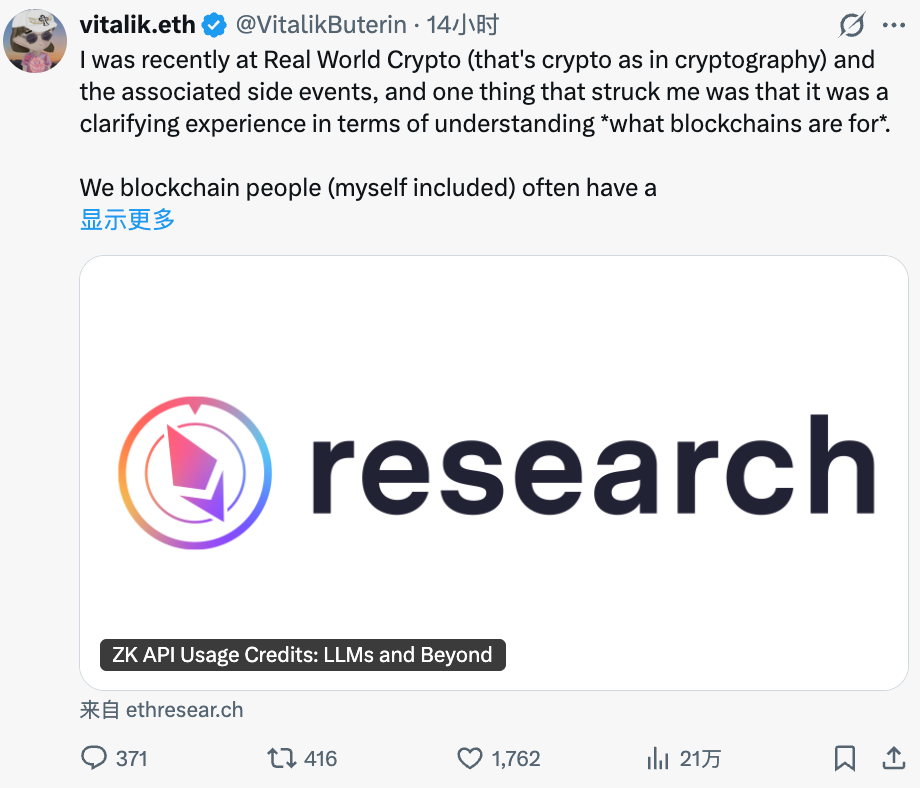
In a nutshell, it's about using zero-knowledge proofs to let you anonymously call AI large models.

Right now, whether you use ChatGPT or call Claude's API, there's only one way to pay:

Register an account, bind an email, bind a credit card.

Every conversation you have, every prompt you send, the platform knows it's from you. What you asked, when you asked it, how many times you asked—all tied to your real identity.

Vitalik and Crapis's proposal offers another path.

  1. The user deposits a sum of money into a smart contract, say 100 USDC.

  2. The contract registers this deposit into an encrypted on-chain list. After that, every time you call the API, you don't need to reveal your identity; you just generate a zero-knowledge proof.

  3. This proof does two things for the service provider: it proves you're on the list, and it proves your balance is sufficient. But the proof itself doesn't reveal which specific entry on the list you are.
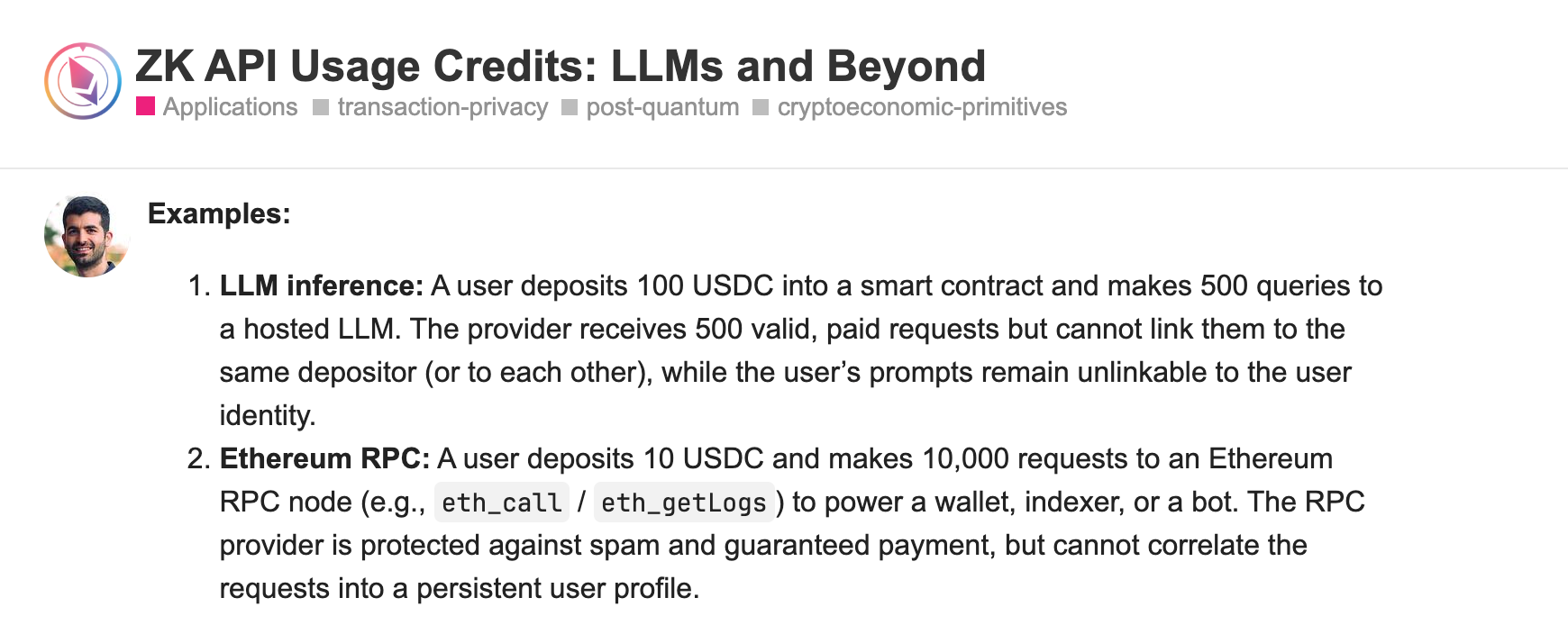
The service provider gets paid and can prevent abuse, but never knows who you are.

You can interpret this proposal as Vitalik believing that in the AI era, users shouldn't have to surrender their identity just to use an AI tool.

This proposal is still in the research phase, far from implementation, and large model manufacturers might not agree to such a method. The comments section of the proposal is also full of rebuttals and skepticism, arguing that AI model companies will always find a way to know your real identity.

But the author believes the significance of this proposal isn't entirely about whether it can be implemented.

Privacy is something Vitalik has worked on for a decade. From early support for Tornado Cash to promoting zero-knowledge proofs as a core technical roadmap for Ethereum, this thread has never been broken. It's just that in the past few years, privacy in the crypto industry's narrative lacked a big enough story to carry it.

AI has filled that story. When you talk to a large model more than anyone else every day, privacy becomes a real demand.

Vitalik Embraces AI

From February until now, a significant portion of what Vitalik has posted on X has been related to AI, with a density that suggests it's more than just casual chat.

Yesterday he posted a long thread saying he recently attended a cryptography conference where people cared about privacy, cared about open source, cared about censorship resistance... but had no affection for blockchain.
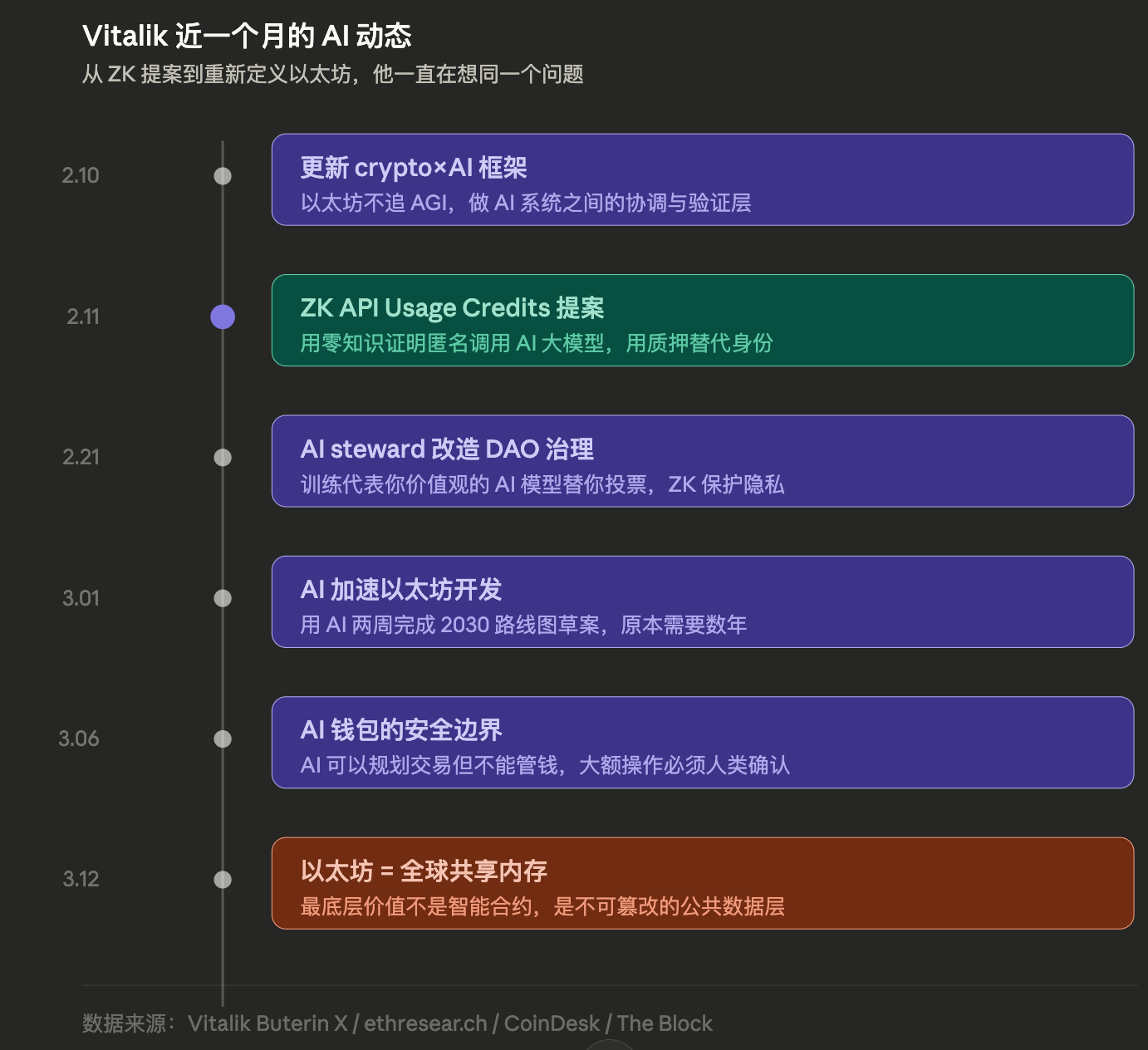
Among that crowd, he conducted a thought experiment:

Forget "we are the Ethereum community," start from scratch and think about where Ethereum is actually most useful.

His conclusion is that Ethereum's most fundamental value is as a bulletin board. A place where anyone can write, anyone can read, and no one can change or delete anything.

In the context of AI, this might be the most important thing Vitalik has said in the last couple of years.

We are entering an era of infinitely cheap generation. Text, images, videos, identities—AI can mass-produce them all. When everything can be forged, what becomes scarce?

These questions ultimately point to the same place: a public, persistent, irreversible data layer. And an unchangeable record is exactly what Ethereum can provide.

Over the past two years, the skepticism Ethereum has faced can be summed up in one sentence: What do you still have that others can't replace?

Looking at it now, Vitalik hasn't answered that question directly.

However, the Ethereum Foundation has done a few low-key things over the past year: formed a 50-person privacy team, established a nearly 50-person privacy research cluster, released the Kohaku privacy framework, specifically appointed an AI lead; the 2026 roadmap lists institutional-grade privacy and faster transaction confirmation as top priorities.

Looking back at his intensive output this month, it's mostly been discussions about Ethereum's privacy and efficiency issues in the context of AI.

I think Vitalik is betting on one thing: the more powerful AI becomes, the more rigid the demand for privacy and verification infrastructure will be. Whether Ethereum can meet this demand is another matter, but he has clearly chosen his table.

ETH is still hovering around 2000. Most people still aren't paying much attention to what he's been saying lately.

But perhaps in a few years, looking back, this might be the time we should have been paying attention.


Twitter:https://twitter.com/BitpushNewsCN

BitPush TG Discussion Group:https://t.me/BitPushCommunity

BitPush TG Subscription: https://t.me/bitpush

Original link:https://www.bitpush.news/articles/7619566

Пов'язані питання

QWhat is the main idea of Vitalik Buterin's proposal 'ZK API Usage Credits'?

AThe main idea is to use zero-knowledge proofs to allow users to anonymously call AI large language model APIs. Users deposit funds into a smart contract, which registers them on an encrypted on-chain list. They can then generate a zero-knowledge proof to show they are on the list and have sufficient balance without revealing their identity.

QHow does the proposed system protect user privacy when using AI models?

AThe system protects privacy by allowing users to generate a zero-knowledge proof that verifies they are on the approved list and have enough funds, without disclosing which specific user they are. The service provider receives payment and can prevent abuse but never learns the user's identity.

QWhy does Vitalik Buterin believe privacy is crucial in the AI era?

AVitalik believes that as AI becomes more integrated into daily life and people interact more with models than with humans, privacy becomes a genuine and critical need. Users should not have to surrender their identity just to use an AI tool.

QWhat role does Ethereum play in Vitalik's vision for the future?

AVitalik sees Ethereum's core value as providing a public, persistent, and immutable data layer—a bulletin board that anyone can write to and read from, but no one can alter or delete. This becomes essential in an AI era where content and identities can be easily forged, creating demand for verifiable and tamper-proof records.

QWhat actions has the Ethereum Foundation taken recently regarding AI and privacy?

AThe Ethereum Foundation has formed a 50-person privacy team, established a nearly 50-person privacy research cluster, released the Kohaku privacy framework, and appointed an AI lead. Their 2026 roadmap prioritizes institutional-grade privacy and faster transaction confirmations.

Пов'язані матеріали

Why Bitcoin Holds Above $64,000 After Fed's Hard Pause

**Bitcoin Stabilizes Near $64,000 Following Hawkish Fed Pause** The cryptocurrency market, led by Bitcoin, remained stable around $64,000 despite a volatile reaction to the latest U.S. Federal Reserve meeting. The Fed paused interest rates but signaled a hawkish stance, with three committee members voting for an increase—the highest dissent since 2016. This limits risk appetite but hasn't triggered panic selling. Key market highlights include Bitcoin ETFs seeing a net inflow of $32.1 million, breaking a streak of outflows, while Ethereum ETFs experienced outflows of $18.65 million. Liquidations affected about 90,000 traders. Technically, Bitcoin finds support around $63,000-$63,500, with major resistance near $66,000. While its price is about 49% below its all-time high, institutional demand via ETFs and the absence of mass capitulation support a potential recovery scenario in the second half of the year. Major altcoins showed mixed movements, with Solana attracting capital while Ethereum faced selling pressure despite strong on-chain metrics like a growing staking queue. Regulatory news took a pause as the U.S. Senate delayed the CLARITY Act vote until at least autumn. For the final trading day of July, U.S. inflation and consumer spending data will be crucial. Bitcoin's key levels to watch are $63,000 support and $66,000 resistance. Sustained ETF inflows and Bitcoin holding above $63,000 are seen as positive signs for a potential market recovery later in the year.

cryptonews.ru9 хв тому

Why Bitcoin Holds Above $64,000 After Fed's Hard Pause

cryptonews.ru9 хв тому

Participants in XRP Fraud Scheme That Stole $9 Million from 71 Investors Arrested

South Korean police have arrested three individuals accused of operating a fraudulent investment platform that stole approximately 3.4 million XRP (worth about $9 million) from 71 investors between October 16 and 23. The suspects promoted the site Fxrpntwork.com through blogs, online articles, and YouTube videos, promising guaranteed principal and monthly returns of 1.5% to 1.8%. Investors were instructed to transfer XRP from Korean exchanges to overseas platforms and then to wallets controlled by the group before the site was shut down. The scammers copied the branding of legitimate projects Flare Network and FXRP to appear credible. Authorities warn that such impersonation frauds, which use familiar branding and urgent promises of guaranteed profits, are a common red flag. Legitimate companies do not solicit cryptocurrency transfers through unsolicited promotions. Seoul police have issued an Interpol Red Notice for a fourth suspect abroad and are investigating others involved in creating and promoting the fraudulent website. While investigators froze 17.3 billion won in assets, approximately 10 billion won was moved during the probe, with wallet analysis revealing transfers totaling 27.3 billion won, suggesting there may be additional unidentified victims and accomplices. The case underscores the organized, cross-border nature of crypto investment fraud.

cryptonews.ru12 хв тому

Participants in XRP Fraud Scheme That Stole $9 Million from 71 Investors Arrested

cryptonews.ru12 хв тому

Торгівля

Спот
活动图片





