Visa Effect

marsbitОпубліковано о 2026-01-15Востаннє оновлено о 2026-01-15

Анотація

Visa Effect: A Blueprint for Stablecoin Network Growth The article draws parallels between the fragmented early days of the credit card industry and the current state of stablecoins. In the 1960s, numerous banks operated isolated payment networks, creating settlement chaos. Visa succeeded not just through technology, but by creating a cooperative, independent structure that aligned incentives. It acted as a neutral third party, allowing member banks to share profits proportionally, have governance rights, and initially adhere to exclusivity clauses. This fostered powerful network effects. Today, stablecoins face similar fragmentation, with over 300 stablecoins listed on Defillama. Services that enable protocols to issue their own branded stablecoins (e.g., Ethena, Anchorage Digital) are compared to the failed BankAmericard model, which only fractures liquidity and prevents any single stablecoin from achieving mainstream network effects. The proposed solution is a Visa-like model for stablecoins: an independent, third-party cooperative. Issuers and applications supporting a specific asset class would join, share in reserve yields, and have governance rights over the stablecoin's development. This structure would consolidate liquidity, create internal compounding network effects, and drive widespread adoption.

Author: Nishil Jain

Compiled by: Block unicorn

Preface

In the 1960s, the credit card industry was in chaos. Banks across the United States were trying to establish their own payment networks, but each network operated independently. If you held a Bank of America credit card, you could only use it at merchants that had a cooperation agreement with Bank of America. When banks tried to expand their business to other banks, all credit card payments encountered the problem of interbank settlement.

If a merchant accepted a card issued by another bank, the transaction had to be settled through its original check settlement system. The more banks that joined, the more settlement problems arose.

Then Visa emerged. Although the technology it introduced undoubtedly played a huge role in the credit card payment revolution, the more important success lay in its global universality and its success in getting global banks to join its network. Today, almost every bank in the world has become a member of the Visa network.

While this seems very normal today, imagine trying to convince the first thousand banks, both inside and outside the United States, that joining a cooperation agreement instead of building their own network was a wise move. Then you begin to realize the scale of this endeavor.

By 1980, Visa had become the dominant payment network, processing about 60% of credit card transactions in the United States. Currently, Visa operates in over 200 countries.

The key was not more advanced technology or more funding, but the structure: a model that could coordinate incentives, decentralize ownership, and create compound network effects.

Today, stablecoins face the same fragmentation problem. And the solution may be the same as what Visa did fifty years ago.

Experiments Before Visa

Other companies that appeared before Visa failed to develop.

American Express (AMEX) tried to expand its credit card business as an independent bank, but its scale expansion was limited to continuously adding new merchants to its banking network. On the other hand, BankAmericard was different; Bank of America owned its credit card network, and other banks only utilized its network effects and brand value.

American Express had to approach each merchant and user individually to open their bank accounts, while Visa achieved scale by accepting banks itself. Each bank that joined the Visa cooperative network automatically gained thousands of new customers and hundreds of new merchants.

On the other hand, BankAmericard had infrastructure issues. They did not know how to efficiently settle credit card transactions from one consumer bank account to another merchant bank account. There was no efficient settlement system between them.

The more banks that joined, the worse this problem became. Thus, Visa was born.

The Four Pillars of Visa's Network Effects

From the story of Visa, we learn about 2-3 important factors that led to the accumulation of its network effects:

Visa benefited from its status as an independent third party. To ensure that no bank felt threatened by competition, Visa was designed as a cooperative independent organization. Visa did not participate in competing for the distribution pie; the banks competed for it.

This incentivized participating banks to compete for a larger share of the profits. Each bank was entitled to a portion of the total profits, proportional to the total transaction volume it processed.

Banks had a say in the network's functions. Visa's rules and changes had to be voted on by all relevant banks and required 80% approval to pass.

Visa had exclusivity clauses with each bank (at least initially); anyone joining the cooperative could only use Visa cards and the network and could not join other networks—thus, to interact with Visa banks, you also needed to be part of its network.

When Visa's founder, Dee Hock, traveled across the United States to persuade banks to join the Visa network, he had to explain to each bank that joining the Visa network was more beneficial than building their own credit card network.
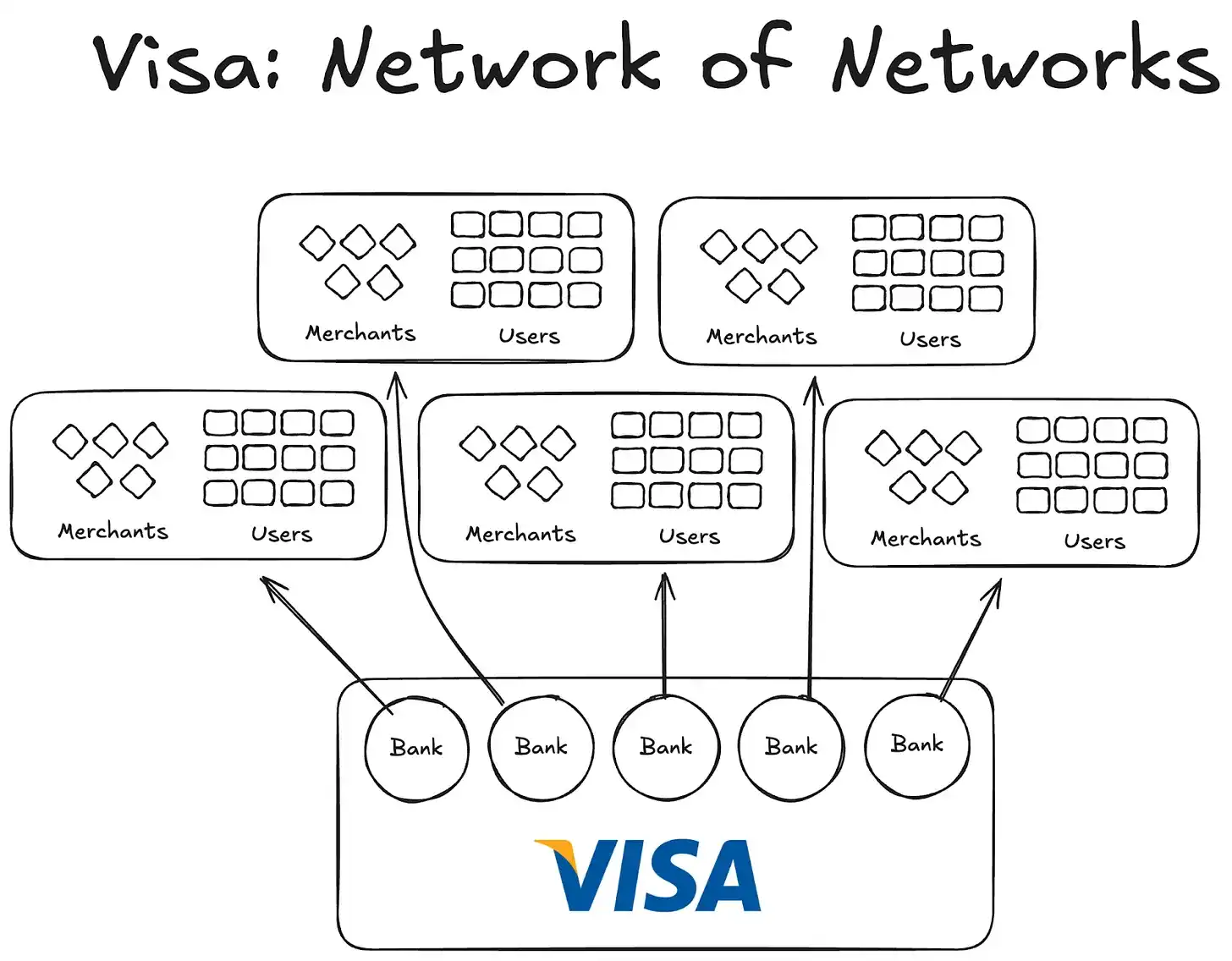
He had to explain that joining Visa meant more users and more merchants would be connected to the same network, which would promote more digital transactions globally and bring more benefits to all participants. He also had to explain that if they built their own credit card network, their user base would be very limited.

Implications for Stablecoins

In a sense, Anchorage Digital and other companies now offering stablecoin-as-a-service are replaying the BankAmericard story in the stablecoin space. They provide the underlying infrastructure for new issuers to build stablecoins, but liquidity continues to fragment into new tokens.

Currently, over 300 stablecoins are listed on Defillama. Moreover, each newly created stablecoin is limited to its own ecosystem. As a result, no single stablecoin can generate the network effects needed to go mainstream.

Since the same underlying assets support these new coins, why do we need more coins with new code?

In our Visa story, these are like BankAmericards. Ethena, Anchorage Digital, M0, or Bridge—each allows a protocol to issue its own stablecoin, but this only exacerbates industry fragmentation.

Ethena is another similar protocol that allows yield transmission and white-label customization of its stablecoin. Just like MegaETH issuing USDm—they issued USDm through tools that support USDtb.

However, this model failed. It only fragments the ecosystem.

In the credit card case, the brand differences between banks did not matter because it did not create any friction in user-to-merchant payments. The underlying issuance and payment layer was always Visa.

However, for stablecoins, this is not the case. Different token codes mean an infinite number of liquidity pools.

Merchants (or in this case, applications or protocols) will not add all stablecoins issued by M0 or Bridge to their list of accepted stablecoins. They will decide based on the liquidity of these stablecoins in the open market; the coins with the most holders and the highest liquidity should be accepted, while the rest will not.

The Way Forward: The Visa Model for Stablecoins
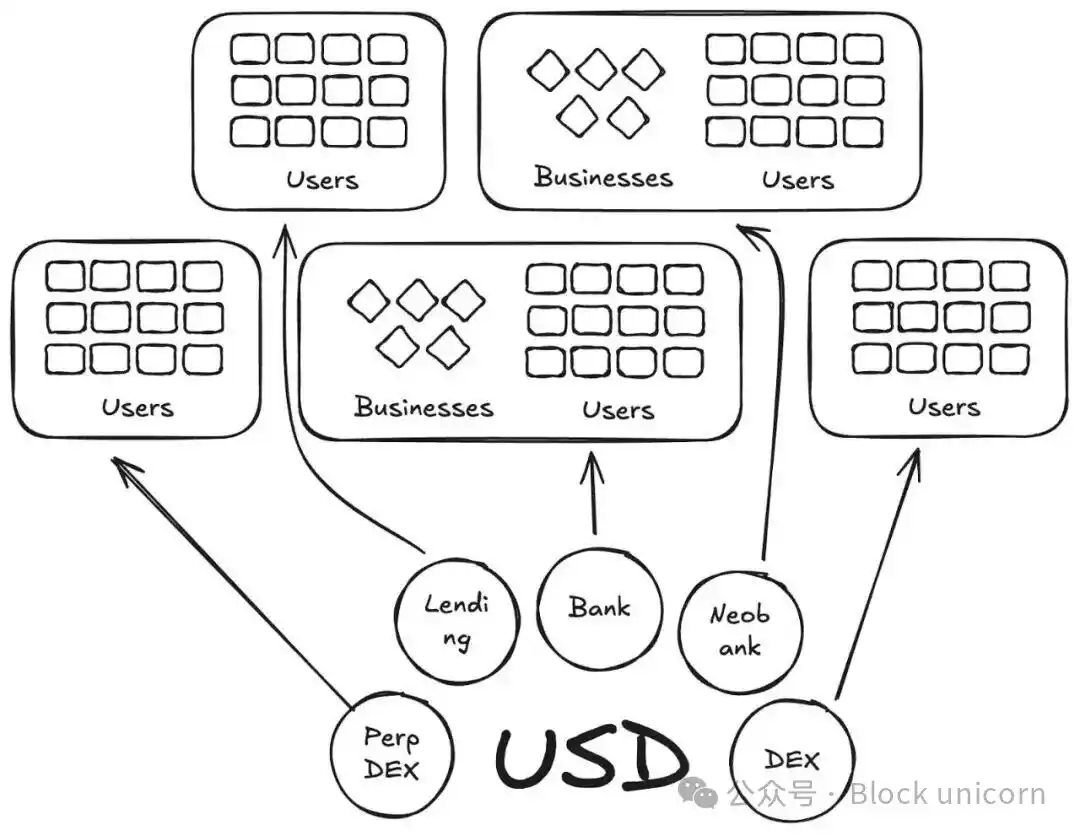
We need independent third-party institutions to manage stablecoins of different asset classes. Issuers and applications supporting these assets should be able to join cooperatives and access reserve earnings. At the same time, they should also have governance rights and be able to vote on the direction of their chosen stablecoin.

From a network effects perspective, this would be a superior model. As more issuers and protocols join the same token, it will facilitate the widespread adoption of a token that retains earnings internally rather than flowing into others' pockets.


Пов'язані питання

QWhat was the main challenge faced by the credit card industry in the 1960s, and how did Visa address it?

AThe main challenge was fragmentation, with each bank operating its own isolated payment network. Visa addressed this by creating a cooperative network that allowed banks to join and share infrastructure, enabling universal acceptance and efficient interbank settlement.

QHow did Visa's structure differ from competitors like American Express and BankAmericard, and why was it more successful?

AVisa operated as an independent, cooperative organization where banks shared ownership and governance, avoiding competition among members. In contrast, American Express acted as a single bank expanding alone, and BankAmericard had infrastructure issues with interbank settlement. Visa's model incentivized participation and scaled network effects more effectively.

QWhat are the key pillars of Visa's network effects as described in the article?

AThe key pillars are: 1) Visa's independent third-party status to avoid competition among banks, 2) Profit sharing proportional to transaction volume, 3) Governance through voting by member banks requiring 80% approval, and 4) Initial exclusivity clauses preventing members from joining other networks.

QHow does the current stablecoin landscape resemble the pre-Visa credit card era, and what problem does this create?

AThe stablecoin landscape is fragmented, with over 300 stablecoins on Defillama, each limited to its own ecosystem. This prevents network effects, causes liquidity fragmentation, and hinders mainstream adoption, similar to how isolated bank networks struggled before Visa.

QWhat solution does the article propose for stablecoins, inspired by Visa's model?

AThe article proposes an independent third-party cooperative for stablecoins, where issuers and applications join to share reserve yields and governance rights. This would unify liquidity, enhance network effects, and keep benefits within the ecosystem rather than fragmenting them.

Пов'язані матеріали

Google and Amazon Simultaneously Invest Heavily in a Competitor: The Most Absurd Business Logic of the AI Era Is Becoming Reality

In a span of four days, Amazon announced an additional $25 billion investment, and Google pledged up to $40 billion—both direct competitors pouring over $65 billion into the same AI startup, Anthropic. Rather than a typical venture capital move, this signals the latest escalation in the cloud wars. The core of the deal is not equity but compute pre-orders: Anthropic must spend the majority of these funds on AWS and Google Cloud services and chips, effectively locking in massive future compute consumption. This reflects a shift in cloud market dynamics—enterprises now choose cloud providers based on which hosts the best AI models, not just price or stability. With OpenAI deeply tied to Microsoft, Anthropic’s Claude has become the only viable strategic asset for Google and Amazon to remain competitive. Anthropic’s annualized revenue has surged to $30 billion, and it is expanding into verticals like biotech, positioning itself as a cross-industry AI infrastructure layer. However, this funding comes with constraints: Anthropic’s independence is challenged as it balances two rival investors, its safety-first narrative faces pressure from regulatory scrutiny, and its path to IPO introduces new financial pressures. Globally, this accelerates a "tri-polar" closed-loop structure in AI infrastructure, with Microsoft-OpenAI, Google-Anthropic, and Amazon-Anthropic forming exclusive model-cloud alliances. In contrast, China’s landscape differs—investments like Alibaba and Tencent backing open-source model firm DeepSeek reflect a more decoupled approach, though closed-source models from major cloud providers still dominate. The $65 billion bet is ultimately about securing a seat at the table in an AI-defined future—where missing the model layer means losing the cloud war.

marsbit1 год тому

Google and Amazon Simultaneously Invest Heavily in a Competitor: The Most Absurd Business Logic of the AI Era Is Becoming Reality

marsbit1 год тому

Computing Power Constrained, Why Did DeepSeek-V4 Open Source?

DeepSeek-V4 has been released as a preview open-source model, featuring 1 million tokens of context length as a baseline capability—previously a premium feature locked behind enterprise paywalls by major overseas AI firms. The official announcement, however, openly acknowledges computational constraints, particularly limited service throughput for the high-end DeepSeek-V4-Pro version due to restricted high-end computing power. Rather than competing on pure scale, DeepSeek adopts a pragmatic approach that balances algorithmic innovation with hardware realities in China’s AI ecosystem. The V4-Pro model uses a highly sparse architecture with 1.6T total parameters but only activates 49B during inference. It performs strongly in agentic coding, knowledge-intensive tasks, and STEM reasoning, competing closely with top-tier closed models like Gemini Pro 3.1 and Claude Opus 4.6 in certain scenarios. A key strategic product is the Flash edition, with 284B total parameters but only 13B activated—making it cost-effective and accessible for mid- and low-tier hardware, including domestic AI chips from Huawei (Ascend), Cambricon, and Hygon. This design supports broader adoption across developers and SMEs while stimulating China's domestic semiconductor ecosystem. Despite facing talent outflow and intense competition in user traffic—with rivals like Doubao and Qianwen leading in monthly active users—DeepSeek has maintained technical momentum. The release also comes amid reports of a new funding round targeting a valuation exceeding $10 billion, potentially setting a new record in China’s LLM sector. Ultimately, DeepSeek-V4 represents a shift toward open yet realistic infrastructure development in the constrained compute landscape of Chinese AI, emphasizing engineering efficiency and domestic hardware compatibility over pure model scale.

marsbit2 год тому

Computing Power Constrained, Why Did DeepSeek-V4 Open Source?

marsbit2 год тому

Торгівля

Спот
Ф'ючерси
活动图片




