Venezuela, Sanctioned and Kicked Out of the Dollar System by the U.S., Turns to USDT

marsbitОпубліковано о 2026-02-22Востаннє оновлено о 2026-02-22

Анотація

Venezuela, heavily sanctioned by the US and cut off from the dollar system, has turned to USDT (Tether) to manage a significant portion of its national revenue, particularly from oil sales. An estimated 80% of the country's oil transactions are now conducted using the stablecoin. This shift was not a voluntary adoption of cryptocurrency but a necessity due to the inability to legally transact in USD. The Venezuelan government, which once banned stablecoins, now facilitates their use for both corporate and retail payments, including salaries and groceries. However, the use of cryptocurrencies like USDT remains limited in large-scale illicit activities, such as drug trafficking, where traditional cash-based and trade-based money laundering methods still dominate. US authorities have not emphasized crypto in recent indictments, suggesting that digital assets may not yet be practical for moving very large sums illicitly. Nonetheless, Venezuela’s embrace of a digital dollar sets a precedent for other nations under sanctions and may paradoxically reinforce the global dominance of the dollar.

Author: Blockworks

Compiled by: Deep Tide TechFlow

Deep Tide Introduction: Venezuela's case is the most powerful real-world footnote for stablecoins—not because they chose crypto, but because they had no other choice. This article demonstrates the complete path of a sovereign nation forced to adopt USDT under sanction pressure, while also revealing the real limitations of stablecoins in large-scale money laundering scenarios.
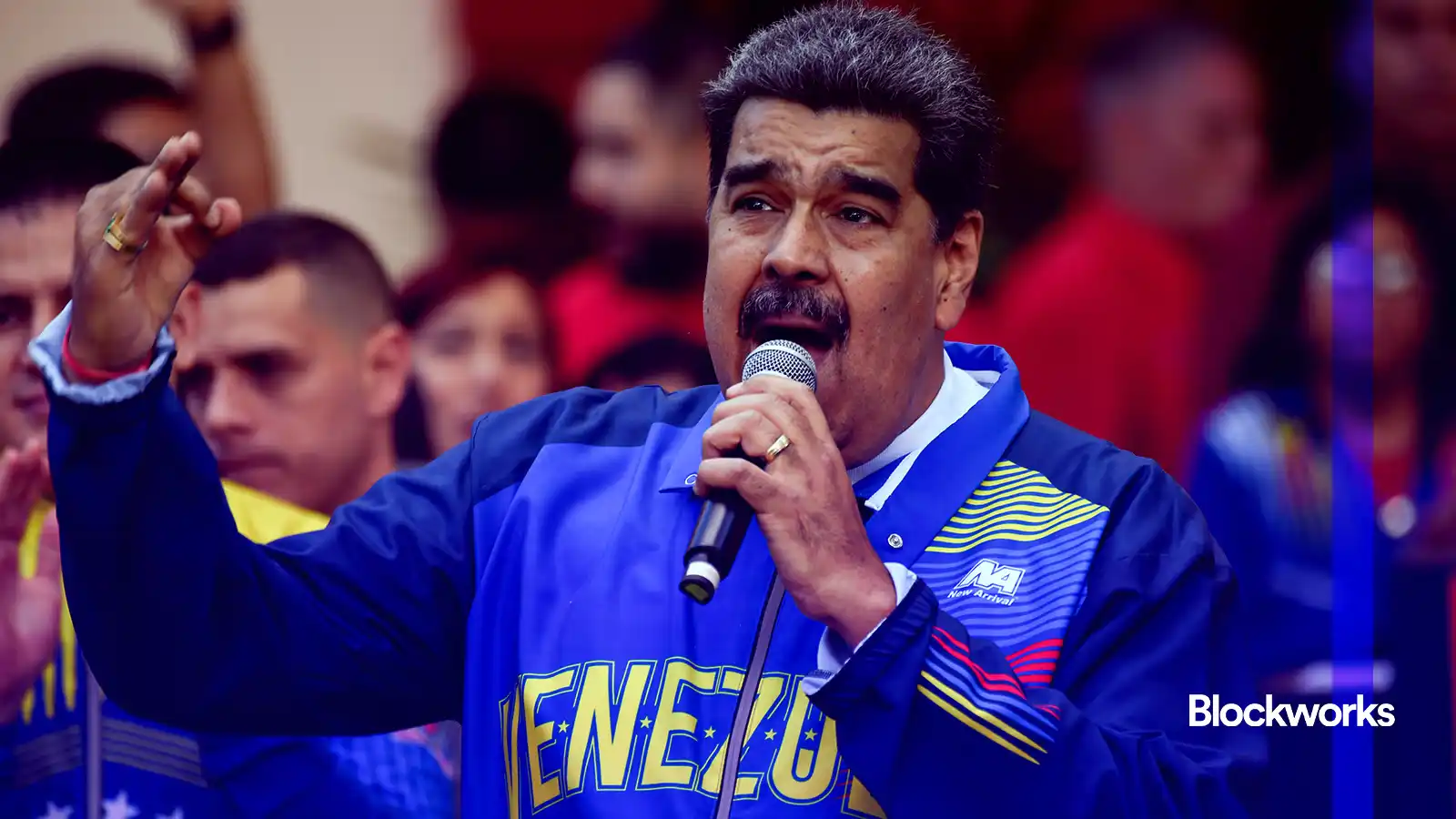
"I don't think it's a bad thing, this so-called 'dollarization' process... Thank God it exists."

— Nicolás Maduro

A recent report by The New York Times stated that Venezuela has become "the first country to manage a large portion of its fiscal revenue using cryptocurrency."

But this was not an active choice.

Approximately half of Venezuela's revenue comes from oil sales denominated in U.S. dollars. As a sanctioned country, Venezuela cannot legally send or receive dollars.

Previously, sanctioned governments typically exchanged oil for dollars—or bartered oil for goods or infrastructure investments—through a network of shell companies and offshore banks.

Now, they have a simpler option: accept stablecoins as payment. Economist Asdrúbal Oliveros estimates that Tether's USDT is the medium of exchange for about 80% of Venezuela's oil sales.

The Venezuelan government once banned the use of stablecoins for transactions, viewing them as a threat to the bolívar. But the devastating impact of U.S. sanctions left it with almost no choice, ultimately forcing it to embrace stablecoins.

Venezuela's current interim president, Delcy Rodriguez, acknowledged the inevitability of crypto-driven dollarization as early as August last year. She told business leaders at the time that "non-traditional management mechanisms" were being implemented to better manage the bolívar exchange rate.

Reuters reported shortly thereafter: "The Venezuelan government has allowed greater use of USDT since June." With state approval, banks now sell USDT obtained from oil sales to local businesses, which use these stablecoins to pay domestic and international suppliers.

They also hope stablecoins will circulate at the retail level: the head of Venezuela's National Supermarket Association recently stated on national television that grocery stores are advancing system upgrades to accept USDT payments.

In other words, the Venezuelan government is encouraging the use of dollars issued by Tether to replace its own currency, the bolívar.

As a result, USDT—which many Venezuelans call "Binance dollars"—is now used in various scenarios, "from buying groceries and paying apartment management fees to issuing salaries and paying suppliers."

So, for a stablecoin enthusiast like me, it was quite disappointing to see that the U.S. government's indictment against Nicolás Maduro didn't even mention cryptocurrency or stablecoins.

The indictment describes illegal fund flows using the old ways: planes returning from Mexico "loaded with drug proceeds"; weapons like grenades bartered for cocaine; protection fees paid by sharing shipments of cocaine; and a $2.5 million cash bribe.

Why no mention of cryptocurrency?

There are two possibilities: 1) The U.S. government has stopped publicly criticizing crypto, and prosecutors know when to skip it; or 2) Crypto and stablecoins are still inadequate for the scale of funding required by Maduro and his associates. The former is more interesting, but the latter is more likely the truth.

"It is difficult for the state to quickly liquidate these [crypto] assets," explained Asdrúbal Oliveros, "because transferring crypto funds requires going through various controls that are currently not being met."

A report by TRM Labs reached a similar conclusion: "Large-scale drug trafficking organizations still heavily rely on physical cash, trade-based money laundering, and the protection of state or quasi-state institutions when moving core proceeds. Cryptocurrency typically plays a secondary or complementary role rather than replacing these mechanisms."

Analysts from the national security think tank Lawfare also agree: "Cryptocurrency-based sanctions evasion remains a drop in the bucket compared to traditional illicit finance channels."

Some are more optimistic about the practicality of stablecoins and crypto in the field of "international payments."

For example, InSight Crime reported that Mexican drug cartels are sustained by an "industrial-scale crypto money laundering pipeline" that funnels black money through digital networks to Chinese chemical suppliers.

They detailed a niche market where stablecoins have found a fit: acting as intermediaries connecting Chinese money brokers who need dollars to sell to clients circumventing China's capital controls, and Mexican drug cartels who need to buy fentanyl precursor chemicals from China.

This isn't the product-market fit crypto enthusiasts hoped for, but in terms of actual behavior, the fit is quite strong. For instance, the DEA stated that its seizures of illicit cash have significantly decreased because criminal groups are "placing cryptocurrency above traditional cash laundering schemes."

Correspondingly, seizures of "virtual currency" have risen significantly: between 2020 and 2024, the DEA seized $2.5 billion in cryptocurrency, compared to only $2.2 billion in cash.

This might explain why Maduro and his associates stick to more traditional payment methods—traceable cryptocurrency and freezable stablecoins are not yet ready for the largest-scale money laundering needs.

Nonetheless, Venezuela's embrace of the digital dollar is setting a precedent. Lawfare concluded: "U.S. adversaries have established a working proof-of-concept, and emerging financial technologies may further consolidate it."

If that's the case, the U.S. dollar itself might be further consolidated as a result.

Being prohibited from using dollars did not push Venezuela to adopt the yuan for oil settlements—instead, it led the government to switch to the digital dollar.

Пов'язані питання

QWhy has Venezuela turned to using USDT for its oil sales according to the article?

ADue to U.S. sanctions, Venezuela cannot legally send or receive U.S. dollars. Approximately 80% of its oil sales are now conducted using Tether's USDT as a transaction medium, as it provides a simpler alternative to traditional workarounds involving shell companies and offshore banks.

QWhat was the Venezuelan government's initial stance on stablecoins like USDT, and why did it change?

AThe Venezuelan government initially banned stablecoin transactions, viewing them as a threat to the Bolivar. However, the devastating impact of U.S. sanctions left them with almost no choice, forcing them to embrace stablecoins to manage revenue and economic activities.

QHow is USDT being used within Venezuela beyond oil sales, as mentioned in the article?

AUSDT is used for various daily transactions, including buying groceries, paying apartment management fees, disbursing salaries, and settling payments with suppliers. The government is encouraging its use at the retail level, with supermarkets adapting systems to accept USDT payments.

QWhy does the article suggest that cryptocurrencies and stablecoins were not mentioned in the U.S. government's indictment against Nicolás Maduro?

AThe article presents two possibilities: 1) The U.S. government has shifted away from publicly criticizing crypto, and prosecutors omitted it strategically, or 2) Cryptocurrencies and stablecoins are still inadequate for the scale of money laundering required by Maduro and his associates, with traditional methods like cash and trade-based laundering remaining dominant.

QWhat broader implication does the article highlight regarding the use of digital dollars like USDT in sanctioned economies?

AThe article suggests that Venezuela's adoption of USDT sets a precedent, creating a 'working proof-of-concept' for other U.S. adversaries. This could further entrench the use of digital dollars, ironically strengthening the U.S. dollar's role even in economies sanctioned by the U.S., rather than prompting a shift to alternatives like the Chinese yuan.

Пов'язані матеріали

Ethereum Q1 2026 Report: Fees Decline, Users and Transaction Volume Hit New Highs

Ethereum Q1 2026 Report: Fees Down, Users & Transactions Hit New Highs Token Terminal's Q1 2026 report on Ethereum presents a pivotal development: the network achieved record highs in monthly active users (13.2M, +85.9% YoY), total transactions (200.4M, +81.5% YoY), and throughput (25.78 TPS), while transaction fees on the mainnet plummeted by 47.9% quarter-over-quarter. This shift is attributed to the network's strategic move into a "low fees for scale" phase, exemplified by the Fusaka upgrade which increased data capacity and lowered block space costs, releasing pent-up demand (a manifestation of Jevons's Paradox). The report highlights a core narrative shift for Ethereum: from a DeFi-centric blockchain to a global financial settlement layer. It maintains a dominant position in tokenized assets, holding majority market shares among top chains in stablecoins (61.8%), tokenized funds (73.0%), and tokenized commodities (84.0%). Growth in tokenized funds (+73.1% YoY) and commodities (+325.9% YoY) was particularly strong, driven by institutions like BlackRock and JPMorgan entering the space. Contrasting these usage gains, several USD-denominated value metrics declined in Q1: fully diluted market cap fell 30.3% QoQ, total value locked (TVL) dropped 11.0%, and ecosystem transaction volume decreased 24.0%. The report interprets this as Ethereum prioritizing long-term network expansion and cementing its role as the default settlement layer for finance over short-term fee capture. The commentary from Etherealize argues that, much like the early internet, Ethereum's open, permissionless model is poised to win over closed alternatives as institutional tokenization accelerates.

marsbit1 год тому

Ethereum Q1 2026 Report: Fees Decline, Users and Transaction Volume Hit New Highs

marsbit1 год тому

He Just Raised 2.7 Billion, and Li Fei-Fei Also Invested

Pete Florence, a former senior research scientist at Google DeepMind and a key contributor to the Vision-Language-Action (VLA) model architecture, is deliberately distancing his startup, Generalist AI, from the trendy "world model" label. He argues that the industry should prioritize concrete goals over buzzwords. His goal is to create robots that can perform a vast range of unseen tasks with high speed and success rates, without needing task-specific training data. Recently, his company raised $400 million (¥2.7 billion) at a $2 billion valuation. Notable investors include NVIDIA's NVentures, Bezos Expeditions, NFDG, as well as Xiaomi co-founder Lin Bin, Zoom founder Eric Yuan, and renowned AI scientist Fei-Fei Li. Florence's approach stems from his academic background at MIT under Professor Russ Tedrake, focusing on understanding the physical world. After joining DeepMind, he developed models like Transporter Network and co-created the VLA framework. He left in 2025 to found Generalist AI. The company has launched two models: GEN-0, which demonstrated that scaling laws apply to physical motion, and GEN-1. GEN-1 was trained on over 500,000 hours of physical interaction data collected via a specialized wearable device. It achieves a 99% success rate on precise mechanical tasks like folding boxes and maintains performance three times faster than its predecessor. Florence believes GEN-1 is reaching a commercial utility threshold similar to the GPT-3 inflection point. The substantial funding round, following GEN-1's release, signifies strong investor confidence in Generalist AI's practical, goal-driven path to creating versatile, useful robots, regardless of the "world model" terminology.

marsbit1 год тому

He Just Raised 2.7 Billion, and Li Fei-Fei Also Invested

marsbit1 год тому

Two Legends Lost in Three Days: Is Google's AI Talent Dam Cracking?

In three days, Google lost two AI legends. On June 18, Noam Shazeer, co-author of the seminal "Attention is All You Need" paper and Gemini co-lead, left for OpenAI. Just 48 hours later, John Jumper, 2024 Nobel laureate and AlphaFold lead, departed DeepMind for Anthropic. This follows Andrej Karpathy joining Anthropic in May. These moves highlight a structural trend: top AI talent is concentrating at mission-driven, pre-IPO firms like OpenAI and Anthropic, while Google becomes a primary source. The exodus stems from a core mission mismatch. Google's ad-centric model often subordinates AI research to product and revenue goals, creating friction for pioneers like Shazeer, who returned in 2024 only to leave again. In contrast, OpenAI and Anthropic offer singular focus on pushing AI boundaries, whether towards AGI or safety-aligned models, which deeply appeals to top researchers like Jumper. Financial incentives amplify the pull. With both OpenAI and Anthropic nearing IPO, employees stand to gain immensely from equity, an upside Google's mature stock cannot match. Furthermore, the 2023 merger of Google Brain and DeepMind, intended to consolidate strength, has instead created cultural tension and slowed the path from research to product, as evidenced by Gemini's pace. This talent redistribution is reshaping the AI landscape. While Google retains vast data and compute resources, its true crisis is the quiet, continuous loss of the people who define the field's future. The real moat in AI is not infrastructure, but the concentration of brilliant minds—a battle Google is currently losing.

marsbit3 год тому

Two Legends Lost in Three Days: Is Google's AI Talent Dam Cracking?

marsbit3 год тому

Behind the AI Report Card, Lies a Chinese 'Exam Setter'

Beyond the familiar performance charts like MMLU-Pro and MMMU, which major AI models strive to ace, stands a key "examiner": Chinese-Canadian researcher Wenhu Chen. An assistant professor at the University of Waterloo and founder of TIGERLab, Chen addresses the crucial need for more rigorous AI evaluation. As models like GPT-4 began scoring near-perfect results on older benchmarks like MMLU, it became difficult to distinguish their true capabilities. In response, Chen introduced MMLU-Pro in 2024, featuring harder, more reasoning-focused questions with more answer choices, successfully reintroducing meaningful performance gaps. His work extends to multi-modal evaluation with MMMU and its enhanced version, MMMU-Pro. These benchmarks test a model's ability to understand and reason with complex information from images, charts, and text across diverse academic subjects, exposing the significant challenges even top models face in genuine comprehension. Chen's background in complex QA, table reasoning, and his experience at Google DeepMind on projects like Gemini inform his approach. He understands that effective benchmarks must anticipate how models might "cheat" by memorizing data or avoiding visual analysis. His lab also actively researches video understanding and generation models (e.g., UniVideo, Vamba), ensuring his evaluation work is grounded in practical model-building challenges. Now at Meta's Super Intelligence Lab, Chen continues his focus on multi-modal data and evaluation, representing the deep yet often unseen contributions of Chinese talent in shaping the fundamental tools of the AI industry.

marsbit3 год тому

Behind the AI Report Card, Lies a Chinese 'Exam Setter'

marsbit3 год тому

Торгівля

Спот
Ф'ючерси
活动图片