VCs on 2025 Crypto Investments: 84% of 118 Tokens Break Issue Price, Only One Type of Company is Quietly Making Money

marsbitОпубліковано о 2026-04-22Востаннє оновлено о 2026-04-22

Анотація

Crypto investor Ching Tseng categorizes the market into four quadrants based on two axes: crypto-native vs. traditional finance (TradFi)-oriented, and having traction vs. no traction. In 2025, 84.7% of 118 tracked token launches fell below their issuance price, with a median fully diluted valuation drop of 71%. Crypto-native projects without traction are experiencing massive capital destruction, often relying on speculative narratives without sustainable revenue or user retention. Crypto-native teams with traction, often built in prior cycles, generate real revenue but face structural challenges with their tokens lacking direct value capture mechanisms. While some have implemented successful buyback programs, the core issue remains finding growth beyond crypto volatility. TradFi-oriented startups without traction face long, costly enterprise sales cycles but benefit from a robust M&A environment, with crypto acquisitions reaching a record $8.6 billion in 2025. The current winners are TradFi-oriented companies with traction, particularly in the Real World Asset (RWA) tokenization space, which grew from $5.5B to $18.6B in 2025. They are winning through enterprise sales, building alliances, and improving unit economics on established compliance stacks. Their main risk is being bypassed by large incumbent institutions building their own infrastructure. The overarching theme is market maturation, where narrative alone is insufficient for long-term success.

Author: Ching Tseng

Compiled by: Deep Tide TechFlow

Deep Tide Guide: Investor Ching Tseng categorizes crypto companies into four quadrants: crypto-native/traditional finance-oriented, with traction/without traction. In 2025, 84.7% of 118 token issuances broke their issue price. Crypto-native projects without traction are massively destroying capital, while traditional finance-oriented companies with traction are capturing the $18 billion RWA market. This article clarifies where the money is flowing and which tokenomics models have failed.

Sitting on the investor side this year, I found that almost every crypto founder I met can be classified into one of four categories. The two axes are simple: crypto-native vs. traditional finance-oriented, with traction vs. without traction. Four quadrants, covering about 75% of the market.

The challenges faced by each quadrant are completely different. Here is my breakdown.
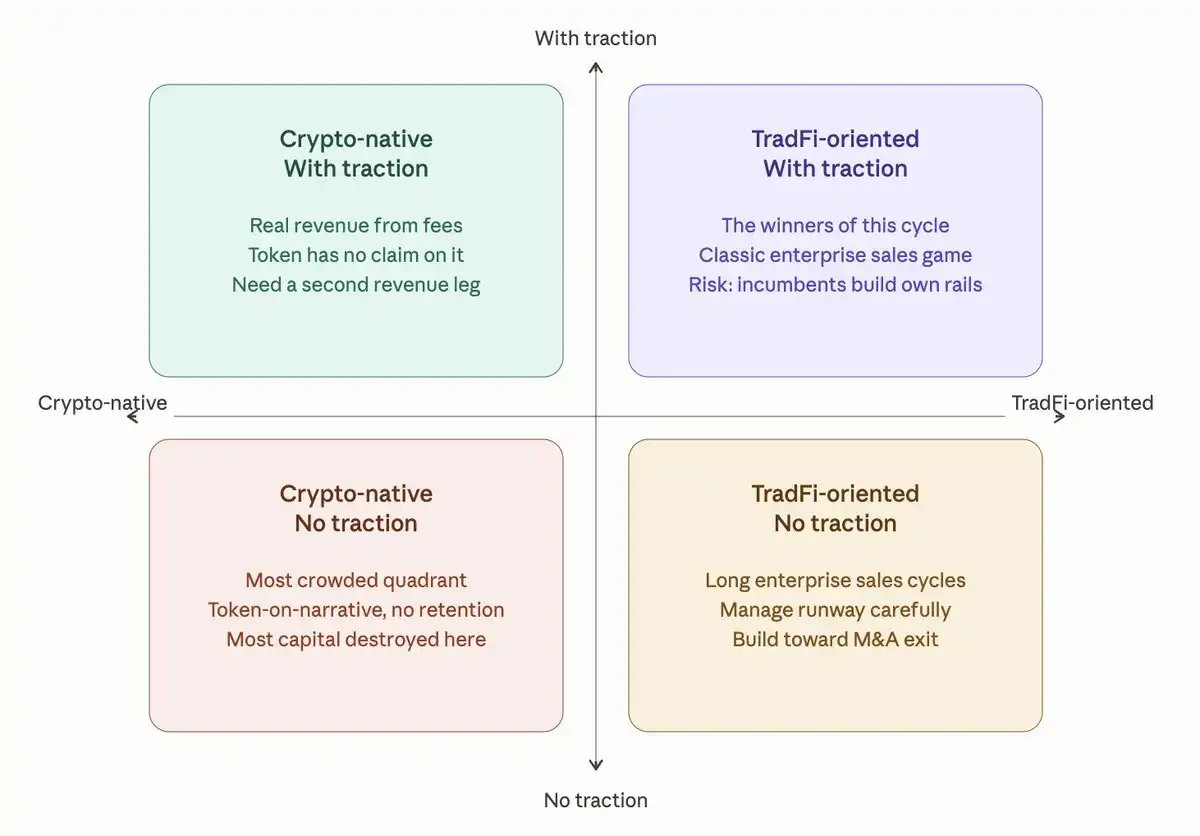
Crypto-Native, Without Traction

This is the most crowded quadrant and the area where capital is being destroyed most severely.

These teams are still showcasing TVL numbers that were inflated in the last cycle but cannot explain why they worked back then. They ask for valuations of $20 million, $30 million, sometimes even $200 million, with only a utility token and a roadmap, claiming the token has a "clear use case" because it is used to pay fees or for governance voting.

The data is brutal. Among the 118 token issuances tracked in 2025, 84.7% fell below their issue price, with the median fully diluted valuation dropping by 71%. Some of the most hyped "native DeFi L1s" of this cycle saw their TVL drop by over 90% in the first year after launch, with tokens following a similar trend. AI-related token groups saw an average annual return of -50%, with several top performers of 2024 pulling back over 80% from their peaks.

The pattern is consistent. Initial traction comes from users seeking quick profits rather than genuinely liking your product. Tokens priced based on narratives, without revenue or user retention to support their valuations, bled in 2025. Massive emissions exposed that on-chain activity was primarily mercenary behavior.

What this quadrant needs to internalize is: the long-term value of a token comes from the team's ability to generate revenue and return capital to holders, not from artificial utility that forces users to spend it. Regulation still prevents anyone from publicly saying "the token is equity," but empirically, that is the only model that works. Everything else is, at best, a cyclical trade.

If you are here, the honest approach is not to issue another token. It is to return to the basics: who are your real users, what are they willing to pay for, and how can you capture a portion of that?

Crypto-Native, With Traction

This quadrant is full of teams that built something real many years ago, often in the last cycle, and have been quietly earning decent revenue from trading, lending, or exchange fees. The teams are small, cash flow covers salaries, and the product works.

Sounds good? But they also have challenges to overcome.

Most issued tokens early and are now stuck with a structural problem: revenue exists, but the token has no mechanical claim to it. Some of the largest products in the market handle monthly trading volumes of tens or even hundreds of millions of dollars, but for years the direct value captured by the token has been zero. No matter how good the revenue/profits are, the market does not truly trade the token at a consistent multiple; the market prices expected growth, not current economic conditions.

The buyback debate is the other half of the story for this quadrant. Some protocols that promised weekly fee-funded buybacks in early 2025 saw their prices rise over 40% in the following month. Others running automated, fee-funded buyback programs cumulatively bought back over $1 billion in tokens within seven months, with single-day buybacks nearing $4 million at their peak. DeFi buybacks totaled approximately $2 billion in 2024-2025.

Buybacks sound like the answer. Sometimes they are. But for teams in this quadrant without excess revenue, buying back tokens is just burning future runway to defend a price that may not hold. The harder and better question is, can you grow a second revenue line not tied to crypto volatility? Because if traditional finance-oriented competitors build better distribution into institutions while you are still surviving on altcoin traders, your moat will quickly turn into commodity-priced infrastructure.

Traditional Finance-Oriented, Without Traction

This group ballooned in 2024-2025. Custody tools, compliance middleware, tokenization rails, on-chain forex, institutional settlement—all genuinely useful. All expensive. All have enterprise sales cycles measured in quarters, not weeks.

The problem is not the product. It's the math. Founders raised $15 million to $30 million assuming institutions would come, but even onboarding a tier-1 bank client can take 12-18 months and requires compliance infrastructure that eats a year of burn before the first dollar of revenue lands.

The good news is that the exit environment for this quadrant is exceptionally healthy. Crypto M&A hit a record $8.6 billion in 2025, with over 140 VC-backed crypto companies acquired, a 59% jump year-over-year. Several of the largest deals saw existing giants paying hundreds of millions to billions of dollars for distribution, licenses, and enterprise relationships in derivatives, trading infrastructure, and payment rails.

If you are in this quadrant, the cool-headed play is: manage valuation and cash runway like your life depends on it, aim for a meaningful M&A outcome, because it is real. Don't price yourself out of the acquirer pool. Don't burn 24 months of runway chasing one enterprise logo. Build complementary partnerships with larger players who might ultimately want to acquire you.

Traditional Finance-Oriented, With Traction

The winners of the current regime.

Tokenized real-world assets grew from $5.5 billion at the start of 2025 to $18.6 billion by year-end, a 3.4x growth in twelve months. The largest tokenization platforms now handle billions in institutional liquidity, with market leaders holding around 20% share, supporting one of the world's largest tokenized treasury funds with nearly $3 billion AUM.

These companies aren't trying to convince anyone crypto is the future. Their institutional clients have already decided. The game now is straightforward enterprise sales: win more banks, more asset managers, more issuers; build alliance structures where an institution buying one of your products naturally buys three more from your partners; compress unit economics on the compliance and custody stack you've already built.

If the team is a pure service provider, this becomes a classic enterprise software war: sales velocity, net retention, integration depth.

The primary risk for this quadrant is not from crypto-native competition. It's from existing behemoths, large asset managers and global banks, eventually building their own rails, bypassing the startups that helped them adapt to the chain. The window is real, but not infinite.

The four quadrants appear different on the surface but are all navigating the same underlying shift: the market is maturing.

This doesn't mean narrative is dead. Institutions also chase hot themes, as anyone who has watched semiconductor and AI valuations over the past two years knows. But in a mature market, the half-life of pure narrative is shorter. It can still get you started, but it cannot keep you going.


Пов'язані питання

QAccording to the article, what percentage of the 118 token launches tracked in 2025 fell below their issuance price?

A84.7% of the 118 token launches tracked in 2025 fell below their issuance price.

QWhich quadrant of crypto companies is described as the current winners of the system and is capitalizing on the RWA market?

AThe 'Traditional Finance-Oriented, With Traction' quadrant is described as the current winners, capitalizing on the tokenized real-world asset (RWA) market which grew to $18.6 billion.

QWhat is the primary risk for companies in the 'Traditional Finance-Oriented, With Traction' quadrant?

AThe primary risk is not from crypto-native competitors, but from existing giants like large asset managers and global banks who may build their own on-chain infrastructure, bypassing the startups that helped them adapt.

QWhat does the data suggest is the only empirically working model for a token's long-term value?

AThe data suggests that the only empirically working model is one where the token is treated as equity, meaning the team generates revenue and returns capital to holders, rather than forcing artificial utility.

QWhat was the total value of crypto M&A (Mergers and Acquisitions) in 2025, as stated in the article?

ACrypto M&A reached a record $8.6 billion in 2025.

Пов'язані матеріали

ETH Bull and Bear Views Compilation: Can Ethereum's Value Flow Back to ETH?

Titled "ETH Bull and Bear Views: Can Ethereum's Value Flow Back to ETH?", this article synthesizes the current heated debate around Ethereum's native token, ETH, following Bankless co-founder David Hoffman's decision to sell his entire ETH holdings. The **bullish case**, represented by figures like Tom Lee (BitMine CEO) and Raoul Pal, argues that ETH's core thesis remains intact. They contend Ethereum is the essential, secure, and neutral foundational layer for future finance—encompassing stablecoins, RWA, DeFi, L2s, and Agentic AI. Bulls bet on ETH's long-term revaluation as institutional adoption of on-chain finance grows, with significant buying activity from entities like BitMine and Consensys cited as evidence. Conversely, the **bearish perspective**, led by Hoffman and analysts like Markus Thielen, questions ETH's value capture mechanism. They acknowledge Ethereum's network success but argue that the value created by L2s, DeFi, and applications does not sufficiently accrue to the ETH token itself. Bears point to ETH's prolonged underperformance versus the broader crypto market, lack of traditional cash flows, weakening "ultrasound money" narrative, and apparent institutional retreat (e.g., Harvard Management Company exiting its ETH ETF position) as key concerns. The debate highlights a pivotal shift: ETH is no longer just a community belief asset. The central question is whether ETH can transition from being a "**used infrastructure**" to a "**continuously bought and held core asset**" as more value enters the Ethereum ecosystem. The market is now critically examining the direct link between network growth and ETH's value.

marsbit46 хв тому

ETH Bull and Bear Views Compilation: Can Ethereum's Value Flow Back to ETH?

marsbit46 хв тому

Crypto is dead, Perps are forever

The crypto industry is shifting from a focus on creating native assets (like altcoins and protocol tokens) to becoming a "global asset pipeline." Native cryptocurrencies, except for Bitcoin, are seen as failing in their value storage and utility promises, with demand driven largely by speculation. Attention and liquidity are now moving toward real-world assets (RWAs) like U.S. stocks, bonds, gold, and oil traded on-chain via perpetual contracts (Perps). Stablecoins like USDT and USDC set the precedent, proving blockchain's core strength is efficient global settlement and transfer, not inventing new monetary systems. Meanwhile, assets like Ethereum and many DeFi tokens struggle as their narratives weaken against tangible traditional assets and the rapid real-world progress of AI. Perpetual contracts have emerged as a pivotal innovation. They simplify trading by offering pure price exposure to any asset, bypassing complexities of ownership, custody, and traditional market hours. Projects like Hyperliquid gained traction by combining CEX-like efficiency with on-chain transparency, capitalizing on post-FTX distrust, macroeconomic volatility, and the surge in demand for 24/7 stock trading. In conclusion, while the era of speculative native "crypto assets" may be over, perpetual contracts persist as the industry's most potent financial instrument—transforming all assets into globally accessible, constantly tradable instruments centered on price speculation.

marsbit52 хв тому

Crypto is dead, Perps are forever

marsbit52 хв тому

Tencent, Alibaba, ByteDance in a Battle for the Skill Store

Skill is becoming a key concept in the AI field, essentially serving as a structured "instruction manual" for AI Agents that specifies tool calls, decision logic, and output standards. This allows Agents to execute predefined tasks. As the number of Skills grows, distribution platforms have emerged. Major tech companies are swiftly entering this space. In March, Tencent, Alibaba, and ByteDance launched Skill stores within their respective Agent platforms. Subsequently, players like Zhipu AI, Meituan, and Xiaohongshu joined the fray. This competition for the "Skill store" is fundamentally a battle for the AI-era user entry point; whoever controls distribution controls the users. While ByteDance's Coze has experimented with paid Skills, most platforms offer them for free. The real value lies not in the stores themselves but in using them to attract and retain users within an ecosystem, driving revenue from services like cloud computing, model calls, or advertising. The landscape features three main player types: 1) **Internet giants** (e.g., Alibaba, ByteDance, Tencent, Meituan), leveraging Skills to drive traffic and monetize through their broader ecosystems (cloud services, transactions, ads). 2) **Large model companies** (e.g., Zhipu AI, Moonshot AI), using Skill stores to increase user engagement and monetize model API calls. 3) **Content platforms** (e.g., Xiaohongshu), treating Skills as a new content format to generate traffic and ad revenue. However, transforming Skill stores into a sustainable business faces significant hurdles. Key challenges include: the **difficulty in pricing Skills** due to inconsistent outputs across different models and contexts; **lack of cost transparency** (varying token consumption); **security risks** like Skill poisoning; and the **absence of standardized protocols** for development and evaluation. Unlike standardized mobile apps, Skills are often personalized workflows resistant to uniformity, which hinders the establishment of a reliable review and monetization system akin to the App Store. While there is genuine user demand for paid Skills—particularly in enterprise (e.g., contract review) and certain personal productivity scenarios—current platforms offer developers limited and unpredictable distribution. The future of Skill stores depends on overcoming these standardization, evaluation, and safety challenges to make acquiring a Skill as straightforward as downloading an app. For now, the stores function more as display shelves than robust marketplaces.

marsbit52 хв тому

Tencent, Alibaba, ByteDance in a Battle for the Skill Store

marsbit52 хв тому

The Crypto Scene Is Dead, Perpetual Swaps Are Eternal

The crypto industry is undergoing a fundamental shift. The era defined by minting novel, native digital assets (altcoins) is fading. These assets, lacking real-world cash flows or clear value, are losing relevance as attention and capital flow elsewhere. Two powerful external forces are reshaping the space. First, traditional assets like U.S. stocks, bonds, gold, and oil are being tokenized and traded on-chain. Second, the explosive growth of AI, with its tangible products, has overshadowed crypto's once-dominant "future narrative." This marks a critical pivot: crypto is transitioning from being a "factory for new assets" to becoming a "global conduit for existing assets." Its validated utility is not complex financial reinvention but efficient global settlement, transfer, and trading—the original promise of blockchain. Stablecoins like USDT and USDC exemplify this, offering faster dollar movement rather than replacing it. Consequently, native ecosystems like Ethereum face profound challenges. While still crucial infrastructure, ETH struggles to capture value as users interact with Layer 2s or trade traditional assets without needing to hold it. DeFi's grand narrative of rebuilding finance has narrowed to core needs like cheap transfers and deep liquidity. The true breakout innovation is the perpetual contract (Perp). It brilliantly bypasses the complexities of direct asset ownership (custody, compliance, dividends) by creating pure price exposure. Users can speculate on the price movement of *any* asset—NVIDIA, gold, oil—24/7, globally, and with leverage. This "price casino" model, while risky and ethically fraught, delivers unmatched liquidity and accessibility. Projects like Hyperliquid succeeded not by inventing new mechanics but by perfecting the timing and execution of this model. Key drivers included making on-chain Perps feel like centralized exchanges, post-FTX trust migration towards transparency, and rising demand to trade macro assets and equities round-the-clock. In conclusion, the crypto world's most enduring successes are the dollar (via stablecoins), Bitcoin, and trading. Its new frontier is not creating alternative assets but providing a seamless, perpetual trading layer—a new API—for the world's existing financial system. The age of native altcoins is over; the age of perpetual synthetic exposure has begun.

Odaily星球日报1 год тому

The Crypto Scene Is Dead, Perpetual Swaps Are Eternal

Odaily星球日报1 год тому

Торгівля

Спот
Ф'ючерси

Популярні статті

Як купити ONE

Ласкаво просимо до HTX.com! Ми зробили покупку Harmony (ONE) простою та зручною. Дотримуйтесь нашої покрокової інструкції, щоб розпочати свою криптовалютну подорож.Крок 1: Створіть обліковий запис на HTXВикористовуйте свою електронну пошту або номер телефону, щоб зареєструвати обліковий запис на HTX безплатно. Пройдіть безпроблемну реєстрацію й отримайте доступ до всіх функцій.ЗареєструватисьКрок 2: Перейдіть до розділу Купити крипту і виберіть спосіб оплатиКредитна/дебетова картка: використовуйте вашу картку Visa або Mastercard, щоб миттєво купити Harmony (ONE).Баланс: використовуйте кошти з балансу вашого рахунку HTX для безперешкодної торгівлі.Треті особи: ми додали популярні способи оплати, такі як Google Pay та Apple Pay, щоб підвищити зручність.P2P: Торгуйте безпосередньо з іншими користувачами на HTX.Позабіржова торгівля (OTC): ми пропонуємо індивідуальні послуги та конкурентні обмінні курси для трейдерів.Крок 3: Зберігайте свої Harmony (ONE)Після придбання Harmony (ONE) збережіть його у своєму обліковому записі на HTX. Крім того, ви можете відправити його в інше місце за допомогою блокчейн-переказу або використовувати його для торгівлі іншими криптовалютами.Крок 4: Торгівля Harmony (ONE)Легко торгуйте Harmony (ONE) на спотовому ринку HTX. Просто увійдіть до свого облікового запису, виберіть торгову пару, укладайте угоди та спостерігайте за ними в режимі реального часу. Ми пропонуємо зручний досвід як для початківців, так і для досвідчених трейдерів.

346 переглядів усьогоОпубліковано 2024.12.12Оновлено 2026.06.02

Як купити ONE

Обговорення

Ласкаво просимо до спільноти HTX. Тут ви можете бути в курсі останніх подій розвитку платформи та отримати доступ до професійної ринкової інформації. Нижче представлені думки користувачів щодо ціни ONE (ONE).

活动图片