Valued at 600 Billion, NVIDIA Invests 10 Billion! How Nokia, After Selling Its Phones, Is Making a Comeback

marsbitОпубліковано о 2026-05-29Востаннє оновлено о 2026-05-29

Анотація

Once known as its mobile phones were sold in 2013, Nokia has staged a remarkable commercial comeback, now standing as a "patent giant" and "AI infrastructure builder." In Q1 2026, its net profit surged over 200% year-over-year. Nokia retains a vast portfolio of over 26,000 patent families, including over 7,000 essential 5G patents. This creates a high-margin "licensing" business, generating €1.5 billion in 2025 with over 70% operating margin, from smartphone makers to automotive and streaming media companies. Beyond patents, Nokia is a key player in AI infrastructure. Its acquisition of Infinera made it a top supplier of high-speed optical modules for AI data centers. Its AI-RAN technology allows 5G base stations to utilize idle computing power for AI inference tasks. A strategic $1 billion investment from NVIDIA in 2025 aims to unlock this distributed edge compute potential, with their joint AI Aerial platform already in trials. Looking ahead, Nokia is actively shaping 6G standards with AI-native architecture and is transitioning toward a recurring revenue model through network automation and SaaS offerings. With strong free cash flow and dividends, Nokia has transformed from a faded mobile brand into a core technology player poised for the AI and 6G era.

If we talk about the most unexpected winner in the AI track in 2026, Nokia definitely counts as one.

Most people's memory of it still lingers on the lonely背影 of selling its mobile phone business in 2013 and the definitive conclusion of "being淘汰 by the times."

But the reality is that this company, misunderstood as having "disappeared," has quietly completed a textbook-level business rebirth.

In the first quarter of 2026, Nokia's net profit skyrocketed by over 200% year-on-year. Holding 5G Standard Essential Patents ranking among the top six globally, it received a strategic investment endorsement of $10 billion from NVIDIA. Orders for its optical networking business are in such high demand that delivery schedules are already booked until the second half of the year.

The former "King of Mobile Phones" now stands at the core track of the global technology industry once again with the dual identity of a "Patent Giant + AI Infrastructure Provider."

PART 01

The "Lying Down" Business of Nokia After the Phone Curtain Call

The public's misunderstanding about Nokia essentially equates the "failure of the mobile phone business" with "corporate failure."

Many people overlook the fact that Microsoft only bought the brand usage rights and manufacturing business of Nokia's mobile phones back then, leaving the most valuable communication technology patents, of which Nokia didn't sell a single one.

As of 2025, Nokia holds over 26,000 patent families, including more than 7,000 5G Standard Essential Patents (SEPs), with about 70% of the patent families having a remaining validity period of over ten years.

What do these patents mean?

All global mobile phone manufacturers, whether Apple, Samsung, Huawei, or Xiaomi, as long as their devices support 4G or 5G communication, cannot bypass Nokia's technical barriers and must pay it patent licensing fees.

Nokia's royalty rate for 5G phones is no more than 3 euros per unit. Although the unit price seems low, the profit margin on this revenue is extremely high, almost akin to a "rent collection" model.

The 2025 financial report shows that Nokia's patent licensing business generated annual net sales of 1.5 billion euros, with an operating profit margin exceeding 70%, of which over 800 million euros in core cellular patent revenue has been locked in until 2030.
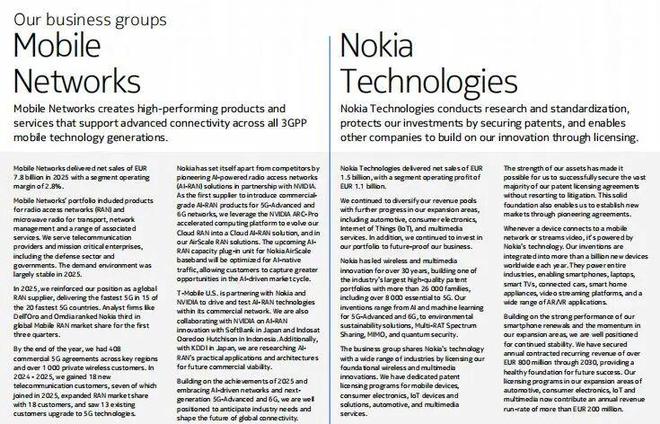
Source: 2025 Financial Report

More notably, Nokia is systematically replicating this "patent royalty" model from the traditional mobile phone field to multiple high-growth sectors.

Riding the wave of automotive intelligence, in 2025, Nokia reached 4G/5G patent licensing agreements with automakers like Mercedes-Benz and at least four Chinese automakers. Through the Avanci patent pool, its 5G automotive patent fee is set at $32 per vehicle, and $20 per vehicle for 4G.

Furthermore, Nokia has also reached into the video streaming sector. In 2025, it completed the acquisition of 298 core video codec patents from LG Electronics. By the end of the year, it had signed licensing agreements with seven streaming platforms including Amazon and Starz.

Simultaneously, it initiated patent lawsuits against giants like Paramount and Warner Bros. in the US, Germany, and other places, accelerating the implementation of a "playback tax" across the industry.

From handheld terminals to smart cars, and further to digital content and the Internet of Things, by the end of 2025, Nokia had signed patent licensing agreements with over 250 enterprises worldwide, building a patent royalty network covering all scenarios.

PART 02


Nokia's New "Optical-Compute Integration" Engine After the AI Computing Boom

If patents are Nokia's "cash cow," then optical networks and AI-RAN are its true engines charging into the AI era.

Relying on these two core technologies, this underestimated company has long been deeply embedded in the core of AI computing infrastructure, becoming a key partner for giants like NVIDIA, Google, and Microsoft.

In June 2024, Nokia acquired the US optical communications company Infinera for $2.3 billion, thereby gaining full-chain technology from optical chips, optical modules to transmission systems, boosting its market share to second globally, only behind Huawei.

The real value of this acquisition lies in: there are very few companies worldwide capable of independently designing and manufacturing high-end optical semiconductor chips, and Infinera is one of them.

This means Nokia can directly supply high-speed optical modules of 800G and 1.6T to AI data centers, with a single optical fiber transmission rate as high as 1.6 Tbps and latency reduced to microseconds.

Performance is the most direct proof: its optical networking revenue grew 19% in 2025, and rose another 20% in Q1 2026, with an operating profit margin exceeding 15%, over five times that of its mobile networking business. The book-to-bill ratio is far greater than 1, with customers queuing for goods. Among the top ten global cloud service providers, nine use Nokia's optical networking technology.

If optical networking brings stable hardware orders for Nokia, AI-RAN earns it long-term, sustainable service revenue.

Traditional 5G base stations typically have baseband computing utilization rates below 10% during nighttime traffic troughs. Nokia's AI-RAN technology allows base stations to run AI inference tasks using idle computing power while ensuring communication quality, enabling localized processing for smart security, autonomous driving edge computing, lightweight large model inference, etc.

In October 2025, NVIDIA invested a whopping $10 billion in strategic funding, precisely eyeing the dormant computing power within Nokia's global millions of base stations.
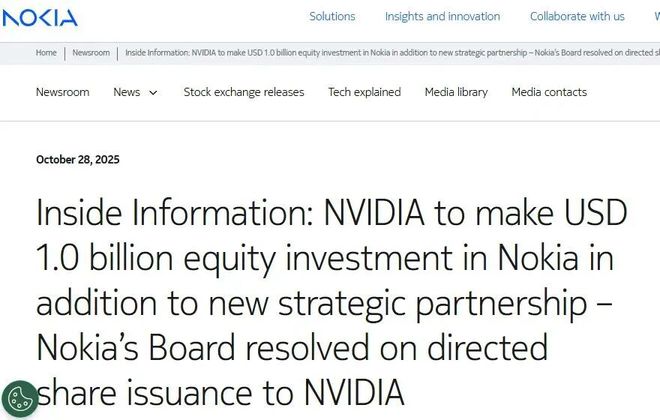
Source: Company Website

The jointly launched AI Aerial platform deeply integrates NVIDIA GPUs with Nokia's base station network. It has already been piloted in Indonesia, completing Southeast Asia's first AI-driven 5G call.

Currently, AI-RAN is undergoing pilot verification with over 10 leading global operators. In Q1 2026, revenue from AI and cloud customers grew 49% year-on-year, with quarterly orders reaching about one billion euros, becoming Nokia's fastest-growing emerging business.

PART 03

Nokia's "Positioning + Subscription" Dual Springboard Before 6G Standardization

For a long time, the capital market has priced Nokia using traditional telecom equipment vendor valuation standards, resulting in a significantly lower price-to-earnings ratio compared to peers like Ericsson and Cisco.

However, this valuation discount will be completely broken with the advent of the 6G era. 2026 is a crucial year for 6G standard setting, with formal commercialization expected by 2030.

Relying on its industry-leading AI-native architecture, Nokia is expected to achieve an overtaking in the 6G era and become a core global standard-setter.

Its advantages are mainly concentrated in: being able to embed AI capabilities directly into the network's physical layer and data link layer, enabling smooth evolution on existing AirScale base stations without additional hardware; the intelligent resource optimization technology jointly tested with KDDI, which reduces base station power consumption by 40% and increases throughput fourfold, has already been verified; promoting the inclusion of non-terrestrial networks in the 6G standard to achieve global coverage.

More crucially, in October 2025, Nokia and Ericsson joined hands with Germany's Fraunhofer HHI in a historic tripartite cooperation, jointly promoting the formulation of 6G video codec standards, further enhancing Nokia's influence in this field.
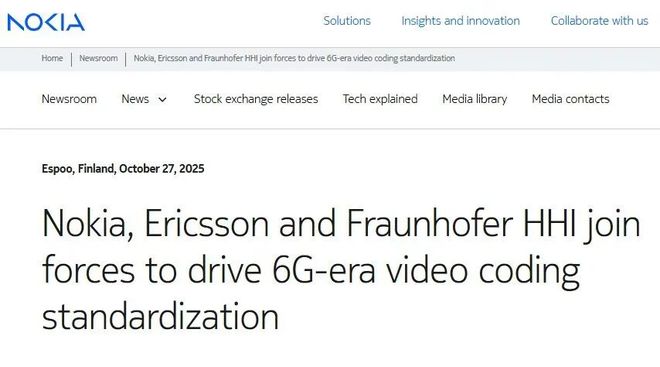
Source: Company Website


Simultaneously, Nokia is breaking the traditional telecom equipment vendor model of one-time sales, transitioning towards a persistent revenue technology service provider through network automation and subscription-based services.

Currently, Nokia has launched 9 SaaS products, with an addressable market size projected to reach $2.6 billion in 2026. Its MantaRay SON self-organizing network solution has been deployed and validated in the networks of over 120 global customers. The entire MantaRay product portfolio supports the TM Forum's Level 4 Autonomous Network level, significantly reducing manual intervention.

Additionally, the 2025 financial report shows that its full-year free cash flow reached 1.5 billion euros, with an FCF conversion rate of 72%, and a free cash flow yield of approximately 4.4%. The company's stable and continuous dividend payouts also provide investors with a certain level of cash return assurance.

Today's Nokia has long shed its old label of a "nostalgia brand" and transformed into a hidden giant holding core technologies, binding with the AI红利, and positioning for the future of 6G.

Market perception always lags behind industrial transformation, but as more capital begins to re-examine Nokia's true value, the curtain on a long-overdue value re-rating is just beginning to rise.


Пов'язані питання

QWhat is the core reason behind Nokia's dramatic financial turnaround in 2026, as described in the article?

ANokia's dramatic turnaround is attributed to its transformation into a 'patent giant + AI infrastructure provider.' It leverages a massive patent portfolio (particularly 5G SEPs) for high-margin licensing revenue and has become a key player in AI infrastructure through its optical network business and AI-RAN technology.

QHow does Nokia's patent licensing business generate revenue, and what new markets is it expanding into beyond smartphones?

ANokia's patent licensing business generates revenue by charging fees to all manufacturers of 4G/5G devices. It is expanding into new markets like smart vehicles (charging per-car fees through the Avanci pool) and video streaming platforms (through acquired video codec patents and lawsuits to enforce 'streaming taxes').

QWhat strategic acquisition did Nokia make in 2024 to strengthen its position in the AI infrastructure market, and what key capability did it gain?

AIn 2024, Nokia acquired the US optical communications company Infinera for $2.3 billion. This gave it the crucial capability to design and manufacture high-end optical semiconductor chips, allowing it to supply high-speed optical modules (like 800G and 1.6T) directly to AI data centers.

QWhat is AI-RAN, and why did NVIDIA invest $1 billion in a strategic partnership with Nokia in this area?

AAI-RAN is Nokia's technology that allows 5G base stations to use their idle computing power during low-traffic periods to run AI inference tasks locally. NVIDIA invested $1 billion to partner with Nokia to tap into the vast, underutilized compute power within Nokia's global network of millions of base stations, integrating its GPUs with Nokia's network through the AI Aerial platform.

QHow is Nokia positioning itself for the 6G era, according to the article, and what business model shift is it undergoing?

AFor the 6G era, Nokia is positioning itself as a core standard-setter by leveraging its AI-native architecture and participating in key alliances (e.g., with Ericsson and Fraunhofer HHI). It is also shifting its business model from a traditional one-time telecom equipment seller to a technology service provider with recurring revenue through SaaS products and subscription-based network automation services.

Пов'язані матеріали

Why More AI Agents Does Not Equal Higher Productivity?

Editor's Note: As AI Agents become cheaper and easier to use, a new constraint emerges: the cost isn't in launching more Agents, but in the human attention required to manage, judge, and integrate their outputs. This hidden cost is called the "orchestration tax." The article argues that a developer's cognitive bandwidth is the key bottleneck—a serial, non-parallelizable resource akin to a Global Interpreter Lock (GIL). While many Agents can run concurrently, their results ultimately require human judgment for review, conflict resolution, and final integration. Therefore, more Agents don't automatically mean higher productivity; they can simply create longer queues, lead to cognitive fatigue, and create the illusion of busyness without real output. The core solution is to design workflows around this scarce human attention. Key strategies include: scaling the number of Agents to match review capacity (not UI capacity), categorizing tasks (delegating independent ones, keeping complex judgment-heavy ones serial), batch reviewing results to minimize context-switching costs, automating verifiable checks to reserve human judgment for critical decisions, and protecting focused, uninterrupted thinking time. Ultimately, the critical skill is not launching many Agents, but architecting systems that respect the fundamental limit of human attention. Unpaid "orchestration tax" accumulates as both technical and cognitive debt, undermining system understanding and quality. True productivity comes from thoughtfully managing the single-threaded resource—your focus.

marsbit1 год тому

Why More AI Agents Does Not Equal Higher Productivity?

marsbit1 год тому

Three Years Later: Looking Back at My Predictions About ChatGPT in 2023

Three Years Later: Revisiting My 2023 Predictions on ChatGPT In March 2023, shortly after ChatGPT's launch, I made 20 predictions about its future. Now, in mid-2026, I've used AI agents to fact-check each one against the latest data. Overall, most major directional forecasts were correct, with only one outright error (incorrectly stating GPT-4 had 100 trillion parameters). Key successes included predicting that RAG and retrieval architectures would become the standard for handling knowledge and hallucinations, that natural language interfaces (LUI) would create a massive new industry layer beyond the models themselves, and that China would develop viable large language models, significantly closing the performance gap with Western counterparts within about three years. Predictions about the absence of mass unemployment, the rise of a new "robot network" for agent communication, and ChatGPT not possessing consciousness also held true in their core arguments. However, the "devil was in the details." Errors frequently involved specific numbers, timelines, or overlooking distributional effects. I tended to overestimate the speed of adoption (e.g., for agent networks) while underestimating the ultimate scale of capabilities or costs (e.g., AI winning IMO gold without tools, or the extreme capital required for frontier models). Other misjudgments included: underestimating how AI would reinforce, not dissolve, information filter bubbles; incorrectly assuming AI-generated content would easily circumvent copyright (it has instead triggered record-breaking settlements); and misidentifying where value would be captured (it accrued overwhelmingly to the compute layer, like Nvidia, not just the application or model layers). Key lessons from reviewing these predictions are: 1) Directional and mechanistic insights are far more reliable than precise numbers or absolute statements. 2) There's a consistent bias to overestimate short-term speed but underestimate long-term magnitude. 3) Errors often lie in missing distributional impacts within a generally correct aggregate trend. 4) Predictions phrased with nuance and caveats aged the best. 5) Some fundamental debates (e.g., on machine consciousness or the ultimate value chain) remain unresolved even after three years. This exercise is less about scoring the past and more about establishing rules for clearer thinking about the next three years of AI.

marsbit7 год тому

Three Years Later: Looking Back at My Predictions About ChatGPT in 2023

marsbit7 год тому

Three Years Later: Looking Back on My 2023 Predictions for ChatGPT

Looking Back After Three Years: Revisiting My 2023 Predictions on ChatGPT In March 2023, shortly after ChatGPT's debut and before GPT-4's release, I made over twenty predictions about AI's future based on limited information and intuition. Now, in May 2026, I revisited those forecasts using an AI-driven analysis with 41 Opus 4.8 agents to cross-reference them with the latest data. The assessment used symbols: ✅ Correct, 🟢 Mostly Correct, 🟡 Partially Correct, ❌ Incorrect. Overall, the directional judgments held up well, with only one major factual error regarding GPT-4's rumored parameter size (incorrectly cited as 100T). However, nuances and degrees of accuracy revealed more. **What Was Largely Correct:** Predictions about mechanisms and directions proved accurate. The rise of RAG (Retrieval-Augmented Generation) as the standard architecture for combating AI hallucination was confirmed, as was the transformative potential of LUI (Language User Interface) in creating a new industry layer atop GUIs. The emergence of "robot networks" (agent-to-agent communication protocols) and China's rapid catch-up in developing capable large models (closing the performance gap with top models to ~2.7%) were also on point. The analysis affirmed that LLMs lack consciousness and that the Turing Test merely measures perceived intelligence. **What Was Off Target:** Errors often involved specific numbers, over-optimistic timelines, or misjudged distributions. The prediction that value would primarily accrue to the application layer was half-right but missed NVIDIA's dominance as the profitable infrastructure layer. Forecasts about AI circumventing copyright issues and fostering a "global common ground" by averaging human viewpoints were incorrect; instead, major copyright settlements occurred and AI personalization is increasing. Estimates for model training costs ("$5-10 billion cap") were significantly off, underestimating frontier costs and overestimating replication costs. The notion that LLMs could never do complex math without tools was disproven by later models winning IMO gold. **Key Patterns from the Review:** 1. **Direction over precision:** Judgments about mechanisms and trends were more reliable than specific numbers or definitive statements. 2. **Timing bias:** There was a tendency to overestimate short-term speed but underestimate long-term magnitude and transformation. 3. **The distribution blind spot:** Aggregate-level correctness often masked uneven impacts (e.g., on young professionals' employment). 4. **The value of qualifiers:** Predictions framed with caution (e.g., "reportedly," "for now," "prototype in 2-3 years") aged better. 5. **Some debates continue:** Issues like the nature of "emergent abilities" or machine consciousness remain unresolved. This three-year review highlights that while seeing the big picture is crucial, humility regarding specifics, timelines, and disparate impacts is essential for future forecasting.

链捕手10 год тому

Three Years Later: Looking Back on My 2023 Predictions for ChatGPT

链捕手10 год тому

AI Bubble Warning: AI Investments Are Negative Returns for Most Tech Giants

The article issues a stark warning about a potential AI investment bubble. It notes that while the AI boom shares similarities with the TMT bubble of the late 1990s, its scale is vastly larger, currently driving 93% of U.S. GDP growth. Major hyperscale cloud providers like Microsoft, Alphabet, Amazon, Meta, and Oracle are planning to invest trillions in AI data centers over the coming years. However, calculations based on analyst projections for 2025-2030 reveal a concerning math problem: expected capital expenditure growth far outpaces projected revenue growth. Even under an extremely optimistic scenario of zero costs, the implied return on investment for most of these tech giants (except Amazon) is deeply negative. This suggests that the current trajectory could lead to one of history's largest shareholder value destruction events. The piece outlines two potential escapes: AI generating vastly more revenue than currently anticipated—a near-impossible task—or a significant cutback in the planned investment splurge. The latter scenario could trigger a domino effect, severely impacting the entire tech supply chain (from Nvidia to TSMC), potentially pushing the U.S. economy into recession, and causing a major stock market downturn. The author suggests upcoming high-profile IPOs by companies like OpenAI and Anthropic might represent a transfer of risk from early investors to public market participants. While the peak of the hype cycle might sustain investment through 2026, the fundamental financial dilemma remains unresolved, setting the stage for a potential market correction in 2027 or 2028, similar to the years following Alan Greenspan's "irrational exuberance" warning.

marsbit11 год тому

AI Bubble Warning: AI Investments Are Negative Returns for Most Tech Giants

marsbit11 год тому

Торгівля

Спот
Ф'ючерси
活动图片




