Valued at 600 Billion, NVIDIA Invests 10 Billion! How Nokia, After Selling Its Phones, Is Making a Comeback

marsbitОпубліковано о 2026-05-29Востаннє оновлено о 2026-05-29

Анотація

Once known as its mobile phones were sold in 2013, Nokia has staged a remarkable commercial comeback, now standing as a "patent giant" and "AI infrastructure builder." In Q1 2026, its net profit surged over 200% year-over-year. Nokia retains a vast portfolio of over 26,000 patent families, including over 7,000 essential 5G patents. This creates a high-margin "licensing" business, generating €1.5 billion in 2025 with over 70% operating margin, from smartphone makers to automotive and streaming media companies. Beyond patents, Nokia is a key player in AI infrastructure. Its acquisition of Infinera made it a top supplier of high-speed optical modules for AI data centers. Its AI-RAN technology allows 5G base stations to utilize idle computing power for AI inference tasks. A strategic $1 billion investment from NVIDIA in 2025 aims to unlock this distributed edge compute potential, with their joint AI Aerial platform already in trials. Looking ahead, Nokia is actively shaping 6G standards with AI-native architecture and is transitioning toward a recurring revenue model through network automation and SaaS offerings. With strong free cash flow and dividends, Nokia has transformed from a faded mobile brand into a core technology player poised for the AI and 6G era.

If we talk about the most unexpected winner in the AI track in 2026, Nokia definitely counts as one.

Most people's memory of it still lingers on the lonely背影 of selling its mobile phone business in 2013 and the definitive conclusion of "being淘汰 by the times."

But the reality is that this company, misunderstood as having "disappeared," has quietly completed a textbook-level business rebirth.

In the first quarter of 2026, Nokia's net profit skyrocketed by over 200% year-on-year. Holding 5G Standard Essential Patents ranking among the top six globally, it received a strategic investment endorsement of $10 billion from NVIDIA. Orders for its optical networking business are in such high demand that delivery schedules are already booked until the second half of the year.

The former "King of Mobile Phones" now stands at the core track of the global technology industry once again with the dual identity of a "Patent Giant + AI Infrastructure Provider."

PART 01

The "Lying Down" Business of Nokia After the Phone Curtain Call

The public's misunderstanding about Nokia essentially equates the "failure of the mobile phone business" with "corporate failure."

Many people overlook the fact that Microsoft only bought the brand usage rights and manufacturing business of Nokia's mobile phones back then, leaving the most valuable communication technology patents, of which Nokia didn't sell a single one.

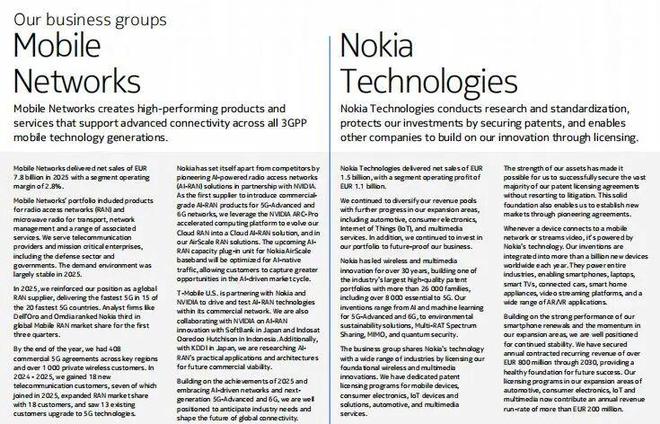
As of 2025, Nokia holds over 26,000 patent families, including more than 7,000 5G Standard Essential Patents (SEPs), with about 70% of the patent families having a remaining validity period of over ten years.

What do these patents mean?

All global mobile phone manufacturers, whether Apple, Samsung, Huawei, or Xiaomi, as long as their devices support 4G or 5G communication, cannot bypass Nokia's technical barriers and must pay it patent licensing fees.

Nokia's royalty rate for 5G phones is no more than 3 euros per unit. Although the unit price seems low, the profit margin on this revenue is extremely high, almost akin to a "rent collection" model.

The 2025 financial report shows that Nokia's patent licensing business generated annual net sales of 1.5 billion euros, with an operating profit margin exceeding 70%, of which over 800 million euros in core cellular patent revenue has been locked in until 2030.
Source: 2025 Financial Report

More notably, Nokia is systematically replicating this "patent royalty" model from the traditional mobile phone field to multiple high-growth sectors.

Riding the wave of automotive intelligence, in 2025, Nokia reached 4G/5G patent licensing agreements with automakers like Mercedes-Benz and at least four Chinese automakers. Through the Avanci patent pool, its 5G automotive patent fee is set at $32 per vehicle, and $20 per vehicle for 4G.

Furthermore, Nokia has also reached into the video streaming sector. In 2025, it completed the acquisition of 298 core video codec patents from LG Electronics. By the end of the year, it had signed licensing agreements with seven streaming platforms including Amazon and Starz.

Simultaneously, it initiated patent lawsuits against giants like Paramount and Warner Bros. in the US, Germany, and other places, accelerating the implementation of a "playback tax" across the industry.

From handheld terminals to smart cars, and further to digital content and the Internet of Things, by the end of 2025, Nokia had signed patent licensing agreements with over 250 enterprises worldwide, building a patent royalty network covering all scenarios.

PART 02


Nokia's New "Optical-Compute Integration" Engine After the AI Computing Boom

If patents are Nokia's "cash cow," then optical networks and AI-RAN are its true engines charging into the AI era.

Relying on these two core technologies, this underestimated company has long been deeply embedded in the core of AI computing infrastructure, becoming a key partner for giants like NVIDIA, Google, and Microsoft.

In June 2024, Nokia acquired the US optical communications company Infinera for $2.3 billion, thereby gaining full-chain technology from optical chips, optical modules to transmission systems, boosting its market share to second globally, only behind Huawei.

The real value of this acquisition lies in: there are very few companies worldwide capable of independently designing and manufacturing high-end optical semiconductor chips, and Infinera is one of them.

This means Nokia can directly supply high-speed optical modules of 800G and 1.6T to AI data centers, with a single optical fiber transmission rate as high as 1.6 Tbps and latency reduced to microseconds.

Performance is the most direct proof: its optical networking revenue grew 19% in 2025, and rose another 20% in Q1 2026, with an operating profit margin exceeding 15%, over five times that of its mobile networking business. The book-to-bill ratio is far greater than 1, with customers queuing for goods. Among the top ten global cloud service providers, nine use Nokia's optical networking technology.

If optical networking brings stable hardware orders for Nokia, AI-RAN earns it long-term, sustainable service revenue.

Traditional 5G base stations typically have baseband computing utilization rates below 10% during nighttime traffic troughs. Nokia's AI-RAN technology allows base stations to run AI inference tasks using idle computing power while ensuring communication quality, enabling localized processing for smart security, autonomous driving edge computing, lightweight large model inference, etc.

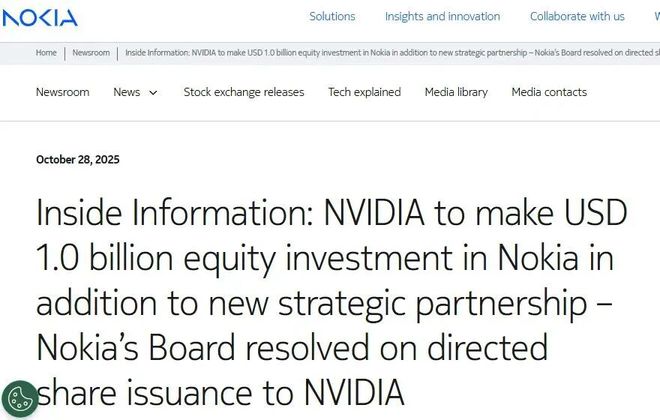
In October 2025, NVIDIA invested a whopping $10 billion in strategic funding, precisely eyeing the dormant computing power within Nokia's global millions of base stations.
Source: Company Website

The jointly launched AI Aerial platform deeply integrates NVIDIA GPUs with Nokia's base station network. It has already been piloted in Indonesia, completing Southeast Asia's first AI-driven 5G call.

Currently, AI-RAN is undergoing pilot verification with over 10 leading global operators. In Q1 2026, revenue from AI and cloud customers grew 49% year-on-year, with quarterly orders reaching about one billion euros, becoming Nokia's fastest-growing emerging business.

PART 03

Nokia's "Positioning + Subscription" Dual Springboard Before 6G Standardization

For a long time, the capital market has priced Nokia using traditional telecom equipment vendor valuation standards, resulting in a significantly lower price-to-earnings ratio compared to peers like Ericsson and Cisco.

However, this valuation discount will be completely broken with the advent of the 6G era. 2026 is a crucial year for 6G standard setting, with formal commercialization expected by 2030.

Relying on its industry-leading AI-native architecture, Nokia is expected to achieve an overtaking in the 6G era and become a core global standard-setter.

Its advantages are mainly concentrated in: being able to embed AI capabilities directly into the network's physical layer and data link layer, enabling smooth evolution on existing AirScale base stations without additional hardware; the intelligent resource optimization technology jointly tested with KDDI, which reduces base station power consumption by 40% and increases throughput fourfold, has already been verified; promoting the inclusion of non-terrestrial networks in the 6G standard to achieve global coverage.

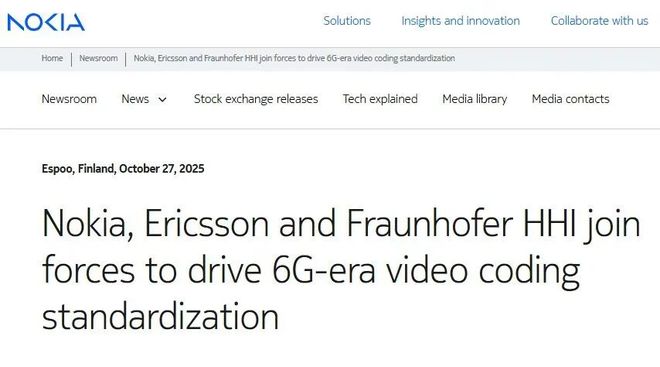
More crucially, in October 2025, Nokia and Ericsson joined hands with Germany's Fraunhofer HHI in a historic tripartite cooperation, jointly promoting the formulation of 6G video codec standards, further enhancing Nokia's influence in this field.
Source: Company Website


Simultaneously, Nokia is breaking the traditional telecom equipment vendor model of one-time sales, transitioning towards a persistent revenue technology service provider through network automation and subscription-based services.

Currently, Nokia has launched 9 SaaS products, with an addressable market size projected to reach $2.6 billion in 2026. Its MantaRay SON self-organizing network solution has been deployed and validated in the networks of over 120 global customers. The entire MantaRay product portfolio supports the TM Forum's Level 4 Autonomous Network level, significantly reducing manual intervention.

Additionally, the 2025 financial report shows that its full-year free cash flow reached 1.5 billion euros, with an FCF conversion rate of 72%, and a free cash flow yield of approximately 4.4%. The company's stable and continuous dividend payouts also provide investors with a certain level of cash return assurance.

Today's Nokia has long shed its old label of a "nostalgia brand" and transformed into a hidden giant holding core technologies, binding with the AI红利, and positioning for the future of 6G.

Market perception always lags behind industrial transformation, but as more capital begins to re-examine Nokia's true value, the curtain on a long-overdue value re-rating is just beginning to rise.


Пов'язані питання

QWhat is the core reason behind Nokia's dramatic financial turnaround in 2026, as described in the article?

ANokia's dramatic turnaround is attributed to its transformation into a 'patent giant + AI infrastructure provider.' It leverages a massive patent portfolio (particularly 5G SEPs) for high-margin licensing revenue and has become a key player in AI infrastructure through its optical network business and AI-RAN technology.

QHow does Nokia's patent licensing business generate revenue, and what new markets is it expanding into beyond smartphones?

ANokia's patent licensing business generates revenue by charging fees to all manufacturers of 4G/5G devices. It is expanding into new markets like smart vehicles (charging per-car fees through the Avanci pool) and video streaming platforms (through acquired video codec patents and lawsuits to enforce 'streaming taxes').

QWhat strategic acquisition did Nokia make in 2024 to strengthen its position in the AI infrastructure market, and what key capability did it gain?

AIn 2024, Nokia acquired the US optical communications company Infinera for $2.3 billion. This gave it the crucial capability to design and manufacture high-end optical semiconductor chips, allowing it to supply high-speed optical modules (like 800G and 1.6T) directly to AI data centers.

QWhat is AI-RAN, and why did NVIDIA invest $1 billion in a strategic partnership with Nokia in this area?

AAI-RAN is Nokia's technology that allows 5G base stations to use their idle computing power during low-traffic periods to run AI inference tasks locally. NVIDIA invested $1 billion to partner with Nokia to tap into the vast, underutilized compute power within Nokia's global network of millions of base stations, integrating its GPUs with Nokia's network through the AI Aerial platform.

QHow is Nokia positioning itself for the 6G era, according to the article, and what business model shift is it undergoing?

AFor the 6G era, Nokia is positioning itself as a core standard-setter by leveraging its AI-native architecture and participating in key alliances (e.g., with Ericsson and Fraunhofer HHI). It is also shifting its business model from a traditional one-time telecom equipment seller to a technology service provider with recurring revenue through SaaS products and subscription-based network automation services.

Пов'язані матеріали

Bloomberg Uncovered: How Do China's Wealthy Circumvent the Annual $50,000 Limit to Transfer Assets?

**Summary: How Wealthy Chinese Circumvent $50,000 Annual Foreign Exchange Limits** Despite China's strict capital controls, including an annual $50,000 per person foreign exchange quota, an estimated $150 billion in funds still leaves the country annually via various gray and underground channels. This report outlines the evolution of China's "capital wall" and the methods used to bypass it. **The Evolving Capital Controls:** * **Foundation (1994):** The system of "current account convertibility with strict capital account controls" was established. * **Quota Set (2007):** The $50,000 individual annual forex purchase limit was formalized. * **Crackdown Begins (2015-2017):** Following market volatility, enforcement tightened. Banks were required to scrutinize transactions, and channels like using UnionPay cards for Hong Kong insurance premiums or buying overseas property were blocked. * **Digital & Legal Upgrades (2024-2026):** Enhanced algorithms now flag suspicious patterns (e.g., "smurfing"). The Common Reporting Standard (CRS) provides Chinese tax authorities with data on citizens' offshore accounts. Unlicensed cross-border brokers have been targeted. **Five Primary Methods for Moving Capital:** 1. **Underground Banking / "Hawala" (Duiqiao):** The largest-scale method. No money crosses borders. Clients pay RMB to a domestic account; an overseas associate deposits equivalent foreign currency into the client's offshore account. Risks include high fees, account freezes, and legal penalties. 2. **"Smurfing" or "Ant Moving":** Using multiple individuals' $50,000 quotas to pool funds for one offshore recipient. Increasingly detected by anti-money laundering algorithms. 3. **Trade Invoice Manipulation:** Businesses over-invoice imports or under-invoice exports via offshore shell companies, creating a pretext to transfer excess funds abroad under the guise of trade. 4. **Channel Migration:** After a crackdown on internet brokers, funds flow toward more compliant but costly channels like major banks' cross-border wealth management services or Qualified Domestic Institutional Investor (QDII) quotas. 5. **Structural Arrangements:** High-net-worth individuals use complex, high-cost legal structures involving offshore trusts, insurance, and investment migration programs to transfer asset ownership. **Regulatory Response: Focusing on People, Not Just Money** The current strategy extends oversight from enterprises to **individual residents**. Tools like CRS allow retroactive visibility into offshore assets. Cryptocurrencies, once seen as a potential loophole, are now actively monitored and prosecuted as an illegal channel. The underlying driver remains: with significant wealth concentrated among millions of affluent households seeking diversification amid domestic economic shifts, the incentive to move assets offshore persists despite regulatory barriers.

marsbit6 хв тому

Bloomberg Uncovered: How Do China's Wealthy Circumvent the Annual $50,000 Limit to Transfer Assets?

marsbit6 хв тому

Ethereum's Ballmer Moment: As Everyone Is Bearish, the Circulating Supply Is Disappearing

"Ethereum's Ballmer Moment: Circulation Shrinks Amid Bearish Sentiment" Amid widespread bearish sentiment, with prominent figures like Bankless founder David Hoffman selling ETH and young developers flocking to Solana, some argue Ethereum is entering its "Ballmer era"—akin to Microsoft's perceived stagnation under Steve Ballmer. While surface-level criticisms about slow protocol development, cautious leadership, and competitive pressure are valid, underlying fundamentals tell a different story. Approximately 30% of ETH is staked, major holders like BitMine are accumulating, and spot ETFs continue to absorb supply. Regulatory clarity, including the SEC/CFTC's March ruling on staking rewards and the potential passage of the CLARITY Act, is transforming crypto from a regulatory threat into a legitimized framework. This institutionalization, alongside a shrinking circulating supply (with net issuance around 0.23% annually), creates significant buy-side pressure independent of fee-based value capture. The broader crypto total addressable market is expanding through regulated stablecoins, tokenized assets, and institutional adoption. While public chains face competition from permissioned alternatives, the winning model appears to be permissioned assets settling on public chains like Ethereum and Solana. The author advocates a non-maximalist, barbell strategy: holding ETH for its institutional role and supply squeeze, SOL for consumer/throughput trends, BTC as a macro hedge, and a basket of next-gen L1s. Key bullish drivers for ETH include rapid circulation shrinkage, potential Q2 staked ETF approvals, regulatory tailwinds solidifying its role as a default settlement layer, and the optionality of an eventual "Satya moment" leadership shift. Despite bearish consensus, the current setup—where crypto is "not hot" and regulatory groundwork is being laid—presents a compelling investment opportunity. The crypto cycle's focus may have shifted to AI, but blockchain infrastructure is gaining a legal and institutional foothold precisely while attention is elsewhere.

marsbit6 хв тому

Ethereum's Ballmer Moment: As Everyone Is Bearish, the Circulating Supply Is Disappearing

marsbit6 хв тому

Claude Code Introduces Dynamic Workflows: Enabling AI to Form Teams and Collaborate

Claude Code introduces dynamic workflows, enabling AI to coordinate teams of specialized agents for complex tasks. This transforms Claude from a code assistant into a programmable workbench. Workflows address key limitations of single-agent systems: agentic laziness (premature task completion), self-preferential bias (favoring own outputs), and goal drift (losing sight of original objectives). The system allows Claude to dynamically create execution frameworks using JavaScript. It can split tasks, dispatch parallel agents for isolated work (e.g., in separate worktrees), implement adversarial validation, run tournaments, and synthesize results. This multi-agent approach is valuable for tasks requiring deep research, factual verification, code migration, root cause analysis, large-scale triage, and qualitative sorting. Key patterns include: classify-and-route, fan-out-and-synthesize, adversarial verification, generate-and-filter, tournaments, and loop-until-done. While token usage is higher, workflows excel where tasks resemble programming—needing problem decomposition, isolated context, hypothesis testing, and handling many details. They extend Claude Code's utility beyond technical work to areas like business plan review, resume screening, and naming brainstorm. The feature is not a universal solution but points to a future where AI tool competitiveness depends on organizing reliable, reusable, and auditable execution flows for complex goals.

marsbit48 хв тому

Claude Code Introduces Dynamic Workflows: Enabling AI to Form Teams and Collaborate

marsbit48 хв тому

Hyperliquid, Wall Street's 24/7 Trading Convenience Store

Hyperliquid: The 24/7 Trading "Convenience Store" for Wall Street Hyperliquid, a decentralized cryptocurrency exchange, has become a go-to platform for Wall Street traders seeking to trade around the clock, especially during traditional market closures. Founded by Jeff Yan, a former quantitative trader, after the FTX collapse, the platform emphasizes user self-custody of assets. It offers a wide range of perpetual contracts—leveraged derivatives with no expiry—on assets from Bitcoin and crude oil to the S&P 500 and even pre-IPO companies like SpaceX. A notable example involves a hedge fund trader who capitalized on geopolitical news over a weekend, securing a 243% return on oil derivatives before markets reopened. The platform, run by just 11 employees, generated approximately $800 million in revenue last year, and its native token HYPE has seen significant growth. Its rise highlights the merging of traditional finance and crypto. While U.S. users are currently restricted, recent CFTC rule changes could open access. The platform is known for its transparency, having processed $10 billion in liquidations during a market crash while competitors faltered. Regulators warn of the high risks and complexity of perpetual contracts for retail investors. Key to its appeal is a strong community culture, direct engagement with founders, and a simple interface. Despite rules against VPN use, it attracts global users with its permissionless approach. Hyperliquid plans to expand into prediction markets and options, aiming to eventually host all financial activity.

marsbit48 хв тому

Hyperliquid, Wall Street's 24/7 Trading Convenience Store

marsbit48 хв тому

Торгівля

Спот
Ф'ючерси
活动图片




