Original | Odaily Planet Daily (@OdailyChina)
Author | Azuma (@azuma_eth)

After the U.S. stock market closed on May 8, commercial aerospace company Rocket Lab (RKLB) released a Q1 2026 earnings report that far exceeded market expectations.
The financial report data shows that Rocket Lab's Q1 revenue reached $200.3 million, a significant year-on-year increase of 63.5%, higher than the expected $189 million; the Q2 revenue guidance was raised to $225 to $240 million, far exceeding the $205 million given by analysts. Although an operating loss of $56 million indicates the company is still in a "cash-burning" mode, the adjusted gross margin has climbed to 43% (only 33.4% in the same period last year), meaning the company is significantly improving its unit economics while scaling up —— simply put, its "efficiency" in burning cash is becoming higher.
Boosted by the positive earnings report, RKLB's after-hours trading rose nearly 7%, with a year-to-date gain of 240%.
As SpaceX's historic IPO approaches, commercial spaceflight has become another hot sector in the U.S. stock market, with capital beginning to assign internet-level valuation imagination to the act of "building rockets." In this boom, besides SpaceX, whose valuation points to $1.75 to $2 trillion and whose pre-IPO shares carry a significant premium, Rocket Lab has also become a popular alternative option in the eyes of many investors due to its positioning as "the pure commercial spaceflight concept stock most resembling SpaceX."
The "Only Affordable Alternative" to SpaceX?
The reason Rocket Lab is seen as the current "only affordable alternative" to SpaceX is because Rocket Lab is perfectly replicating the successful path validated by SpaceX —— first using small rockets to establish a commercial closed loop and reusable technology, then using large rockets to optimize costs and capture core markets.
Electron: The Dominant Force in the Small Rocket Segment
In the business of building rockets, there are countless PowerPoint presentations, but companies that can reliably send rockets into space are few and far between. Currently, Rocket Lab's "Electron" rocket is the world's only small launch vehicle achieving high-frequency, reliable commercial operations, and it is also the second most frequently launched rocket in the United States, second only to SpaceX's "Falcon 9."
The "maturity" of the Electron is reflected not only in its dozens of launch records and extremely high success rate, but also in the implementation of its recovery technology. Rocket Lab has successfully recovered first-stage boosters from the ocean multiple times and has even reused engines in subsequent launches. This engineering mastery of "reusable" technology is precisely the trump card weapon that allows SpaceX to dominate the commercial space market.
Neutron: The Chaser of Falcon 9
If small rockets are Rocket Lab's entry ticket, then the medium-to-large rocket "Neutron" currently under development is the main engine for its drive towards a hundred-billion-dollar market cap.
Neutron is not simply a scaled-up version of Electron; it was designed from the outset with a strong "targeted" purpose —— to catch up with Falcon 9. The Falcon 9 remains the only commercially available reusable medium-to-large rocket on the market, giving SpaceX absolute monopoly power in this segment.
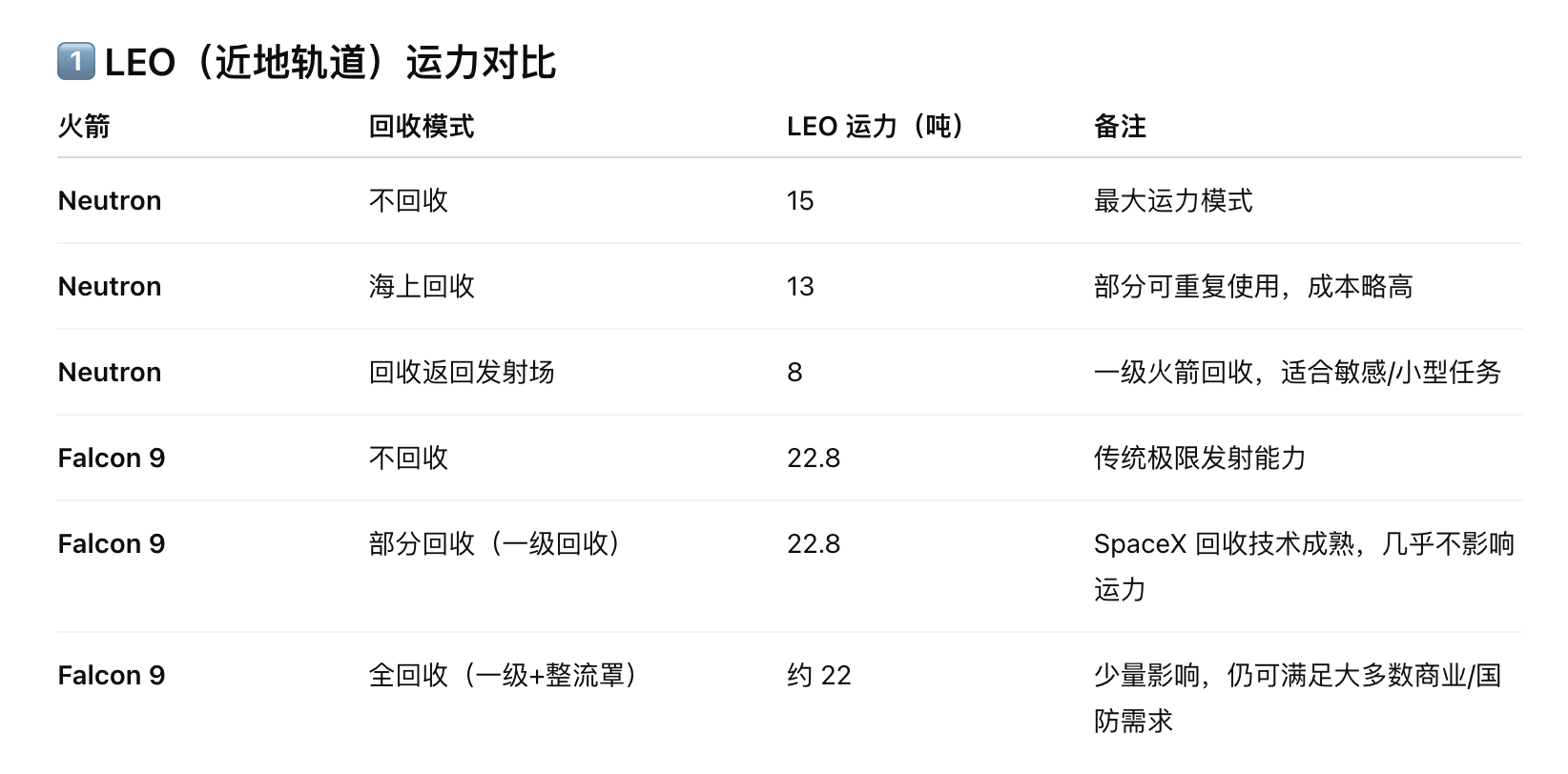
The emergence of Neutron holds its greatest significance as potentially becoming the world's only second option capable of competing with Falcon 9, although its designed payload capacity (approx. 8-15 tons) is still slightly inferior to Falcon 9's. However, in terms of engineering logic, it attempts to achieve a curve-overtaking advantage over its predecessor through "latecomer advantages" —— with unique designs like the HungryHippo fairing and Archimedes engines, Neutron aims to surpass Falcon 9 in efficiency regarding fairing recovery and engine reusability.
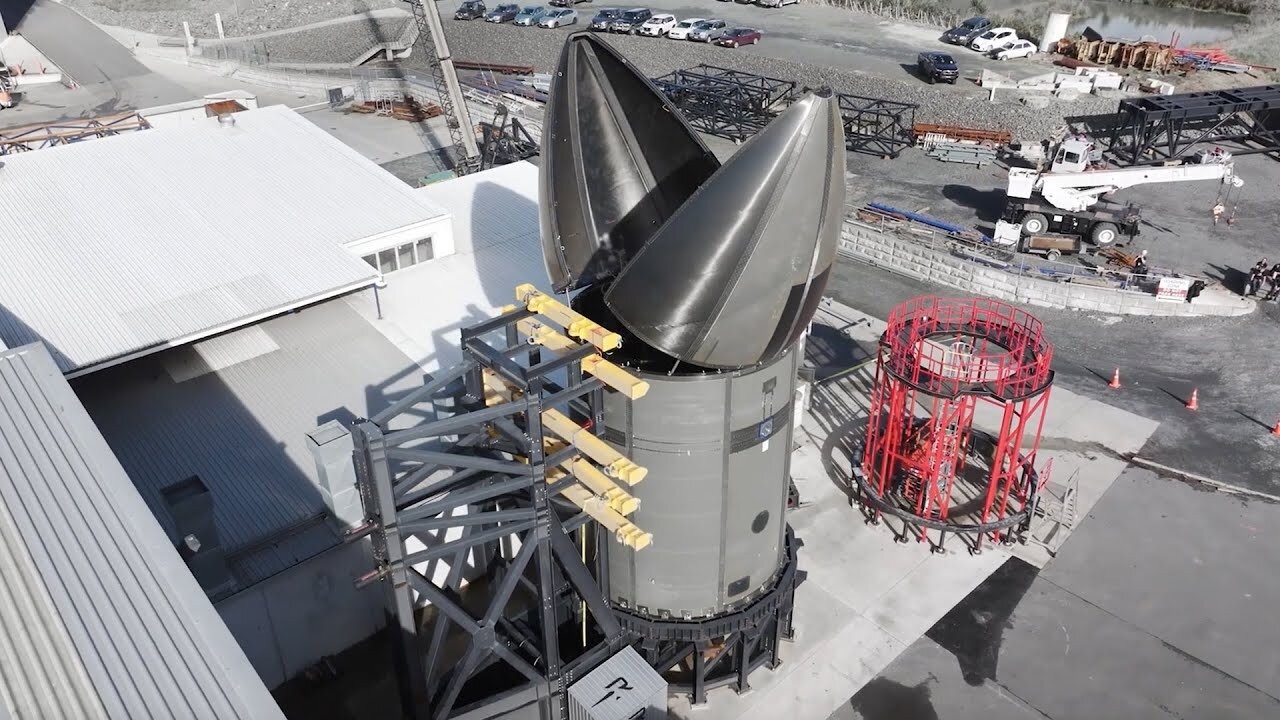
- Odaily Note: HungryHippo is the most notable design highlight of Neutron. Unlike SpaceX, which needs to fish out fairing fragments worth millions of dollars from the sea after each launch, Neutron's fairing features a fixed, non-separating design connected to the first stage. When releasing the second stage, it opens like a "hippopotamus opening its mouth," closes again after deployment, and descends for recovery along with the first stage. This means the fairing does not need to undergo difficult sea recovery and complex post-landing reassembly; it's ready for refilling upon landing.
Judging from the currently disclosed testing progress, Rocket Lab is rapidly closing the generational gap with SpaceX in medium-to-large launch capabilities.
"Building Rockets" plus "Building Satellites": Replicating SpaceX's Ecosystem Closed Loop
Just as SpaceX has Starlink, Rocket Lab is also building its own "Launch + Manufacturing" dual-wheel drive ecosystem. Rocket Lab's "Space Systems" business (covering satellite platforms, Photon spacecraft, solar arrays, etc.) currently accounts for nearly seventy percent of its total revenue. This means that even while Neutron is still in development, Rocket Lab can generate substantial revenue by selling satellite components.
This kind of "full industry chain coverage" business model is almost unique to Rocket Lab in the public market, prior to SpaceX's own listing.
Vast Valuation Difference: A Reflection of Reality and an Investment Opportunity
Currently, SpaceX's private market valuation is as high as $1.75 to $2 trillion, while Rocket Lab's market cap has just passed $45 billion. The enormous valuation gap objectively reflects the difference in the current standings of the two companies, but this is precisely where investors see the most attractive "odds."
In today's global commercial space sector, there is essentially only one company that can stably achieve high-frequency launches, reusability, large payload capacity, and low cost: SpaceX. The cost advantage of Falcon 9 has reached a level that discourages most competitors, and this advantage is gradually forming a terrifying virtuous cycle —— the cheaper it gets, the more it launches; the more it launches, the more data it gathers; the more data, the faster the upgrades; the faster the upgrades, the cheaper it gets... This moat built by scale, data, and pace leaves countless followers in awe.
But Rocket Lab's opportunity lies in the fact that, so far, Neutron appears to be the most promising reusable medium-to-large rocket capable of catching up with Falcon 9's pace. The mere label of "the only alternative after SpaceX" is already compelling enough. Once Neutron successfully completes its test flight, Rocket Lab's valuation logic will fundamentally shift from "a small rocket company" to "the world's second platform company possessing medium-to-large reusable rocket capability," potentially capturing a significant number of commercial contracts from SpaceX's hands —— therefore, much of the current market frenzy surrounding Rocket Lab is, to a large extent, a bet on the probability of Neutron's success.
At this point in 2026, as SpaceX has shattered the trillion-dollar valuation ceiling, Rocket Lab, with a market cap of only about 2.5% of SpaceX's, clearly possesses greater upward potential.
The Biggest Risk: "Neutron" Hasn't Flown Yet...
But there is a major suspense in this story —— Can Neutron actually fly on time?
According to the latest disclosures, Neutron's first flight is scheduled for the end of 2026. However, looking back at history, the launch of any new type of rocket is subject to delays. The aerospace industry has a harsh reality —— A PowerPoint rocket ≠ a real rocket.
Historically, many rockets never flew; many rockets exploded on their first attempt; and many rockets failed in their cost-control designs. Neutron has yet to make its first flight. If the Neutron's development encounters setbacks or its first flight is delayed, its current market valuation will face severe pressure testing, making it difficult to continue the narrative no matter how good the story is.






