Valuation of $1 Billion, After Five Years of Exploration, Why Did It Suddenly 'Admit Defeat'?

比推Опубліковано о 2025-12-09Востаннє оновлено о 2025-12-09

Анотація

After five years of development, $180 million in funding, and a valuation nearing $1 billion, Farcaster has officially conceded that its Web3 social strategy did not succeed. Co-founder Dan Romero announced a major pivot: abandoning the "social-first" approach to focus entirely on wallet development. Farcaster, launched in 2020, aimed to solve Web2 platform issues like centralized control, user data ownership, and creator monetization through a decentralized protocol. Despite initial traction in 2024—when monthly active users (MAU) briefly surged to 80,000—growth proved unsustainable. MAU later fell to under 20,000 by late 2025, with the platform failing to attract users beyond a highly specific crypto-native audience. Key challenges included high onboarding barriers, heavily insular content, and an inability to compete with mainstream social platforms like X or Instagram. As one observer noted, it’s “easier to add social features to a wallet than to add a wallet to a social product.” Data revealed that Farcaster’s built-in wallet—initially a supplementary feature—showed stronger growth, retention, and usage metrics than its social components. This shift toward wallet-centric utility reflects a broader realization: in Web3, financial tools like transactions, transfers, and token interactions represent a clearer path to product-market fit than social features alone. The company’s acquisition of token launch tool Clanker and integration of AI agent capabilities further sign...

After five years of operation, raising approximately $180 million in funding, and reaching a valuation nearing $1 billion, Farcaster has officially admitted: the path of Web3 social has not succeeded.
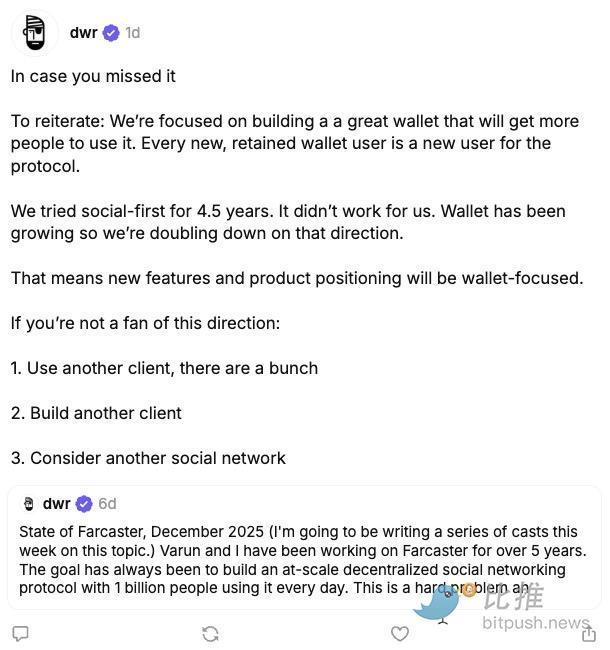
Recently, Farcaster co-founder Dan Romero posted a series of messages on the platform, announcing that the team will abandon the "social-first" product strategy and instead fully focus on the wallet direction. In his statement, this is not an active upgrade but a choice forced by reality after a long period of attempts.

"We tried social-first for 4.5 years, but it didn't work."

This judgment not only signifies Farcaster's transformation but also once again highlights the structural challenges of Web3 social.

The Gap Between Ideal and Reality: Why Farcaster Failed to Become the "Decentralized Twitter"

Farcaster was born in 2020, during the rise of the Web3 narrative. It attempted to address three core issues of Web2 social platforms:

  • Platform monopoly and censorship

  • User data not belonging to the users themselves

  • Creators unable to monetize directly

Its design philosophy was highly idealistic:

  • Decentralized protocol layer

  • Freedom to build clients

  • On-chain social relationships, migratable

Among the various "decentralized social" projects, Farcaster was once considered the product to achieve Product-Market Fit (PMF). Especially after Warpcast gained traction in 2023, many KOLs from Crypto Twitter joined, making it appear as the prototype of the next-generation social network.

However, problems soon emerged.

According to Farcaster's monthly active user (MAU) statistics on Dune Analytics, Farcaster's user growth trajectory shows a very clear but not optimistic pattern:
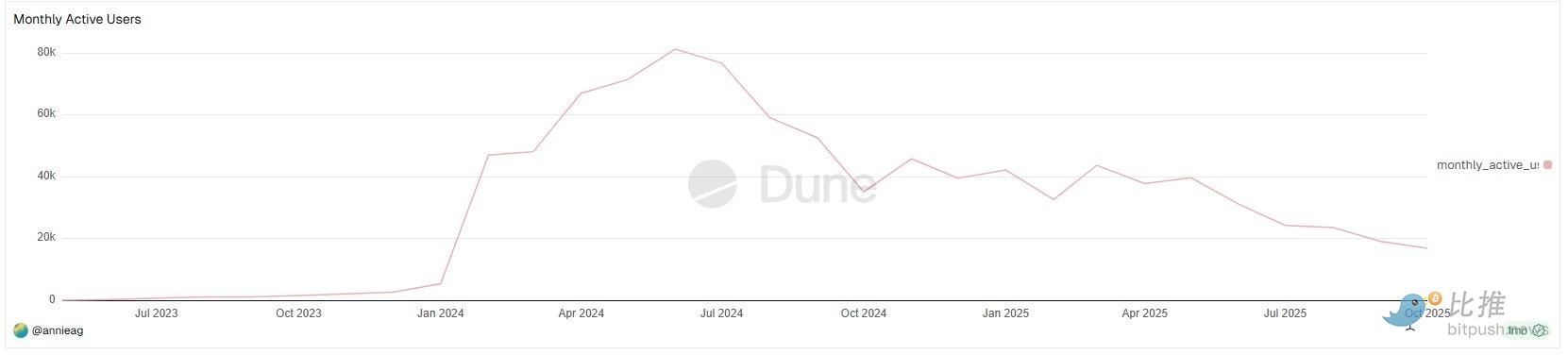
For most of 2023, Farcaster's monthly active users were almost negligible;
The real growth inflection point occurred in early 2024, with MAU rapidly increasing from a few thousand to approximately 40,000–50,000 in a short period, and even approaching 80,000 MAU by mid-2024.

This was the only truly scalable growth window since Farcaster's inception. It is particularly noteworthy that this growth did not happen during a bear market but during a period of high activity in the Base ecosystem and the emergence of dense SocialFi narratives.

However, this window did not last long.
Starting in the second half of 2024, MAU data showed a clear decline, and over the following year, it exhibited a volatile downward trend:

  • MAU rebounded multiple times, but the peaks continued to lower

  • By the second half of 2025, monthly active users had fallen to less than 20,000

In fact, Farcaster's growth has always been unable to "break through," with its user structure highly homogeneous:

  • Crypto industry professionals

  • VCs

  • Builders

  • Crypto-native users

For ordinary users:

  • High registration barrier

  • Social content is heavily "insider-focused"

  • User experience not superior to X / Instagram

This made Farcaster unable to form true network effects.

DeFi KOL Ignas (@DeFiIgnas) on X直言, Farcaster "just admitted what everyone has felt for a long time":

The strength of X's (formerly Twitter) network effects is almost impossible to break head-on.
This is not a problem of the crypto narrative but a structural barrier of social products. From a product perspective, Farcaster's social issues are very typical:

  • User growth has always been locked within the crypto-native population

  • Content is highly internalized, difficult to spill over

  • Creator monetization and user retention did not form a positive feedback loop

This is why Ignas summarized Farcaster's new strategy in one sentence:

"It's easier to add social features to a wallet than to add a wallet to a social product."

This judgment essentially acknowledges that "social is not the first-order need of Web3."

"The Bubble Is Comfortable, but the Numbers Are Cold"

If the MAU data answers "how Farcaster performed," then another question is: How big is this market itself?

Crypto creator Wiimee provided a set of impactful comparative data on X.
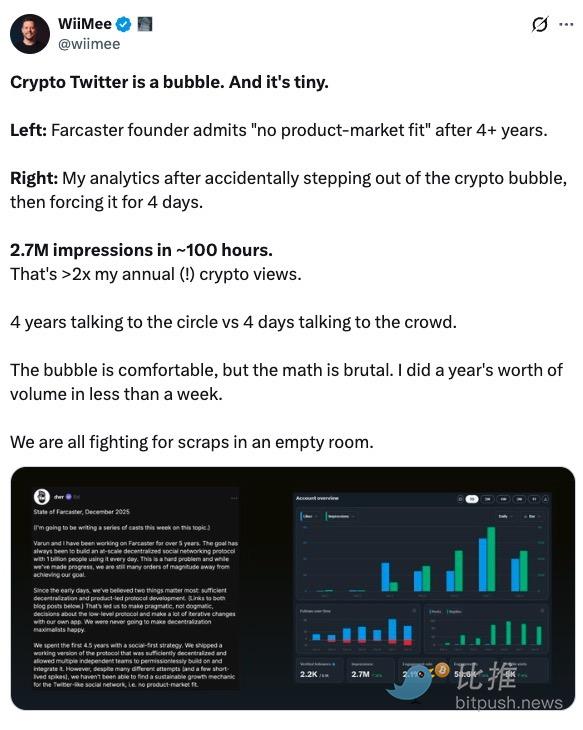
After "accidentally stepping out of the crypto content circle," Wiimee created content for a broader audience for four consecutive days. His analysis data showed that in about 100 hours, he received 2.7 million impressions, more than double the total views of all his crypto content over the past year.

He stated:

"Crypto Twitter is a bubble, and it's small. Four years of speaking to insiders are not as effective as four days of speaking to the general public."

This is not a direct criticism of Farcaster but reveals a more fundamental issue:
Crypto social itself is a highly self-reinforcing ecosystem with weak spillover capabilities. When content, relationships, and attention are confined to the same batch of native users, even the most refined protocol design cannot break through the upper limit of market scale.

This means Farcaster is not facing the problem of "the product not being good enough" but "there aren't enough people in the field."

The Wallet, However, Achieved PMF

What truly changed Farcaster's internal judgment was not the reflection on social but the unexpected validation of the wallet.

Earlier in 2024, Farcaster introduced a built-in wallet in its application, initially intended as a supplement to the social experience. However, from the usage data, the wallet's growth slope, frequency of use, and retention performance were significantly different from the social module.

Dan Romero emphasized in a public response:

"Every new and retained wallet user is a new user for the protocol."

This statement itself reveals the core logic of the strategic shift. The wallet addresses not "the desire to express" but real, rigid on-chain behavioral needs: transfers, transactions, signatures, and interactions with new applications.

In October, Farcaster acquired Clanker, an AI Agent-driven token issuance tool, and gradually integrated it into the wallet system. This move was also seen as the team's clear bet on the "wallet-first" path.

From a commercial perspective, this direction has obvious advantages:

  • Higher frequency of use

  • Clearer monetization path

  • Tighter integration with the on-chain ecosystem

In comparison, social features are more like icing on the cake rather than the engine driving growth.

Although the wallet strategy is justified by the data, community controversy has also arisen.

Several long-term users explicitly stated that they are not opposed to the wallet itself but are uncomfortable with the accompanying cultural shift: from "users" being redefined as "traders," and from "co-builders" being labeled as "old guard."

This exposes a practical problem: when a product direction changes, community emotions are often harder to migrate than the roadmap. Farcaster's protocol layer remains decentralized, but the choice of product direction is still concentrated in the hands of the team. This tension is amplified during transformation.

Romero later admitted that communication was problematic but clearly stated that the team had made its choice.
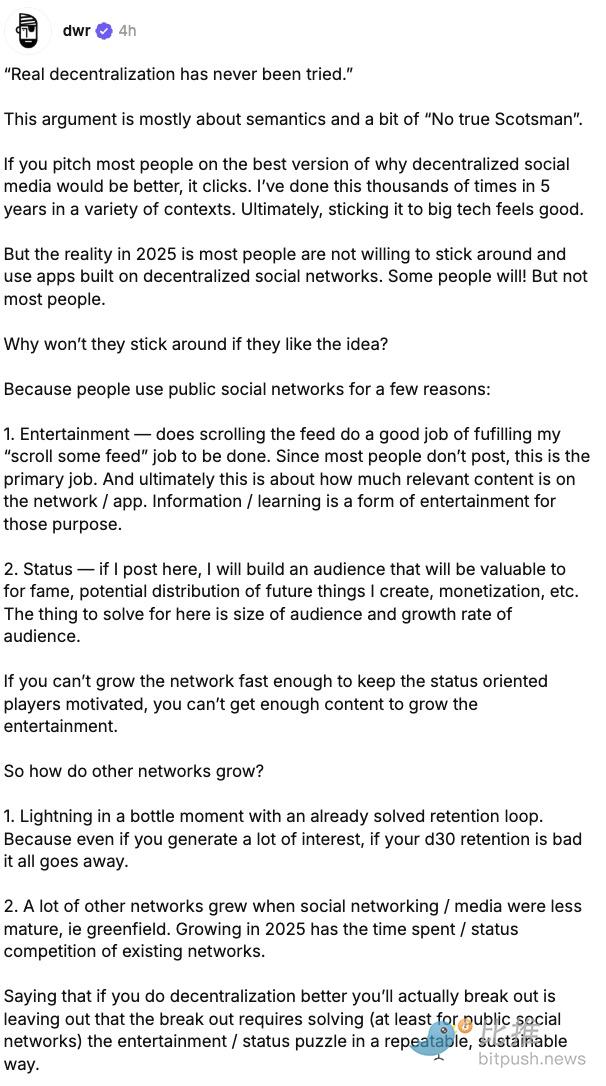
This is not arrogance but a common realistic decision for startup projects in their later stages. In this sense, Farcaster did not abandon the social ideal but gave up the illusion of its scalability.

As one observer put it:

"First, let them stay for the tools; then, social will have its space."

Farcaster's choice may not be the most romantic, but it is likely the closest to reality. Deeply integrating native financial tools (wallets, transactions, issuance) is the practical path to converting into sustainable commercial value.


Original link:https://www.bitpush.news/articles/7594068

Пов'язані питання

QWhy did Farcaster decide to shift its focus from social to wallet?

AFarcaster shifted its focus because after 4.5 years of prioritizing social features, the strategy did not work. The user base remained small and highly crypto-native, failing to achieve broader adoption or network effects. In contrast, the wallet feature showed better growth, retention, and alignment with real user needs like transactions and on-chain interactions.

QWhat were the main challenges Farcaster faced in its attempt to build a decentralized social platform?

AFarcaster faced challenges such as high user registration barriers, content that was too niche and crypto-focused, and an inability to compete with established platforms like X (Twitter) or Instagram in terms of user experience. It failed to break out of the crypto-native user circle and could not form genuine network effects.

QHow did Farcaster's user growth perform over time, and what did the data reveal?

AFarcaster's monthly active users (MAU) saw a brief surge in early 2024, rising to around 40,000-50,000 and peaking near 80,000 by mid-2024. However, from late 2024 onwards, MAU declined significantly, dropping to under 20,000 by the second half of 2025. The data showed that growth was unsustainable and limited to a homogenous group of crypto users.

QWhat does the comparison between crypto content and mainstream content exposure, as highlighted by Wiimee, indicate about the crypto social ecosystem?

AWiimee's comparison showed that crypto content has a very limited reach compared to mainstream content. He gained 2.7 million impressions in four days by targeting a general audience, which was more than double the exposure of his entire year's crypto content. This indicates that the crypto social ecosystem is a small, self-contained bubble with weak outward expansion capabilities.

QWhat are the advantages of Farcaster's new wallet-focused strategy over its previous social-first approach?

AThe wallet-focused strategy offers higher usage frequency, clearer monetization paths, and tighter integration with on-chain ecosystems. It addresses real, rigid needs like transfers, transactions, and interactions with dApps, making it more sustainable for growth and commercial value compared to social features, which were less critical for user retention.

Пов'язані матеріали

In Conversation with Ray Dalio: We Are Currently in an AI Bubble, with 1% of My Portfolio in Bitcoin

Ray Dalio, founder of Bridgewater Associates, warns in an interview that the current AI boom shows classic bubble characteristics, which could lead to significant economic downturns as seen in past cycles like 1929 or 2000. He explains that speculative enthusiasm, fueled by debt and overvaluation, often precedes a crash when rising rates or taxation force asset sales, causing widespread losses and recession. Dalio also outlines his "Big Cycle" theory, describing an approximate 80-year pattern where widening wealth gaps, massive government deficits, and shifting geopolitical power (like China's rise) create internal conflict and global instability. He emphasizes that we are in a late-cycle, transitional phase where traditional powers like the US and UK face decline. For personal wealth protection, Dalio advises diversification beyond cash into assets like stocks, bonds, real estate, and particularly gold, which he prefers over Bitcoin. While he holds about 1% of his portfolio in Bitcoin as a non-printable hard asset, he views gold as more secure from technological or governmental threats. Regarding AI's impact, Dalio believes it will disproportionately benefit capital owners, worsening inequality by replacing both physical and cognitive labor. He suggests that human intuition and emotional intelligence, combined with AI, will be key for future workers. On taxation, Dalio argues that wealth taxes are impractical and risk triggering asset sell-offs, reducing productive investment. He points to the UK as a cautionary example of debt, low productivity, and political strife. Geopolitically, Dalio foresees a more regionalized world, with the US showing weakness in prolonged conflicts like with Iran, akin to past imperial declines. The ideal outcome, he suggests, is coexisting powerful blocs (e.g., Americas, China-Asia Pacific) without major war.

marsbit2 год тому

In Conversation with Ray Dalio: We Are Currently in an AI Bubble, with 1% of My Portfolio in Bitcoin

marsbit2 год тому

Daily 7.2 Trillion KRW: Foreign Capital's Record Net Buying on Friday! Wall Street Says Headwinds for Korean Stock Fund Flows Have Subsided

South Korean stock market sees a dramatic shift in fund flows. On July 31, foreign investors made a record net purchase of approximately KRW 7.2 trillion in KOSPI stocks, marking a fundamental reversal from the persistent large-scale net outflows seen in previous months. This contributed to a significant narrowing of foreign net selling in July to KRW 9.8 trillion, down sharply from KRW 48.4 trillion in June and KRW 44.5 trillion in May. Simultaneously, domestic institutional pressure eased. South Korean pension funds and asset managers turned to a net buying position in July, purchasing KRW 1.0 trillion worth of KOSPI shares, contrasting with net sales in May and June. Market volatility is expected to be dampened by new financial regulations. Effective July 31, the Financial Services Commission tightened access for retail investors to single-stock leveraged ETFs by raising the minimum cash deposit requirement. Trading volumes for these products subsequently dropped to about 50% of their monthly average. Citigroup Research maintains its year-end KOSPI target of 10,000 points. The firm cites several supportive factors: the substantial easing of headwinds from capital outflows, a robust fundamental outlook for the semiconductor sector, historically low market valuations, strong economic fundamentals, and the potential for policy support from financial authorities if needed.

marsbit2 год тому

Daily 7.2 Trillion KRW: Foreign Capital's Record Net Buying on Friday! Wall Street Says Headwinds for Korean Stock Fund Flows Have Subsided

marsbit2 год тому

Thanks to Dice Rolls, Bitcoin Keys Are Stored Offline, But Not Everyone Will Do It

The article discusses using dice rolls to generate secure Bitcoin wallet seeds, providing entropy independent of potentially flawed hardware random number generators. It explains that each fair dice roll offers about 2.585 bits of entropy, with around 50 rolls needed for a standard 12-word seed phrase and 99+ recommended for higher security. This method gained attention after a vulnerability was revealed in some Coldcard hardware wallets, where a faulty firmware RNG (dating back to 2021) compromised generated keys. The analysis notes that while a dice-generated main seed was safe from this specific flaw, other Coldcard functions (like creating paper wallets, backup keys, or passwords) could still be vulnerable if they used the defective RNG. The piece argues that while dice-based entropy is technically robust, the manual process is error-prone, tedious, and unrealistic for most new users, who might make mistakes in recording or inputting rolls. It concludes that while manual entropy generation should remain an option for advanced users, the long-term goal is to develop reliable, user-friendly hardware and software that securely generates randomness without requiring specialized knowledge. Coldcard users are advised to check their firmware version and replace any secondary secrets (like paper wallet keys) created with vulnerable devices, while also considering multi-signature setups with devices from different manufacturers for added security.

cryptonews.ru7 год тому

Thanks to Dice Rolls, Bitcoin Keys Are Stored Offline, But Not Everyone Will Do It

cryptonews.ru7 год тому

Торгівля

Спот
活动图片




