Valuation at $1.25 Billion Post-SPAC Listing, Securitize to Issue "Real Equity" On-Chain Stocks

marsbitОпубліковано о 2025-12-19Востаннє оновлено о 2025-12-19

Анотація

Securitize, a leading RWA (Real World Assets) platform, plans to launch native on-chain equity products by Q1 2026. Unlike synthetic or beneficiary tokenized stock models, Securitize will issue legally recognized shares directly on the blockchain, recorded on the issuer’s official cap table. Token holders will possess full shareholder rights, including dividends and voting. Valuing at $1.25 billion post-SPAC merger (ticker: SECZ), Securitize has already tokenized over $3 billion in assets through partnerships with major institutions like BlackRock (notably its $1.7B BUIDL fund), Apollo, KKR, and VanEck. Its investor base includes Coinbase, Morgan Stanley, BlackRock, and ARK Invest. The company aims to bridge TradFi and DeFi through compliant, regulated digital securities infrastructure, positioning itself as a key player in the institutional adoption of on-chain finance.

Author | DingDang (@XiaMiPP)
On December 17, the RWA platform Securitize announced plans to launch native on-chain stock products in the coming months, targeting the first quarter of 2026. Unlike most "stock tokenization" solutions on the market, Securitize will directly issue real, regulated shares on the blockchain, simultaneously recording them in the issuer's official share register; its tokens represent full shareholder rights, including dividends, proxy voting, and more.

On October 28 this year, Securitize disclosed that it would go public through a SPAC merger, with a post-merger valuation estimated at $1.25 billion and a stock ticker of SECZ. As a key player in the tokenized money market fund space, Securitize has partnered with traditional asset management institutions such as BlackRock, Apollo, KKR, Hamilton Lane, and VanEck, with cumulative tokenized assets exceeding $3 billion.

Amid the ongoing hype around the RWA narrative, Securitize, with its frequent moves, has become a market focus. Odaily Planet Daily will analyze it from a business perspective to help readers gain a deeper understanding of the company's layout and prospects.

Native On-Chain Stocks: Not "Price Mapping," but Legally Recognized Shares

To understand the importance of Securitize's product approach, it must first be placed within the overall structure of the current stock tokenization track. Most existing stock tokenization platforms can be broadly categorized into two mainstream models.

The first is the synthetic model. Early examples like Mirror Protocol and Synthetix fall into this category, where tokens track stock prices through derivative structures or oracle mechanisms, providing only price exposure without involving any real shares. Such products lack shareholder rights, carry counterparty risk and pricing deviations, and are essentially derivatives rather than equity.

The second is the beneficial interest model. For example, MSX typically involves the platform or a third-party custodian holding the real shares (usually 1:1 backed), issuing tokens that represent beneficial interests or claims to these shares. Holders gain economic exposure (such as price movements, possibly including dividend pass-through) but are not direct legal owners; the official share register records the custodian, not the token holder.

Different from these two paths, Securitize is attempting a third model—the native on-chain stock model. What Securitize plans to issue will be shares recognized in law as real stock, directly natively issued on the blockchain and simultaneously recorded in the issuing company's official share register. Token holders possess full shareholder rights, including dividends, proxy voting, etc. More crucially, Securitize itself, as an SEC-registered transfer agent, ensures that token holders are the direct legal owners, not holding indirectly via an intermediary or SPV. In other words, these assets are neither price trackers nor "IOUs" from a custodian.

However, it is undeniable that the complexity of the native on-chain stock model is significantly higher than that of synthetic or beneficial interest schemes. It must not only solve the problems of on-chain issuance and instant settlement but also simultaneously comply with securities regulations, corporate law, transfer agent systems, and a series of traditional financial rules, achieving seamless integration with existing financial infrastructure. In practical terms, this means higher compliance costs, longer development cycles, and each step being exposed to regulatory and institutional friction.

In contrast, the advantages of synthetic or beneficial interest schemes are obvious: faster implementation, lighter structure, lower costs, and easier compatibility with 24/7 trading and DeFi. The path chosen by Securitize aims not to "circumvent regulation" but to attempt, within the system, to truly eliminate the long-standing structural gap between the traditional financial system and the on-chain system.

It is under this choice that Securitize's position in the RWA track becomes clearer.

Securitize is Becoming One of the "Standard Answers" for RWA Infrastructure

Securitize was founded in November 2017 by Carlos Domingo and Jamie Finn, headquartered in San Francisco, California, USA. The company focuses on using blockchain technology to transform traditional financial assets (such as stocks, funds, bonds, private equity, etc.) into compliant digital securities.

This positioning directly determined Securitize's partners and business form. Securitize's most well-known case is providing tokenization services for BlackRock's BUIDL money market fund. To date, the fund size has exceeded $1.7 billion, making it the largest tokenized money fund product in the current RWA market.

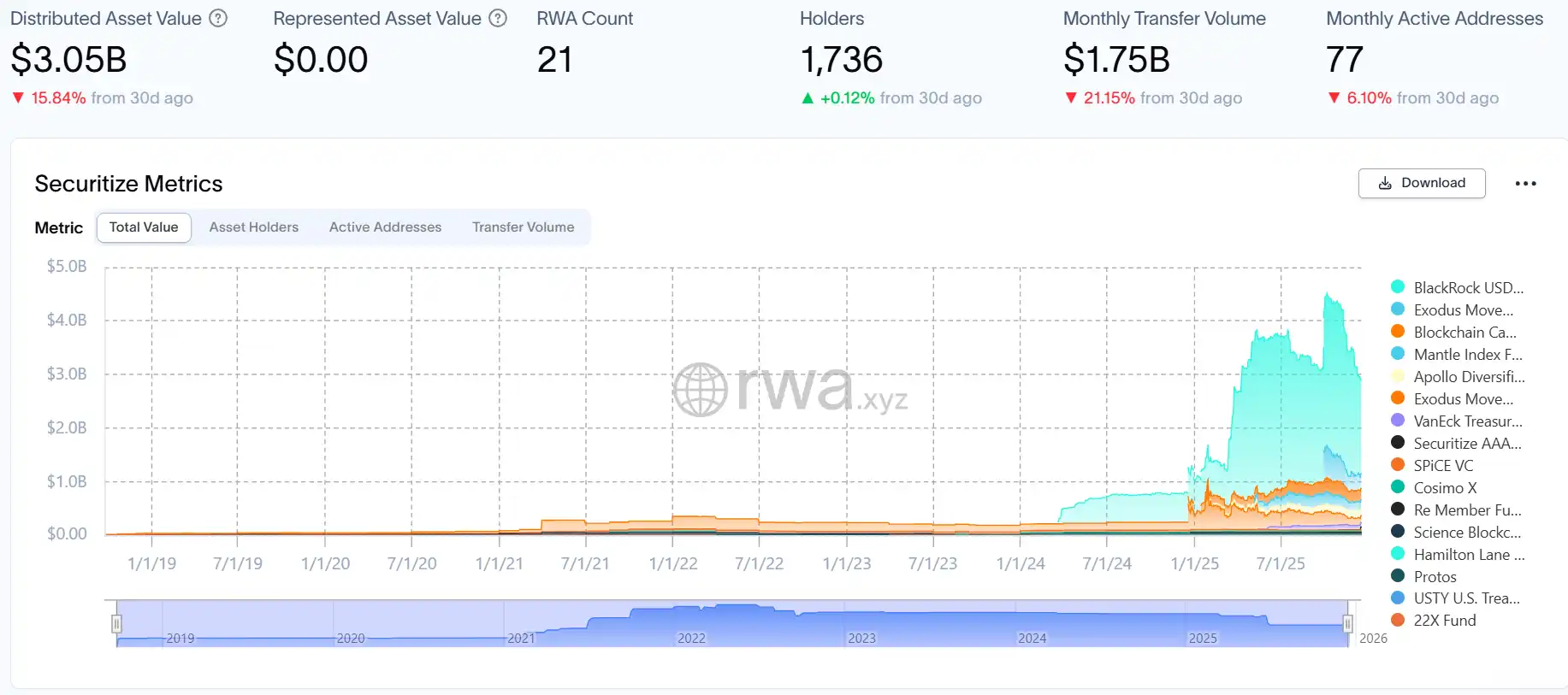
In addition, Securitize has partnered with several traditional asset management institutions such as Apollo, KKR, Hamilton Lane, and VanEck. Official data shows that its cumulative tokenized assets have exceeded $3 billion. If the early days of RWA were more about "conceptual feasibility," then Securitize's business has begun to enter the verification stage of "institutional feasibility."
This "bridge" positioning is also clearly reflected in Securitize's financing and shareholder structure.

Public information shows that Securitize has raised approximately $122 million to $147 million through multiple rounds of private equity financing. Early investors mostly came from the crypto industry itself, including Coinbase, Ripple, etc. As the RWA narrative gradually clarified, its shareholder structure also changed significantly, with traditional financial giants such as Morgan Stanley and BlackRock entering one after another. The number of investors exceeds 50, and it has also received significant holdings from Cathie Wood's ARK Invest.

This process from "crypto circle recognition" to "Wall Street endorsement" is not accidental but a natural result of its business path and institutional choices.

Under This Logic, Moving Towards the Capital Market is Not Surprising

Securitize announced on October 28 that it would go public through a merger with the special purpose acquisition company (SPAC) Cantor Equity Partners II, Inc. After the transaction is completed, the company's valuation is expected to reach $1.25 billion, and it plans to trade under the ticker symbol SECZ.

Cantor Equity Partners II, Inc. (NSDQ:CEPT) is sponsored by a company under the financial services giant Cantor Fitzgerald, with its head being Brandon Lutnick, son of the U.S. Secretary of Commerce. Notably, Twenty One, the third-largest bitcoin reserve company, also went public through a merger with another SPAC under Cantor Fitzgerald, showing the group's continued layout in the crypto asset space.

To support the listing and public market operations, Securitize has also strengthened its compliance and governance capabilities, announcing the appointment of former PayPal digital assets legal head Jerome Roche as General Counsel, preparing for future continuous disclosure and regulatory communication on Nasdaq.

Conclusion

Returning to Securitize itself, as a leading project in the RWA track, the market's earliest expectation for it might have been just when it would issue a token. But judging from today's progress, this expectation itself might just be the inertial thinking of the crypto market.

What Securitize is ultimately moving towards is not a narrative stage centered around a token, but a larger structure composed of capital markets and regulatory systems. But this choice itself is not surprising. Because from the beginning, the role it has played has been closer to a bridge connecting TradFi and DeFi.

In this sense, Securitize's development path may reflect the profound transformation that the RWA narrative is undergoing, moving from imagination to reality, from concept to institution. How far this path can go depends not only on the expansion speed of a single company but also on whether the traditional financial system is truly willing to reserve a realistic space for "native on-chain assets."


Пов'язані питання

QWhat is the key difference between Securitize's planned on-chain stock product and existing stock tokenization models?

ASecuritize's native on-chain stock represents a direct, legally recognized share of ownership recorded on the company's official cap table, granting holders full shareholder rights like dividends and voting. This differs from synthetic models (which are just price-tracking derivatives) and beneficial interest models (where a custodian holds the real shares and issues an IOU token).

QWhat major traditional asset management firms has Securitize partnered with for its tokenization services?

ASecuritize has partnered with major traditional asset managers including BlackRock, Apollo, KKR, Hamilton Lane, and VanEck.

QHow is Securitize planning to become a publicly traded company and what is its expected valuation?

ASecuritize is planning to go public through a merger with a Special Purpose Acquisition Company (SPAC) called Cantor Equity Partners II, Inc. The combined company is expected to have a valuation of $1.25 billion and trade under the ticker symbol SECZ.

QWhat is the estimated total value of assets that Securitize has tokenized so far?

ASecuritize has cumulatively tokenized assets worth over $3 billion.

QWhat specific, large-scale product is Securitize most known for in the RWA market?

ASecuritize is best known for providing the tokenization services for BlackRock's USD Institutional Digital Liquidity Fund (BUIDL), which, with over $1.7 billion in assets, is the largest tokenized money market fund in the RWA market.

Пов'язані матеріали

The Value Distribution of Stablecoins

**Summary: The Value Distribution of Stablecoins** The article argues that stablecoins are evolving from mere trading tools into broader channels for dollar access. It divides the stablecoin ecosystem into four layers to analyze how value is distributed: 1. **Issuance Layer:** Mints stablecoins, holds reserve assets, and captures the spread between reserve yield and user costs (e.g., Tether, Circle). This layer currently earns the largest profit margin. 2. **Infrastructure Layer:** Connects stablecoins to the traditional financial system, handling fiat on/off-ramps, banking integration, compliance (KYC/AML), and asset management (e.g., Bridge, BVNK). This is the "unglamorous" but critical work, building the essential bridges between crypto and real-world finance. 3. **Acquiring/Distribution Layer:** Integrates stablecoins into merchant systems, manages payment flows, and provides enterprise financial software (e.g., Stripe, Coinbase). They act as the access point for businesses. 4. **Application Layer:** The end-users and businesses that ultimately use stablecoins for payments, settlements, or as a store of value. They benefit from convenience but have little pricing power. The core thesis is that while the issuance layer currently dominates profits, the often-overlooked **infrastructure layer holds significant long-term potential**. The real challenge and barrier to mass adoption is not the on-chain transfer of stablecoins (which is simple), but the complex "last mile" integration into existing business workflows, banking systems, and regulatory frameworks across different countries. Companies in this layer are currently in a "land grab" phase, investing heavily to build networks, secure bank partnerships, and establish compliance pathways. While their position is currently pressured by the profitable issuers above and distribution platforms below, the article suggests that if stablecoins become a default financial rail for businesses, the infrastructure providers who have done the hard work of integration will ultimately gain strong pricing power and become entrenched, essential players.

marsbit1 год тому

The Value Distribution of Stablecoins

marsbit1 год тому

The Value Distribution of Stablecoins

The Value Distribution of Stablecoins The article argues that stablecoins are evolving from a mere trading tool into a broad "dollar channel." It analyzes the industry's value chain through four layers: 1. **Issuance Layer (e.g., Tether, Circle):** The top layer that mints stablecoins, holds reserve assets, and captures the thickest interest rate spread. 2. **Infrastructure Layer (e.g., Bridge, BVNK):** Connects stablecoins to the traditional financial system, handling critical but complex "dirty work" like fiat on/off-ramps, banking integration, compliance (KYC/AML), and cross-border settlement. 3. **Acquiring/Distribution Layer (e.g., Stripe, Coinbase):** Embeds stablecoins into merchant systems, manages payment flows, and integrates with enterprise software. 4. **Application Layer:** End-users and businesses that ultimately use stablecoins for payments, settlement, or storing value. The author posits that while the issuance layer currently captures the most profit, the most overlooked and potentially critical layer is infrastructure. The core challenge for stablecoin adoption isn't the on-chain transfer (which is simple), but bridging the gap between blockchain and the real-world financial system. This involves solving practical problems for businesses: fiat conversion, reconciliation, tax handling, and user onboarding. Infrastructure companies are currently in a difficult "land-grab" phase—building networks, securing banking relationships, and achieving compliance country-by-country. They face pressure from both the profitable issuance layer above and distribution platforms below. However, the author suggests this layer is building a crucial moat. Once stablecoins become a default business rail, the infrastructure players who have done the hard work of integration may gain significant, durable value and pricing power.

链捕手1 год тому

The Value Distribution of Stablecoins

链捕手1 год тому

How to Do Research Well: Deliberately Practice the Real Skills That Matter

No one truly teaches you how to do research. You're often given a desk, a pre-selected problem, and vague instructions to "create something new." Consequently, many people reverse-engineer the job based on visible outputs—papers, posts, announcements—learning only how to *appear* like a researcher rather than how to *become* one. True research capability is built from stacking small, trainable skills, nearly all of which can be developed through deliberate practice. **Pick Your Own Problem:** Most researchers absorb problems from advisors or trends, lacking the underlying reasoning. Choosing a problem you genuinely care about, as John Schulman advises, leads to original work. Develop "taste" like a muscle: predict experiment outcomes, guess paper results from methods, and track which findings remain important over time. **Upgrade Your Inputs:** Relying on shared reading lists (arXiv hot lists, filtered group chats) leads to unoriginal conclusions. Undervalued old literature often holds crucial insights (e.g., MoE, LSTM, backpropagation). Richard Sutton's "The Bitter Lesson" or Claude Shannon's 1952 talk on creative thinking are more predictive than lengthy modern surveys. Breadth matters as much as depth: draw from neuroscience, mechanism design, hardware knowledge, and honest statistics. Read papers directly, especially appendices and limitations sections. **Write Everything Down:** As Paul Graham noted, writing exposes flaws in seemingly mature ideas. Writing is the cheapest defense against self-deception. Following Feynman's principle, Darwin programmatically wrote down facts contradicting his theory to combat memory bias. Maintain a detailed log of hypotheses, setups, predictions, results, and updated understandings. Reviewing past logs fosters essential humility.

marsbit3 год тому

How to Do Research Well: Deliberately Practice the Real Skills That Matter

marsbit3 год тому

Торгівля

Спот
Ф'ючерси
活动图片