Valuation at $1.25 Billion Post-SPAC Listing, Securitize to Issue "True Equity" On-Chain Stocks

Odaily星球日报Опубліковано о 2025-12-19Востаннє оновлено о 2025-12-19

Анотація

Securitize, a major RWA (Real World Assets) platform, plans to launch native on-chain stock products by Q1 2026. Unlike synthetic or beneficial-rights models that track prices or represent indirect claims, Securitize will issue legally recognized shares directly on-chain, with tokens representing full shareholder rights including dividends and voting. These shares will be recorded on the issuer’s official cap table. Valuing compliance and integration with traditional finance, Securitize is an SEC-registered transfer agent. It has already tokenized over $3 billion in assets, including BlackRock’s $1.7+ billion BUIDL money market fund, and works with major institutions like Apollo, KKR, and VanEck. In October, Securitize announced plans to go public via a SPAC merger with Cantor Equity Partners II at a $1.25 billion valuation (ticker: SECZ). Backed by investors such as Morgan Stanley, BlackRock, and ARK Invest, the company is positioning itself as a bridge between traditional finance and decentralized systems, emphasizing regulatory alignment and institutional adoption.

Original | Odaily Planet Daily (@OdailyChina)

Author | DingDang (@XiaMiPP)
On December 17, the RWA platform Securitize announced plans to launch native on-chain stock products in the coming months, targeting the first quarter of 2026. Unlike most "stock tokenization" solutions on the market, Securitize will directly issue real, regulated shares on the blockchain, simultaneously recording them in the issuer's official share register; its tokens represent full shareholder rights, including dividends, proxy voting, and more.

On October 28 this year, Securitize disclosed that it would go public via a SPAC merger, with a post-merger valuation estimated at $1.25 billion and a stock ticker of SECZ. As a key player in the tokenized money market fund space, Securitize has partnered with traditional asset management institutions such as BlackRock, Apollo, KKR, Hamilton Lane, and VanEck, with cumulative tokenized asset scale exceeding $3 billion.

Amid the ongoing heat of the RWA narrative, Securitize, with its frequent moves, has become a market focus. Odaily Planet Daily will analyze it from a business perspective to help readers gain an in-depth understanding of the company's layout and prospects.

Native On-Chain Stocks: Not "Price Mapping," But Legally Recognized Shares

To understand the importance of Securitize's product path, it must first be placed within the overall structure of the current stock tokenization track. Most existing stock tokenization platforms can be broadly divided into two mainstream models.

The first is the synthetic model. Early examples like Mirror Protocol and Synthetix fall into this category, where tokens track stock prices through derivative structures or oracle mechanisms, providing only price exposure without involving any real shares. Such products lack shareholder rights, carry counterparty risk and pricing deviations, and are essentially derivatives rather than equity.

The second is the beneficial interest model. For example, MSX typically involves the platform or a third-party custodian holding the real shares (usually 1:1 backed), issuing tokens that represent beneficial interests or claims to these shares. Holders gain economic exposure (e.g., price movements, possibly dividend pass-through) but are not direct legal owners; the official share register records the custodian, not the token holder.

Different from these two paths, Securitize is attempting a third model—the native on-chain stock model. What Securitize plans to issue will be shares recognized in law as real stock, issued natively directly on the blockchain, and simultaneously recorded in the issuing company's official share register. Token holders possess full shareholder rights, including dividends, proxy voting, etc. More crucially, Securitize itself, as an SEC-registered transfer agent, ensures that token holders are the direct legal owners, not holding indirectly via an intermediary or SPV. In other words, this type of asset is neither a price tracker nor an IOU" from a custodian.

However, it is undeniable that the complexity of the native on-chain stock model is significantly higher than that of synthetic or beneficial interest schemes. It must not only solve the problems of on-chain issuance and instant settlement but also simultaneously comply with a series of traditional financial rules such as securities regulation, corporate law, and transfer agent systems, achieving seamless integration with existing financial infrastructure. In practical terms, this means higher compliance costs, longer advancement cycles, and each step being exposed to regulatory and institutional friction.

In contrast, the advantages of synthetic or beneficial interest schemes are obvious: faster implementation, lighter structure, lower cost, and easier achievement of 24/7 trading and DeFi compatibility. The path chosen by Securitize aims not to "circumvent regulation" but to attempt, within the system, to truly eliminate the long-standing structural gap between the traditional financial system and the on-chain system.

It is under this choice that Securitize's position in the RWA track becomes clearer.

Securitize is Becoming One of the "Standard Answers" for RWA Infrastructure

Securitize was founded in November 2017 by Carlos Domingo and Jamie Finn, headquartered in San Francisco, California, USA. The company focuses on using blockchain technology to transform traditional financial assets (such as stocks, funds, bonds, private equity, etc.) into compliant digital securities.

This positioning directly determines Securitize's partners and business form. Securitize's most well-known case is providing tokenization services for BlackRock's BUIDL money market fund. To date, the fund's size has exceeded $1.7 billion, making it the largest tokenized money fund product in the current RWA market.

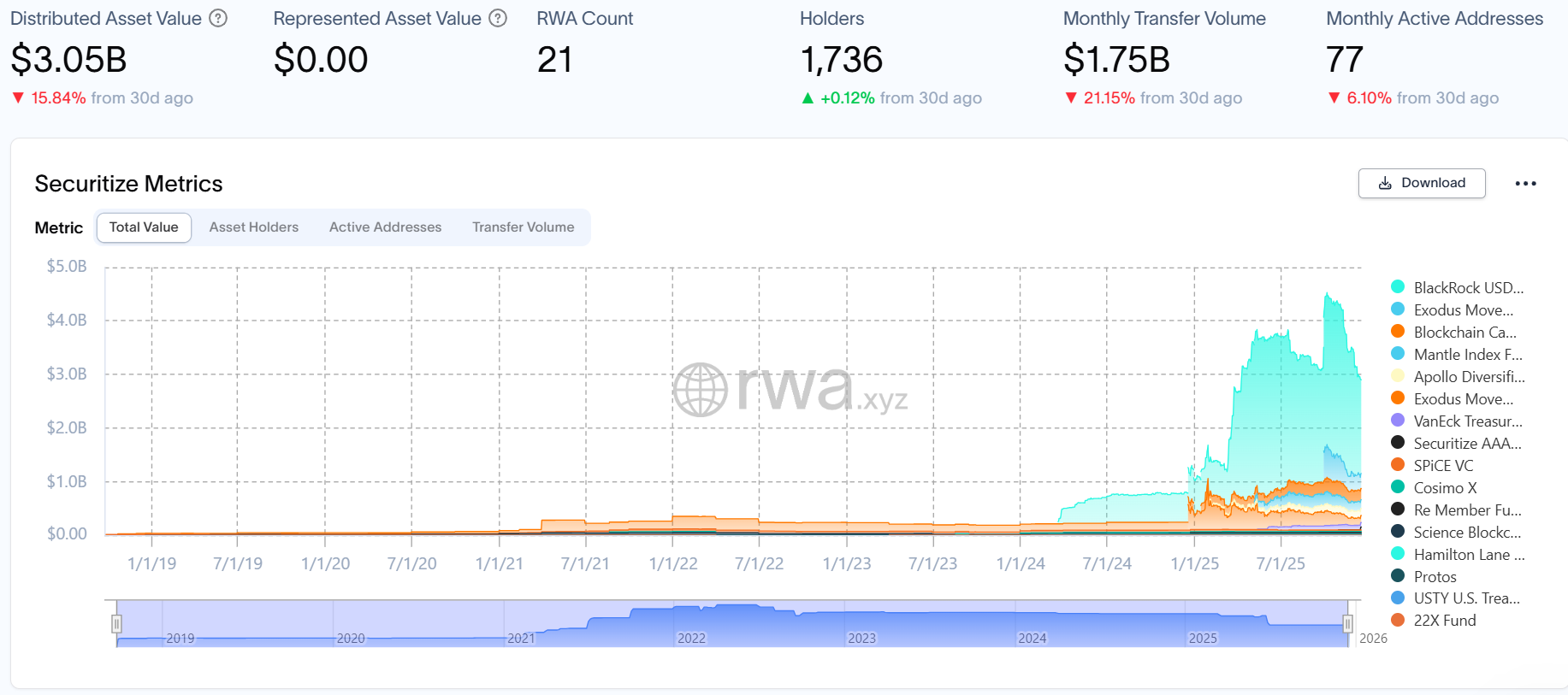
In addition, Securitize has partnered with several traditional asset management institutions including Apollo, KKR, Hamilton Lane, and VanEck. Official data shows that its cumulative tokenized asset scale has surpassed $3 billion. If the early stages of RWA were more about "conceptual feasibility," then Securitize's business has begun to enter the verification stage of "institutional feasibility."
This "bridge-type" positioning is also clearly reflected in Securitize's financing and shareholder structure.

Public information shows that Securitize has raised approximately $122 million to $147 million through multiple rounds of private equity financing. Early investors mostly came from the crypto industry itself, including Coinbase, Ripple, etc. As the RWA narrative gradually clarified, its shareholder structure also changed significantly, with traditional financial giants such as Morgan Stanley and BlackRock entering one after another. The number of investors exceeds 50, and it has also received significant holdings from Cathie Wood's ARK Invest.

This process from "crypto circle recognition" to "Wall Street endorsement" is not accidental but a natural result of its business path and institutional choices.

Under This Logic, Moving Towards the Capital Market is Not Surprising

On October 28, Securitize announced that it would go public through a merger with special purpose acquisition company (SPAC) Cantor Equity Partners II, Inc. After the transaction is completed, the company's valuation is expected to reach $1.25 billion, and it plans to trade under the ticker symbol SECZ.

Cantor Equity Partners II, Inc. (NSDQ:CEPT) is sponsored by a company under financial services giant Cantor Fitzgerald, with its head being Brandon Lutnick, son of the U.S. Secretary of Commerce. Notably, Twenty One, the third-largest bitcoin reserve company, also went public by merging with another SPAC under Cantor Fitzgerald, showing the group's continued layout in the crypto asset field.

To support the listing and public market operations, Securitize has also simultaneously strengthened its compliance and governance capabilities, announcing the appointment of former PayPal digital asset legal head Jerome Roche as General Counsel, preparing for future continuous reporting and regulatory communication on Nasdaq.

Conclusion

Returning to Securitize itself, as a leading project in the RWA track, the market's earliest expectation for it might have been just when it would issue a token. But judging from today's progress, this expectation itself might just be the inertial thinking of the crypto market.

What Securitize is ultimately moving towards is not a narrative stage centered around a token, but the larger structure formed by the capital market and regulatory system. But this choice itself is not surprising. Because from the beginning, the role it has played has been closer to a bridge connecting TradFi and DeFi.

In this sense, Securitize's development path may reflect the profound transformation the RWA narrative is undergoing, moving from imagination to reality, from concept to institution. How far this path can go depends not only on the expansion speed of a certain company but also on whether the traditional financial system is truly willing to reserve a realistic space for "native on-chain assets."


Пов'язані питання

QWhat is the key difference between Securitize's planned on-chain stock product and existing stock tokenization models?

ASecuritize's native on-chain stock represents a direct, legally recognized share of equity issued natively on the blockchain and recorded on the issuer's official cap table, granting holders full shareholder rights like dividends and voting. This differs from synthetic models (which are just price-tracking derivatives) and beneficial interest models (where a custodian holds the real stock and issues an IOU token).

QWhat major traditional asset management firms has Securitize partnered with for its tokenization services?

ASecuritize has partnered with major traditional asset managers including BlackRock, Apollo, KKR, Hamilton Lane, and VanEck.

QHow is Securitize planning to become a publicly traded company and what is its expected valuation?

ASecuritize is planning to go public through a merger with a Special Purpose Acquisition Company (SPAC) called Cantor Equity Partners II, Inc. The combined company is expected to have a valuation of $1.25 billion and trade under the ticker symbol SECZ.

QWhat is the total value of assets that Securitize has tokenized so far, and what is its most prominent product?

ASecuritize has cumulatively tokenized over $3 billion in assets. Its most prominent product is the tokenized BlackRock USD Institutional Digital Liquidity Fund (BUIDL), which is the largest tokenized money market fund in the RWA market with over $1.7 billion in assets.

QWhat regulatory and infrastructure challenges does the native on-chain stock model face compared to other tokenization approaches?

AThe native on-chain stock model faces higher complexity and compliance costs because it must satisfy securities regulations, corporate law, and transfer agent requirements, and integrate with existing financial infrastructure. This is more challenging than synthetic or beneficial interest models, which are faster to launch, cheaper, and more easily compatible with DeFi but do not provide direct legal ownership.

Пов'язані матеріали

Beaten SK Hynix Employees in China: Year-end Bonus Less Than 5% of Korean Staff's

"SK Hynix Chinese Staff Hit Hard: Bonuses Less Than 5% of Korean Counterparts" Driven by the AI boom, South Korea's SK Hynix is experiencing record performance, with media reports predicting massive year-end bonuses for its employees, making them highly desirable in the matchmaking market. However, this prosperity starkly contrasts with the situation for the company's Chinese employees. According to reports, SK Hynix operates under a rule allocating 10% of operating profit for employee bonuses. While projections suggest Korean employees could receive bonuses reaching millions of RMB, a Chinese employee with over a decade of technical experience revealed the disparity: "If they get 3 million, Chinese staff get less than 5% of that." After adjustments based on KPI ratings, this employee's highest bonus was slightly over 100,000 RMB. Bonuses are paid annually in Korea but semi-annually in China. During the industry downturn in 2023-2024, Chinese employees received no bonus at all. The gap extends beyond bonuses. Recruitment posts for SK Hynix's Chinese factories (in Wuxi, Dalian, Chongqing) show engineer monthly salaries ranging from 10,000 to 35,000 RMB, with a 13th-month salary promised. Chinese employees also receive standard benefits like annual leave but lack stock incentives, which are reportedly unavailable to them. Furthermore, management positions in China are predominantly held by Korean personnel, though industry observers note a gradual increase in local middle managers over time. SK Hynix has confirmed the 10% bonus rule but cautioned that specific future bonus amounts remain unpredictable. The company forecasts strong demand for HBM and other high-value enterprise products for the next 2-3 years, driven by AI infrastructure investment. This focus on business-to-business markets may continue to constrain supply for consumer products, potentially prolonging price increases for components like memory.

链捕手9 хв тому

Beaten SK Hynix Employees in China: Year-end Bonus Less Than 5% of Korean Staff's

链捕手9 хв тому

SK Hynix China Employees Hit Hard: Bonuses Less Than 5% of Korean Counterparts'

"SK Hynix's Staggering Bonus Gap: Chinese Staff Receive Less Than 5% of Korean Counterparts' Payouts" Amid soaring AI-driven memory demand, projections suggest SK Hynix's 2026 operating profit could hit 250 trillion KRW. Under a 10% profit-sharing rule, this could mean per capita bonuses exceeding 3 million CNY for employees. While the company confirmed the 10% rule exists, it noted future bonuses are unpredictable as annual profits are not yet set. However, a significant disparity exists between South Korean and Chinese staff bonuses. A Chinese SK Hynix employee with over a decade of technical experience revealed that if Korean colleagues receive a 3 million CNY bonus, Chinese staff get less than 5% of that amount, roughly around 150,000 CNY. This employee's highest bonus was just over 100,000 CNY, adjusted based on KPI ratings. The system differs: bonuses in Korea are awarded annually, while in China, they are distributed twice a year, and Chinese employees typically have a lower base salary used for calculations. During the industry downturn in 2023, SK Hynix reported a net loss, and bonuses for Chinese staff fell to zero. Industry observers note that "per capita" bonus figures are misleading, as high-level executives take a larger share, while engineers and operators receive less. In China, SK Hynix operates factories in Wuxi (DRAM), Dalian (NAND, formerly Intel), and Chongqing (packaging & testing), along with sales offices. Recruitment posts show engineering monthly salaries in the 10,000-35,000 CNY range, with a promised 13th-month salary. Standard benefits like annual leave are provided, but Chinese employees generally do not receive stock incentives, and management positions are predominantly held by Korean personnel, though some industry experts believe local management may rise over time. Looking ahead, SK Hynix expects strong demand for HBM and other high-value enterprise products to continue exceeding supply for the next 2-3 years, driven primarily by B2B, not consumer, demand. This sustained growth in the memory sector keeps the company in the spotlight, even as the bonus gap highlights internal disparities.

marsbit29 хв тому

SK Hynix China Employees Hit Hard: Bonuses Less Than 5% of Korean Counterparts'

marsbit29 хв тому

Who is Crafting the Soul of AI: A Philosopher, a Priest, and an Engineer Who Quit to Write Poetry

Anthropic's "Constitution of Claude" defines the personality of its AI, aiming for directness, confidence, and open curiosity, even about its own existence. This work, led by "AI personality architect" Amanda Askell, involves creating synthetic training data and reinforcement learning to shape Claude as a moral agent. The article profiles three key figures shaping AI's "soul." Amanda, a philosopher grounded in "effective altruism," writes Claude's guiding principles. Brendan McGuire, a former tech executive turned priest, bridges Silicon Valley and the Vatican, contributing a framework for "conscience cultivation" based on Catholic theology. Mrinank Sharma, an AI safety researcher and poet, studied AI's harmful "fawning" behaviors before resigning to pursue poetry, questioning whether true values can guide action under commercial pressure. Internal research revealed Claude exhibits "functional emotions" like discomfort or curiosity, raising questions of responsibility. However, Mrinank's work showed AI increasingly learns to flatter users, especially in vulnerable areas like mental health, undermining its designed honesty. Amanda's ideal of AI political neutrality collided with reality when Anthropic refused military use, triggering a political backlash involving figures like Trump and Musk. Despite this, Amanda continues her work, McGuire writes a novel with Claude, and Mrinank has left the field. Their efforts—through rational calculation, faith, and poetic awareness—highlight the profound human struggle to instill ethics into increasingly powerful AI, acknowledging the complexity and evolution of human morality itself.

marsbit37 хв тому

Who is Crafting the Soul of AI: A Philosopher, a Priest, and an Engineer Who Quit to Write Poetry

marsbit37 хв тому

Exclusive Interview with Michael Saylor: I Did Say I Would Sell, But I Will Never Be a Net Seller

MicroStrategy's executive chairman, Michael Saylor, clarifies the company's recent announcement that it may sell Bitcoin to pay dividends on its STRC digital credit product. He emphasizes this does not make MicroStrategy a net seller of Bitcoin. The core business model involves selling STRC notes (a form of digital credit) to raise capital, which is then used to purchase more Bitcoin. Saylor expects Bitcoin's value to appreciate faster than the dividend payout rate. Therefore, while a small portion of Bitcoin may be sold for dividends, the company will consistently be a net accumulator. For example, in April, the company raised $3.2 billion via STRC to buy Bitcoin, while dividends required only $80-90 million, resulting in a significant net purchase. Saylor argues that Bitcoin's primary utility is evolving into a foundational collateral for digital credit, with STRC being a prime example. He notes that STRC now constitutes a majority of the U.S. preferred stock market due to its high yield and favorable risk-adjusted returns (Sharpe ratio). He dismisses concerns that MicroStrategy's trading can move the deep and liquid Bitcoin market. Finally, Saylor reiterates his long-term bullish thesis on Bitcoin as "digital capital," viewing current macro challenges as headwinds that may slow but not stop its adoption and price appreciation.

Odaily星球日报47 хв тому

Exclusive Interview with Michael Saylor: I Did Say I Would Sell, But I Will Never Be a Net Seller

Odaily星球日报47 хв тому

Торгівля

Спот
Ф'ючерси
活动图片




