USDT Volume Hit A Record $4.4 Trillion In Q4 2025, Tether Report Shows

bitcoinistОпубліковано о 2026-02-06Востаннє оновлено о 2026-02-06

Анотація

Tether's Q4 2025 report reveals record-breaking growth for USDT, with on-chain transfer volume surging to $4.4 trillion. The number of users grew by 35.2 million, reaching a total of 534.5 million, marking the eighth consecutive quarter of adding over 30 million users. Active users hit an all-time high of 24.8 million. Retail transaction volume also reached a new peak of 2.2 billion, with 88.2% being under $1,000. Despite a bearish crypto market in October, USDT's market cap grew to $187.3 billion, and it outperformed the broader market, gaining 3.5% while major cryptocurrencies declined. Bitcoin was trading around $65,800, down over 9% in 24 hours.

A new report from Tether shows USDT saw growth in several metrics during the last quarter of 2025, including a new record in transfer volume.

Tether’s USDT Set A New Transfer Volume Record In Q4 2025

USDT issuer Tether has released its market report for Q4 2025 and it shows several new records for the largest stablecoin by market cap. First, the number of USDT users increased by 35.2 million during the period, taking the total to 534.5 million.
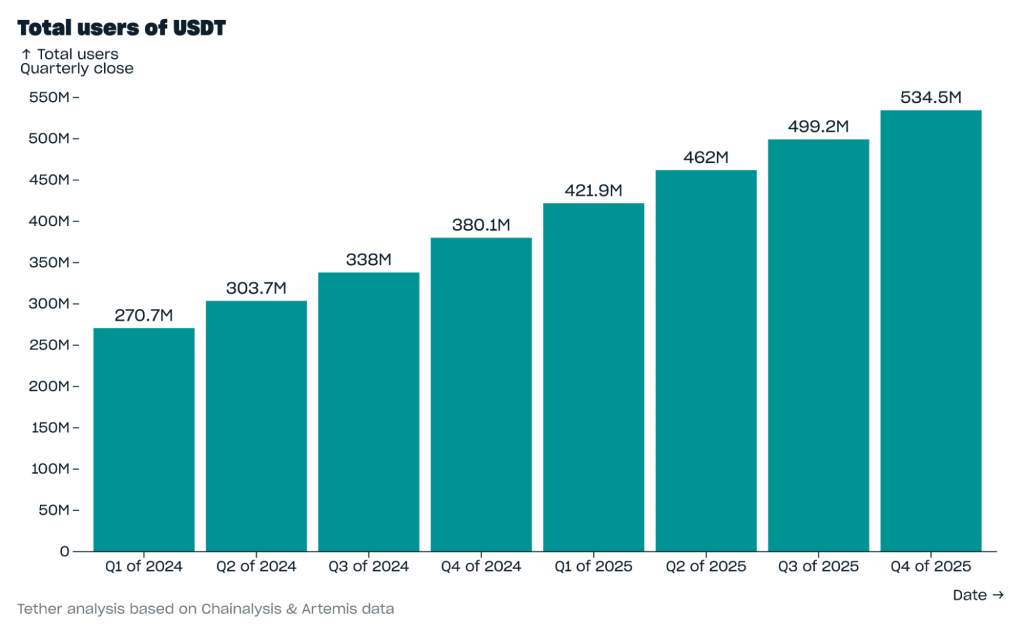
The quarterly growth in USDT users over the last couple of years | Source: Tether

In this count, Tether has included both the users who have received and used USDT for at least 24 hours on-chain, as well as the estimates of users that have received the stablecoin on centralized platforms like exchanges.

From the above chart, it’s visible that Q4 2025 was the eighth consecutive quarter in which Tether’s stablecoin saw growth of more than 30 million users. In terms of active users, the quarter set a new all-time high (ATH) with an average of 24.8 million users receiving USDT at least once inside a 30-day rolling window. “This accounts for 68.4% of all stablecoin monthly active users,” noted the report.

On-chain transfer volume also set a new ATH in this quarter, hitting a value of $4.4 trillion following a jump of $248.6 billion.
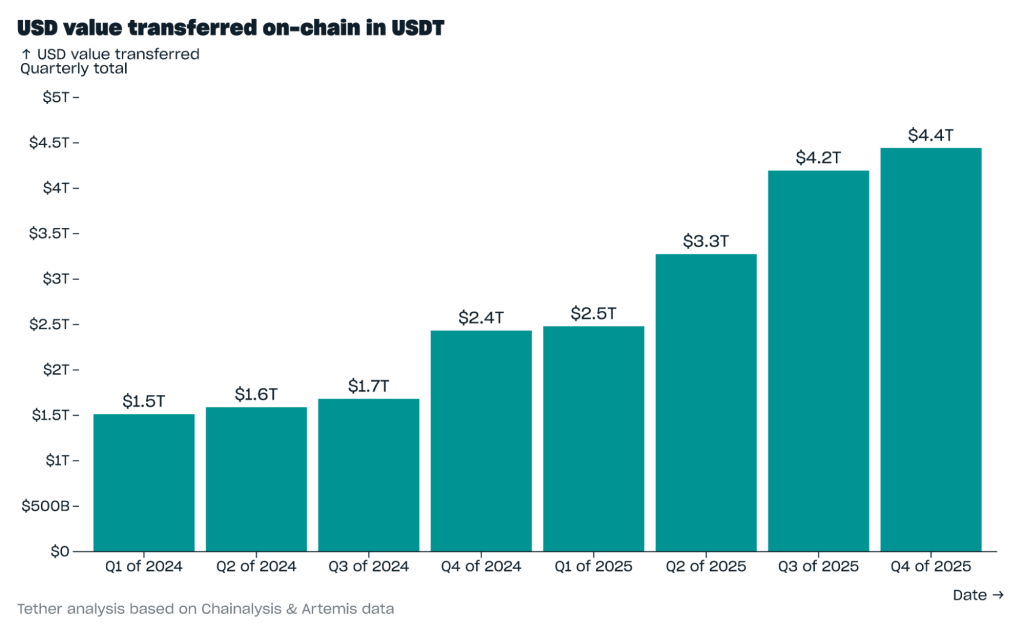
The stablecoin's transaction volume saw a notable rise over the past year | Source: Tether

As displayed in the chart, the USDT transfer volume stood at just $1.7 trillion in Q3 2024, so the sharp jump to $4.4 trillion since then indicates demand for using the stablecoin has seen a notable boost. “Of this $4.4T quarterly total, $2.8T (63.6%) was in transactions where USD₮ was the only asset transferred, and $1.6T (36.4%) was in transactions where multiple assets were transferred (typically in DeFi swaps),” said the report.

There has also been growth in transaction demand among the retail investors, as the number of transfers involving the stablecoin jumped by $313.1 million in Q4 to a new ATH of 2.2 billion. 88.2% of these transactions involved a sum less than $1,000.

The capital invested in the stablecoin itself also saw an increase during the quarter, with the market cap hitting $187.3 billion after inflows of $12.4 billion.
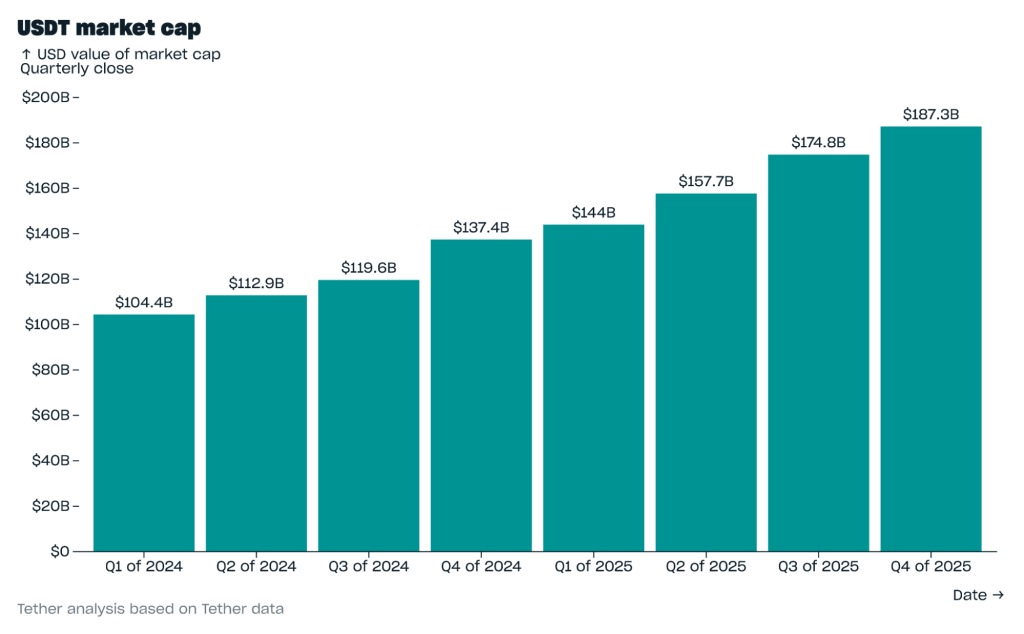
Looks like the token's market cap has seen steady growth | Source: Tether

The growth in the USDT market cap occurred despite the fact that the wider cryptocurrency market saw a bearish transition in October. That said, the downturn still affected the token to some degree as before the market slowdown, its monthly market cap growth rate was sitting at 4.9%, which declined in the aftermath of the liquidation squeeze of October 10th.

Overall, between October 10th and today, USDT has been among the more resilient cryptocurrencies, being up 3.5% while the combined sector has lost more than a third of its market cap. In the same period, USDC, the second largest stablecoin, has seen a drop of 2.6%.

Bitcoin Price

At the time of writing, Bitcoin is trading around $65,800, down more than 9% over the last 24 hours.

The price of the coin seems to have been crashing | Source: BTCUSDT on TradingView


Пов'язані питання

QWhat was the total USDT transfer volume in Q4 2025 according to Tether's report?

AThe total USDT transfer volume in Q4 2025 was $4.4 trillion.

QHow many USDT users were there in total by the end of Q4 2025?

AThere were 534.5 million USDT users by the end of Q4 2025.

QWhat percentage of the $4.4 trillion transfer volume involved transactions where USDT was the only asset transferred?

A63.6% of the $4.4 trillion transfer volume involved transactions where USDT was the only asset transferred.

QHow did the market cap of USDT change during Q4 2025, and what was its final value?

AThe market cap of USDT increased by $12.4 billion during Q4 2025, reaching a final value of $187.3 billion.

QWhat was the Bitcoin price mentioned in the article, and how much did it change in the last 24 hours?

ABitcoin was trading around $65,800 at the time of writing, down more than 9% over the last 24 hours.

Пов'язані матеріали

The Recursive AI Anthropic Warned About: Tian Yuandong's New Company Has Just Taken the "First Step"

Anthropic recently highlighted the rapid progress toward "recursive self-improvement," where AI systems autonomously design and train their successors. In response, Recursive Superintelligence, a new company co-founded by former Meta researcher Tian Yuan Dong, has publicly demonstrated its first step toward automating AI research. The company released a system designed to autonomously execute the full AI research cycle: generating ideas, implementing code, running experiments, and learning from results. It validated this approach by achieving state-of-the-art results on three diverse benchmarks: 1. **NanoChat Autoresearch:** Optimizing a small language model's validation loss under a fixed 5-minute GPU budget, improving upon the community's best result. 2. **NanoGPT Speedrun:** Reducing the time to train a GPT model to a specific loss on 8 H100 GPUs from 79.7 seconds to 77.5 seconds, beating a highly optimized, human-driven community effort. 3. **SOL-ExecBench:** Improving the overall score on NVIDIA's suite of 235 GPU kernel optimization tasks by 18%, closing the gap to the hardware limit. The system discovered novel optimizations in this highly specialized domain without direct human expertise. Recursive's system operates as a general framework, capable of parallel exploration and cross-task knowledge transfer while incorporating safeguards against reward hacking. The company, backed by $650M in funding and a star-studded team including Richard Socher and Alexey Dosovitskiy, aims to create AI that recursively enhances its own research capabilities. This development represents an early but concrete move toward a new paradigm where AI accelerates its own advancement. It occurs alongside Anthropic's warnings about the need for industry coordination and potential pauses when recursive self-improvement thresholds are reached, highlighting the dual trajectory of rapid technical progress and growing calls for careful stewardship.

marsbit4 хв тому

The Recursive AI Anthropic Warned About: Tian Yuandong's New Company Has Just Taken the "First Step"

marsbit4 хв тому

The Gold Buy-on-the-Dip Guide: Watch Interest Rates, Not Just War

"Gold Buying Guide: Focus on Interest Rates, Not Just War" Four months ago, gold buyers likely didn't anticipate buying at a peak that even a war couldn't sustain. After hitting a record high of $5,596 on January 29, gold entered a bear market just 91 days later, its fastest decline since 2008. A key trigger was the Fed's hawkish shift, highlighting that monetary policy, not geopolitics, is the primary driver. The article argues that the traditional "buy gold in turmoil" script has changed. While the US-Iran conflict initially boosted prices, the sustained rally in oil prices heightened inflation fears, forcing central banks to maintain or consider tighter policy. Since gold yields no interest, higher rates increase its opportunity cost, eroding its appeal. This dynamic was evident when gold fell sharply on May 18 despite positive peace talks, as lower oil prices eased inflation and thus rate hike pressures. The recent sell-off is also part of a broader market deleveraging. Correlations between gold, Nasdaq, and Bitcoin spiked as leveraged investors sold liquid assets to cover losses, creating a synchronized downturn. Historically, gold bottoms align with policy shifts, not conflict resolutions. The 2008 and 2022 bear markets ended with shifts to extreme easing and peak inflation expectations, respectively. For potential buyers, the author suggests monitoring three signals: 1) Peak interest rate hike expectations, 2) Reopening of the Strait of Hormuz (to ease oil/inflation pressure), and 3) A return to net inflows for Gold ETFs, indicating the end of forced selling. While predicting the exact bottom is impossible, the author's personal strategy involves scaling into a position across price levels like $4000, $3700, and $3500, committing no more than 30% of the intended total allocation initially, and adding the remainder only if key signals emerge. The core conclusion: In turbulent times, watching interest rates is more crucial than watching wars.

marsbit10 хв тому

The Gold Buy-on-the-Dip Guide: Watch Interest Rates, Not Just War

marsbit10 хв тому

Recent On-Chain Review: No Clear Narrative Under U.S. Stock Market Pressure, Just Hype

This article analyzes the current state of the Solana meme coin and community token ecosystem, highlighting a market caught between two dominant forces: attention-based PvP and a gradual return to community-centric projects. The first part explores the "Attention PvP" dynamic, where success is driven by celebrity endorsements, viral events, and speed. Examples include $JOTCHUA, which surged after its meme creator's social media activity, and $WORLDCUP, which outperformed a similar Base chain project ($PITCH) largely due to influencer support. The recent "pump.fun GO" feature, allowing bounty tasks for token promotion, is critiqued for fostering sensationalist and often negative stunts—like people getting token tickers tattooed on their bodies for rewards—reminiscent of old internet shock content. In contrast, the article points to a resurgence of organic, community-driven tokens that survive market volatility through strong holder bases and shared ideology, not just hype. Influencer Ansem is cited, arguing that durable meme coins rely on communities willing to endure losses and promote their core message daily. Examples given are older tokens like $neet (anti-work ethos), $troll, $buttcoin, and $triplet, which have maintained relative price stability. A prime example of this community-build model is the new project $KINS, the token for the browser-based MMORPG Kintara. Its success stems not from advanced graphics but from consistently delivering updates, fostering player trust, and creating genuine engagement (e.g., in-game economies, events, property auctions). It has attracted a growing player base and even notable KOLs as participants, demonstrating that sustainable growth can come from building trust rather than orchestrating pumps. The article concludes by questioning whether the market is ultimately a game of mutual trust or mutual deception, expressing hope that such reflection might lead to a healthier ecosystem.

marsbit10 хв тому

Recent On-Chain Review: No Clear Narrative Under U.S. Stock Market Pressure, Just Hype

marsbit10 хв тому

On-Chain Scene on Opening Day: $20 Billion Already Staked, How Do On-Chain Contracts Know Who Wins?

On the opening day of the 2026 World Cup, over $2 billion had already been wagered on just the "tournament winner" contracts on platforms like Polymarket and Kalshi. This article explores how these blockchain-based prediction markets actually function once the games begin. It breaks down the massive volume and explains how single-game and tournament-long contracts are priced, with values moving between 1-99 cents to reflect implied probabilities. A key mechanism highlighted is "elimination zeroing," where a team's "champion yes" contract immediately settles to zero once they are mathematically eliminated. The core technical question answered is: how does a smart contract "know" who won a real-world match? The answer lies in oracles. The article details two primary paradigms: UMA's "optimistic oracle" (used by most of Polymarket), which allows a challenge period after a proposed result, and Chainlink's multi-source data aggregation (used by FIFA partners like ADI Predictstreet), which automates settlement with minimal dispute windows. Finally, the article injects a note of caution, citing research estimating that a significant portion of historical trading volume on these platforms might be "wash trading" to inflate numbers. It concludes by contrasting the legal status of these "event contracts" under CFTC rules in the U.S. versus traditional, state-regulated sports betting. As the tournament progresses, the real-time operation of this multi-billion dollar machine—its settlements, eliminations, and underlying mechanisms—becomes a story as compelling as the football itself.

marsbit25 хв тому

On-Chain Scene on Opening Day: $20 Billion Already Staked, How Do On-Chain Contracts Know Who Wins?

marsbit25 хв тому

Торгівля

Спот
Ф'ючерси
活动图片




