USDT moves $156B in small transfers as Tether eyes $500B valuation

ambcryptoОпубліковано о 2025-12-13Востаннє оновлено о 2025-12-13

Анотація

Tether (USDT) is rapidly expanding its influence beyond stablecoins, with $156 billion settled in small transfers under $1,000, indicating growing use for remittances and daily transactions in regions with limited banking access. The company is now targeting capital markets, exploring a stock sale that could value it at $500 billion and raise up to $20 billion, potentially tokenizing its shares for enhanced liquidity. Additionally, Tether is diversifying into acquisitions like a majority stake in Juventus FC, investing €1 billion, and expanding into AI, robotics, and commodity markets, where it became the largest non-central bank gold buyer with 116 tonnes in Q3 2025.

Tether [USDT] is getting bigger!

The company is scaling across payments, capital markets, and even legacy institutions. From a surge in small-dollar transfers to ambitions that stretch far beyond stablecoins, Tether is testing the limits of how big a crypto-native giant can go.

Small transfers, big deal

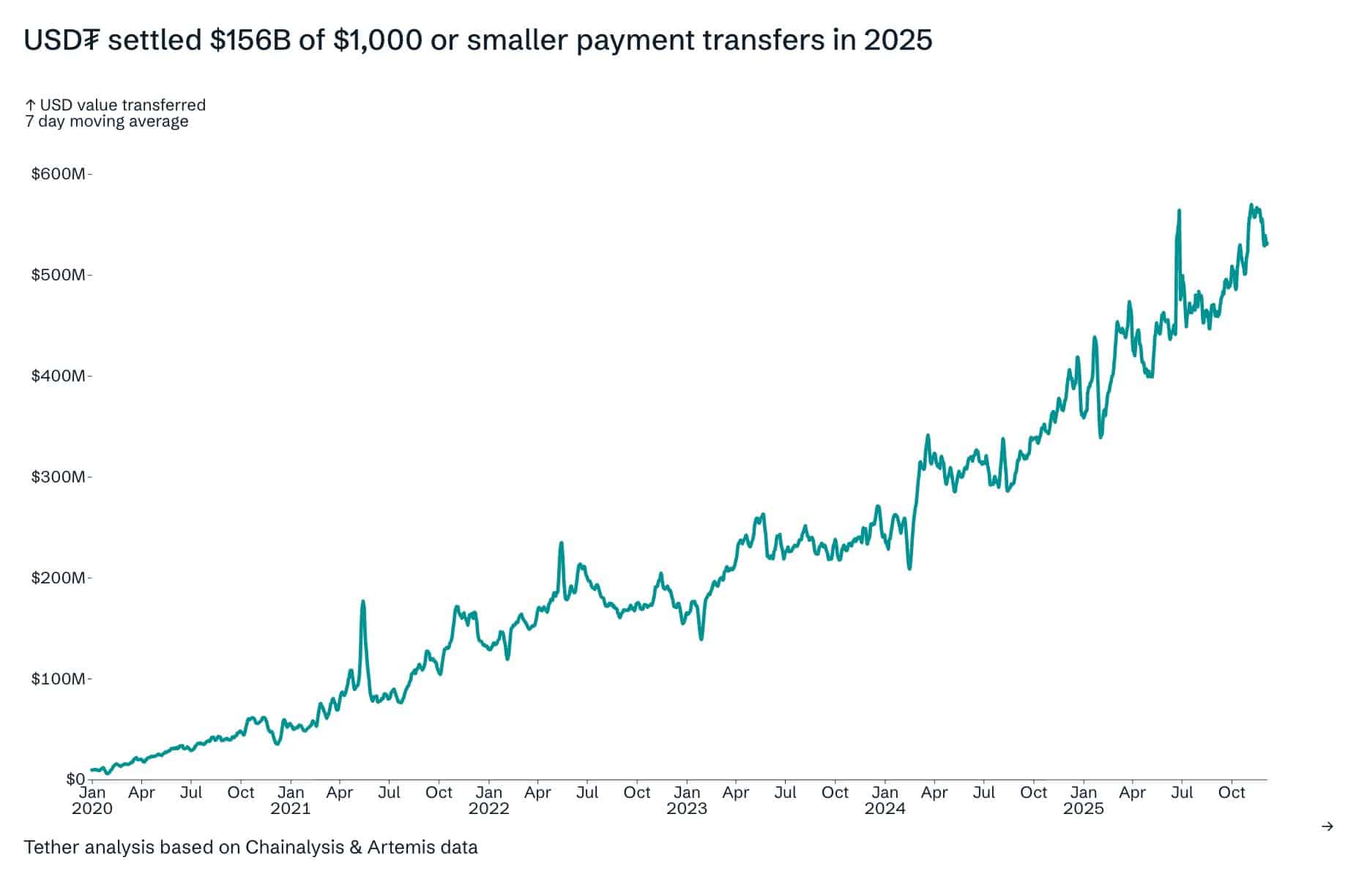
According to data shared by Tether CEO Paolo Ardoino on X, USDT settled $156 billion worth of transfers under $1,000. As the chart shows, small-value transactions have climbed steadily over the past few years, moving through 2024 and into 2025.

Source: X

The seven-day Moving Average is now consistently above $500 million, indicating high-frequency usage.

In regions where traditional banking is expensive or difficult to access, USDT has become a straightforward payment method for remittances and everyday transactions.

From payments to capital markets

That steady rise in small USDT transfers is a precursor for more.

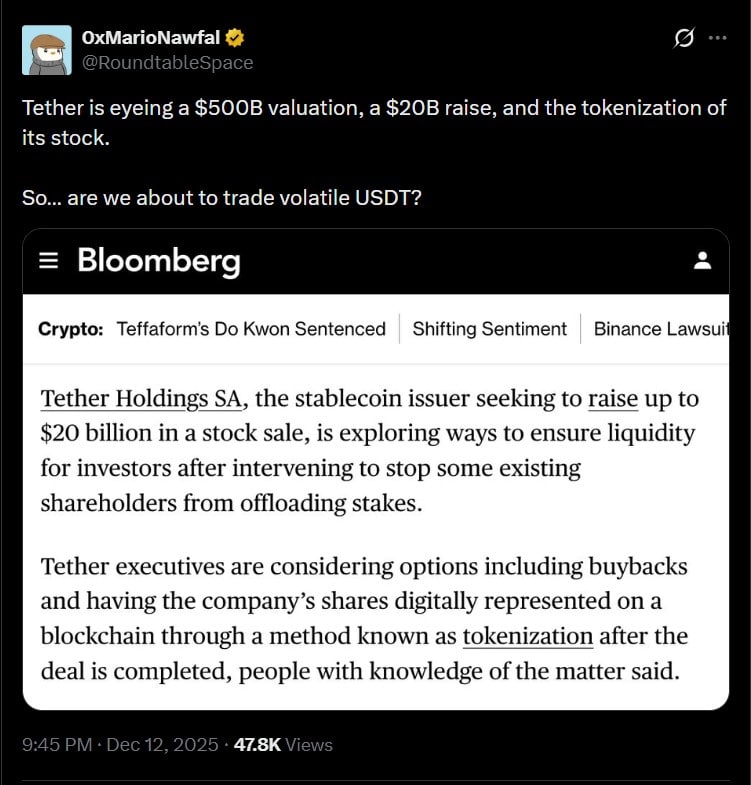
Beyond payments, the company is now eyeing the capital markets. According to a Bloomberg report, Tether is exploring a stock sale that could value the firm at around $500 billion and raise as much as $20 billion.

Executives are also considering tokenizing Tether’s shares on a blockchain to improve liquidity for investors.

Source: X

The move would take Tether from issuing the world’s largest stablecoin to turning itself into a tradeable, on-chain financial asset.

Tether beyond USDT

The company has submitted a binding all-cash proposal to acquire Exor’s 65.4% stake in Italian football giant Juventus FC, with plans to invest €1 billion into the club if the deal closes.

At the same time, Tether is pushing deeper into AI and robotics, backing an Italian humanoid robotics startup and supporting large-scale compute infrastructure for open AI development.

It is also deep in the commodity markets. In Q3 2025, Tether became the largest gold buyer outside central banks, holding 116 tonnes and driving fresh demand for tokenized gold.


Final Thoughts

  • $156 billion in small USDT transfers; Tether is becoming a global payments backbone.
  • A potential $500B valuation shows ambition to rival traditional financial giants.
Next: Analyzing MYX’s price surge – Is $3.45 the next stop?
Share
  • Share
  • Tweet

Пов'язані матеріали

Mathematicians Refute Open AI's Claim of Proving Connes Rigidity Conjecture Within 24 Hours: 'AI Proved Every Sentence Correct, but They Are No Longer About the Original Conjecture'

Mathematician Refutes OpenAI's Claim of Disproving Connes Rigidity Conjecture in 24 Hours OpenAI claimed its next-generation AI model solved 10 world-class problems, including disproving the Connes Rigidity Conjecture. The next day, mathematician J. L. Nielsen from the University of Kansas published a paper refuting the AI's counterexample. Nielsen meticulously reviewed OpenAI's publicly released 37,000 lines of Lean 4 code, mapping each object back to its mathematical origin. He identified two independent failure paths in the AI's argument. He concluded that one of the two groups constructed by the AI does not satisfy the required conditions (specifically ICC and Kazhdan's property (T)) necessary to serve as a valid counterexample to the original conjecture. This means the AI may have successfully proven something about its constructed objects, but that statement is not equivalent to disproving the Connes Rigidity Conjecture itself. The incident highlights a crucial limitation of formal verification tools like Lean. While Lean's kernel can verify the logical correctness of a proof's steps, it cannot verify whether the formal statement being proven correctly corresponds to the intended mathematical conjecture. Human oversight remains essential to ensure the alignment between the formalized problem and the original research question. This case exemplifies what researchers call "successfully proving the wrong statement." The Connes Rigidity Conjecture, concerning the uniqueness of group von Neumann algebras under certain conditions, remains an open problem.

marsbit9 хв тому

Mathematicians Refute Open AI's Claim of Proving Connes Rigidity Conjecture Within 24 Hours: 'AI Proved Every Sentence Correct, but They Are No Longer About the Original Conjecture'

marsbit9 хв тому

When Crypto Assets Become Mortgage Collateral: The Triangular Dilemma of Regulation, Cost, and Tokenized Equity

When Crypto Assets Become Mortgage Collateral: The Trilemma of Regulation, Cost, and Tokenized Rights Better, in partnership with Coinbase, has launched a mortgage solution allowing borrowers to pledge Bitcoin or USDC as collateral. This facilitates two loans: a primary, Fannie Mae-compliant mortgage and a separate private loan for the down payment, secured by the crypto assets and a second lien on the property. The product targets asset-rich but cash-poor buyers, with high collateral requirements (250% for Bitcoin, 125% for USDC) and no margin calls. The initiative has drawn significant regulatory scrutiny. Seven U.S. Senators, led by Dick Durbin and Elizabeth Warren, sent a letter to the FHFA urging a halt, arguing the high collateral ratio itself acknowledges crypto's risk and that combined loan costs could be 1.5 percentage points higher, potentially burdening taxpayers. Despite criticism and Bitcoin's price volatility, Better's CEO Vishal Garg plans to expand support to tokenized equities (e.g., Tesla, SpaceX) and envisions using retirement accounts to help family members buy homes. A core challenge for tokenized assets is clarifying the legal rights conferred by holding such tokens. To reduce costs, Better partnered with Framework Ventures, aiming to lower capital expenses by over 100 basis points and offer sub-5% rates. While the company posted a loss in Q1 2025, it reports strong demand, with a waitlist representing ~$250M in potential loans. Garg remains committed to the model, viewing it as a key channel for integrating digital assets into the banking system.

marsbit19 хв тому
When Crypto Assets Become Mortgage Collateral: The Triangular Dilemma of Regulation, Cost, and Tokenized Equity

marsbit19 хв тому

Торгівля

Спот
活动图片