USDC vs. USDT: $70.2T volume drives shift as Circle expands into Africa

ambcryptoОпубліковано о 2026-03-25Востаннє оновлено о 2026-03-25

Анотація

Circle partners with Sasai Fintech (Cassava Technologies) to expand USDC into Africa, aiming to revolutionize cross-border payments by making them faster, cheaper, and more reliable. This integration into Sasai's mobile platform addresses high fees (often over 7%) and slow traditional systems. The move occurs as stablecoins process $70.2T in annual volume, with USDC gaining market share against USDT, signaling a shift toward reliable, transparent systems. However, Circle faces regulatory challenges in the U.S., including concerns from the upcoming CLARITY Act, which contributed to a recent 20% stock drop. The expansion highlights a strategic focus on high-growth markets like Africa despite domestic uncertainties.

While many are currently concerned about Circle’s stock performance on the NYSE, the company’s partnership with Sasai Fintech, a business of Cassava Technologies, tells an interesting story.

This move isn’t just about expanding into Africa; it’s aimed at tackling a long‐standing challenge: cross‐border payments that remain slow, costly, and inefficient. The plan is to bring USDC into Sasai’s mobile platform, which already supports payments and remittances across multiple African countries.

USDC x Sasai’s partnership: A green flag

Currently, fees can go above 7%, so using a stablecoin like USDC can make transactions faster, cheaper, and more reliable.

By adding USDC into a mobile platform that already supports fast-moving trade, it removes the delays and high costs of traditional systems, where transactions can take days.

Additionally, the partnership is also meant to offer a stable and transparent way to make cross-border payments. This would, in turn, help businesses avoid local currency swings while staying connected to the global market.

Executives weighing in

Remarking on the same, Strive Masiyiwa, Founder and Executive Chairman at Cassava Technologies, said,

Africa’s digital economy is entering a new era, propelled by entrepreneurship, a mobile-first generation, and the acceleration of intra-regional trade.

Adding more to the sentiment, Jeremy Allaire, co-founder and CEO at Circle, noted,

Working with Cassava, we can extend the benefits of USDC and onchain infrastructure into high-growth payment corridors to deliver always-on global connectivity.

Stablecoin’s market dynamics: USDC vs. USDT

The partnership comes at an important time for stablecoins, which have handled a huge $70.2 trillion in transactions over the past year. While USDT was leading for most of 2025, things started to change in early 2026.

Even though total activity slowed a bit in March after a strong February, USDC has started catching up and even briefly matched USDT’s share.
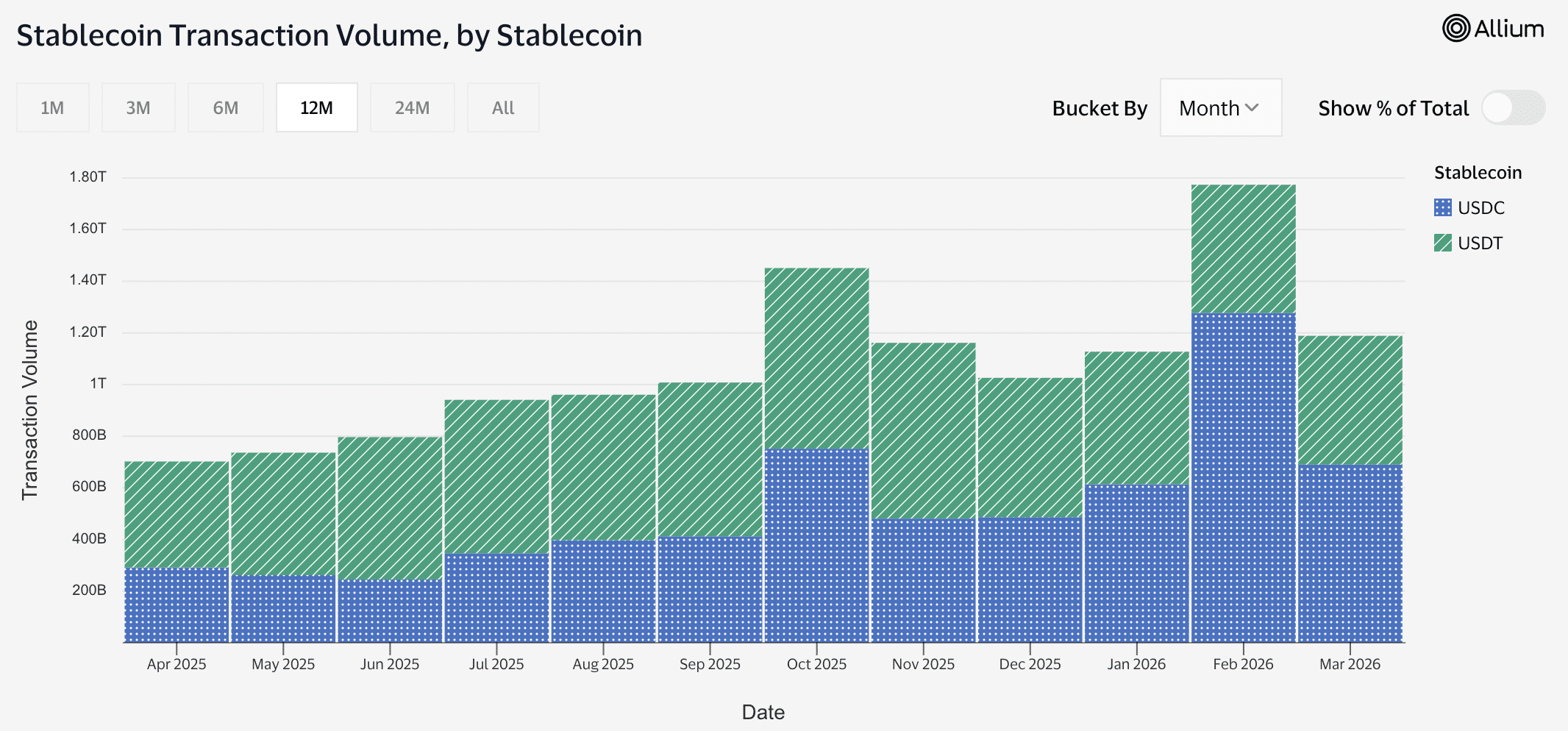
Source: Visa on-chain analytics

This rise in USDC signals a shift away from pure speculation toward more reliable systems, something Circle is now bringing to markets like Africa.

Regulatory clarity and more

While Circle expands into Africa, its position in the United States has become shaky due to new regulations.

In 2025, the GENIUS Act gave a positive direction for stablecoins by supporting dollar-backed digital assets. But now, the upcoming CLARITY Act is creating fresh concerns.

This has made investors nervous, as it could directly impact how companies like Circle generate revenue. As a result, Circle’s stock (CRCL) recently saw a sharp drop of nearly 20% on the 24th of March, closing at $101.17.

All this together shows that Circle is at a turning point, dealing with regulatory challenges in the U.S. while building a strong, usage-driven future in markets like Africa.


Final Summary

  • Integrating USDC into Sasai’s mobile network could cut remittance costs and speed up settlements.
  • The rising competition between USDC and USDT reflects demand for transparency and regulatory alignment.


Пов'язані питання

QWhat is the primary goal of Circle's partnership with Sasai Fintech in Africa?

AThe primary goal is to tackle the challenges of slow, costly, and inefficient cross-border payments by integrating USDC into Sasai's mobile platform to make transactions faster, cheaper, and more reliable.

QAccording to the article, what significant shift in the stablecoin market does the rise of USDC signal?

AThe rise of USDC signals a shift away from pure speculation toward more reliable and transparent systems for cross-border payments and remittances.

QWhat recent U.S. regulatory development has created concerns for Circle and its investors?

AThe upcoming CLARITY Act has created fresh concerns and investor nervousness, as it could directly impact how companies like Circle generate revenue, contributing to a sharp drop in its stock price.

QHow much transaction volume have stablecoins handled over the past year, as mentioned in the article?

AStablecoins have handled a huge $70.2 trillion in transactions over the past year.

QWhich two key benefits does the article suggest the USDC integration will bring to African markets?

AThe integration is expected to cut remittance costs and speed up settlement times for cross-border payments.

Пов'язані матеріали

In Jinjiang, Fujian, a Storage Super Unicorn Lies Quiet

In Fujian's Jinjiang, a city known for sportswear, lies a quiet semiconductor giant: Fujian Jinhua Integrated Circuit Co. (JHICC). Once a promising domestic DRAM manufacturer alongside Yangtze Memory and ChangXin Memory Technologies (CXMT), its journey was derailed in 2018 when the U.S. placed it on an Entity List and filed criminal charges for alleged trade secret theft. This halted production for years. A turning point came in February 2024 when a U.S. federal court found JHICC not guilty. However, it had lost crucial time. While CXMT soared to become a top-valued A-share company in 2024, JHICC, with an estimated valuation of 80 billion RMB, was just restarting. Its current output is primarily customized DDR4 chips, not the advanced DDR5/HBM demanded for AI, but it still benefits from the broader memory chip upcycle. JHICC's story is tied to Chen Zhengkun, a veteran engineer who left Micron to lead the venture. Founded in 2016 with state-backed funding, JHICC partnered with Taiwan's UMC to develop DRAM technology. Rapid progress was cut short by the U.S. actions, which Micron initiated, partly due to its heavy reliance on the Chinese market. Post-sanctions, Chen's team worked to rebuild the production line with reduced reliance on U.S. technology. According to its records, JHICC achieved small-scale production and revenue growth under immense pressure. It now focuses on the stable "niche" DRAM market (e.g., TVs, routers) with a monthly capacity of ~40,000 wafers, aiming for 60,000 by 2026. It holds over 1,000 patents but remains on the Entity List. For Jinjiang, investing in JHICC was a bold industrial leap. The local government provided unwavering financial and logistical support during the crisis, helping the company survive. JHICC has become the anchor for a growing local semiconductor cluster. Though its scale lags behind domestic peers, JHICC's persistence symbolizes a hard-won foothold in a global market long dominated by Samsung, SK Hynix, and Micron. Having missed one boom, it seeks a place in the new AI-driven memory supercycle.

marsbit1 хв тому

In Jinjiang, Fujian, a Storage Super Unicorn Lies Quiet

marsbit1 хв тому

Must-Watch Events Next Week|CLARITY Act Could Face Senate Vote; SpaceX, Circle to Report Earnings (8.3-8.9)

**Summary: Key Events and Developments to Watch (August 3-9)** The upcoming week is marked by significant financial disclosures, key legislative deadlines, and notable product updates. **Major Financial Events:** Several companies are scheduled to release their Q2 2026 earnings. American Bitcoin (ABTC) will report on August 3, followed by SpaceX and Hut 8 Mining Corp. on August 4, and Circle on August 5. Notably, a significant portion of SpaceX shares (up to 12% of total shares) will be unlocked on August 6 following their earnings release. **Key Legislative Deadline:** The U.S. Senate faces an August 7 deadline to secure 60 votes for the CLARITY Act, a bipartisan bill aiming to establish a federal regulatory framework for cryptocurrencies. The Senate may hold a full vote on the bill during the week. **Economic Data:** The U.S. July Non-Farm Payrolls report will be released on August 7, providing crucial labor market data. **Technology & Product Updates:** * **Shutdowns:** DeFi portfolio tracker Zapper and wallet app Ctrl Wallet will cease operations on August 3. * **Upgrades:** LayerZero will deprecate its v1 relayers on August 3. XRP Ledger's new version 3.3.0, featuring five new functions, is expected next week. * **AI:** Elon Musk announced that the advanced Grok 4.6 AI model is set for release around August 7. * **Bitcoin:** The BIP-110 forced signaling for a potential Bitcoin network change is scheduled to begin around August 8. **Other Notable Events:** Chinese robotics firm Unitree Tech has set its preliminary price inquiry for its IPO for August 5. South Korean exchange Upbit will delist AQT and AERGO tokens on August 3.

marsbit2 год тому

Must-Watch Events Next Week|CLARITY Act Could Face Senate Vote; SpaceX, Circle to Report Earnings (8.3-8.9)

marsbit2 год тому

Торгівля

Спот
活动图片




