US Treasury Secretary Urges Congress To Pass Crypto Market Structure Bill This Spring

bitcoinistОпубліковано о 2026-02-14Востаннє оновлено о 2026-02-14

Анотація

US Treasury Secretary Scott Bessent has urged Congress to pass the stalled crypto market structure bill, the CLARITY Act, this spring to provide market reassurance amid recent volatility. He noted that some industry opposition has contributed to instability and emphasized the importance of bipartisan cooperation to advance the legislation. Bessent warned that the opportunity could diminish if Democrats gain control of the House in November. Patrick Witt of the Crypto Council also discussed the bill's progress, highlighting that the Senate Agriculture Committee portion has passed, but the Banking Committee's section remains pending. He called for compromise to address issues like stablecoin regulations without derailing the broader bill, which includes key measures on regulatory clarity and developer protections.

The US Secretary of the Treasury has called for the passage of the long-awaited crypto market structure bill this spring to provide reassurance to the industry amid recent market volatility.

Bessent Calls For Crypto Market Structure Bill

On Friday, Treasury Secretary Scott Bessent urged the US lawmakers to pass the stalled crypto market structure bill soon, highlighting the importance of getting the legislation on President Donald Trump’s desk before the end of the spring legislative window.

In a CNBC interview, Bessent affirmed that part of the recent market volatility was “self-induced” due to the reaction of some industry participants to the bill. He affirmed that some digital assets firms have been blocking it, which hasn’t been “good for the overall crypto community.”

Notably, the long-awaited CLARITY Act has been stalled for nearly a month after the Senate Banking Committee published its bill draft. The legislation was heavily criticized by crypto industry leaders, who slammed multiple of its policies, including key restrictions for stablecoin issuers.

The Treasury Secretary considers that passing the bill would “give great comfort” to the market at a time of significant volatility. Moreover, he pointed out that there’s a bipartisan working group trying to advance the legislation, with democrats “that want to work with republicans on getting a market structure bill.”

However, Bessent noted that the chances of getting a deal done could fall apart if Democrats take control of the House of Representatives in November, highlighting the Biden administration’s crackdown on the industry.

“There’s a lot of innovation that goes on adjacent to crypto, the blockchain, and DeFi. So, I think it’s important to get this clarity bill done as soon as possible and on the president’s desk this spring,” he concluded.

‘More Work To Be Done’

Similarly, Patrick Witt, executive director of the US President’s Council of Advisors for Digital Assets, discussed the progress on the crypto market structure bill on Friday.

Speaking with Yahoo Finance, Witt stated, “We are working hard to address the issues that were raised that led to the postponement of that markup and hopefully get that back on the book soon.”

He highlighted that lawmakers were able to pass the Senate Agriculture Committee’s half of the CLARITY Act, which handles the Commodity Futures Trading Commission (CFTC)’s portion of the bill.

The Crypto Council’s executive director outlined that once the Senate Banking Committee’s portion of the bill is passed, the two pieces of legislation will need to be reconciled before a final vote on the Senate floor. “So, more work to be done, but we are a step closer with the passage of the Ag portion of this a couple of weeks ago,” he said.

Discussing who must bend to advance the bill, Witt affirmed that both sides would have to compromise. “It’s unfortunate that this has become such a big issue, because ultimately, this is not the stablecoin bill that was the GENIUS Act,” he said.

“What we’ve encouraged both sides to do is find a middle ground. Let’s use a scalpel heel here to address this narrow issue of idle yield (...). But let’s not take a chainsaw out of this; let’s not let this derail the bill. There is so much goodness in this bill, no matter what your perspective is,” Witt continued.

He listed some of the “excellent measures” proposed in the bill, including the clear line between the SEC and the CFTC, regulatory jurisdiction, and developer protections, which he considers to be “critical to future-proof this industry from a future Gary Gensler or, God forbid, a Secretary of the Treasury Elizabeth Warren.”

Lastly, he shared that the White House might host another meeting between the banking and crypto industry to discuss the payment of stablecoin rewards.
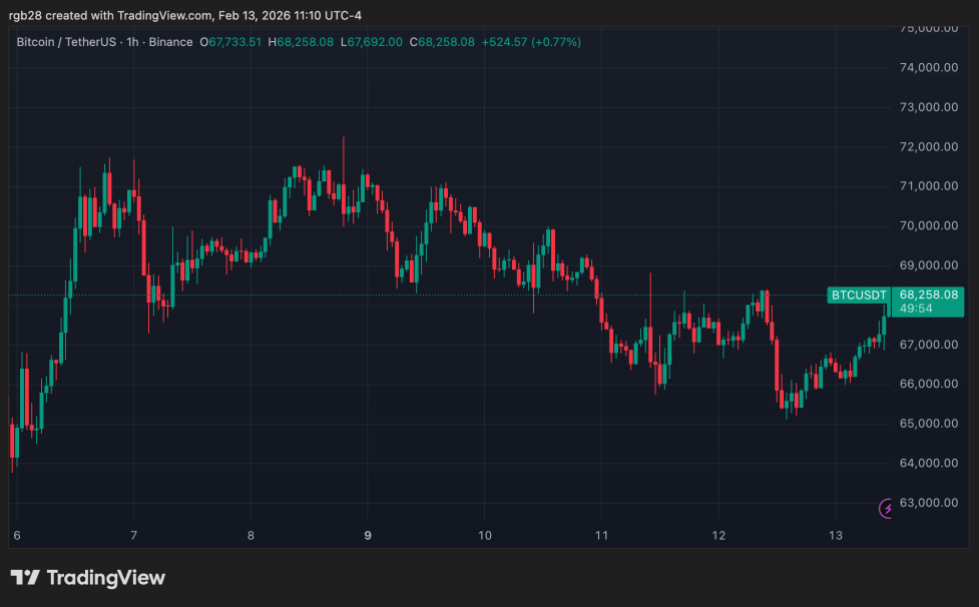
Bitcoin (BTC) trades at $68,258 in the one-week chart. Source: BTCUSDT on TradingView


Пов'язані питання

QWho is urging Congress to pass the crypto market structure bill and when?

AUS Treasury Secretary Scott Bessent is urging Congress to pass the crypto market structure bill this spring.

QWhat is the name of the specific bill that has been stalled in the Senate?

AThe specific bill is called the CLARITY Act.

QAccording to the Treasury Secretary, why is it important to pass the bill quickly?

AHe believes passing the bill would 'give great comfort' to the market during a time of significant volatility and provide regulatory clarity for the industry.

QWhat potential political event could cause the chances of a deal to 'fall apart'?

AThe chances of a deal could fall apart if Democrats take control of the House of Representatives in November.

QWhich two committees' bills need to be reconciled before a final Senate vote?

AThe bills from the Senate Banking Committee and the Senate Agriculture Committee need to be reconciled.

Пов'язані матеріали

Winter for Crypto IPOs: Consensys and Ledger Withdraw Applications

The crypto IPO window is tightening significantly in 2026, marked by prominent companies delaying or pausing their public listing plans. Following a successful 2025 "harvest year" that saw Circle, Bullish, and Gemini go public amidst a bull market, the tide has turned. Consensys, developer of MetaMask, recently postponed its IPO until at least fall 2026. Hardware wallet leader Ledger also suspended its planned US listing due to unfavorable market conditions, with Kraken having previously delayed its own plans. This shift is driven by a cooling market in 2026, characterized by a significant Bitcoin price correction, declining trading volumes, and reduced investor risk appetite for crypto stocks. The poor post-IPO performance of 2025 listings like Circle and Bullish, which saw major share price declines, has heightened investor caution. This contrasts sharply with the current AI sector, where companies like SpaceX, OpenAI, and Anthropic are commanding massive valuations and investor enthusiasm based on narratives of stable, exponential growth. Crypto companies now face pressure to transition from hype-driven models to demonstrating reliable cash flows and robust compliance. While the paused IPO plans may lead to valuation resets and affect ecosystem liquidity, they also accelerate industry consolidation toward stronger, more compliant infrastructure players. A potential recovery in Bitcoin's price and clearer regulations could reopen the IPO window in the latter half of 2026.

marsbit57 хв тому

Winter for Crypto IPOs: Consensys and Ledger Withdraw Applications

marsbit57 хв тому

ChatGPT Can Manage Your Money for You. Would You Trust It with Your Bank Account?

OpenAI has launched a personal finance tool for ChatGPT, currently in preview for US-based ChatGPT Pro users. This feature allows users to connect their bank and investment accounts (via Plaid, supporting over 12,000 institutions) directly to ChatGPT. It analyzes transactions, generates visual dashboards, and offers conversational financial advice—such as budgeting or planning for major purchases—based on the user's actual data. This move follows OpenAI's acquisitions of fintech startups Roi and Hiro Finance, signaling a strategic push into vertical "super assistant" applications, similar to its earlier health-focused feature. However, the launch has sparked significant privacy concerns. Critics question the safety of granting such sensitive financial access to an AI, especially amid ongoing lawsuits alleging OpenAI shared user chat data with third parties like Meta and Google. OpenAI emphasizes that ChatGPT only reads data (no transaction capabilities), deletes it within 30 days if disconnected, and offers opt-out options for model training. Yet, trust remains a major hurdle. The trend reflects a broader industry shift: AI companies like Anthropic and Perplexity are also targeting high-value, data-rich domains like finance and health. While technically promising, the tool operates in a regulatory gray area—it provides personalized guidance but disclaims formal financial advice or liability. Ultimately, OpenAI's challenge is convincing users to trust an AI with their most private financial information.

marsbit58 хв тому

ChatGPT Can Manage Your Money for You. Would You Trust It with Your Bank Account?

marsbit58 хв тому

Торгівля

Спот
Ф'ючерси
活动图片




