US Stocks Surge 16% in Two Months: Only 4 Occurrences in History, the Most Recent Was Just Before the 1987 Crash

marsbitОпубліковано о 2026-06-03Востаннє оновлено о 2026-06-03

Анотація

U.S. stocks have surged 16% over April and May, a gain seen only four times since WWII, according to Deutsche Bank strategist Henry Allen. Three prior instances followed recessions, but the sole non-recession precedent was in early 1987, months before the "Black Monday" crash. The current rally is underpinned by AI enthusiasm and strong data, but its speed without an economic recovery is historically unprecedented. Meanwhile, credit spreads remain near record lows despite growing consumer strain—the U.S. savings rate hit just 2.6% in April, a level last seen before the Global Financial Crisis, and consumer sentiment is at its lowest since 1952. Market risks are concentrated. While stocks and credit markets appear immune to geopolitical tensions, sovereign bonds tell a different story. Treasury yields have tracked oil prices and recently hit multi-year highs, creating a widening divergence with equities. Surprisingly stable oil prices, despite the prolonged closure of the Strait of Hormuz, have been a key pillar for risk assets. However, if the blockage persists, this support could fade, raising the risk of a stagflation shock not currently priced in.

Original Author: Zhao Ying

Original Source: Wall Street News

The recent strong rally in U.S. stocks is triggering historical alarms. The S&P 500 index has accumulated a 16% gain from April to May, a magnitude of increase that has occurred only 4 times since World War II. Three of those instances happened during recovery phases following economic recessions. The sole precedent not in a post-recession context occurred just months before the "Black Monday" crash in 1987.

Deutsche Bank macro strategist Henry Allen points out that the current rally is not taking place against a backdrop of post-recession recovery, making the historical comparison particularly stark. Meanwhile, credit spreads remain at historically low levels, but pressure signals from the consumer side are accumulating, expectations for Federal Reserve interest rate hikes are heating up, and the divergence between sovereign bond markets and stock markets continues to widen.

With multiple risk factors converging, market tail risks are becoming exceptionally concentrated. Henry Allen wrote in the report, "The tail risks in the current distribution are exceptionally prominent, both at the geopolitical level and at the market level."

Historical Precedents Are Rare, Only One Non-Recession Example Exists

The S&P 500's two-month gain of 16% from April to May has only 4 precedents since WWII.

Three of them occurred during powerful rebounds following recessions: the post-COVID-19 recovery from April to May 2020, the post-global financial crisis rebound from March to April 2009, and the recovery rally following the first oil crisis from January to February 1975.

The 4th instance was from January to February 1987. That was just months before October's "Black Monday" — the day the S&P 500 plunged 20% in a single session.
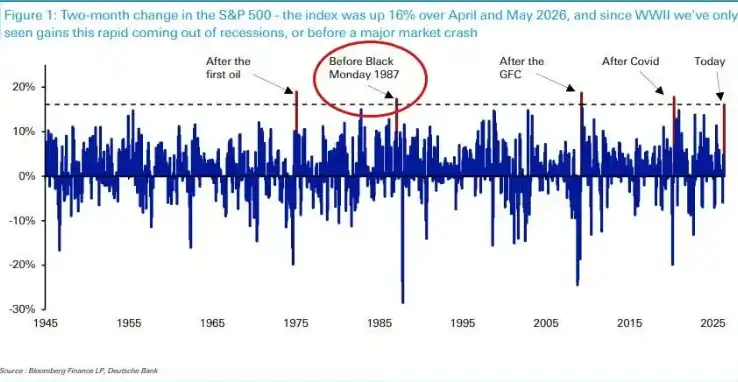
Henry Allen emphasizes that the current rally has its fundamental support, including high enthusiasm for artificial intelligence and strong economic data, but "the pace of gains itself has broken all recent precedents." In an economy not emerging from a recession, a rebound of this speed has never ended well in history.

Furthermore, the S&P 500 is on track to achieve its fourth consecutive year of double-digit gains, a record not seen since the late 1990s.

Excessive Optimism in Credit Markets, Consumer Pressure Signals Overlooked

The strength in equities has also spread to credit markets. Credit spreads in both the US and Europe are currently narrower than before the US-Iran conflict erupted, showing the market's high tolerance for risk.

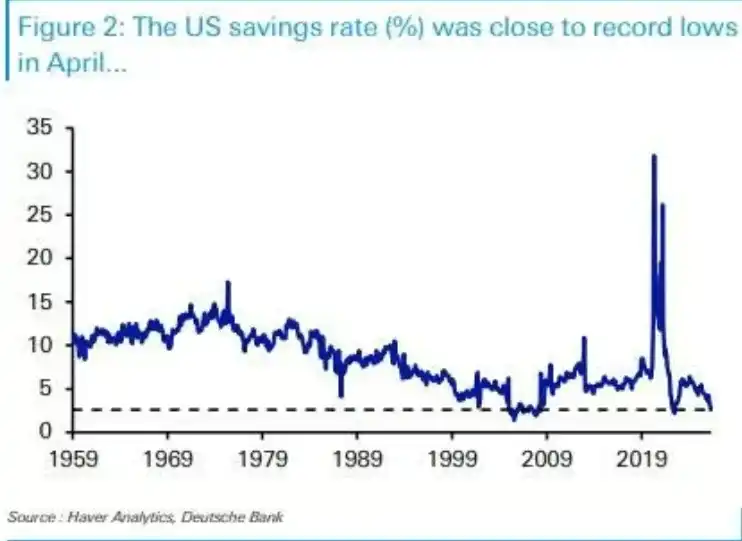
However, warning signals at the consumer level are accumulating. The US savings rate was just 2.6% in April, a similarly low level historically seen in only two other periods: a single month in 2022 (when pandemic-era excess savings were being depleted) and just before the global financial crisis erupted. Meanwhile, the University of Michigan Consumer Sentiment Index hit its all-time low in May since records began in 1952.

The monetary policy environment is also tightening. The European Central Bank is widely expected to raise interest rates this month, and market bets on Federal Reserve rate hikes in 2026 are heating up — with US PCE inflation reaching 3.8% year-on-year in April, providing support for this expectation.
Henry Allen notes that historically, hawkish stances from the Federal Reserve have often coincided with widening credit spreads, as seen in 2022, late 2018, and from 2015 to 2016. The current calm in credit markets forms a clear divergence from this historical pattern.

Bond Market Bearing Pressure Alone, Divergence with Stocks Continues to Widen

While equity and credit markets show high immunity to geopolitical risks, sovereign bond markets have charted a distinctly different course.

Over the past month, the yield on the 10-year US Treasury note has almost completely tracked oil price movements, clearly decoupling from other asset classes. In mid-May, sovereign bond yields hit multi-year highs: the 30-year US Treasury yield rose to 5.18%, the highest since 2007; the 10-year German bund yield climbed to 3.19%, the highest since 2011.

At that time, stocks were just a step away from record highs, while bond yields were already at levels not seen in over a decade. This divergence shows no signs of convergence to this day.

Henry Allen believes that bond markets more directly price in inflation and fiscal risks, hence reacting more sensitively to geopolitical shocks. The persistent divergence between stock and bond markets is itself a manifestation of current market fragility.

Unexpectedly Stable Oil Prices: A Key Pillar for Risk Assets

The blockade of the Strait of Hormuz has lasted far longer than initial market expectations, yet the reaction in oil prices has been surprisingly mild, which partly explains the resilience of risk assets.

When the US-Iran conflict erupted on February 28, the White House initially estimated the operation would last 4 to 6 weeks. However, the Strait of Hormuz remains blocked to this day. According to prediction market Polymarket data, the probability of normal navigation resuming by the end of June has plummeted from around 80% in mid-April to just 22%.
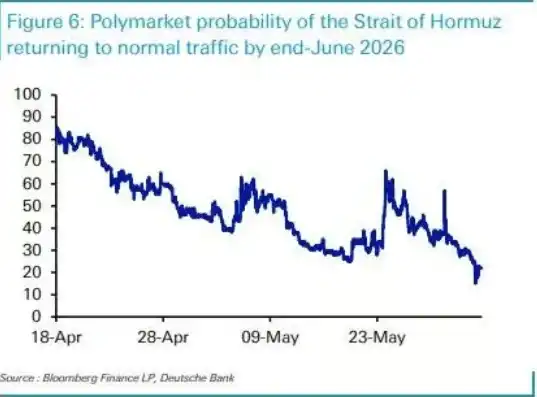
Despite this, the oil futures curve has remained relatively stable. Just two weeks after the conflict began, on March 13, the 6-month Brent crude futures contract settled at $85.66 per barrel. On June 1, the same contract was quoted around $84.88, barely moving.

Henry Allen points out that it is precisely because the oil futures curve has not shifted significantly higher that investors have not priced in serious stagflation risks, thereby avoiding larger-scale selling of risk assets. However, he warns that if the Strait of Hormuz blockade persists, whether this support can be maintained remains uncertain.


Трендові криптовалюти

Пов'язані питання

QAccording to the article, how many times since WWII has the S&P 500 gained 16% in a two-month period, and what is the key characteristic of the only non-recessionary precedent?

AAccording to the article, the S&P 500 has gained 16% in a two-month period only 4 times since WWII. Three of these instances occurred during recoveries from recessions. The only non-recessionary precedent was in January-February 1987, which preceded the 'Black Monday' crash later that year.

QWhat consumer-related warning signs are mentioned in the article as potential risks being overlooked by the market?

AThe article mentions two key consumer-related warning signs: the U.S. savings rate was only 2.6% in April (a level historically only seen briefly in 2022 and before the global financial crisis), and the University of Michigan Consumer Sentiment Index hit its lowest recorded level since 1952 in May.

QWhat historical anomaly does the article point out regarding the current relationship between Federal Reserve policy expectations and credit spreads?

AThe article points out a historical anomaly where tightening Federal Reserve policy has typically coincided with widening credit spreads, as seen in 2022, late 2018, and 2015-2016. However, currently, despite rising expectations for Fed rate hikes, credit spreads remain at historically low levels, showing a clear divergence from this past pattern.

QHow has the sovereign bond market behaved differently from the stock and credit markets in response to recent geopolitical risks?

AWhile stock and credit markets have shown resilience, the sovereign bond market has been under significant pressure. Specifically, the 10-year U.S. Treasury yield has closely followed oil price movements, decoupling from other assets. Yields on long-term U.S. and German government bonds recently hit multi-year highs, indicating the bond market is more directly pricing in inflation and fiscal risks.

QWhy has the oil market's reaction to the prolonged closure of the Strait of Hormuz been described as a 'key pillar' for risk assets?

AThe oil market's reaction has been a 'key pillar' for risk assets because, despite the Strait of Hormuz closure lasting much longer than initially expected, oil futures prices have remained surprisingly stable. This lack of a sharp upward move in the oil futures curve has prevented investors from pricing in severe stagflation risks, thereby avoiding a larger sell-off in riskier assets like stocks.

Пов'язані матеріали

Podcast Notes | Conversation with GSR Asset Management Head: To Determine if This Crypto Rally is Real, Just Watch the Lending Rates on Aave

Podcast Summary: Dialogue with GSR's Head of Asset Management: To Determine if This Crypto Rally is Real, Just Check Lending Rates on Aave Andy Baehr, Managing Director of Asset Management at GSR, discusses the current crypto market, characterizing it as stuck in a state of "ambivalence" with short-lived, unsustainable rallies. He outlines a simple framework: the market moves between "ambivalence" and "conviction" (sustained upward momentum). Currently, every rally resembles a single-stage rocket booster that quickly fizzles out. Baehr identifies three key signals to watch: 1) DeFi lending rates, 2) the potential passage of the CLARITY Act, and 3) the market forming a consensus on the "Fed hawkish peak." He emphasizes that the most immediate indicator for the sustainability of the recent CPI-triggered rally is the USDC borrowing rate on Aave, currently around 3.75%—close to U.S. Treasury yields. The absence of a credit spread indicates low leverage demand and a lack of market energy. He explains that a healthy, sustained rally requires layered buying pressure. Last year's rally progressed from an ETH short squeeze to crypto-native trader influx and finally to ETF inflows. Currently, this structure is missing. Other potential structural buyers like Digital Asset Treasury (DAT) companies are absent, and ETF flows have proven transient. Baehr notes that while small-cap crypto tokens outperformed large caps in Q2—a potential sign of capitation in major assets—capital is also flowing to more exciting opportunities like AI stocks and tech IPOs, leaving crypto sidelined. Regarding DeFi, he highlights that platforms like Aave provide a clear, real-time signal of leverage demand through their supply/demand-driven interest rates. A significant, sustained rate increase would signal genuine market conviction. He also observes the quiet emergence of fixed-income-like products and vaults in DeFi. On regulation, the probability of the CLARITY Act passing before the August 7th deadline has dropped linearly from 75% to below 40% on Polymarket. Baehr suggests its passage would be treated as a bullish surprise, a potent driver for price movement. However, political hurdles, including ethical clause debates and disclosures about the First Family's crypto profits, remain significant obstacles. Ultimately, the market awaits clarity on the Fed's terminal rate under Chair Warsh. Until the "Fed Solstice"—the point where the market collectively understands the peak of hawkish policy—sustained conviction will be difficult to achieve.

marsbit27 хв тому

Podcast Notes | Conversation with GSR Asset Management Head: To Determine if This Crypto Rally is Real, Just Watch the Lending Rates on Aave

marsbit27 хв тому

7 Months After the Collapse of Huiwang, Southeast Asia's Escrow Platforms Undergo a Major Reshuffle

Following the collapse of Huione Pay—dubbed the "Alipay of Southeast Asia"—seven months ago, the region's underground financial guarantee platform sector is undergoing a significant reshuffle. This power vacuum has been swiftly filled by emerging platforms such as XinBi, Tiger/Navigator, JinBei (renamed JinBo), Dali/Tiancheng, and FullyLight. These platforms, operating largely via Telegram and offering services like escrow for illicit transactions, have absorbed the vast user base and markets left behind by Huione. While positioning themselves as "trust intermediaries," their primary clientele consists of networks involved in online scams, money laundering, illegal gambling, and even human trafficking. For instance, the Tiger/Navigator platform explicitly provides "escrow" services for kidnapping-for-ransom operations ("强押车交易"). Data underscores the immense scale: Huione alone processed over $103 billion in cryptocurrency payments and facilitated over $31 billion through its escrow market before its downfall, linking it to Cambodia's notorious Prince Group. Since its collapse, competitors have seen explosive growth. For example, the XinBi platform has accumulated over $1.6 billion in total USDT revenue, while platforms like NewPay, OkPay (under Dali), and FullyLight Wallet collectively processed over $4.8 billion in USDT in a single year. This ecosystem thrives in regions like Cambodia and Myanmar, where regulatory gaps allow these platforms to act as critical financial infrastructure for sprawling cybercrime industries, from scam compounds to online casinos. The article concludes that the moniker "Southeast Asian Alipay" is a misnomer, obscuring the platforms' fundamental role in enabling serious criminal enterprises rather than representing legitimate financial innovation.

Odaily星球日报1 год тому

7 Months After the Collapse of Huiwang, Southeast Asia's Escrow Platforms Undergo a Major Reshuffle

Odaily星球日报1 год тому

Торгівля

Спот

Популярні статті

Як купити 4

Ласкаво просимо до HTX.com! Ми зробили покупку 4 (4) простою та зручною. Дотримуйтесь нашої покрокової інструкції, щоб розпочати свою криптовалютну подорож.Крок 1: Створіть обліковий запис на HTXВикористовуйте свою електронну пошту або номер телефону, щоб зареєструвати обліковий запис на HTX безплатно. Пройдіть безпроблемну реєстрацію й отримайте доступ до всіх функцій.ЗареєструватисьКрок 2: Перейдіть до розділу Купити крипту і виберіть спосіб оплатиКредитна/дебетова картка: використовуйте вашу картку Visa або Mastercard, щоб миттєво купити 4 (4).Баланс: використовуйте кошти з балансу вашого рахунку HTX для безперешкодної торгівлі.Треті особи: ми додали популярні способи оплати, такі як Google Pay та Apple Pay, щоб підвищити зручність.P2P: Торгуйте безпосередньо з іншими користувачами на HTX.Позабіржова торгівля (OTC): ми пропонуємо індивідуальні послуги та конкурентні обмінні курси для трейдерів.Крок 3: Зберігайте свої 4 (4)Після придбання 4 (4) збережіть його у своєму обліковому записі на HTX. Крім того, ви можете відправити його в інше місце за допомогою блокчейн-переказу або використовувати його для торгівлі іншими криптовалютами.Крок 4: Торгівля 4 (4)Легко торгуйте 4 (4) на спотовому ринку HTX. Просто увійдіть до свого облікового запису, виберіть торгову пару, укладайте угоди та спостерігайте за ними в режимі реального часу. Ми пропонуємо зручний досвід як для початківців, так і для досвідчених трейдерів.

475 переглядів усьогоОпубліковано 2025.10.20Оновлено 2026.06.02

Як купити 4

Обговорення

Ласкаво просимо до спільноти HTX. Тут ви можете бути в курсі останніх подій розвитку платформи та отримати доступ до професійної ринкової інформації. Нижче представлені думки користувачів щодо ціни 4 (4).

活动图片