US Spot XRP ETF Inflows Hit A One-Month High: Here Are The Numbers

bitcoinistОпубліковано о 2026-01-06Востаннє оновлено о 2026-01-06

Анотація

US spot XRP ETFs recorded their strongest net inflow in over a month on January 5, with $46.1 million in new investments—the seventh-largest daily inflow since launch. This surge coincided with XRP’s price rising over 11% to approximately $2.40. Total net assets for the ETF cohort reached $1.65 billion, with cumulative inflows hitting $1.23 billion. Bitwise led issuers with $16.61 million in daily inflows, followed by Franklin, Grayscale, and 21Shares. Canary’s XRPC remained the largest fund by net assets at $407 million. The day reflected active trading and a re-acceleration in investor interest after a quieter period in late December.

US spot XRP exchange-traded funds (ETFs) logged their strongest day of net inflows in more than a month on Jan. 5, as XRP rallied sharply and trading activity accelerated across both the token and the ETF wrapper.

SoSoValue data shows the ETF complex pulled in $46.1 million in net new money on Jan. 5, the seventh-largest inflow day since launch and the biggest since Dec. 3, when daily net inflows reached $50.27 million. The same dataset shows cumulative net inflows rising to $1.23 billion, while total net assets climbed to $1.65 billion, alongside $72.15 million in total value traded.
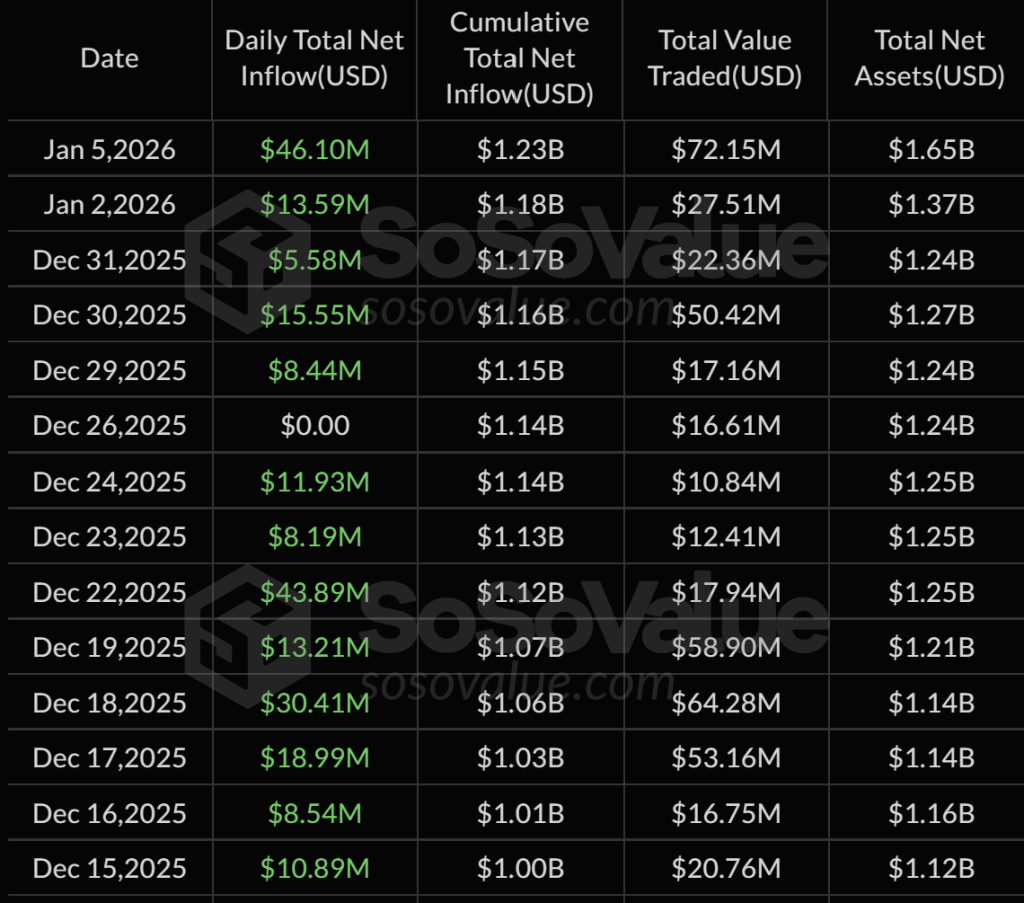
US spot XRP ETF daily flow data | Source: SoSoValue

US Spot XRP ETF Snapshot

The move coincided with a broad jump in XRP itself. The cryptocurrency rose more than 11% over the past 24 hours to around $2.40, lifting its market capitalization above $144.3 billion. Spot trading volume reached $7.32 billion, up 144% over the same period, according to CoinMarketCap data.

Flow leadership on Jan. 5 was distributed across all issuers rather than concentrated in a single product. According to SoSoValue’s market-data table, Bitwise’s XRP product led with $16.61 million in daily net inflows, while Franklin’s XRPZ brought in $12.59 million, Grayscale’s GXRP added $9.89 million, and 21Shares’ TOXR posted $7.01 million.

Measured by total net assets, the issuer leaderboard remained led by Canary’s XRPC at $407.01 million as of Jan. 5, giving it the largest footprint in the US spot XRP ETF cohort despite posting $0.00 in net inflows on the day.

21Shares’ TOXR follows with $324.39 million, narrowly ahead of Bitwise’s XRP at $322.85 million. Franklin’s XRPZ ranked fourth at $298.38 million, while Grayscale’s GXRP was close behind at $294.35 million, showing how tightly clustered the mid-pack has become even as XRPC maintains a clear lead at the top.

US spot XRP ETF data by sponsor | Source: SoSoValue

While the inflow tally was the headline, secondary metrics suggested the day was not simply a passive allocation event. Several products printed sizable on-venue value traded, including XRPZ at $27.98 million and Bitwise’s XRP at $23.06 million, pointing to active participation rather than slow, incremental creation activity.

Notably, Jan. 5’s $46.1 million haul was notable, but it was still only the seventh-largest single-day inflow since the US spot XRP ETF cohort launched. The biggest subscription days were clustered earlier in the product’s life, when headline inflows regularly printed above current levels, making Monday’s figure less about a new peak and more about a clear re-acceleration after a quieter stretch through late December, and the strongest day since Dec. 3’s $50.27 million.

At press time, XRP traded at $2.33.
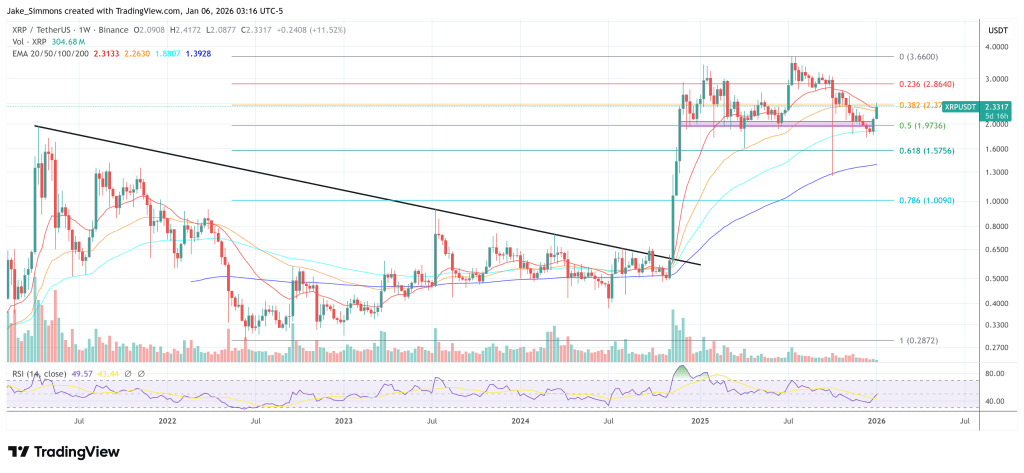
XRP faces the 0.382 Fib, 1-week chart | Source: XRPUSDT on TradingView.com

Трендові криптовалюти

Пов'язані питання

QWhat was the net inflow day for US spot XRP ETFs on January 5th, and how much was it?

AJanuary 5th was the strongest day of net inflows in over a month for US spot XRP ETFs, with a total of $46.1 million in net new money.

QWhich issuer's XRP ETF product led in daily net inflows on January 5th, and what was the amount?

ABitwise's XRP product led in daily net inflows on January 5th, bringing in $16.61 million.

QWhat was the total cumulative net inflow and total net asset value for the US spot XRP ETF complex as of the data?

AThe cumulative net inflows rose to $1.23 billion, while the total net assets climbed to $1.65 billion.

QWhich ETF has the largest total net assets, and what was its value?

ACanary's XRPC has the largest total net assets, valued at $407.01 million as of January 5th.

QHow did the price of XRP perform in the 24 hours leading up to the report?

AThe cryptocurrency XRP rose more than 11% over the past 24 hours to around $2.40.

Пов'язані матеріали

Agent Race Ends, Super Workbench Takes Over

The era of fragmented AI agents is ending. Over the past month, China's tech giants—Tencent, Alibaba, and ByteDance—have simultaneously shifted strategy: instead of launching new, standalone AI agents, they are consolidating their various agent projects into unified "super workbenches." Tencent integrated its QClaw teams into WorkBuddy, a strategic product hailed as a potential third flagship after QQ and WeChat. Alibaba is merging its QoderWork, Wukong, and MuleRun agents into a new "Qianwen Office" platform under DingTalk's leadership. ByteDance rebranded its TRAE SOLO coding agent to TRAE Work, signaling a broader focus on workflow collaboration. This convergence marks a pivotal industry consensus. The initial exploration phase, where companies rapidly built numerous overlapping agents for different scenarios, proved costly and inefficient. With open-source tools eroding technical barriers, competition has shifted from agent creation to resource consolidation and cost control. Historically, platform wars are won not by creating more products, but by simplifying them—as seen with browsers unifying web access and super-apps consolidating services. Now, the "super workbench" aims to become the unified AI entry point for work. This reflects a deeper market realization: the primary audience for AI is no longer just programmers (a market in the tens of millions) but all knowledge workers (a market of billions). The real opportunity lies in augmenting everyday tasks—managing emails, documents, data, and meetings—across the entire workday. The core battleground is becoming control over the primary AI entry point that employees use daily. Tencent's WorkBuddy leverages WeChat and Tencent Docs; Alibaba's Qianwen Office taps into DingTalk's organizational data; ByteDance's TRAE Work integrates with Feishu's workflows. Whoever owns this "super workbench" gains strategic control over orchestrating enterprise data and APIs. This shift is redefining enterprise software. Traditional SaaS applications, valued for their user interfaces, will recede into the background. Their core functionalities will be exposed as standardized "Skills" or APIs for the super workbench's agents to invoke. Software value will shift from selling user seats to charging based on API calls and outcomes delivered. The evolution of agents is moving through clear stages: first as novel standalone products, then as consolidated primary work entry points, and finally as pervasive, invisible capabilities embedded into the digital fabric. The recent moves by major tech firms signal the transition from the first stage into the second, accelerating toward the third. In the end, the most successful agent technology may become invisible—like electricity or the HTTP protocol—a fundamental, unnamed infrastructure powering work itself.

marsbit8 хв тому

Agent Race Ends, Super Workbench Takes Over

marsbit8 хв тому

Michael Saylor: 110 Reasons to Oppose BIP-110

Michael Saylor presents 110 arguments against Bitcoin Improvement Proposal (BIP) 110, a soft fork aimed at restricting certain non-monetary data storage uses (like inscriptions) on the Bitcoin blockchain. He acknowledges the proponents' valid concerns—such as node costs, fee pressure, and preserving Bitcoin's monetary focus—but fundamentally disagrees with the proposed solution. Saylor argues that BIP 110 represents a dangerous precedent of using consensus rules to enforce value judgments on transaction validity, moving away from Bitcoin's core principles of neutrality and permissionless innovation. His key objections are organized into eleven categories: 1) It violates neutrality and hard consensus by banning currently valid transactions. 2) It fails to meet the high burden of proof required for a consensus change, lacking concrete data on the alleged crisis. 3) Its seven bundled technical restrictions are overly broad, targeting generic script functionalities and blocking future upgrade paths. 4) It sacrifices compatibility and future optionality by closing off designed upgrade hooks. 5) Its temporary rules add significant complexity (grandfathering, expiry states) without sufficient justification. 6) The economic and security impacts, particularly on miner revenue and fee markets, are uncertain and unmodeled. 7) Superior, market-based tools (fee markets, relay/mining policies) already exist to manage blockchain load. 8) It stifles innovation by creating a chilling effect for developers. 9) Its modified activation mechanism (55% threshold, forced signaling) is aggressive and risks network splits. 10) The precedent it sets—using consensus to suppress disliked but legal uses—is more dangerous than the problem it aims to solve. 11) A better path exists: improving measurements, refining resource-based policies, and allowing market forces to work. Saylor concludes that Bitcoin's strength lies in its neutral rules, open markets, and hard consensus. Changing these foundational elements to target specific use cases is an unnecessary and risky "iatrogenic" intervention. He advocates for guarding Bitcoin's neutrality rather than acting as its redeemer.

marsbit24 хв тому

Michael Saylor: 110 Reasons to Oppose BIP-110

marsbit24 хв тому

Торгівля

Спот

Популярні статті

Як купити ONE

Ласкаво просимо до HTX.com! Ми зробили покупку Harmony (ONE) простою та зручною. Дотримуйтесь нашої покрокової інструкції, щоб розпочати свою криптовалютну подорож.Крок 1: Створіть обліковий запис на HTXВикористовуйте свою електронну пошту або номер телефону, щоб зареєструвати обліковий запис на HTX безплатно. Пройдіть безпроблемну реєстрацію й отримайте доступ до всіх функцій.ЗареєструватисьКрок 2: Перейдіть до розділу Купити крипту і виберіть спосіб оплатиКредитна/дебетова картка: використовуйте вашу картку Visa або Mastercard, щоб миттєво купити Harmony (ONE).Баланс: використовуйте кошти з балансу вашого рахунку HTX для безперешкодної торгівлі.Треті особи: ми додали популярні способи оплати, такі як Google Pay та Apple Pay, щоб підвищити зручність.P2P: Торгуйте безпосередньо з іншими користувачами на HTX.Позабіржова торгівля (OTC): ми пропонуємо індивідуальні послуги та конкурентні обмінні курси для трейдерів.Крок 3: Зберігайте свої Harmony (ONE)Після придбання Harmony (ONE) збережіть його у своєму обліковому записі на HTX. Крім того, ви можете відправити його в інше місце за допомогою блокчейн-переказу або використовувати його для торгівлі іншими криптовалютами.Крок 4: Торгівля Harmony (ONE)Легко торгуйте Harmony (ONE) на спотовому ринку HTX. Просто увійдіть до свого облікового запису, виберіть торгову пару, укладайте угоди та спостерігайте за ними в режимі реального часу. Ми пропонуємо зручний досвід як для початківців, так і для досвідчених трейдерів.

428 переглядів усьогоОпубліковано 2024.12.12Оновлено 2026.06.02

Як купити ONE

Обговорення

Ласкаво просимо до спільноти HTX. Тут ви можете бути в курсі останніх подій розвитку платформи та отримати доступ до професійної ринкової інформації. Нижче представлені думки користувачів щодо ціни ONE (ONE).

活动图片










