US Senate Targets Fall 2026 Release for Crypto Tax Bill Amid CLARITY Act Push

TheNewsCryptoОпубліковано о 2026-06-24Востаннє оновлено о 2026-06-24

Анотація

U.S. Senators are targeting Fall 2026 for the potential release of a dedicated cryptocurrency tax bill. Senator Steve Daines revealed that Republicans have already developed a framework for the legislation, which aligns closely with recent crypto tax proposals from the House of Representatives. The Senate Finance Committee's move is driven by growing congressional interest in establishing clearer tax rules for virtual assets, addressing areas like staking rewards and mining. Concurrently, lawmakers continue to prioritize the broader Digital Asset Market CLARITY Act, which passed the Senate Banking Committee with bipartisan support. This act aims to create comprehensive regulations and define federal regulatory authority over cryptocurrencies. Over 200 industry groups are advocating for its passage, arguing that regulatory clarity will boost innovation and investment. Market observers view the tax bill and the CLARITY Act as complementary efforts to build a more complete regulatory framework for digital assets. While neither proposal has been finalized, the legislative activity signals accelerating progress in U.S. crypto regulation.

U.S. Lawmakers continue to advance digital asset regulations as the Senate moves closer to introducing dedicated cryptocurrency tax legislation. Senator Steve Daines revealed that Republican senators had already developed the framework. During an interview with Bloomberg Tax, Sen. Steve Daines said, “sooner rather than later”. He also said, “We’ve put together a framework,” Which means Congress has developed a framework for deliberation and discussion. Although Daines did not reveal any further information, he added that the plan is very similar to recent cryptocurrency tax bills proposed by the House of Representatives.
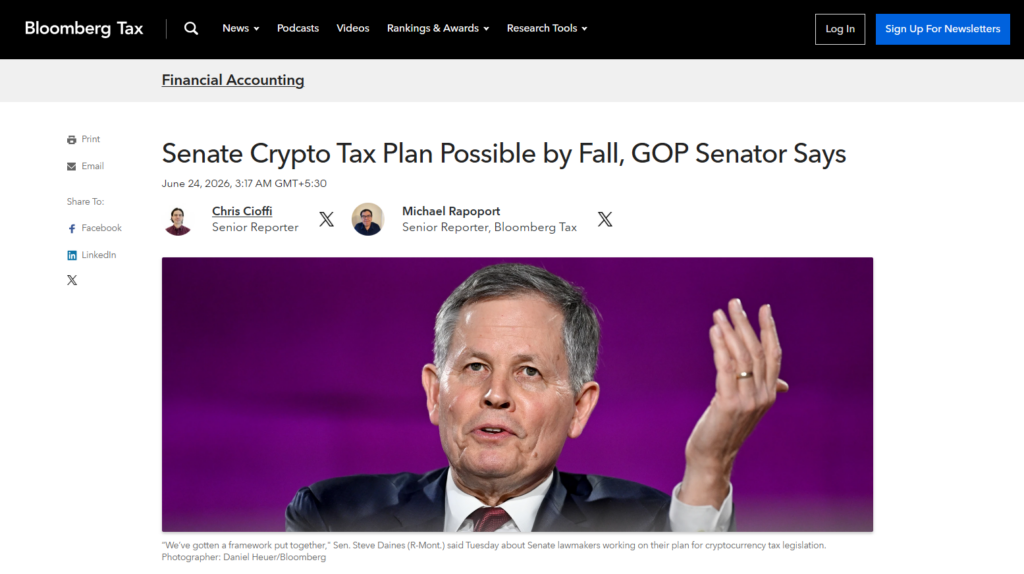
Source: Bloomberg Tax

Growing congressional interest in clearer tax rules for virtual assets prompted the Senate to develop the proposal. The Senate Finance Committee has previously discussed cryptocurrency tax legislation. Especially during hearings on staking rewards, mining, and other issues associated with the reporting of digital assets.

Additionally, several drafts of cryptocurrency tax legislation have been proposed in the House of Representatives, including by the House Ways and Means Committee. The legislation deals with such issues as staking, mining, decentralized finance operations, stablecoin transactions, and others.

CLARITY Act Still the Top Priority

While the Senate is moving forward with its tax proposal, the lawmakers are still discussing the Digital Asset Market CLARITY Act. This act aims at building an all-encompassing regulation for cryptocurrencies and defining regulatory authority for both federal authorities. The Senate Banking Committee passed this bill via a 15-9 bipartisan vote. Although the Senate is awaiting other provisions, the act is already under discussion.

Meanwhile, industry groups remain advocates for the bill, with over 200 cryptocurrency companies calling on the Senate leadership to put the bill up for a vote. They say that clear regulations will spur innovation and investments in the US digital assets market.

Regulatory Clarity Is Still at the Top of the Agenda

Both projects will be followed by market players because taxation and regulation are always crucial for the crypto business and investors. It is believed that the tax provision of the Senate and the CLARITY Act are complementary moves that aim at creating a more complete framework for digital assets. Despite the fact that neither of the projects has been finally approved yet, the activity of Congress demonstrates that the development of legislation for cryptocurrencies is gaining pace. It may be quite interesting for the next few months.

Highlighted Crypto News:

Ripple Secures Preliminary MiCA Approval in Luxembourg for Europe-Wide Expansion

TagsBlockchainBloombergClarity ACTCrypto Taxcrypto taxationSenatorU.SU.S Congress

Трендові криптовалюти

Пов'язані питання

QWhat is the target release timeline for the US Senate's crypto tax bill, according to the article?

AThe US Senate is targeting a Fall 2026 release for its cryptocurrency tax bill.

QAccording to Senator Steve Daines, what stage has Congress reached regarding the crypto tax framework?

AAccording to Senator Steve Daines, Congress has developed a framework for the cryptocurrency tax legislation for deliberation and discussion.

QWhat is the main goal of the Digital Asset Market CLARITY Act mentioned in the article?

AThe main goal of the CLARITY Act is to build an all-encompassing regulation for cryptocurrencies and define regulatory authority for federal authorities.

QWhy are market players closely following both the Senate's tax proposal and the CLARITY Act?

AMarket players are closely following both projects because taxation and regulation are crucial for the crypto business and investors, and these moves aim to create a more complete framework for digital assets.

QHow did the industry show its support for the CLARITY Act, as per the article?

AOver 200 cryptocurrency companies called on the Senate leadership to put the CLARITY Act up for a vote, advocating that clear regulations will spur innovation and investments in the US digital assets market.

Пов'язані матеріали

How xBubble Breaks Through in the VC-Heavily-Backed OPC Economy

xBubble: Addressing the Structural Gap in the VC-Backed OPC Economy The concept of OPC (One Person Company) is evolving from a buzzword to a significant AI-driven market. While AI coding tools like Replit and Lovable have validated demand from non-technical users wanting to build applications, a key gap remains: the leap from creating a demo to running a stable, evolving business. These tools still require users to manage the development process, including technical judgments for integrations, modifications, and deployments—a major hurdle for OPCs. xBubble, by DAPPOS, tackles this by shifting from "Prompt-to-Code" to "SOP-to-Business." Instead of generating code from instructions, its core is a system of pre-organized SOPs (Standard Operating Procedures) that translate business goals—like "sell World Cup merchandise"—into complete, executable workflows. This includes generating cohesive assets, pages, payment systems, and backend logic. The platform is augmented by a network of third-party service providers who handle infrastructure (hosting, domains, payment setup), acting like "on-site service engineers." Users can pay for these services directly with xBubble credits, simplifying onboarding. This ecosystem aims to deliver not just an app, but a complete, modifiable business launch path. xBubble targets a clear OPC segment: small commercial nodes (e.g., creators, merchants) with existing products, customers, or channels, but for whom a full tech team is unjustifiable. Its potential lies in SOPs accumulating expertise from real cases, improving reliability and reducing delivery costs over time. Additionally, its native support for crypto payments caters to global or digital-native OPCs. In summary, as AI democratizes software creation, xBubble's opportunity is to prove that "SOP-to-Business" provides more immediate value for launching a real, operational business than a powerful but unstructured AI coding tool.

链捕手2 хв тому

How xBubble Breaks Through in the VC-Heavily-Backed OPC Economy

链捕手2 хв тому

If It's Not a Clear Yes, It's a No: A Nine-Year Retrospective by a VC Who Survived Four Cycles

**"Invest Only When Certain": A Nine-Year Retrospective from a VC Across Four Cycles** IOSG founder Jocy shares hard-earned lessons from nine years and over a hundred investments in Web3. The core challenge isn't identifying successful founders, but understanding why talented founders with solid ideas still fail. Through building a "failed founder database," IOSG identified six recurring failure patterns. **Founder Trait Red Flags:** 1. **Emotionally Unstable:** Founders who react defensively to criticism or publicly lash out under pressure (e.g., 80% drawdowns) often fail. Resilience is key. 2. **Lacking Hunger / Having a Fallback:** Founders with significant safety nets (family wealth, cushy fallback jobs) may lack the "do-or-die" commitment needed to survive crypto's brutal cycles. 3. **Unchecked Ego:** Includes "polished execution machines" who excel in known frameworks but struggle when paradigms shift, and "professor-types" who are technically brilliant but resistant to commercial feedback or coaching. **Project Structure Red Flags:** 4. **Token-First, Not Product-First:** Treating the token solely as a fundraising tool with no real utility or connection to product value is a major warning sign. The project should have value even if the token goes to zero. 5. **No Day-1 Exit Thesis:** Founders must have a clear, staged capital strategy from the start, understanding what each funding round needs to prove to unlock the next. "Exit before entry" is crucial. 6. **No Full-Cycle Experience:** Founders who haven't lived through a complete crypto bull/bear cycle (e.g., 2018, 2022) often underestimate their vulnerability. IOSG limits initial checks for such teams to $250k, sizing for risk. **The Positive Flipside: Desirable Founder Traits** The ideal candidate exhibits: obsessive problem-depth, being a second-time founder with a non-consensus vision, strong communication skills with *controlled* ego, relentless perseverance, and a global perspective with agency and taste (increasingly vital in the AI era). **Three Survival Tips for Founders:** 1. **Cash Flow Over Narrative:** Real revenue is what sustains projects, not vanity metrics. 2. **Tokens Are a Liability:** Avoid issuing a token unless absolutely necessary. The hidden costs (market making, liquidity, compliance) are immense, often a multi-million-dollar burden. 3. **Respect Liquidity:** Sell during peaks to build treasury, buy back to support the protocol during troughs. Be realistic about valuations and your ability to deliver for the next round. The final principle is simple yet paramount: **"If it's a borderline 'yes' or 'no,' don't invest."** In an industry that reinvents itself every few years, the discipline to consistently say "no" is the ultimate secret to longevity.

Foresight News27 хв тому

If It's Not a Clear Yes, It's a No: A Nine-Year Retrospective by a VC Who Survived Four Cycles

Foresight News27 хв тому

SemiAnalysis Deep Dive into CXMT: $50 Billion Revenue, An IPO Amidst a Supercycle

SemiAnalysis' in-depth report on ChangXin Memory Technologies (CXMT) details its rapid rise as China's largest upcoming semiconductor IPO. Founded in 2016 by Zhu Yiming, CXMT built its DRAM foundation on acquired patents and talent from the bankrupt German firm Qimonda. It achieved its first annual profit in 2025 after nearly a decade of significant capital support, primarily from patient Hefei municipal investors who fostered a local supply chain. The company is now capitalizing on a strong DRAM supercycle. Its revenue soared from ~$3.3B in 2024 to ~$8.6B in 2025, with Q1 2026 alone reaching ~$7.3B. SemiAnalysis projects full-year 2026 revenue could exceed $50B, driven by soaring ASPs rather than massive market share gains. While CXMT is closing the capacity gap with Micron, its product mix remains heavily focused on commodity DDR/LPDDR, which currently offers higher margins than its nascent HBM business. CXMT faces significant challenges in HBM, struggling with yield and stability for HBM3 8-Hi stacks while lagging behind the big three (Samsung, SK Hynix, Micron) in advanced nodes. However, strategic national priorities for AI self-sufficiency may push it to accelerate HBM capacity. Its complex IPO structure reveals heavy state-backed ownership and voting control over its fabs, with Alibaba appearing as both a key cloud customer and a minority shareholder. The IPO aims to raise ~$4.1B, primarily to strengthen its core DRAM manufacturing base.

marsbit47 хв тому

SemiAnalysis Deep Dive into CXMT: $50 Billion Revenue, An IPO Amidst a Supercycle

marsbit47 хв тому

Торгівля

Спот
Ф'ючерси

Популярні статті

Як купити PUSH

Ласкаво просимо до HTX.com! Ми зробили покупку Push Protocol (PUSH) простою та зручною. Дотримуйтесь нашої покрокової інструкції, щоб розпочати свою криптовалютну подорож.Крок 1: Створіть обліковий запис на HTXВикористовуйте свою електронну пошту або номер телефону, щоб зареєструвати обліковий запис на HTX безплатно. Пройдіть безпроблемну реєстрацію й отримайте доступ до всіх функцій.ЗареєструватисьКрок 2: Перейдіть до розділу Купити крипту і виберіть спосіб оплатиКредитна/дебетова картка: використовуйте вашу картку Visa або Mastercard, щоб миттєво купити Push Protocol (PUSH).Баланс: використовуйте кошти з балансу вашого рахунку HTX для безперешкодної торгівлі.Треті особи: ми додали популярні способи оплати, такі як Google Pay та Apple Pay, щоб підвищити зручність.P2P: Торгуйте безпосередньо з іншими користувачами на HTX.Позабіржова торгівля (OTC): ми пропонуємо індивідуальні послуги та конкурентні обмінні курси для трейдерів.Крок 3: Зберігайте свої Push Protocol (PUSH)Після придбання Push Protocol (PUSH) збережіть його у своєму обліковому записі на HTX. Крім того, ви можете відправити його в інше місце за допомогою блокчейн-переказу або використовувати його для торгівлі іншими криптовалютами.Крок 4: Торгівля Push Protocol (PUSH)Легко торгуйте Push Protocol (PUSH) на спотовому ринку HTX. Просто увійдіть до свого облікового запису, виберіть торгову пару, укладайте угоди та спостерігайте за ними в режимі реального часу. Ми пропонуємо зручний досвід як для початківців, так і для досвідчених трейдерів.

580 переглядів усьогоОпубліковано 2024.12.13Оновлено 2026.06.02

Як купити PUSH

Обговорення

Ласкаво просимо до спільноти HTX. Тут ви можете бути в курсі останніх подій розвитку платформи та отримати доступ до професійної ринкової інформації. Нижче представлені думки користувачів щодо ціни PUSH (PUSH).

活动图片