US SEC Issues Key Crypto Custody Guidelines For Broker-Dealers

bitcoinistОпубліковано о 2025-12-19Востаннє оновлено о 2025-12-19

In its latest effort to provide clearer regulatory clarity, the US Securities and Exchange Commission (SEC) has published detailed guidelines for broker-dealers on the custody of crypto assets.

SEC Clarifies Crypto Custody Standards For Broker-Dealers

On Wednesday, the SEC’s staff of the Division of Trading and Markets issued a statement addressed its views on the application of paragraph (b)(1) of Rule 15c3-3 to crypto assets that are considered securities, including tokenized versions of an equity or debt security.

Under Securities Exchange Act of 1934, Rule 15c3-3 requires any broker-dealer to “promptly obtain and thereafter maintain physical possession or control of all fully paid and excess margin securities it carries for the account of customers.”

The new guidelines clarify how “any broker-dealer that carries crypto asset securities for customers, including broker-dealers that conduct a traditional securities business” can maintain compliance with this rule despite tokens being on the blockchain.

According to the SEC’s statement, a broker-dealer can consider itself to have “physical possession” of the crypto assets if it has direct access to the asset and the capability to transfer it on the associated distributed ledger technology (DLT).

Broker-dealers must also conduct and document an throughout assessment “of the distributed ledger technology and the associated network where transfers of ownership of a crypto asset security are recorded prior to undertaking to maintain possession of the crypto asset security, and at reasonable intervals thereafter.”

In additions, they must establish, maintain, and enforce “reasonably designed written policies and procedures” to ensure the assets’ security, the protection of private keys, they have adequate plans to address unexpected disruptions to its possession of the crypto assets, including theft, unauthorized used, network attacks, and hard forks.

This circumstance emphasizes that a broker-dealer has policies, procedures, and controls reasonably designed to help ensure that no other person, including the broker-dealer’s customer or a third-party (including the broker-dealer’s affiliate), has access to the relevant private keys and the ability to transfer the asset without the authorization of the broker-dealer.

Meanwhile, the agency explained that “a broker-dealer does not deem itself to possess a crypto asset security if the broker-dealer is aware of any material security or operational problems or weaknesses with the distributed ledger technology and associated network used to access and transfer the crypto asset security or is aware of other material risks posed to the broker-dealer’s business by custodying the crypto asset security.”

SEC’s Path To Clearer Rules

The SEC affirmed that the statement is part of its efforts to provide greater clarity on the application of federal securities laws to crypto assets. Notably, the regulatory agency recently published guidelines to help educate retail investors about the ways they can hold crypto assets and is pushing to modernize its rules to facilitate an positive market environment.

Earlier this month, the US regulator revealed it is evaluating tokenization to modernize the issuance, trading, and settlement of public equities. SEC chairman Paul Atkins asserted that “Distributed ledger technology and the tokenization of financial assets, including securities, have the potential to transform our capital markets.”

Moreover, Atkins recently stated that the Commission could issue innovation exemption rules for crypto firms in early 2026. The agency has been considering the rule exemption since July to “permit novel ways of trading and more narrowly tailored forms of relief to facilitate the building of other components of a tokenized securities ecosystem.”

The change would allow crypto firms to quickly launch products without having to comply with “burdensome prescriptive regulatory requirements that hinder productive economic activity.” Instead, they would “be able to comply with certain principles-based conditions designed to achieve the core policy aims of the federal securities laws.”
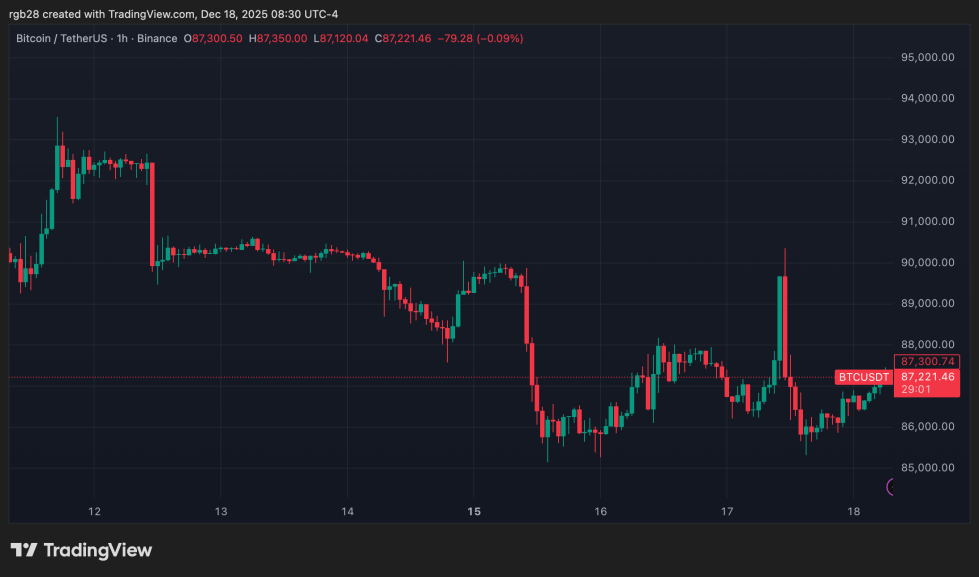
Bitcoin (BTC) trades at $87,221 in the one-week chart. Source: BTCUSDT on TradingView


Пов'язані питання

QWhat is the main focus of the new SEC guidelines for broker-dealers regarding crypto assets?

AThe guidelines clarify how broker-dealers can maintain compliance with Rule 15c3-3 when custodying crypto assets that are considered securities, including requirements for physical possession, security assessments, and written policies.

QAccording to the SEC, when can a broker-dealer consider itself to have 'physical possession' of a crypto asset security?

AA broker-dealer can consider itself to have physical possession if it has direct access to the asset and the capability to transfer it on the associated distributed ledger technology (DLT).

QWhat must broker-dealers assess and document prior to maintaining possession of crypto asset securities?

AThey must conduct and document a thorough assessment of the distributed ledger technology and the associated network where ownership transfers are recorded, both before custody and at reasonable intervals thereafter.

QWhat potential future regulatory change for crypto firms did SEC chairman Paul Atkins mention?

AHe stated that the Commission could issue innovation exemption rules in early 2026, allowing crypto firms to launch products without burdensome prescriptive requirements while complying with principles-based conditions.

QWhat broader initiative is the SEC undertaking regarding tokenization and distributed ledger technology?

AThe SEC is evaluating tokenization to modernize the issuance, trading, and settlement of public equities, recognizing its potential to transform capital markets.

Пов'язані матеріали

The Second Half of Macro Influencer Fu Peng's Career

Fu Peng, a prominent Chinese macroeconomist and former chief economist of Northeast Securities, has joined Hong Kong-based digital asset management firm Bitfire Group (formerly New Huo Group) as its chief economist. This move, announced in April 2026, triggered an 11% surge in Bitfire's stock price. Fu, known for his accessible macroeconomic commentary and large social media following, will focus on integrating digital assets into global asset allocation frameworks, particularly combining FICC (fixed income, currencies, and commodities) with cryptocurrencies for institutional clients. His career includes roles at Lehman Brothers and Solomon International, with significant influence gained through public communication. However, in late 2024, Fu faced temporary social media bans after a controversial private speech at HSBC on China's economic challenges, though he denied regulatory sanctions. He later left Northeast Securities citing health reasons. Bitfire, a licensed virtual asset manager serving high-net-worth clients, seeks to build trust and attract traditional capital through Fu’s expertise and credibility. The partnership represents a strategic shift for both: Fu enters the crypto sector after a traditional finance peak, while Bitfire aims to leverage his macro framework for institutional adoption. Outcomes remain uncertain regarding capital inflows and compatibility within corporate structure.

marsbit51 хв тому

The Second Half of Macro Influencer Fu Peng's Career

marsbit51 хв тому

Торгівля

Спот
Ф'ючерси

Популярні статті

Як купити US

Ласкаво просимо до HTX.com! Ми зробили покупку Talus Network (US) простою та зручною. Дотримуйтесь нашої покрокової інструкції, щоб розпочати свою криптовалютну подорож.Крок 1: Створіть обліковий запис на HTXВикористовуйте свою електронну пошту або номер телефону, щоб зареєструвати обліковий запис на HTX безплатно. Пройдіть безпроблемну реєстрацію й отримайте доступ до всіх функцій.ЗареєструватисьКрок 2: Перейдіть до розділу Купити крипту і виберіть спосіб оплатиКредитна/дебетова картка: використовуйте вашу картку Visa або Mastercard, щоб миттєво купити Talus Network (US).Баланс: використовуйте кошти з балансу вашого рахунку HTX для безперешкодної торгівлі.Треті особи: ми додали популярні способи оплати, такі як Google Pay та Apple Pay, щоб підвищити зручність.P2P: Торгуйте безпосередньо з іншими користувачами на HTX.Позабіржова торгівля (OTC): ми пропонуємо індивідуальні послуги та конкурентні обмінні курси для трейдерів.Крок 3: Зберігайте свої Talus Network (US)Після придбання Talus Network (US) збережіть його у своєму обліковому записі на HTX. Крім того, ви можете відправити його в інше місце за допомогою блокчейн-переказу або використовувати його для торгівлі іншими криптовалютами.Крок 4: Торгівля Talus Network (US)Легко торгуйте Talus Network (US) на спотовому ринку HTX. Просто увійдіть до свого облікового запису, виберіть торгову пару, укладайте угоди та спостерігайте за ними в режимі реального часу. Ми пропонуємо зручний досвід як для початківців, так і для досвідчених трейдерів.

1.2k переглядів усьогоОпубліковано 2025.12.11Оновлено 2025.12.11

Як купити US

Обговорення

Ласкаво просимо до спільноти HTX. Тут ви можете бути в курсі останніх подій розвитку платформи та отримати доступ до професійної ринкової інформації. Нижче представлені думки користувачів щодо ціни US (US).

活动图片












