US prosecutors request new trial for Tornado Cash co-founder Roman Storm

TheNewsCryptoОпубліковано о 2026-03-10Востаннє оновлено о 2026-03-10

Анотація

U.S. prosecutors are seeking a retrial for Tornado Cash co-founder Roman Storm on charges of money laundering conspiracy and sanctions violations after a previous jury failed to reach a unanimous verdict on those counts. Although Storm was convicted of operating an unlicensed money-transmitting business, the unresolved charges allow for a new trial. Prosecutors proposed a retrial as early as October, while Storm’s defense suggested availability no sooner than 2026. The case is closely watched in the crypto industry, as it could set a precedent for the legal liability of developers working on decentralized financial software and open-source protocols.

U.S. prosecutors are seeking a retrial for Roman Storm, the co-founder of the cryptocurrency mixing service Tornado Cash. This comes after a federal jury issued a mixed verdict in the previous trial. The case has received considerable attention in the cryptocurrency industry because it has the potential to set the stage for the legal accountability of decentralized software developers. Prosecutors in Manhattan are seeking a retrial for Roman Storm on two counts after the jury failed to reach a unanimous verdict in the previous trial.

The Letter For The Retrial

Jay Clayton wrote to Katherine Polk Failla on Monday and asked her to arrange for a retrial of Roman Storm on charges of conspiracy to commit money laundering and conspiracy to violate sanctions. The government suggested the period between Oct. 5 and Oct. 12 for the trial, indicating that it could take around three weeks for the process to end. The letter indicated that the government was ready to retry the case as early as between March and May. However, Storm’s defense attorneys indicated to the prosecutors that they could only participate in the process as late as 2026.

During the earlier trial, the jurors found Storm guilty of conspiring to run an unlicensed money transmitting business in association with the crypto mixer known as Tornado Cash. However, the jury did not arrive at a unanimous decision regarding the money laundering charge and sanctions conspiracy charge, which means that these charges are eligible for retrial. Storm continues to stand by his plea of not guilty and had previously moved to dismiss the money transmitting charge. His legal representatives had argued that the prosecution failed to prove that he intended to help illicit actors use his platform. Clayton’s letter also stated that Storm’s legal representatives argued it was premature to seek a retrial until the court resolves the motion to dismiss, scheduled for argument in early April.

Tornado Cash is now a closely watched legal case in the cryptocurrency and decentralized finance spaces. This is because the outcome is thought to have implications for the interpretation of the liability of developers in decentralized software systems. It has been observed that the prosecutors used federal money transmitter laws as the basis for the prosecution of the developer of the Tornado Cash protocol. The jury has since convicted Storm of running an unlicensed money transmitting business.

Meanwhile, the jurors were unable to make a decision on the money laundering conspiracy and sanctions violation charges against Tornado Cash. These unresolved charges give the prosecution the option of holding a retrial for the unresolved charges against Tornado Cash. Legal experts say that a retrial could help determine the extent of liability for developers of open-source financial technologies. Other analysts have cautioned that expansive interpretations of current financial laws could confuse the development of decentralized finance products. Pro-privacy groups have highlighted Tornado Cash’s role as an open-source privacy protocol on blockchain networks.

Highlighted Crypto News:

Trump Signals Iran War May End Very Soon, Floats U.S. Control of the Strait of Hormuz

TagsBlockchainTornado CashU.S

Пов'язані питання

QWhat specific charges is the US government seeking a retrial for against Roman Storm?

AThe US government is seeking a retrial for Roman Storm on the charges of conspiracy to commit money laundering and conspiracy to violate sanctions.

QWhy did the jury's previous verdict lead to the possibility of a retrial?

AThe jury failed to reach a unanimous verdict on the money laundering and sanctions conspiracy charges, making those specific charges eligible for a retrial.

QWhat was the one charge that the jury did convict Roman Storm on in the initial trial?

AThe jury convicted Roman Storm of conspiring to run an unlicensed money transmitting business.

QWhy is the Tornado Cash case considered so significant for the cryptocurrency industry?

AThe case is significant because its outcome could set a legal precedent for determining the liability of developers who create decentralized software and open-source financial technologies.

QWhat argument did Storm's defense team use to challenge the money laundering charge?

AStorm's defense attorneys argued that the prosecution failed to prove he had the intent to help illicit actors use the Tornado Cash platform.

Пов'язані матеріали

CARDS' Brutal Truth of $535M FDV: Only $43M Net Revenue, Profit Margin Halved

The article deconstructs Collector Crypt (CC), a blockchain-based platform for trading tokenized collectible cards, revealing a significant disparity between its high volume and actual business fundamentals. Key findings include: * CC's cumulative revenue of $635M is misleading; 90.6% is instantly returned to users via card buybacks, leaving only $43M in net revenue (6.7% retention). * Trading activity is minimal, with real secondary market trading below $5M. eBay sales as a percentage of volume have declined for six consecutive quarters. * The platform's user base is highly concentrated, with a few dozen high-frequency wallets driving most of the volume, resembling a "casino" with ~420 daily active players. * As volume shifts to higher-priced card packs, the net profit margin has halved from 11.2% to 5.8%. * Token value capture (via burns and buybacks) totals only $1.4M, just 3.4% of net revenue. Meanwhile, operational wallets have off-ramped $45.7M in USDC. * With a Fully Diluted Valuation (FDV) of ~$535M, the token trades at 7.3x net revenue. The float is only 20.5%, with 72% of the supply allocated to insiders and locked until November 2027. The analysis concludes that while CC has found product-market fit as a high-speed gacha machine, it shows little evidence of evolving into a sustainable collector's marketplace, with minimal value accruing to its CARDS token.

marsbit3 хв тому

CARDS' Brutal Truth of $535M FDV: Only $43M Net Revenue, Profit Margin Halved

marsbit3 хв тому

Ethereum 2026 Q1 Review: On-Chain Activity Hits Record Highs, Tokenized Assets Lead the Industry

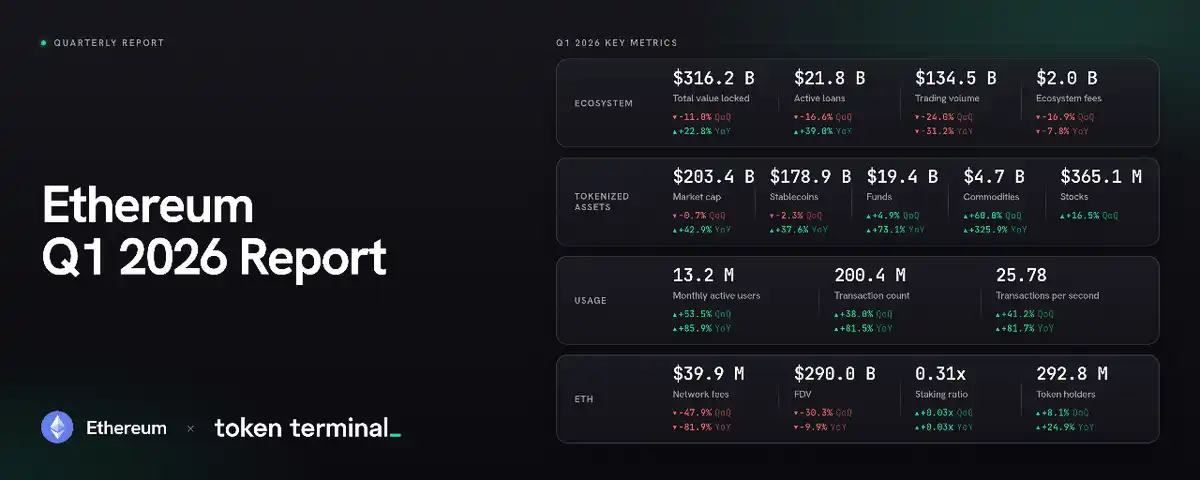
Ethereum Q1 2026 Review: Record On-Chain Activity, Tokenized Assets Lead the Industry. Despite a price correction impacting USD-denominated metrics, Ethereum's on-chain usage hit all-time highs in Q1 2026. Monthly active addresses surged 85.9% year-over-year to 13.2 million, while L1 transactions and throughput also set new records. This growth occurred alongside a significant 47.9% quarterly drop in L1 transaction fees, demonstrating the impact of network scaling via upgrades like the Blob Parameter Fork. The ecosystem maintained its dominance in decentralized finance (DeFi), holding 71% of the total value locked among top chains and 79.2% of active borrowing. Ethereum solidified its position as the primary platform for tokenized real-world assets (RWAs), with a total market cap of $203.4B. It holds leading shares in stablecoins (61.8%), tokenized funds (73%), and tokenized commodities (84%) across major chains. Key developments included the ERC-8004 standard for AI agents and heightened institutional engagement at forums. Major financial institutions like BlackRock, JPMorgan, and a European banking consortium announced new tokenized products on Ethereum throughout the period. The report draws parallels to the early internet, suggesting Ethereum is sacrificing short-term fee revenue for long-term network expansion and adoption. Its strategy focuses on becoming a neutral, open settlement layer for global finance, with scaling roadmaps aiming for tens of thousands of TPS by 2029.

marsbit1 год тому

Ethereum 2026 Q1 Review: On-Chain Activity Hits Record Highs, Tokenized Assets Lead the Industry

marsbit1 год тому

Торгівля

Спот
Ф'ючерси
活动图片