U.S. Liquidity Support Has Arrived, This is the Core Positive Catalyst

marsbitОпубліковано о 2026-08-20Востаннє оновлено о 2026-08-20

Анотація

The U.S. Treasury announced on August 19th an expansion of its liquidity support repurchase operations for long-term bonds. The single-operation limit for older, off-the-run nominal coupon securities in the 10-20 year and 20-30 year maturities will be increased from $2 billion to at least $4 billion, effective from September 9th until the end of the current quarterly refunding on November 4th. The market reacted positively to the news, with yields on 10-year and 30-year Treasury notes falling. This action is seen as a key relief for assets like tech stocks, long-term bonds, gold, and cryptocurrencies, as a lower long-end yield reduces discount rate pressure on valuations. However, analysts caution against interpreting this as a form of quantitative easing (QE). The operation specifically targets less liquid older bonds to improve market functioning, unlike QE which involves the Federal Reserve expanding its balance sheet. The move is viewed primarily as a signal that the Treasury is unwilling to let liquidity deteriorate in the long-end of the bond market, prompting short-covering and a relief rally. Its impact is constrained by the scale (a potential maximum of around $14 billion in additional repurchases this quarter), funding sources that may shift pressure to other maturities, and overarching macro factors like inflation and Fed policy. The sustainability of the resulting market rebound will be tested by the Treasury's November quarterly refunding statement. If it incl...

On August 19th, the U.S. Treasury Department announced an expansion of liquidity support repurchases for long-end Treasury securities, raising the single-operation cap for off-the-run nominal coupon securities in the 10-20 year and 20-30 year maturities from $2 billion to at least $4 billion.

This adjustment will take effect on September 9th and continue until the conclusion of the current quarterly refunding on November 4th. The Treasury stated that subsequent size arrangements will be detailed in the November 4th quarterly refunding announcement.

The market initially traded this as positive news. An AP report noted that after the announcement, the 10-year Treasury yield fell from 4.71% the previous day to 4.64%, and the 30-year yield dropped from 5.28% to 5.18%. A Reuters report mentioned the 30-year yield briefly fell close to 10 basis points to around 5.188%.

For investors holding tech stocks, long-duration bonds, gold, and crypto assets, the most direct impact of this move is on the discount rate. A retreat in long-end yields provides a valuation cushion for risk assets first. However, directly trading this as a "Treasury version of QE" is getting ahead of the story.

The Treasury is Buying Long-End Off-The-Run Securities

This operation is not buying all long-term Treasuries, but rather the less liquid off-the-run securities. Newly issued Treasuries have the best liquidity. Once older issues see fewer trades, their bid-ask spreads are prone to widening, and holders demand higher compensation.

When off-the-run securities become less liquid, the pressure manifests in long-end yields. Market makers and institutions are unwilling to absorb them, forcing the market to offer higher yields to attract buyers. By raising the repurchase cap, the Treasury is essentially proactively buying a portion of these harder-to-trade securities when pressure is high in the long-end market, making the trading system run smoother.

This matters for risk assets because the 30-year yield is one of the valuation anchors. Higher yields lead to heavier discounting of future cash flows, putting pressure on prices of growth tech, AI, high-valuation stocks, and long bonds. Gold and BTC don't have the same cash flow model but are often placed by investors within the trading framework of real rates and global liquidity.

The boundaries are also clear. Fed QE is central bank balance sheet expansion, buying bonds to create bank reserves. Treasury repurchases of off-the-run securities are debt management operations; funds must still be arranged within Treasury accounts and debt issuance structures. It can improve trading conditions for certain maturities and types of securities but does not automatically reduce U.S. government funding needs.

The Market is Buying Long-End Pressure Relief

The market reacted quickly because this move hit investors' most sensitive spot. With the 10-year yield above 4.6% and the 30-year yield above 5%, any signal that can compress term premium is traded as relief from valuation pressure.

Bond prices rise as yields fall. Stocks rise as discount rate pressure eases. Gold benefits if traded on the logic of falling real rates. Crypto assets' reactions depend more on risk appetite and liquidity expectations but can still be pulled into the same macro trade chain.

According to an Axios report, Gennadiy Goldberg of TD Securities characterized this operation as "not QE." Reuters quoted BCA's Ryan Swift saying the move is more about signaling, and the impact may be temporary.

This is precisely the core of this rally. What the market is initially buying is the Treasury's unwillingness to let long-end market liquidity deteriorate, not the fact that the Treasury can sustainably suppress interest rates. The former is enough to trigger short covering; the latter still requires verification through actual purchase volumes and issuance structures.

Bessel's Tool Faces Supply Constraints

The first variable limiting the scope of this trade is size. In the August 5th quarterly refunding statement, the Treasury set the maximum for this quarter's liquidity support repurchases at $38 billion. After raising the long-end operation cap, based on the existing schedule and single-operation caps, the estimated new upper limit is about $14 billion.

That number isn't small for a single-day price reaction, but placed in the context of the U.S. fiscal deficit, long-term Treasury stock, and quarterly funding needs, it's insufficient to change the larger trend. It's more like adding a cushion at the market's most congested point, not removing long-end supply pressure.

The second variable is funding source. Treasury repurchases of off-the-run securities cannot create money out of thin air. If repurchases need to be financed by issuing more short-term or medium-short-term bonds, pressure might simply shift from the long end to other maturities. The yield curve's shape would change, but funding demand would remain.

The third variable is inflation and the Fed. As long as inflation expectations remain unstable, or the Fed maintains a relatively tight stance, long-end yields will ultimately be dictated by fiscal supply, real rates, term premium, and buyer demand. The Treasury can improve market microstructure but can hardly unilaterally rewrite macro pricing.

Therefore, a more prudent assessment is that this operation is marginally positive for long-duration assets, especially likely to trigger a rebound when the market was previously crowded in bets on higher yields. But it doesn't yet prove that the upward pressure on long-end rates has ended.

The November Refunding Tests the Rally's Depth

How far this rally goes depends on whether the Treasury extends this temporary liquidity support into a more systematic adjustment of issuance structure. The November 4th quarterly refunding announcement will provide the next phase's repurchase size and bond issuance arrangements.

If actual repurchase amounts approach the new higher caps, while net new issuance of long-term bonds slows, the market will be more inclined to believe the Treasury is proactively reducing long-end supply pressure. The valuation recovery for long bonds, growth stocks, gold, and BTC would be more likely to continue.

If the repurchase mainly stays a signaling exercise, with long-term issuance pressure not decreasing or even requiring more short-term issuance to fund it, then this operation looks more like a tactical market-stabilizing move. It can reduce short-term volatility but is unlikely to change investors' long-term demands regarding deficits, inflation, and term premium.

For risk assets, this is not an unconditional, extendable easing narrative. It is a cushion in the long-end rates trade. The short-term direction is clear, but its thickness will be determined by actual execution volume and long-term net supply.


Трендові криптовалюти

Пов'язані питання

QWhat action did the U.S. Treasury Department announce on August 19 regarding its liquidity support program?

AThe U.S. Treasury Department announced an expansion of its long-term Treasury liquidity support repurchase operations. Specifically, the single-operation limit for repurchasing old, off-the-run nominal coupon securities in the 10-to-20-year and 20-to-30-year tenors will be increased from $2 billion to at least $4 billion.

QHow did the market react to the Treasury Department's announcement, according to the article?

AThe market initially traded the news as a positive development. Following the announcement, the yield on the 10-year Treasury note fell from 4.71% to 4.64%, and the 30-year yield dropped from 5.28% to 5.18%, with Reuters noting the 30-year yield briefly falling nearly 10 basis points.

QAccording to the article, what is the key difference between the Treasury's repurchase program and the Fed's Quantitative Easing (QE)?

AThe key difference is that the Federal Reserve's QE involves the central bank expanding its balance sheet by purchasing bonds, thereby creating reserves in the banking system. In contrast, the Treasury's repurchase of old bonds is a debt management operation. Its funds must be arranged within the Treasury account and debt issuance structure, and it does not automatically reduce the government's overall financing needs.

QWhat are the three main constraints or variables that limit the potential impact of this Treasury repurchase operation, as discussed in the article?

AThe three main constraints are: 1) The scale of the operation is limited relative to overall fiscal needs; 2) The funding source for the repurchases (e.g., potentially requiring more short-term debt issuance, which could shift pressure to other parts of the yield curve); and 3) The overarching influence of inflation and the Federal Reserve's monetary policy stance, which ultimately drive long-end yield pricing.

QWhat future event does the article identify as a crucial test for determining the sustainability of the market rally triggered by this announcement?

AThe article identifies the Treasury's Quarterly Refunding announcement on November 4 as the crucial test. This event will provide details on the next phase of repurchase scale and bond issuance arrangements, indicating whether the support is temporary or part of a more systematic shift to ease long-end supply pressure.

Пов'язані матеріали

Analysts: MiCA Has Not Caused Significant Global Outflow from USDT

Analysts from Artemis Analytics and independent research from LUISS University and the University of Surrey indicate that the European Union's Markets in Crypto-Assets (MiCA) regulation has not caused a significant global outflow from Tether (USDT), despite its restriction on regulated European platforms. Data shows no notable change in the overall supply or demand for USDT directly linked to MiCA's implementation, nor a large-scale migration of liquidity between exchanges or blockchains. Within Europe, the regulation has shifted trading patterns, with platforms moving toward USD Coin (USDC) instead of USDT. However, this change is localized. On a global scale, the aggregate market shares and trading volumes of major stablecoins have remained largely stable. USDT has retained its position as the leading stablecoin by market capitalization, which stood at approximately $183.27 billion in late July. Activity involving USDT continues to grow primarily outside the EU, particularly in global and emerging markets, as seen in increased user numbers on networks like BNB Chain and Tron. The resilience of dollar-pegged tokens is attributed to their expanding use beyond trading, such as for payments and remittances in regions like Argentina. While MiCA has reshaped the European market structure, it has not yet triggered a comparable shift in the global stablecoin landscape.

cryptonews.ru16 хв тому

Analysts: MiCA Has Not Caused Significant Global Outflow from USDT

cryptonews.ru16 хв тому

Trump Constantly Mentions HYPE in His Remarks, Driving HYPE's Price to Soar Toward Record Highs

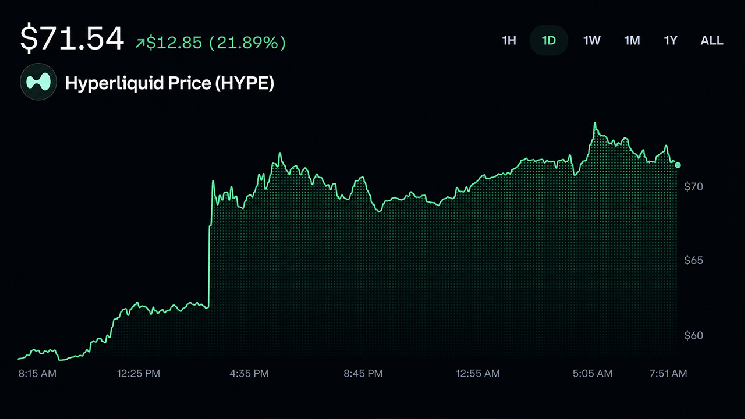
Former US President Donald Trump, during a White House meeting with leaders from crypto, tech, and financial firms on August 19, specifically mentioned CFTC Chairman Michael Selig's work on the Hyperliquid project. Trump's remarks focused on efforts to bring Hyperliquid to the US market compliantly. Attendees included executives from Coinbase, Ripple, Robinhood, SEC, Kraken, Gemini, Cboe, and ICE. Following Trump's comments, Hyperliquid's native token, $HYPE, surged roughly 20-25% within 24 hours, trading between $70-$73, nearing its June 2026 all-time high of over $76. Its market cap approached $18 billion, with daily trading volume exceeding $1.3 billion, ranking it 9th among tokens. However, Trump's statement did not announce any regulatory approval, CFTC registration, or specific US launch timeline. Hyperliquid's main interface still blocks US users, meaning traders were betting on a potential regulatory breakthrough, not a finalized deal. Hyperliquid is a blockchain built for trading, specializing in perpetual futures. It matches orders directly on-chain, aiming for centralized exchange speed while maintaining DeFi transparency and self-custody. At times, it has handled 40-70% of decentralized perpetual futures trading volume. The $HYPE token, launched via an airdrop in November 2024, is central to the network's economics. A significant portion of protocol fees goes to a buyback fund, creating sustained demand for the token. Trump's endorsement is seen as a catalyst for potential US market access, which could open the platform to institutional traders. Shares of Nasdaq-listed Hyperliquid Strategies, centered around $HYPE holdings, also jumped 30-31%, while shares of traditional derivatives operators like Cboe and CME fell. The path to a US launch remains a regulatory "minefield," involving unresolved issues on asset custody, leverage, market oversight, and customer protection. Traders now await concrete proposals from the CFTC, making $HYPE's recent gains dependent on follow-through actions after Trump's supportive signal.

cryptonews.ru19 хв тому

Trump Constantly Mentions HYPE in His Remarks, Driving HYPE's Price to Soar Toward Record Highs

cryptonews.ru19 хв тому

Торгівля

Спот

Популярні статті

Як купити CORE

Ласкаво просимо до HTX.com! Ми зробили покупку CORE (CORE) простою та зручною. Дотримуйтесь нашої покрокової інструкції, щоб розпочати свою криптовалютну подорож.Крок 1: Створіть обліковий запис на HTXВикористовуйте свою електронну пошту або номер телефону, щоб зареєструвати обліковий запис на HTX безплатно. Пройдіть безпроблемну реєстрацію й отримайте доступ до всіх функцій.ЗареєструватисьКрок 2: Перейдіть до розділу Купити крипту і виберіть спосіб оплатиКредитна/дебетова картка: використовуйте вашу картку Visa або Mastercard, щоб миттєво купити CORE (CORE).Баланс: використовуйте кошти з балансу вашого рахунку HTX для безперешкодної торгівлі.Треті особи: ми додали популярні способи оплати, такі як Google Pay та Apple Pay, щоб підвищити зручність.P2P: Торгуйте безпосередньо з іншими користувачами на HTX.Позабіржова торгівля (OTC): ми пропонуємо індивідуальні послуги та конкурентні обмінні курси для трейдерів.Крок 3: Зберігайте свої CORE (CORE)Після придбання CORE (CORE) збережіть його у своєму обліковому записі на HTX. Крім того, ви можете відправити його в інше місце за допомогою блокчейн-переказу або використовувати його для торгівлі іншими криптовалютами.Крок 4: Торгівля CORE (CORE)Легко торгуйте CORE (CORE) на спотовому ринку HTX. Просто увійдіть до свого облікового запису, виберіть торгову пару, укладайте угоди та спостерігайте за ними в режимі реального часу. Ми пропонуємо зручний досвід як для початківців, так і для досвідчених трейдерів.

422 переглядів усьогоОпубліковано 2024.12.13Оновлено 2026.06.02

Як купити CORE

Обговорення

Ласкаво просимо до спільноти HTX. Тут ви можете бути в курсі останніх подій розвитку платформи та отримати доступ до професійної ринкової інформації. Нижче представлені думки користувачів щодо ціни CORE (CORE).

活动图片