U.S. Government Shutdown Difficult, as Both Parties Have Already Calculated the Costs

Odaily星球日报Опубліковано о 2026-01-29Востаннє оновлено о 2026-01-29

Анотація

The U.S. government faces a shutdown risk by January 30 if a funding bill isn't passed, but prediction markets show the probability dropping to 42%, down from 80%. The deadlock stems from partisan disputes over funding for the Department of Homeland Security (DHS), particularly ICE enforcement actions. Democrats seek restrictions after a fatal incident in Minnesota, while Republicans defend ICE's role. Both parties are maneuvering ahead of midterm elections, where control of Congress is at stake. A shutdown could harm the ruling party’s image, making compromise likely. A temporary funding extension is expected to avoid a full shutdown, with negotiations focusing on separating DHS funding from other bills. Reports indicate ongoing talks between Trump and Democratic leaders to prevent a disruption.

Original | Odaily Planet Daily (@OdailyChina)

Author | Golem (@web 3_golem)

A major macroeconomic event this month is whether the U.S. government will shut down by the end of January. Last October, the U.S. government shut down for 43 days, and it only resumed operations after the passage of a temporary funding bill. January 30 is the expiration date of the temporary funding bill. If Congress fails to pass a formal funding bill or if there is no new temporary bill to extend it, the U.S. government will shut down again.

This time, the dispute between the two U.S. parties mainly revolves around the funding for the Department of Homeland Security (DHS). Democrats believe that ICE (Immigration and Customs Enforcement) has issues with its enforcement actions in Minnesota, resulting in two deaths, and they want to strictly restrict funding and related operations. However, Republicans disagree, arguing that ICE is a key force in combating illegal immigration and welfare fraud. As a result, the two sides are at a stalemate. (For details on the dispute between the U.S. parties, please read: Will the U.S. Government Shutdown Storm Strike Again, and Will the Crypto Circle Repeat the Crash Script?)

It is this confrontational state and the approaching expiration date of the temporary funding bill that have sharply increased the probability of a U.S. government shutdown at the end of January in prediction markets. However, this morning, Polymarket data showed that the probability of the U.S. government shutting down at the end of January has continued to decline and currently stands at 42%, down from a previous high of 80%.
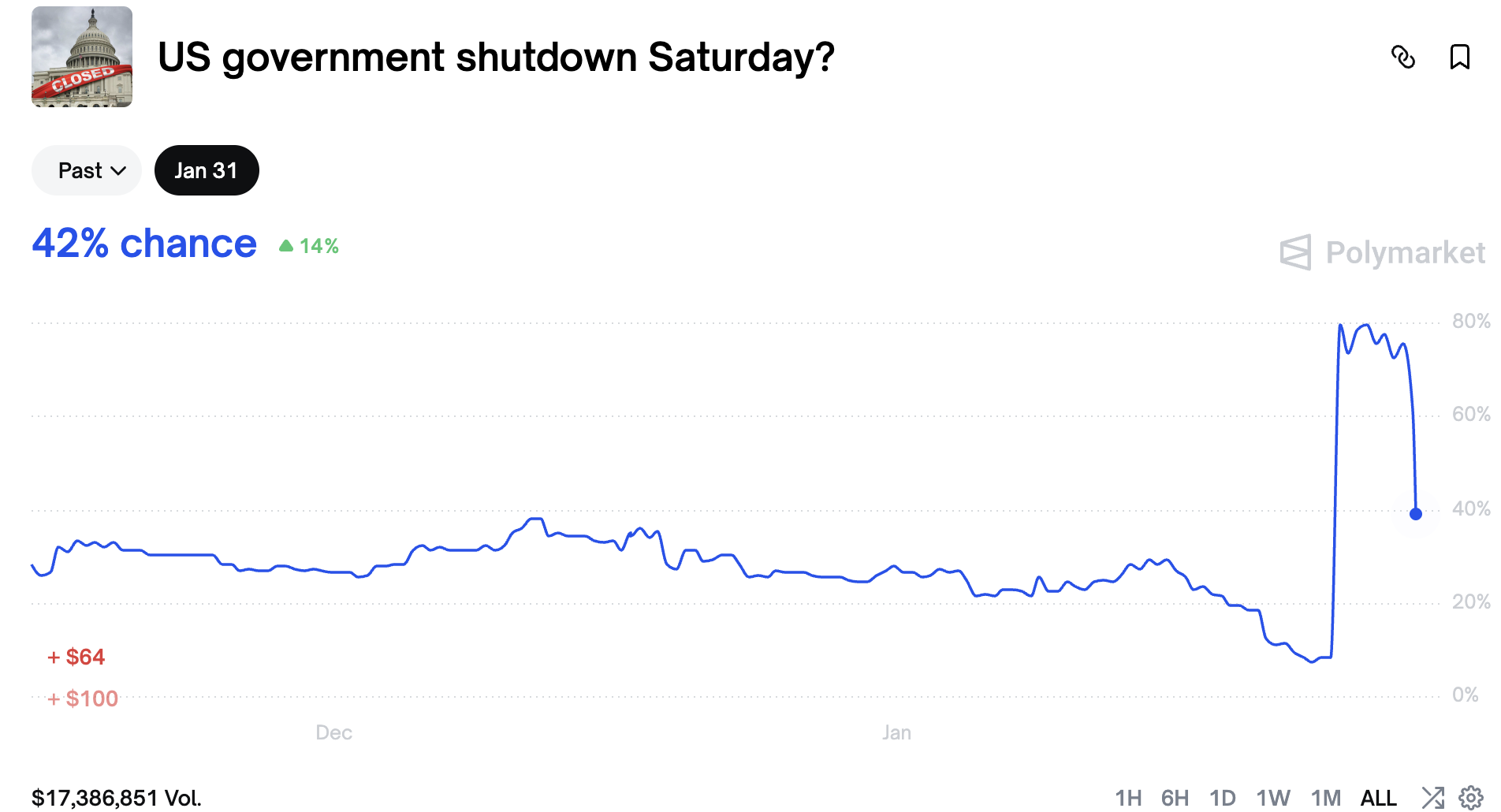
Price changes in prediction markets reflect the results of collective wisdom and博弈. The rising probability that the U.S. government will not shut down at the end of January indicates that people believe the high certainty of a government shutdown, as suggested by the prediction market probabilities, no longer exists under the current U.S. political situation.

Midterm Elections Are the Key Focus of Both U.S. Parties

On January 28, regarding the risk of another possible U.S. government shutdown, U.S. Treasury Secretary Besant stated that the situation is still unclear but emphasized that President Trump has urged the Democratic side to avoid this outcome.

This government shutdown crisis is essentially because the Democrats have caught the Republicans in a political counterattack. The shooting death of a U.S. citizen by ICE officers in Minnesota on January 24 was essentially a result of the Trump administration's increased immigration enforcement efforts, which also led to large-scale public protests expressing dissatisfaction with the Trump administration. The Democrats seized this opportunity and used it as an excuse to block the passage of the funding bill in the Senate. Since it reflects the demands of voters, the Democrats have taken the political initiative in this counterattack.

The Republicans have thus been put in a passive position. If the U.S. government does shut down as a result, the Democrats could blame the Republican government for any subsequent economic and民生 issues (such as delayed economic data releases and large-scale flight delays at airports).

This series of potential chain reactions will also affect the issue that both U.S. parties truly care about this year: the midterm elections.

The U.S. "midterm elections" are held in the second year of a presidential term. All 435 seats in the House of Representatives will be up for election, and approximately one-third of the seats in the Senate are typically up for election. Currently, the Republicans hold a majority in both the House (218 seats) and the Senate (53 seats). For the Republicans to maintain their seat advantage after the midterm elections at the end of the year and reduce governance difficulties, they cannot accumulate too many "stains" politically this year.

Additionally, although the midterm elections do not involve the presidential election, they are also seen as a "midterm referendum" on the incumbent president, affecting the president's policy orientation in the latter two years and reshaping the党内权力结构 and the candidate landscape for the next presidential election. Therefore, it is extremely important for Trump as well.

From the above analysis, it can be seen that this government shutdown is no longer simply a funding issue but a political battlefield set up in advance by both U.S. parties for the midterm elections at the end of the year. The Republicans, in a passive position, are highly likely to compromise to resolve the crisis and矛盾.

For the Democrats, if the Republicans compromise, it would also be a political victory.

Compromise Is Already Underway

This U.S. government shutdown crisis will not be a "full shutdown" like last October (when all 12 funding bills expired). The scale of the shutdown may be much smaller. Funding for the Commerce Department (responsible for releasing GDP data) and the Agriculture Department (responsible for food benefits) has already been secured, but about 78% of federal government functions—involving the remaining six funding bills—may face funding cuts.

The Democrats have already given the Republicans a way out. Senate Minority Leader Chuck Schumer (D-N.Y.) said on January 28 that Senate Democrats are "prepared to quickly advance five funding bills by the January 30 deadline, separate from the Department of Homeland Security funding bill," which could be a way to avoid a large-scale government shutdown. However, Senate Republicans have not yet agreed to separate the DHS bill from the overall funding package.

On the other hand, it is unrealistic to demand changes to the DHS funding before January 30, as any changes to the remaining six funding bills must be approved by the House of Representatives, which will not reconvene until February 2.

For the Democrats, forcing the U.S. government into a shutdown state by being too rigid about amending the funding bill would not be of much benefit, and the "offensive and defensive positions" with the Republicans could even reverse. Therefore, the current consensus between the two U.S. parties may be to pass a temporary funding bill to first address the potential government shutdown and postpone the矛盾 between the two parties.

Just as Odaily was writing this article speculating that the two parties might compromise to avoid a government shutdown, The New York Times also reported that Trump is reaching a possible agreement with Chuck Schumer to avoid a U.S. government shutdown.

According to two informed officials, under the plan being developed, the Senate would separate one of the six spending bills, which aims to fund the Department of Homeland Security, to maintain funding for the military, medical programs, and other federal agencies for the remainder of the fiscal year. The Senate will pass these bills by the Friday midnight deadline, and Congress will also consider a short-term extension of homeland security operations to prevent service disruptions at the TSA, Coast Guard, and FEMA.

It is still unclear how this potential agreement will affect this week's funding bill vote, but it at least shows that the White House and the Senate are working toward resolving the crisis.


Пов'язані питання

QWhat is the main reason for the potential U.S. government shutdown at the end of January?

AThe main reason is the dispute between Democrats and Republicans over funding for the Department of Homeland Security (DHS), particularly related to the enforcement actions of ICE (Immigration and Customs Enforcement) in Minnesota.

QAccording to the article, why did the probability of a government shutdown drop from 80% to 42% on Polymarket?

AThe probability dropped because the prediction market reflected a shift in collective opinion, indicating that people believe the high certainty of a shutdown has diminished due to ongoing political negotiations and potential compromises between the two parties.

QHow does the potential government shutdown relate to the U.S. midterm elections?

AThe shutdown is seen as a political battleground for the midterm elections, where both parties are positioning themselves to avoid blame for economic and民生 issues that could affect their electoral prospects and the balance of power in Congress.

QWhat compromise did Democrats propose to avoid a large-scale government shutdown?

ADemocrats proposed separating the Homeland Security funding bill from the other five remaining appropriations bills, allowing the non-DHS bills to pass quickly while delaying the contentious DHS funding debate.

QWhat temporary solution is being considered to prevent a shutdown before the January 30 deadline?

AA short-term extension for Homeland Security operations is being considered to prevent disruptions to agencies like TSA, Coast Guard, and FEMA, while passing the other appropriations bills to keep most government functions funded.

Пов'язані матеріали

STRC's First Financial Report Post-Depegging, How is Strategy Restoring the Capital Flywheel?

On July 31, 2026, Bitcoin treasury company Strategy released its Q2 financial report. Despite a 6.9% year-over-year increase in revenue to $122 million, the company recorded a substantial net loss of $8.22 billion, primarily due to $8.32 billion in unrealized losses from Bitcoin holdings. While Strategy's core Bitcoin strategy remains intact—its holdings grew 11% to 843,775 BTC—the company is undergoing a fundamental shift in its capital model. Following the de-pegging of its key financing tool, the STRCoin (STRC), from its $100 target in May, Strategy has pivoted from a one-directional "raise funds, buy Bitcoin" cycle to a more dynamic, multi-asset capital management approach. A key part of this new framework is the "Monetization Program," through which Strategy has sold approximately $218.4 million worth of BTC to bolster liquidity. The company's top priority is repairing STRC's peg, committing not to issue discounted shares until it returns to its target range. It has initiated a $1 billion buyback program for discounted digital credit securities, having repurchased $28.9 million face value of STRC so far. Management aims to restore the peg around September 8, 2026. Strategy now actively manages a matrix of assets: Bitcoin (for accumulation or strategic sales), USD cash reserves (now at $3.75 billion), common stock (MSTR), and digital credit securities like STRC. This allows for tactical moves like repurchasing discounted debt or equity to capture value. The future success of Strategy's "capital flywheel" hinges on two factors: the short-term ability to successfully re-peg STRC to restore market confidence in its digital credit system, and the long-term price trajectory of Bitcoin, upon which its entire investment thesis ultimately depends.

Odaily星球日报6 хв тому

STRC's First Financial Report Post-Depegging, How is Strategy Restoring the Capital Flywheel?

Odaily星球日报6 хв тому

With Two Consecutive Quarters of Losses, Coinbase Must Rely on Paths Beyond Trading

Coinbase posted its second consecutive quarterly net loss of $359 million on $1.22 billion in revenue for Q2, highlighting its vulnerability to crypto market cycles where weaker prices and lower volatility reduce user trading. However, the report also reveals a strategic shift in its business model. Despite a 25% quarter-over-quarter decline in global spot trading volume, Coinbase increased its market share to a company-record 10.3%. This suggests its position as a compliant U.S. on-ramp is strengthening even in a cooler market. A key development is the diversification of revenue streams. Transaction revenue fell to $599 million, nearly equaling subscription and services revenue of $555 million. Stablecoin services, generating $292 million, are becoming a crucial revenue "floor." This income, derived from interest on the $20 billion average USDC balance held on its platform, is less tied to daily trading activity. Furthermore, while spot trading volume dropped significantly, derivatives volume held steady at $1.03 trillion. Coinbase is pushing to integrate spot, stablecoin, and derivatives liquidity to create a more interconnected and sticky ecosystem for users. The GAAP net loss includes non-cash expenses like stock-based compensation and crypto asset valuation changes. Its adjusted EBITDA remained positive at $208 million for the 14th straight quarter, indicating core operations can cover ongoing costs. The company is also reducing expenses to manage the downturn. The central question moving forward is whether Coinbase's growing market share, stablecoin revenues, and expanding product integration can sufficiently offset the inherent cyclicality of its core trading business during future market contractions.

marsbit21 хв тому

With Two Consecutive Quarters of Losses, Coinbase Must Rely on Paths Beyond Trading

marsbit21 хв тому

In the Age of Artificial Intelligence, We Need 'Magicians,' Not 'Managers'

In the AI era, leadership must shift from management to magic. As knowledge rapidly expires, value shifts from what leaders know to what they can facilitate. Traditional "inside-out" management, driven by internal experience, is giving way to "outside-in" thinking focused on external opportunities, customer needs, and disruptive change. The core challenge is fostering new ideas that may invalidate existing knowledge. While technologies like steam, electricity, and AI provide the "skeleton" for innovation, it is human vision—connecting technology to customer dreams—that creates magic. Historical figures like Richard Arkwright and Eldridge R. Johnson succeeded not by inventing core technologies, but by reimagining work and business models from the outside in. Leaders must transition from controllers to "architects of flourishing." Their role is to design environments where empowerment, creativity, and adaptive learning thrive. This involves granting autonomy, fostering partnerships, and building resilient systems that scale innovation. Critical leadership qualities now include judgment, creativity, and the ability to learn continuously rather than relying on static expertise. Therefore, cultivating future leaders requires a focus on timeless fundamentals, humanities for broader perspective, and social acuity, rather than over-specialization in quickly outdated technical skills. The future rewards those who respond to the unseen and create conditions for better answers to emerge. Leadership in the AI age is less about having all the answers and more about enabling others to discover them—creating organizations where people explore, imagine, and thrive.

marsbit56 хв тому

In the Age of Artificial Intelligence, We Need 'Magicians,' Not 'Managers'

marsbit56 хв тому

Торгівля

Спот
活动图片