US Fed pulls guidance blocking its banks from engaging with crypto

cointelegraphОпубліковано о 2025-12-18Востаннє оновлено о 2025-12-18

Анотація

The US Federal Reserve has withdrawn its 2023 guidance that restricted how Fed-supervised banks, including uninsured institutions, could engage with crypto. The policy had required uninsured banks to follow the same rules as federally insured ones, effectively blocking them from offering crypto services. The Fed stated the guidance was outdated and that the financial system and its understanding of innovative products have evolved. The move was praised by crypto industry figures, including Custodia Bank CEO Caitlin Long, whose application for a Fed master account was previously denied under the old policy. Simultaneously, the Fed issued new guidance creating a formal pathway for both insured and uninsured state member banks to pursue innovative activities like cryptocurrencies, provided they meet risk-management standards. Fed Vice Chair Michelle Bowman supported the decision as a way to modernize banking, while Governor Michael Barr dissented, arguing it encourages regulatory arbitrage and undermines a level playing field.

The US Federal Reserve has withdrawn a 2023 guidance that limited how Fed-supervised banks, including uninsured ones, engaged with crypto, as US regulators continue to pivot positively toward digital assets.

The 2023 guidance required uninsured banks to follow the same rules as federally insured institutions, based on the principle that similar activities pose similar risks and should be subject to identical regulation.

This prevented uninsured banks from engaging in activities that weren’t permitted for national banks, like crypto services, which automatically disqualified Fed membership because the institution’s primary activities weren’t allowed.

Fed says financial system has evolved since 2023

The Fed said a key reason for withdrawing the guidance was that it was outdated and “the financial system and the Board’s understanding of innovative products and services have evolved.”

“As a result, the 2023 policy statement is no longer appropriate and has been withdrawn,” it said.

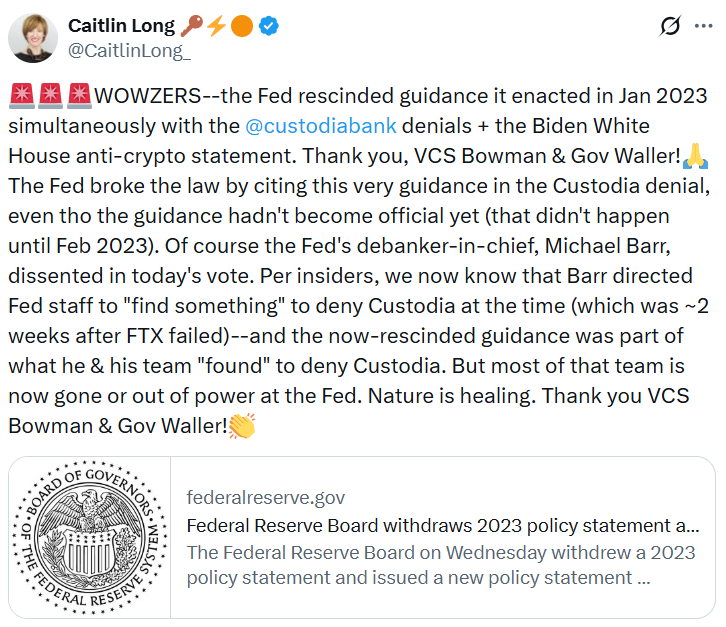
Caitlin Long, the CEO of the crypto‐focused Custodia Bank, applauded the move in an X post on Wednesday, explaining the 2023 guidance was why her institution’s application for a master account was previously denied.
Source: Cailtin Long

A master account with the Fed enables a financial institution to hold balances directly with the US central bank and access its core payment systems, allowing for payment settlement in central bank money rather than relying on another bank as an intermediary.

Related: Trump’s views on interest rates will hold ‘no weight’ at Fed: Hassett

“The Fed broke the law by citing this very guidance in the Custodia denial, even tho the guidance hadn’t become official yet, that didn’t happen until Feb 2023,” Long said.

“But most of that team is now gone or out of power at the Fed. Nature is healing. Thank you VCS Bowman & Gov Waller!” she added.

New guidance to boost bank innovation

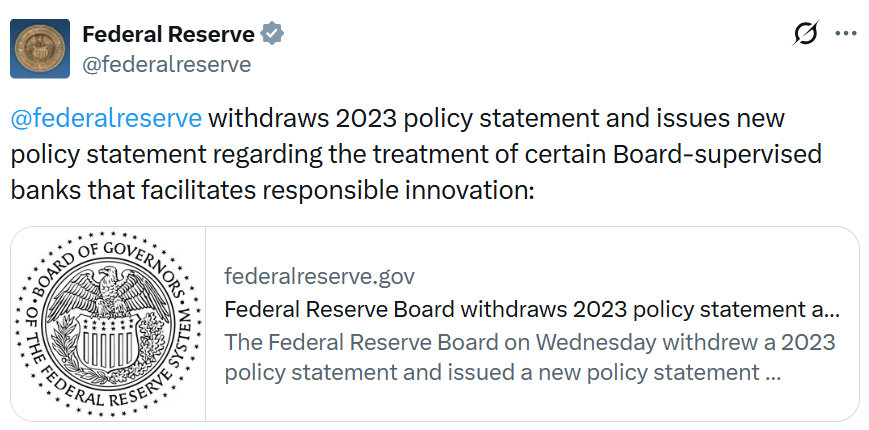
The move on Wednesday came as the Federal Reserve issued new guidance to establish a formal pathway for both insured and uninsured Federal Reserve-supervised state member banks to pursue “innovative activities,” such as cryptocurrencies, provided risk-management expectations are met, according to a statement on Wednesday by the Fed.
Source: Federal Reserve

Fed Vice Chair for Supervision Michelle Bowman said by “creating a pathway for responsible, innovative products and services, the Board is helping ensure that the banking sector remains safe and sound while also modern, efficient, and effective.”

Fed decision wasn’t unanimous

Fed Governor Michael Barr dissented to the decision, arguing that the principle of equal treatment among banks helps maintain a level playing field and prevents regulatory arbitrage.

“This principle continues to hold true today. Therefore, I cannot agree to rescind the current policy statement and adopt a new one that would, in effect, encourage regulatory arbitrage, undermine a level playing field, and promote incentives misaligned with maintaining financial stability. I dissent,” he said.

Barr has been accused of being linked to Operation Chokepoint 2.0, a federal effort to debank crypto companies. However, he was also previously an adviser at Ripple and has pushed for responsible stablecoin regulation.

Magazine: Unstablecoins: Depegging, bank runs and other risks loom

Пов'язані матеріали

Bitcoin's 'Rally Ends,' Officially Entering the Later Stage of a Bear Market?

Bitcoin prices declined 13% this week, reversing the recent rebound and signaling a likely transition into the later stages of a bear market. Key on-chain metrics deteriorated, with the short-term holder cost basis falling below the Realized Price—a pattern last seen in early 2022, characteristic of bear market maturity. The rally to ~$82k proved to be a bear market bounce, as evidenced by the 90-day realized profit/loss ratio failing to sustain above the bullish threshold of 2. Daily realized losses surged to $1.35B, including significant selling from long-term holders who accumulated near cycle tops, indicating ongoing supply redistribution. Price was rejected almost precisely at the aggregate US spot ETF cost basis of ~$83k, turning that level into resistance and leaving the average ETF investor underwater again. Spot market selling pressure intensified, with the 7-day volume delta turning significantly negative to its weakest level since February. While a major long liquidation event cleared over $400M in leverage, spot demand has not yet stepped in to absorb the resulting supply. Options markets continue pricing in higher future volatility (elevated volatility risk premium) and maintain a skew toward put options, reflecting persistent demand for downside protection, though not yet panic. Overall, market structure remains fragile. Sustained recovery likely requires a reclaim of the ETF cost basis, a shift back to positive spot demand, and a slowdown in realized loss-taking. Until then, the market risks further downside or extended consolidation within the broader bear trend.

Foresight News51 хв тому

Bitcoin's 'Rally Ends,' Officially Entering the Later Stage of a Bear Market?

Foresight News51 хв тому

How Risky is the "Death Spiral" of MSTR and STRC?

Summary: This article explores the perceived "death spiral" risk between MicroStrategy (MSTR), its Bitcoin holdings, and its perpetual preferred stock (STRC), drawing comparisons to the LUNA-UST collapse. While both systems feature price anchors, high yields for holders, and potential feedback loops, their core mechanisms differ fundamentally. The MSTR-STRC structure relies on continuous financing to sustain its high dividend payouts, primarily through stock ATM offerings. A negative feedback cycle could occur: falling MSTR stock price makes raising equity capital harder, increasing pressure to sell Bitcoin, which undermines STRC confidence and further depresses MSTR. However, unlike LUNA-UST's automated, direct linkage, the MSTR-STRC loop is weaker and has brakes: STRC dividends can be deferred or rates lowered, and STRC holders have a $100/share liquidation preference in bankruptcy, providing a price floor. The company's sustainability hinges on its ability to continue financing. Its current ~$900 million USD reserves cover only about 6.3 months of its ~$1.71 billion annual interest/dividend burden. The next six months are critical, aligning with both the potential bottom in Bitcoin's four-year cycle and the depletion timeline of its reserves. While a LUNA-style catastrophic collapse is deemed highly unlikely due to structural differences, the key question is whether MicroStrategy can navigate this period through healthy deleveraging to restart its capital engine.

Foresight News1 год тому

How Risky is the "Death Spiral" of MSTR and STRC?

Foresight News1 год тому

Торгівля

Спот
Ф'ючерси

Популярні статті

Як купити US

Ласкаво просимо до HTX.com! Ми зробили покупку Talus Network (US) простою та зручною. Дотримуйтесь нашої покрокової інструкції, щоб розпочати свою криптовалютну подорож.Крок 1: Створіть обліковий запис на HTXВикористовуйте свою електронну пошту або номер телефону, щоб зареєструвати обліковий запис на HTX безплатно. Пройдіть безпроблемну реєстрацію й отримайте доступ до всіх функцій.ЗареєструватисьКрок 2: Перейдіть до розділу Купити крипту і виберіть спосіб оплатиКредитна/дебетова картка: використовуйте вашу картку Visa або Mastercard, щоб миттєво купити Talus Network (US).Баланс: використовуйте кошти з балансу вашого рахунку HTX для безперешкодної торгівлі.Треті особи: ми додали популярні способи оплати, такі як Google Pay та Apple Pay, щоб підвищити зручність.P2P: Торгуйте безпосередньо з іншими користувачами на HTX.Позабіржова торгівля (OTC): ми пропонуємо індивідуальні послуги та конкурентні обмінні курси для трейдерів.Крок 3: Зберігайте свої Talus Network (US)Після придбання Talus Network (US) збережіть його у своєму обліковому записі на HTX. Крім того, ви можете відправити його в інше місце за допомогою блокчейн-переказу або використовувати його для торгівлі іншими криптовалютами.Крок 4: Торгівля Talus Network (US)Легко торгуйте Talus Network (US) на спотовому ринку HTX. Просто увійдіть до свого облікового запису, виберіть торгову пару, укладайте угоди та спостерігайте за ними в режимі реального часу. Ми пропонуємо зручний досвід як для початківців, так і для досвідчених трейдерів.

1.2k переглядів усьогоОпубліковано 2025.12.11Оновлено 2026.06.02

Як купити US

Обговорення

Ласкаво просимо до спільноти HTX. Тут ви можете бути в курсі останніх подій розвитку платформи та отримати доступ до професійної ринкової інформації. Нижче представлені думки користувачів щодо ціни US (US).

活动图片