U.S. Establishes 'Five-Category Law' for Crypto Assets: A Guide to the New Regulatory Framework (Essential Edition)

marsbitОпубліковано о 2026-03-18Востаннє оновлено о 2026-03-18

Анотація

The U.S. SEC and CFTC jointly issued a landmark 68-page regulatory framework on March 17, 2026, establishing a clear classification system for crypto assets. The new rules categorize assets into five types: Digital Commodities (e.g., BTC, ETH), Digital Securities, Regulated Payment Stablecoins, Digital Tools, and Digital Collectibles. A key innovation is the "separation" mechanism, allowing assets to transition from securities to commodities once they become sufficiently decentralized and no longer rely on managerial efforts. The framework also clarifies that activities like mining, staking, wrapping, and airdrops (under certain conditions) are not securities transactions. This guidance aims to reduce regulatory uncertainty, lower compliance costs, and reinforce U.S. leadership in crypto innovation by providing legal clarity and encouraging market transparency.

On March 17, 2026, the U.S. Securities and Exchange Commission (SEC) and the Commodity Futures Trading Commission (CFTC) jointly released an interpretive document numbered 33-11412. This 68-page regulatory framework officially declares: U.S. crypto regulation has ended a decade-long era of "regulation by enforcement" and entered a new era of clarity and harmonization driven by "Project Crypto".
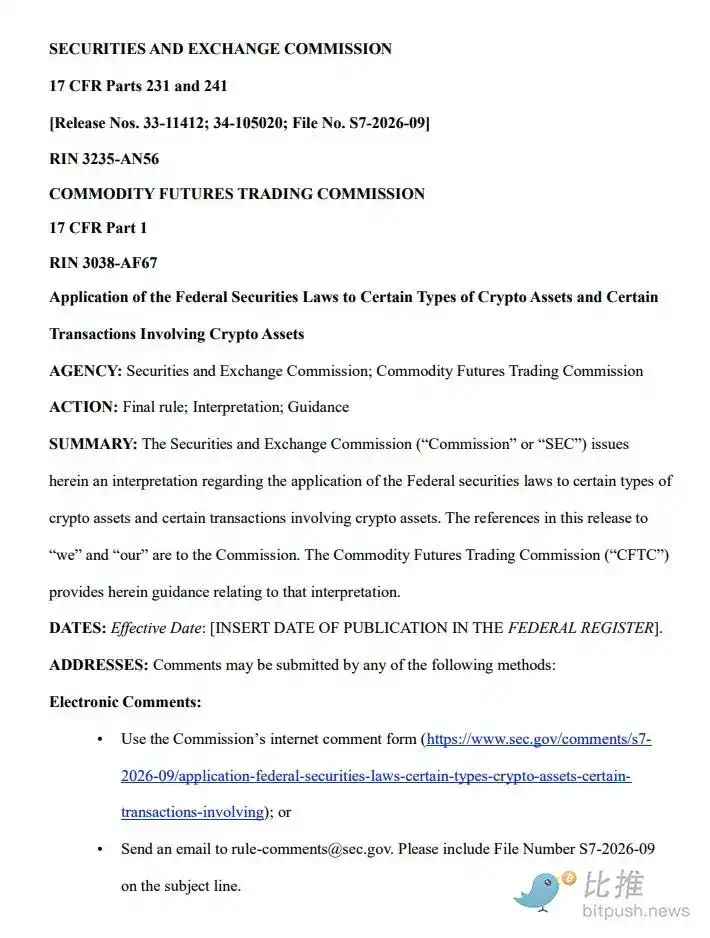
This document is not only a rare achievement of regulatory collaboration between the SEC and CFTC but also the most landmark guidance in the history of U.S. crypto regulation. The following is the full interpretation of the essential edition:

I. Background: "Project Crypto" from Conflict to Collaboration

In 2017, the SEC first applied the Howey test to crypto assets through "The DAO Report." For the next decade, regulation primarily relied on enforcement actions to define asset attributes, leaving the market in a state of uncertainty and controversy.

In early 2025, the SEC established the "Crypto Task Force," subsequently launching the "Project Crypto" initiative led by SEC Chairman Paul S. Atkins and CFTC Chairman Michael S. Selig. The initiative aimed to coordinate the authority of the two major regulatory agencies, establish a unified asset classification method, and provide a clear path for crypto innovation to remain in the U.S. In January 2026, the project was officially upgraded to a joint SEC and CFTC action.

II. Asset Classification: The Logic of the "Five-Category Law" for Crypto Assets

Based on asset characteristics,用途, and functionality, the document divides crypto assets into five major categories, providing the market with a clear classification standard for the first time:

  1. Digital Commodities

    Definition: Refers to those assets whose value stems from the programmatic operation and supply-demand dynamics of a "functionalized" crypto system, rather than relying on the managerial efforts of others.

    Core List: The document explicitly names mainstream tokens such as BTC, ETH, SOL, XRP, ADA, DOT, AVAX, LINK, etc., as digital commodities. These assets are not controlled by any single centralized entity and do not possess inherent economic rights that generate passive income.

  2. Digital Securities

    Definition:即"Tokenized Securities," referring to traditional securities represented in the form of crypto assets, or digital assets possessing the economic substance of securities (e.g., representing enterprise ownership, dividend rights).

    Regulation: Whether on-chain or off-chain, as long as they符合 economic substance, they fall under the SEC's regulatory purview.

  3. Regulated Payment Stablecoins

    Definition: Stablecoins that meet the definition of the 2025 "GENIUS Act" and are issued by authorized institutions.

    Qualification: These stablecoins are explicitly excluded from the definition of "securities" and are primarily受 specific legal constraints as payment instruments.

  4. Digital Tools

    Purpose: Tokens that only have utility functions within specific crypto systems (e.g., access rights or service payments) and are generally not considered securities.

  5. Digital Collectibles

    Definition: Assets intended to be collected and/or used, representing artworks, music, videos, in-game items, or internet memes, etc.

    Examples: CryptoPunks, Chromie Squiggles, WIF, VCOIN, etc.

    Qualification: Not securities themselves; their value stems from supply and demand relationships rather than the managerial efforts of others. However, if fragmented and sold, they may constitute securities.

III. Innovation: "Separation" and "Dynamic Conversion" of Security Attributes

This is the most groundbreaking legal innovation in the document—the SEC首次承认: The "security attribute" of a crypto asset is not permanent.

"Separation" Mechanism

  • Principle: A project may be considered a security (investment contract) during its initial financing phase if it meets the Howey test. But when the project completes its roadmap, achieves autonomous operation of open-source code, and decentralizes network power, the asset can be "separated" from the investment contract.

  • Judgment Standard: When investors no longer reasonably rely on the issuer's "essential managerial efforts" to obtain profits, but instead rely on the system's own operation and market supply and demand, the asset transforms from a "security" to a "digital commodity."

  • Separation Timing: Can occur immediately upon delivery of the asset to the purchaser, or at a future date.

Three Scenarios for Separation

  1. Issuer Fulfills Promises: After completing the essential managerial efforts, even if non-essential maintenance continues, the asset is no longer bound by the investment contract.

  2. Issuer Abandons Project: If publicly宣布放弃 development and no longer fulfills promises, the asset脱离 securities law jurisdiction (but the issuer may still bear legal liability for fraud).

  3. Secondary Market Trading: If subsequent purchasers no longer reasonably expect to rely on the issuer's efforts for profit, the transaction does not constitute a securities transaction.

Transparency Recommendation

The SEC encourages project parties to publicly disclose roadmap progress and milestone achievements to facilitate market identification of the "separation point."

IV. Qualification of On-Chain Activities: "Demining" for Decentralization

Regarding long-disputed activities such as staking, mining, wrapping, and airdrops, the document provides extremely detailed and favorable explanations:

Protocol Mining

  • Qualification: PoW mining is an "administrative or ministerial" activity that ensures network security and verifies transactions.

  • Conclusion: Whether solo mining or joining a mining pool, it does not involve securities issuance.

  • Mining Pool Operation: The activities of mining pool operators are administrative and ministerial, not constituting essential managerial efforts.

Protocol Staking

  • Qualification: Staking is an administrative activity for maintaining network operation.

  • Coverage: Includes solo staking, delegated third-party staking, custodial staking, and liquid staking.

  • Custodial Staking: If a custodian stakes on behalf of users, as long as it does not involve re-lending of assets, leverage, or discretionary trading, it does not constitute a securities activity.

  • Ancillary Services: Slash insurance, early unstaking, flexible reward distribution, asset aggregation, and other auxiliary services are all administrative and ministerial.

Staking Receipt Tokens

  • Qualification: If the underlying asset is a non-security commodity and not subject to an investment contract, the receipt itself is not a security.

  • Principle: The receipt merely exists as a "receipt," does not generate income; income stems from the underlying staking activity.</极速赛车开奖极速赛车开奖直播历史记录直播历史记录

Wrapping Tokens (Wrapping)

  • Definition: Users deposit crypto assets with a custodian or跨链桥, obtaining 1:1锚定的 redeemable wrapped tokens.

  • Qualification: If the underlying asset is a non-security commodity and not subject to an investment contract, wrapping tokens are considered an "administrative function" aimed at enhancing interoperability and do not constitute a securities transaction.

  • Key Restriction: The custodian must lock the assets and cannot lend,抵押, or re-stake them.

Airdrops

  • Qualification Breakthrough: As long as the recipient does not provide money, goods, services, or other consideration, it does not meet the "investment of money" element of the Howey test.

  • Applicable Scenarios:

    Airdropping to wallets holding specific tokens, without prior announcement

    Rewarding early testnet users

    Airdropping to eligible users based on application usage

  • Red Line: If recipients need to provide services (e.g., social media promotion) in exchange for the airdrop, it may constitute securities issuance.

V. Consolidation of U.S. Leadership

The document analyzes its economic significance in detail at the end:

  1. Eliminate "Chilling Effect": By providing legal clarity, reduce business stagnation caused by compliance opacity and encourage crypto innovation to return to the U.S.

  2. Reduce Compliance Costs: Clear classification and separation paths significantly reduce corporate legal consulting and regulatory应对 costs.

  3. Enhance Market Transparency: The new framework requires more detailed disclosure during the "investment contract" phase, better protecting investors.

  4. Promote Competition and Innovation: Clear rules will attract more issuers and entrepreneurs to enter the market.

  5. Improve Pricing Efficiency: Reduce price distortions caused by uncertainty.

VI. Historic Breakthrough in Regulatory Collaboration

Structurally, the document establishes a clear analytical path: first classify the asset, then judge the transaction structure, and finally analyze whether the investment relationship持续存在.

More importantly, this is a rare result of coordination between the SEC and CFTC on crypto regulatory issues. Previously, the two agencies had long-standing differences in defining "securities vs. commodities," and this joint framework实质上 divides the归属 of major asset categories, marking a shift in U.S. crypto regulation from the stage of "inter-agency jurisdictional competition" to a "division of labor system based on unified rules."

This 68-page document not only ends a decade of regulatory chaos but also establishes the U.S.'s leadership position in the global crypto regulatory field. For practitioners, it is a must-read "industry constitution"; for investors, it is a clear "rights protection guide"; for entrepreneurs, it is a clear "compliance roadmap".

The "Wild West" era of crypto assets has officially ended.

Original Link

Пов'язані питання

QWhat is the 'Five-Category Method' for crypto assets established by the SEC and CFTC in the new regulatory framework?

AThe 'Five-Category Method' classifies crypto assets into: 1. Digital Commodities (e.g., BTC, ETH, SOL, XRP, ADA, DOT, AVAX, LINK), 2. Digital Securities (tokenized traditional securities or assets with securities economic substance), 3. Regulated Payment Stablecoins (as defined by the 2025 GENIUS Act), 4. Digital Tools (tokens with utility functions within specific crypto systems), and 5. Digital Collectibles (e.g., CryptoPunks, Chromie Squiggles, WIF, VCOIN).

QWhat is the 'Separation' mechanism introduced in the SEC and CFTC's new framework, and why is it significant?

AThe 'Separation' mechanism allows a crypto asset initially classified as a security (e.g., during fundraising via an investment contract) to transition to a non-security status (e.g., a digital commodity) once the project completes its roadmap, becomes decentralized, and no longer relies on the issuer's 'essential managerial efforts.' This is significant because it acknowledges that an asset's security status is not permanent and provides a clear path for projects to achieve regulatory clarity.

QHow do the SEC and CFTC classify activities like protocol mining, staking, and airdrops under the new framework?

AProtocol mining (PoW) and protocol staking (including solo, delegated, custodial, and liquid staking) are classified as 'administrative or ministerial' activities that maintain network operations and do not constitute securities offerings. Airdrops are generally not considered securities offerings if recipients provide no consideration (money, goods, services); however, if recipients must perform services (e.g., social media promotion) to receive the airdrop, it may be deemed a securities offering.

QWhat are the economic benefits highlighted in the framework for the U.S. crypto industry?

AThe framework aims to: 1. Eliminate the 'chilling effect' of regulatory uncertainty, encouraging crypto innovation to return to the U.S.; 2. Reduce compliance costs through clear classification and separation paths; 3. Enhance market transparency with better disclosure requirements during the 'investment contract' phase; 4. Promote competition and innovation by attracting more issuers and entrepreneurs; and 5. Improve pricing efficiency by reducing price distortions caused by uncertainty.

QWhat does the joint SEC-CFTC framework signify for U.S. crypto regulatory coordination?

AThe framework marks a historic shift from a decade of regulatory ambiguity and inter-agency competition (e.g., over 'security vs. commodity' definitions) to a unified, collaborative approach. It establishes a clear analytical path: classify assets, then evaluate transaction structures, and finally assess whether an investment relationship persists. This coordination positions the U.S. as a leader in global crypto regulation and ends the 'Wild West' era of crypto assets.

Пов'язані матеріали

In Conversation with Ray Dalio: We Are Currently in an AI Bubble, with 1% of My Portfolio in Bitcoin

Ray Dalio, founder of Bridgewater Associates, warns in an interview that the current AI boom shows classic bubble characteristics, which could lead to significant economic downturns as seen in past cycles like 1929 or 2000. He explains that speculative enthusiasm, fueled by debt and overvaluation, often precedes a crash when rising rates or taxation force asset sales, causing widespread losses and recession. Dalio also outlines his "Big Cycle" theory, describing an approximate 80-year pattern where widening wealth gaps, massive government deficits, and shifting geopolitical power (like China's rise) create internal conflict and global instability. He emphasizes that we are in a late-cycle, transitional phase where traditional powers like the US and UK face decline. For personal wealth protection, Dalio advises diversification beyond cash into assets like stocks, bonds, real estate, and particularly gold, which he prefers over Bitcoin. While he holds about 1% of his portfolio in Bitcoin as a non-printable hard asset, he views gold as more secure from technological or governmental threats. Regarding AI's impact, Dalio believes it will disproportionately benefit capital owners, worsening inequality by replacing both physical and cognitive labor. He suggests that human intuition and emotional intelligence, combined with AI, will be key for future workers. On taxation, Dalio argues that wealth taxes are impractical and risk triggering asset sell-offs, reducing productive investment. He points to the UK as a cautionary example of debt, low productivity, and political strife. Geopolitically, Dalio foresees a more regionalized world, with the US showing weakness in prolonged conflicts like with Iran, akin to past imperial declines. The ideal outcome, he suggests, is coexisting powerful blocs (e.g., Americas, China-Asia Pacific) without major war.

marsbit2 год тому

In Conversation with Ray Dalio: We Are Currently in an AI Bubble, with 1% of My Portfolio in Bitcoin

marsbit2 год тому

Daily 7.2 Trillion KRW: Foreign Capital's Record Net Buying on Friday! Wall Street Says Headwinds for Korean Stock Fund Flows Have Subsided

South Korean stock market sees a dramatic shift in fund flows. On July 31, foreign investors made a record net purchase of approximately KRW 7.2 trillion in KOSPI stocks, marking a fundamental reversal from the persistent large-scale net outflows seen in previous months. This contributed to a significant narrowing of foreign net selling in July to KRW 9.8 trillion, down sharply from KRW 48.4 trillion in June and KRW 44.5 trillion in May. Simultaneously, domestic institutional pressure eased. South Korean pension funds and asset managers turned to a net buying position in July, purchasing KRW 1.0 trillion worth of KOSPI shares, contrasting with net sales in May and June. Market volatility is expected to be dampened by new financial regulations. Effective July 31, the Financial Services Commission tightened access for retail investors to single-stock leveraged ETFs by raising the minimum cash deposit requirement. Trading volumes for these products subsequently dropped to about 50% of their monthly average. Citigroup Research maintains its year-end KOSPI target of 10,000 points. The firm cites several supportive factors: the substantial easing of headwinds from capital outflows, a robust fundamental outlook for the semiconductor sector, historically low market valuations, strong economic fundamentals, and the potential for policy support from financial authorities if needed.

marsbit2 год тому

Daily 7.2 Trillion KRW: Foreign Capital's Record Net Buying on Friday! Wall Street Says Headwinds for Korean Stock Fund Flows Have Subsided

marsbit2 год тому

Thanks to Dice Rolls, Bitcoin Keys Are Stored Offline, But Not Everyone Will Do It

The article discusses using dice rolls to generate secure Bitcoin wallet seeds, providing entropy independent of potentially flawed hardware random number generators. It explains that each fair dice roll offers about 2.585 bits of entropy, with around 50 rolls needed for a standard 12-word seed phrase and 99+ recommended for higher security. This method gained attention after a vulnerability was revealed in some Coldcard hardware wallets, where a faulty firmware RNG (dating back to 2021) compromised generated keys. The analysis notes that while a dice-generated main seed was safe from this specific flaw, other Coldcard functions (like creating paper wallets, backup keys, or passwords) could still be vulnerable if they used the defective RNG. The piece argues that while dice-based entropy is technically robust, the manual process is error-prone, tedious, and unrealistic for most new users, who might make mistakes in recording or inputting rolls. It concludes that while manual entropy generation should remain an option for advanced users, the long-term goal is to develop reliable, user-friendly hardware and software that securely generates randomness without requiring specialized knowledge. Coldcard users are advised to check their firmware version and replace any secondary secrets (like paper wallet keys) created with vulnerable devices, while also considering multi-signature setups with devices from different manufacturers for added security.

cryptonews.ru7 год тому

Thanks to Dice Rolls, Bitcoin Keys Are Stored Offline, But Not Everyone Will Do It

cryptonews.ru7 год тому

Торгівля

Спот
活动图片





