US Crypto Policy Debate Intensifies as CLARITY Act Support Fractures

bitcoinistОпубліковано о 2026-01-16Востаннє оновлено о 2026-01-16

Анотація

Washington's efforts to regulate the crypto market face new uncertainty as the CLARITY Act, a key legislative proposal, encounters significant setbacks. Coinbase withdrew its support, citing concerns over restrictions on tokenized equities, crypto rewards, and expanded government data access. This prompted a pause in the Senate Banking Committee's progress on the bill, though the White House reaffirmed its backing. The debate centers on whether the SEC or CFTC should have primary oversight, with exchanges favoring the CFTC's commodity-based approach. Industry leaders are divided, with some supporting the bill as a necessary step forward despite its flaws, while others warn it could stifle innovation. Stablecoin regulation and consumer protection remain contentious issues.

Washington’s long-running effort to bring regulatory clarity to the U.S. crypto market has entered a more uncertain phase. The Digital Asset Market Clarity Act, known as the CLARITY Act, was expected to move closer to a Senate vote this week.

Instead, a sudden withdrawal of support from Coinbase and a last-minute pause by Senate leadership have exposed deep divisions within the industry and among lawmakers. While the White House insists the bill is still on track, the debate over how digital assets should be regulated is becoming more fragmented.
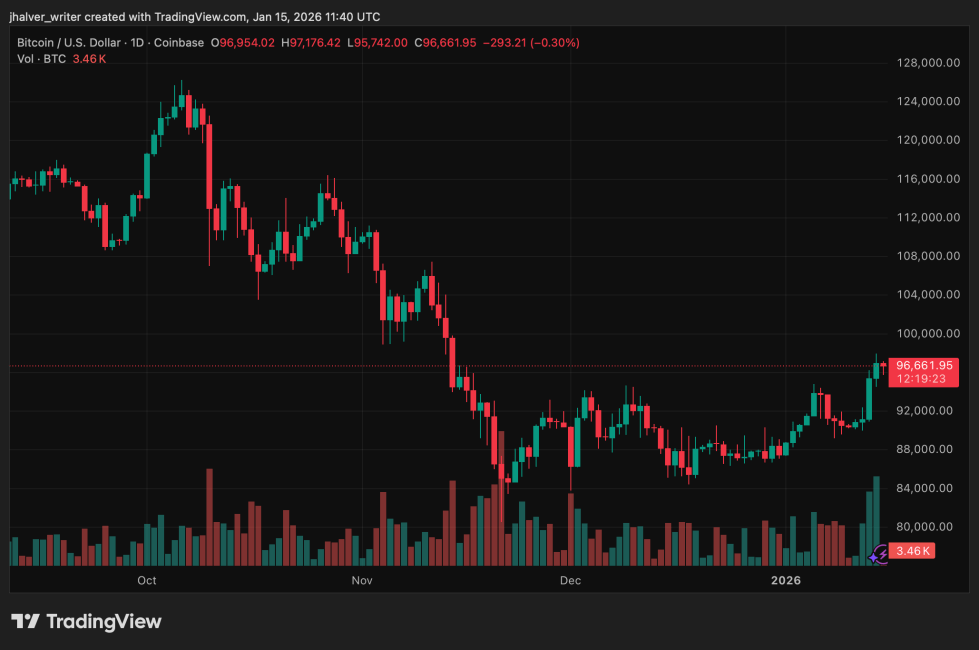
BTC's price records some gains on the daily chart. Source: BTCUSD on Tradingview

Coinbase Withdrawal Triggers Legislative Pause

The immediate turning point came when Coinbase CEO Brian Armstrong announced that the company could no longer support the current draft of the CLARITY Act.

Armstrong argued that the bill would be worse than the existing regulatory uncertainty, citing concerns over limits on tokenized equities, restrictions on crypto rewards, and expanded government access to financial data.

Shortly after, Senate Banking Committee Chair Tim Scott introduced a brief pause in the bill’s progress, cancelling a scheduled markup.

Scott described the delay as procedural rather than political, stating that negotiations were ongoing and bipartisan talks continued. A new markup date has been set for January 27, once updated bill language is released.

Despite the setback, White House AI and crypto czar David Sacks reiterated that the administration still backs the legislation. He said the pause should be used to resolve remaining issues and push forward a framework that allows innovation while strengthening oversight.

Industry Split Over SEC and CFTC Roles

At the core of the dispute is the division of regulatory authority between the Securities and Exchange Commission (SEC) and the Commodity Futures Trading Commission (CFTC) as outlined in the CLARITY Act.

Crypto exchanges generally favor the CFTC’s approach, which treats many digital assets as commodities. The SEC, by contrast, applies securities laws that impose stricter compliance requirements.

Critics argue the bill shifts too much power to the SEC, particularly over tokenized equities and certain crypto products. Coinbase has warned that the proposed rules could effectively block the development of on-chain stock trading and limit user reward programs.

Other industry leaders, including executives from Ripple, a16z, and Kraken, have taken a more cautious stance. While acknowledging flaws in the draft, they argue that passing some form of market structure legislation is better than leaving the sector in regulatory limbo.

Banks, Stablecoins, and the Broader Stakes

Another contentious issue is stablecoin regulation. The CLARITY Act would make it difficult for crypto platforms to offer yield or interest-like rewards on stablecoin holdings. Banks support these restrictions, saying they protect financial stability.

Lawmakers also point to past failures, such as the FTX collapse, as evidence that clearer rules are needed to protect consumers and national security. However, frustration is growing behind the scenes.

Senate sources indicate that some committee members were dissatisfied with Coinbase’s timing, perceiving the withdrawal as disruptive to months of negotiations.

Cover image from ChatGPT, BTCUSD chart from Tradingview

Пов'язані питання

QWhat was the immediate trigger that caused a pause in the progress of the CLARITY Act?

AThe immediate trigger was Coinbase CEO Brian Armstrong's announcement that the company could no longer support the current draft of the bill.

QAccording to Coinbase, what are some specific concerns they have with the proposed CLARITY Act?

ACoinbase cited concerns over limits on tokenized equities, restrictions on crypto rewards, and expanded government access to financial data.

QWhich two U.S. regulatory agencies are at the core of the dispute over the CLARITY Act?

AThe Securities and Exchange Commission (SEC) and the Commodity Futures Trading Commission (CFTC) are at the core of the dispute.

QWhat is the new date set for the markup of the CLARITY Act after the pause?

AA new markup date has been set for January 27, once updated bill language is released.

QBesides Coinbase, which other industry leaders were mentioned as taking a more cautious stance on the bill?

AExecutives from Ripple, a16z, and Kraken were mentioned as taking a more cautious stance, arguing that passing some form of legislation is better than regulatory limbo.

Пов'язані матеріали

Annual Salary of Millions Competing for Electricians, Meta Rushes to Open Its Own Technical School

The AI boom is facing an unexpected bottleneck: a severe shortage of skilled construction workers and electricians. As tech giants like Meta, OpenAI, and Alphabet race to build massive data centers—such as OpenAI's $16 billion "Stargate" project—they are hitting a critical labor wall. The U.S. needs an estimated 130,000 more electricians, 240,000 construction workers, and 150,000 supervisors by 2030 for AI infrastructure alone, but tens of thousands of electrician jobs go unfilled each year. While AI companies offer high premiums, with electricians earning up to $280,000 annually, worker scarcity still causes massive losses—delays on a single project can cost $14.2 million per month. The complexity of building AI data centers, which require immense power (equivalent to powering hundreds of thousands of homes), sophisticated electrical systems, and advanced liquid cooling solutions, demands highly skilled technicians who are in short supply. To combat this, companies are investing heavily in training. Meta has committed $115 million to a free training school offering tuition, housing, and stipends, targeting 5,000 new workers. OpenAI is partnering with unions to secure skilled labor. These efforts are paying off, with a significant rise in Gen Z interest in trade schools over college. However, the power demands are staggering. AI data centers are driving a rapid surge in electricity consumption, projected to account for up to 12% of U.S. power use by 2028 and raising costs for consumers. Furthermore, the construction boom is project-based, leading to a potential future glut of trained workers once building peaks, which could depress wages industry-wide. The race for AI supremacy now depends as much on skilled hands as on advanced chips.

marsbit1 год тому

Annual Salary of Millions Competing for Electricians, Meta Rushes to Open Its Own Technical School

marsbit1 год тому

OpenAI No Longer Sells Its Most Expensive Model for Profit

OpenAI is shifting its business strategy away from promoting its most expensive, flagship models for every task. Recent price cuts—80% for GPT-5.6 Luna and 20% for Terra—signal a deeper change: the company now actively advises users that many tasks don't require the most powerful model. Instead, OpenAI recommends a tiered approach: use the high-end GPT-5.6 Sol for complex planning and analysis, then delegate execution to cheaper models like Luna. This mirrors moves by Anthropic, which recently launched Claude Opus 5 at half the price of its top model, Fable 5. Both companies are de-emphasizing flagship models as primary revenue drivers, using them instead for brand prestige and technological showcases. The industry is entering a "mass-market" phase, similar to automotive, where high-volume, cost-effective models handle daily operations and drive scale. OpenAI's price reductions are partly enabled by AI models themselves optimizing underlying code and infrastructure, creating a self-reinforcing cycle of efficiency gains and cost reduction. Competition is shifting from "who is smartest" to "who offers the best value." The goal is no longer selling individual models but fostering widespread API adoption and ecosystem lock-in. By making AI calls cheap and ubiquitous, companies like OpenAI aim to become the indispensable, utility-like infrastructure powering automated workflows—the "water and electricity" of software, quietly embedded everywhere.

marsbit1 год тому

OpenAI No Longer Sells Its Most Expensive Model for Profit

marsbit1 год тому

Торгівля

Спот
活动图片





