US Banking Lobby Urges OCC To Delay Crypto Charter Applications Approval

bitcoinistОпубліковано о 2026-02-13Востаннє оновлено о 2026-02-13

Анотація

The US's largest banking lobby, the American Bankers Association (ABA), has urged the Office of the Comptroller of the Currency (OCC) to delay its approval of crypto bank charter applications. The ABA cited regulatory uncertainty, the need for greater transparency in the application process, and a lack of finalized federal oversight. This follows the OCC's conditional approval of charters for several crypto firms in December, which raised concerns about blurred regulatory lines. The ABA argues the OCC should wait until Congress finalizes new rules. Additionally, the banking industry opposes granting crypto and fintech firms direct access to the Federal Reserve's payment systems, advocating for a 12-month waiting period to ensure safety and soundness standards are met.

The US’s largest banking lobby has requested the Office of the Comptroller of the Currency (OCC) delay its approval of crypto bank charter applications, suggesting the regulator wait until regulatory uncertainty is cleared.

US Banks Call For Crypto Charter Reviews Delay

On Wednesday, the American Bankers Association (ABA) asked the OCC to pause the review of national bank charter applications for crypto firms, citing uncertainty surrounding emerging business models, the need for greater transparency in charter application and decision-making processes, and a lack of finalized federal oversight.

In a letter, the banking lobby urged the US’s top bank regulator to “ensure that robust, broadly applicable safety and soundness standards are well understood and upheld during this period of rapid innovation to provide greater transparency throughout its charter application and decisioning processes.”

As reported by Bitcoinist, the OCC approved conditional bank charters for Ripple, Circle, BitGo, Paxos, and Fidelity in December, raising concerns that the approvals could blur the lines of banking activities and lead to regulatory arbitrage.

The ABA now calls for patience as emerging crypto regulatory frameworks take shape, suggesting that the review process must be delayed until Congress finishes the rules that many recent OCC charter applicants will ultimately be subject to.

“We urge the OCC to be patient, not measure its application decisioning progress against traditional timelines, and allow each charter applicant’s regulatory responsibilities to come fully into view before moving a charter application forward,” ABA wrote.

The banking association emphasized that appropriate safety and soundness protections, including effective measures against conflicts of interest, and for compliance with other applicable consumer protection laws and regulations, must be in place from the beginning.

Notably, the Trump Family’s main crypto venture, World Liberty Financial, applied for a national trust charter in January. US Senator Elizabeth Warren sent a letter to Comptroller Jonathan Gould asking the agency to pause its review of the application until President Donald Trump divests from the crypto company, arguing that it could create a government ethics problem.

In addition, the association recommended an amendment to the OCC’s regulations to ensure new charter applicants’ names “do not misrepresent the nature of the financial services they intend to offer.”

They suggested that the agency prohibit any charter applicant that limits its activities to either fiduciary activities or trust company operations from including the word “bank” in its name.

ABA argued that “such entities would not be engaged in the business of banking and should, therefore, ‘not have a title that misrepresents the nature of the institution or the services it offers.’”

“Skinny” Accounts Clash

US banks have recently shared their opposition to granting crypto and fintech companies direct access to the Federal Reserve (Fed)’s payment systems, according to Bloomberg.

Earlier this week, the Bank Policy Institute, Clearing House Association, and Financial Services Forum sent a joint letter to the Fed, demanding a 12-month waiting period before firms are eligible to apply for payment accounts.

The banking groups argued the Fed “should block access until newly licensed stablecoin issuers prove they can operate safely.” As Bloomberg noted, crypto and fintech firms currently rely on partner banks for access and compliance infrastructure. However, the Fed’s “skinny” master accounts proposal, first introduced in October, would allow these crypto companies to bypass the intermediation.

Moreover, recent reports from Eleanor Terret claim that the tensions between the US banking sector and the crypto industry have extended from Stablecoin rewards to include the skinny master accounts proposal.

While the digital assets side was “largely positive,” Terret affirmed the banking side worried that crypto’s “less robust regulatory status could pose a problem,” with Better Markets CEO Dennis Kelleher calling the proposal “a reckless giveaway to the crypto industry that unnecessarily expands the Fed’s mandate without justification and undermines the Fed’s true mandate.”
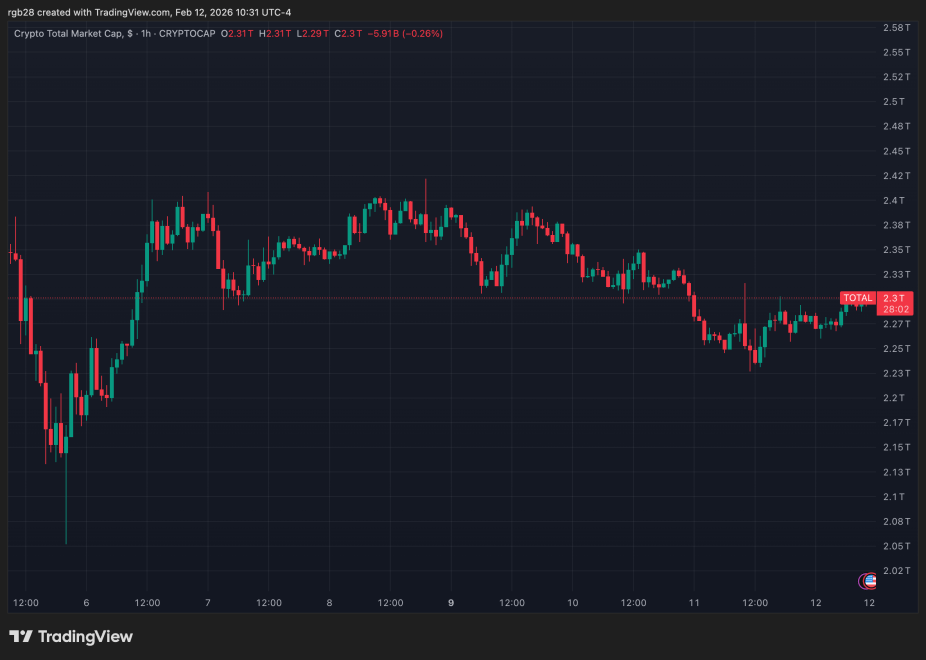
The total crypto market capitalization is at $2.3 trillion in the one-week chart. Source: TOTAL on TradingView


Пов'язані питання

QWhat is the main request made by the American Bankers Association (ABA) to the Office of the Comptroller of the Currency (OCC)?

AThe ABA requested the OCC to pause the review of national bank charter applications for crypto firms until regulatory uncertainty is cleared and Congress finishes establishing the rules.

QWhich crypto companies received conditional bank charters from the OCC in December, as mentioned in the article?

AThe OCC approved conditional bank charters for Ripple, Circle, BitGo, Paxos, and Fidelity in December.

QWhat specific recommendation did the ABA make regarding the naming of new charter applicants?

AThe ABA recommended that the OCC prohibit any charter applicant limited to fiduciary activities or trust company operations from including the word 'bank' in its name to avoid misrepresentation.

QWhy did US banking groups oppose granting crypto and fintech companies direct access to the Federal Reserve's payment systems?

ABanking groups argued that the Fed should block access until newly licensed stablecoin issuers prove they can operate safely, expressing concerns about crypto's less robust regulatory status.

QWhat was the concern raised by US Senator Elizabeth Warren regarding World Liberty Financial's charter application?

ASenator Warren asked the OCC to pause its review of the application until President Donald Trump divests from the crypto company, arguing it could create a government ethics problem.

Пов'язані матеріали

Investors Are Now Hunting for AI Projects on Bilibili and Xiaohongshu

Investors Turn to Bilibili and Xiaohongshu to Source AI Projects The AI hardware boom is in full swing in 2025, with a surge in smart wearables like AI glasses, rings, toys, and companion robots. This frenzy has investors scrambling, not just sifting through business plans, but actively hunting for promising "under-the-radar" projects on youth and tech-enthusiast content platforms like Bilibili and Xiaohongshu. The logic is straightforward: for consumer-facing AI hardware, genuine user demand and potential pitfalls are often revealed earlier in public discussions, comments, and critiques on these communities than in formal pitches. As one industry insider notes, these products must ultimately be tested and understood by real people. This shift highlights a crucial challenge in the sector: user education. The success of AI hardware depends on moving beyond mere efficiency gains to fulfilling higher-order needs like "unleashing personal creativity." Products must convince users they are natural, unobtrusive additions to daily life. Early hype, as seen with devices like the Rabbit R1, often fades if the product fails to clearly solve real-world problems, leading to high return rates and market rejection. The market is now entering a shakeout phase. 2026 is seen as a year of commercial validation. Some projects have already stalled or been canceled due to market resistance, lack of differentiation, or financial woes. However, the long-term opportunity remains vast, with forecasts predicting a multi-trillion dollar global AI hardware market by 2030. The competition is intensifying. With giants like OpenAI and Meta preparing their own hardware, and Chinese companies launching diverse AI-powered products, the battle for user attention, product excellence, and market understanding is just beginning. The core principle endures: in the AI era, it remains a user-sovereign market.

marsbit12 хв тому

Investors Are Now Hunting for AI Projects on Bilibili and Xiaohongshu

marsbit12 хв тому

"Agents' Last Exam", Claude Fable 5 Actually Loses to GPT 5.5

Surprisingly, in the newly released "Agents' Last Exam" (ALE) benchmark from UC Berkeley, GPT-5.5 has outperformed the recently launched and highly-regarded Claude Fable 5. ALE tests AI agents on their ability to perform real-world tasks across 55 professional domains—such as 3D modeling in Siemens NX, creating game scenes in Unreal Engine, and visual effects work in Adobe After Effects—by granting them full GUI and command-line access. In the core task completion rate ranking, GPT-5.5 configurations secured the top two spots (24.0% and 23.0%), while Claude Fable 5 with Claude Code came in third (22.0%). Notably, the highest pass rate was only 24%, and the most difficult "Last-Exam" tier saw most top models, including GPT-5.5 and Fable 5, scoring zero. The benchmark also revealed significant cost and efficiency gaps: Fable 5 spent over four times more money than GPT-5.5's most expensive configuration for a slightly lower score, and was much slower. ALE differs from previous knowledge-based benchmarks by evaluating practical "ability to do" rather than static knowledge retrieval. Its tasks are derived from real expert projects, automatically scored, and designed to prevent cheating through a rotating pool of private challenges. The results suggest that high performance on traditional benchmarks does not necessarily translate to proficiency in complex, open-ended real-world work. The study also notes that agents often fail by prematurely declaring tasks complete without proper verification, and that no single model excels uniformly across all diverse domains.

marsbit18 хв тому

"Agents' Last Exam", Claude Fable 5 Actually Loses to GPT 5.5

marsbit18 хв тому

Торгівля

Спот
Ф'ючерси
活动图片




