Unlocking Unicorn Tickets: From Robinhood to MSX, An On-Chain Experiment in Pre-IPO Democratization

比推Опубліковано о 2026-03-04Востаннє оновлено о 2026-03-04

Анотація

"Unicorn Ticket Opening: From Robinhood to MSX, A Chain-Based Pre-IPO Equality Experiment" The article explores the emerging trend of using tokenization to democratize access to Pre-IPO shares of high-value unicorn companies like SpaceX, OpenAI, and ByteDance. While RWA (Real World Asset) tokenization has already brought traditional assets like bonds and stocks on-chain, the primary market for pre-IPO equities remains largely inaccessible to retail investors. Two main approaches are emerging: 1. **Perpetual Contracts (exemplified by Hyperliquid):** Offers synthetic exposure to a company's valuation through derivatives, providing low barriers and high liquidity but lacking direct ownership of the underlying asset and carrying regulatory uncertainty. 2. **Tokenized Equity Mirrors (exemplified by Robinhood Europe and MSX):** Uses a compliant structure where a regulated third-party custodian (like Republic) holds the actual shares in an SPV (Special Purpose Vehicle). This SPV's equity is then tokenized and distributed to investors. This method, though more complex to implement, provides legally protected ownership rights and a direct claim on the equity. The collaboration between MSX and Republic to launch a Pre-IPO专区 (dedicated zone) in the Asia market, following Robinhood's earlier experiment, is highlighted as a key development. It aims to bridge the gap for Asian investors, offering access to tokenized shares of top unicorns with a low entry threshold (e.g., 10 USDT). ...

By leveraging tokenization, could enabling ordinary users to enter the market for unicorns like SpaceX before their IPO become the new future narrative for RWA?

Written by: Frank

As of 2026, RWA still seems to lack new battlefields.

Looking back over the past 5 years, from stablecoins to U.S. bonds, and then to funds and U.S. stocks, mainstream assets have been gradually introduced into the on-chain ecosystem. Through tokenization, they have become new, tradable financial products, to some extent streamlining the on-chain trading logic for secondary market assets from TradFi.

However, the primary market, that place harboring super unicorns like SpaceX, ByteDance, OpenAI, Anthropic, remains behind closed doors. Users can trade Tesla seamlessly on-chain, yet struggle to buy a "ticket" to SpaceX before the bell rings.

Nevertheless, since last year, boundaries are indeed being explored: Robinhood tested waters in Europe with tokenized equity products for companies like OpenAI; Hyperliquid listed perpetual contracts for SpaceX; and this week, MSX launched on-chain Pre-IPO share offerings for unicorns like SpaceX and ByteDance.

Although the approaches differ, they point in the same direction: Pre-IPO, this previously highly封闭的 primary market, is beginning to embrace the chain.

I. Pre-IPO Is, and Must, Embrace the Chain

To understand the significance of Onchain for Pre-IPO, we must first clarify the unique role "Pre-IPO" plays in the capital market lifecycle.

Long have we heard familiar investment myths: Masayoshi Son finalizing the Alibaba deal in 6 minutes, a16z's early investment in Meta (Facebook), Sequoia's bet on Coinbase, etc. Essentially, they all tell the same story: securing a position in优质 assets before their IPO through institutional身份, capturing the "scissor差" from the valuation leap between private and public markets.

Objectively speaking, they deserve it.

After all, early-stage VC is a "game of probability"; a16z might have invested in hundreds of failed social networks before hitting one Facebook; Masayoshi Son, before and after betting on Alibaba, missed/mis-invested in countless internet companies... Ultimately, bearing extremely high trial-and-error costs, enduring exit cycles as long as a decade, and finally covering overall losses with the超额 returns from a few successful projects—this is the basic business logic of risk investment, and the "risk premium" institutional capital理应 earns.

However, when we discuss Pre-IPO (the eve of listing), the logic undergoes a qualitative change.

Because this is a截然不同的 stage. As the "last mile" before going public, the company has grown into a super unicorn like SpaceX, ByteDance, OpenAI, Anthropic. The business model is extremely mature, revenue paths are clear and visible. Entering at this point carries significantly lower risk compared to early-stage VC, even possessing a certain二级市场-like certainty.

And ironically, in this high-certainty stage, the returns around the IPO can still be astonishing. Take two representative stocks in 2025 as examples: Figma's IPO price was $33, it closed at $115.5 on the first day, a surge of over 250%; Bullish's first-day gain was also接近 290%.

This means that those institutions that secure allocations before the bell, under extremely low risk, still take away the fattest piece of the cake.

Regrettably, even with secondary trading platforms for private company equity like Forge and EquityZen, they普遍 adopt a point-to-point OTC matching model, with entry thresholds in the hundreds of thousands of dollars, and are only open to accredited investors. Ordinary users can only go to the secondary market to pick up the pieces after the IPO bell rings.

From the perspective of capital efficiency, this is inherently an inefficient structure. On one side, unicorn valuations continue to climb; on the other, ordinary investors are blocked outside the high wall. A natural question随之 arises:

Since blockchain can lower the entry barrier for U.S. stocks and achieve asset fragmentation, can it also, through tokenization before unicorn assets go public, allow users to share in the valuation growth红利 during the transition from private to IPO?

II. Diverging Paths: Perps or Tokenized Mirrors?

The on-chain experimentation with Pre-IPO has currently diverged into two logically distinct paths.

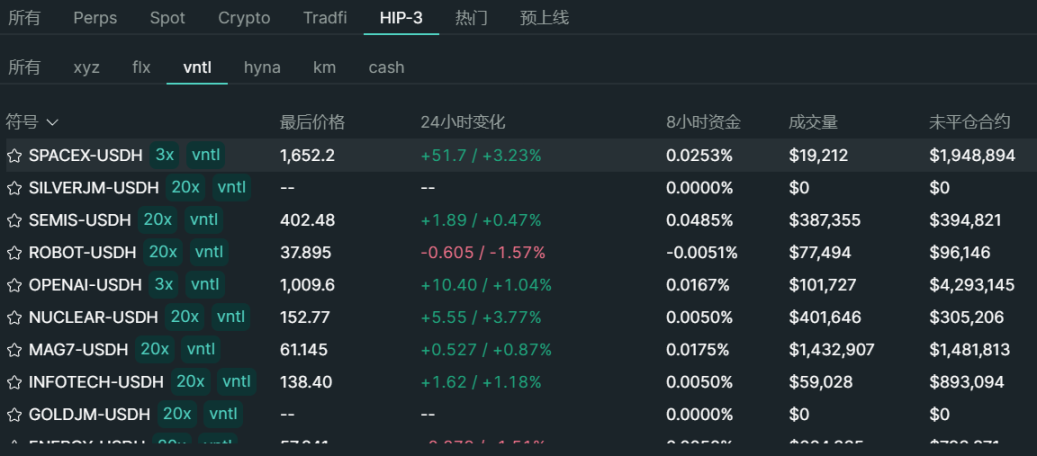
One is the perpetual contract model represented by Hyperliquid. For example, based on the HIP-3 framework, developers can自定义 deploy perpetual contract products for Pre-IPO assets like OpenAI and SpaceX. The core logic is combining Pre-IPO with perpetual contracts, not involving actual equity settlement. Essentially, it bypasses the equity itself, only providing price exposure, allowing users to bet on the valuation rise and fall of companies like SpaceX and OpenAI.

The advantages are obvious: extremely low entry threshold, no need for accredited investor certification; trades are instant, without complex equity settlement processes, etc.

At the mechanism level, we can simply understand it as a betting agreement on the valuation of unicorns like SpaceX. Liquidity is activated jointly by market makers and leverage mechanisms. Precisely because of this, it requires constant attention to whether the oracle is stable, whether the risk control mechanism is reliable, and whether清算 is fair under extreme conditions.

Furthermore, from a compliance perspective, whether this model constitutes变相 securities issuance remains in a global regulatory grey area in major jurisdictions.
The other path is much more difficult: under compliant premises, allowing users to actually hold tokenized equity, not just trade prices.

Robinhood's European test in June 2025 and MSX's launch of the on-chain Pre-IPO zone in March 2026 both point in this direction—both platforms相继 partnered with Republic, a U.S. compliant asset tokenization platform,致力于将真实的 Pre-IPO equity tokenized through an SPV (Special Purpose Vehicle) structure, allowing investors to hold legally protected equity份额.

The core value of this model lies in the fact that the tokens correspond to real existing equity, held by a regulated third-party custodian,具备 legal and asset backing foundation.

Specifically, Republic adopts an "SPV indirect holding" structure. An offshore SPV is established to hold the underlying company shares, and then the SPV's权益 is tokenized and distributed to investors. Although it is still indirect holding, compared to pure derivatives, this model at least establishes a traceable chain of "Token → SPV → Equity".

Of course, the落地 of this model highly depends on compliant infrastructure. It must operate under the U.S. SEC regulatory framework, cooperate with licensed custodians (like BitGo Trust Company, etc.), ensure asset security and legal validity. This also means it is not just product innovation, but an institutional engineering project.

Overall, these two paths represent two截然不同的 value orientations. The former (perps) is closer to DeFi's efficiency logic, pursuing extreme liquidity and low thresholds, at the cost of lacking real correlation with the underlying asset; the latter (tokenized equity mirrors) is closer to TradFi's institutional logic, with the difficulty lying in building the compliance framework.

But regardless of the path chosen, a consensus is forming: through the tokenization of unlisted equity, a "one-and-a-half market"介于 primary and secondary is taking shape.

III. From Robinhood to MSX: The Global Bridge for the "One-and-a-Half Market"

The爆发 of a market requires not only a grand narrative but, more crucially,入口-level products.

From a technical perspective, tokenization technology,经过 years of engineering verification, smart contracts, oracles, and on-chain compliance frameworks all possess the capability to carry complex financial products. From an application perspective, DeFi and TradFi have初步融合. Global users are increasingly accustomed to sharing this era's scarcest优质 asset growth红利 in a decentralized, permissionless manner.

It can be said that the on-chaining of Pre-IPO assets is at a historical inflection point,临门一脚. But单纯的 DeFi protocols often struggle to independently complete user education, compliance docking, and large-scale capital introduction alone. Therefore, at this time, on-chain infrastructure that can connect with traditional financial genes often becomes the most critical variable between narrative and落地.

Looking back, the attempt by Robinhood in June 2025 was profoundly significant.

As a global标杆 for internet retail brokers, it allowed European users to participate in on-chain份额 trading for star unicorns like OpenAI and SpaceX with extremely low thresholds. This算得上 the first time a mainstream broker has taken such a clear, large-scale stance towards the on-chain Pre-IPO market. This verified that the regulatory framework can be adapted弹性地, and proved that the masses have a real and旺盛 demand for such products.

But Europe is just the beginning. The larger, higher-growth Asian market同样 harbors an incremental space that cannot be ignored. And here, a truly entry-level platform is still lacking.
This is precisely why MSX's newly launched Pre-IPO zone deserves attention.

On March 2nd, MSX partnered with Republic—the same platform that supported Robinhood's European compliant structure—replicating this verified path to the Asian market: the first batch opened subscriptions for tokenized equity of top unicorns like SpaceX, ByteDance, Lambda Labs, Cerebras Systems, with a minimum threshold of only 10 USDT.

To some extent, MSX is playing the role of an "Asian version of Robinhood"—using a compliant tokenization structure to connect the稀缺 equity "pre-bell" with global liquidity "post-bell" in the relatively complex regulatory environment of the Asian market, bridging that hardest-to-cross "last mile".

From a broader perspective, the on-chaining of Pre-IPO is never just a one-sided demand from ordinary users; it is essentially a two-way rush:

  • Ordinary users need a truly equitable entry point to share the growth红利 of global top unicorns before the bell rings, without having to wait outside the secondary market door;

  • Private equity and early shareholders同样 hope to introduce an unprecedented global incremental funding pool, exchanging on-chain liquidity for diversified exit options for their holdings;

Both needs一拍即合.

So from Robinhood to MSX, one in Europe, one in Asia,确实说明 the Pre-IPO market is gradually moving from its原始形态 of "point-to-point matching" into the tokenization era of "low threshold, high efficiency".

IV. Final Words

The maturity and large-scale普及 of underlying technology often don't immediately materialize as product爆发. But when accumulation is sufficient, the delayed wave of innovation反而 comes more fiercely.

In this sense, it is not without basis for on-chain Pre-IPO to become a mainstream asset class in the next 3~5 years: blockchain technology has reached today, tokenization infrastructure already possesses the engineering capability to carry complex financial products, on-chain compliance frameworks are gradually clarifying, and bilateral trust between institutions and users is being slowly but steadily built.

But logical feasibility never equals natural occurrence.

Whether the compliance path is clear enough, whether the risk control mechanism is truly reliable, whether the liquidity between institutions and retail investors can be effectively matched, etc.—each is a necessary condition,缺一不可. More importantly, it's not just Robinhood and MSX; more platforms are needed, willing to bear the cost of "being the first to eat crab", using real products and real users to tread a replicable path.

In 2026, will the tokenization of Pre-IPO be a flash-in-the-pan concept game, or the true starting point for重塑 the rules of capital market access? We will know soon.


Disclaimer: All Bitpush articles represent only the author's views and do not constitute investment advice.
RWA

Пов'язані питання

QWhat is the core concept behind the on-chain Pre-IPO equity experiment discussed in the article?

AThe core concept is to use tokenization to allow ordinary users to invest in pre-IPO shares of unicorn companies like SpaceX and ByteDance before they go public. This aims to democratize access to the high-growth, high-return phase traditionally reserved for institutional investors, creating a more inclusive 'level 1.5 market' between private and public markets.

QWhat are the two main technological paths explored for bringing Pre-IPO assets on-chain?

AThe two main paths are: 1) Perpetual contracts (e.g., Hyperliquid's model), which provide synthetic exposure to a company's valuation without holding the actual equity, and 2) Tokenized equity mirrors (e.g., the model used by Robinhood Europe and MSX), where users hold a legal claim to the actual shares through a compliant structure involving SPVs and regulated custodians.

QWhich companies are mentioned as key partners in building the compliant infrastructure for tokenized Pre-IPO shares?

AThe article highlights Republic, a U.S.-regulated asset tokenization platform, as a key infrastructure partner. It has partnered with Robinhood for its European offering and with MSX to bring its compliant framework to the Asian market. Custodians like BitGo Trust Company are also mentioned as crucial for ensuring asset safety and legal validity.

QWhat is the significance of the collaboration between MSX and Republic in the Asian market?

AThe collaboration between MSX and Republic is significant because it replicates the compliant, low-minimum-investment model proven in Europe for the Asian market. MSX acts as an 'Asian version of Robinhood,' using Republic's legal and technical framework to offer tokenized shares of top unicorns like SpaceX to users in a regulated manner, with a minimum entry threshold as low as 10 USDT.

QAccording to the article, what is the fundamental driver for the potential success of on-chain Pre-IPO markets?

AThe fundamental driver is a powerful two-sided demand: 1) Ordinary users demand a fair entry point to share in the growth红利 of top unicorns before their IPOs, and 2) Private companies and early shareholders seek to tap into a new, global pool of incremental capital and gain liquidity options through on-chain trading, creating a natural and mutually beneficial market fit.

Пов'язані матеріали

Microsoft CEO: In the AI Era, How Do You Define a Company's Moat?

Microsoft CEO Satya Nadella argues that in the AI era, a company's true competitive edge, or "moat," is not determined by choosing the single most powerful model, but by its ability to build a continuous "learning loop." This system integrates and evolves by connecting human workflows, domain expertise, organizational judgment, and employee experience. He posits that future companies will accumulate two types of capital: Human Capital (employee knowledge, judgment, creativity) and "Token Capital" (a firm's own built and owned AI capabilities). Importantly, AI amplifies rather than devalues human capital. Human direction is essential to guide progress, as computational power alone is aimless. The core opportunity lies in creating a closed-loop system where human and token capital reinforce each other in a compound, self-improving cycle. A company must be able to preserve its unique institutional knowledge—its "company veteran" expertise—even if it switches underlying general-purpose AI models. This requires private evaluation benchmarks, reinforcement learning environments based on internal data, and queryable knowledge bases. Nadella warns against a future where economic value is concentrated by a few dominant models that commoditize entire industries' knowledge. Instead, the priority should be building a broad "frontier ecosystem" where every company, industry, and nation can own its learning loop. This allows organizations to retain control of their intellectual property, amplify employee capabilities, and ensure the economic value created by AI is captured within their own businesses and communities. True corporate sovereignty in the AI age comes from turning organizational knowledge into a compounding system that creates enduring, defensible value.

marsbit10 хв тому

Microsoft CEO: In the AI Era, How Do You Define a Company's Moat?

marsbit10 хв тому

ETFs Are Just the Ticket: The True Institutionalization of Bitcoin Is Happening Where You Can't See It

Beyond the Bitcoin ETF spotlight, a deeper institutionalization is underway, leveraging Bitcoin as a foundational financial primitive. Institutions are using Bitcoin for purposes long reserved for assets like U.S. Treasuries and gold: as collateral for loans, insurance reserves, and the backbone of rated bonds. Examples include a Barbados-based insurer capitalizing with $40M in Bitcoin reserves and Ledn's $188M securitization of Bitcoin-backed loans, which received the first-ever investment-grade rating (BBB-) from S&P for a digital asset-backed security. This structure was stress-tested during a 27% price drop in early 2026, triggering automatic liquidations that functioned as designed but revealed the systemic risk of synchronized selling across leveraged positions. Infrastructure is evolving to support this, with platforms like Anchorage Digital's Atlas network enabling secure, institutional-grade settlement and collateral management. Strategies like basis trades and corporate treasuries (exemplified by companies like MicroStrategy issuing billions in equity and debt to fund Bitcoin acquisitions) further integrate Bitcoin into financial mechanics. While ETFs solved "how to own" Bitcoin, these developments answer "what to do with it," embedding the asset into the working machinery of finance—as collateral upon which loans, derivatives, and structured products are built. The real, enduring institutional shift is happening in these largely invisible plumbing and financing systems.

marsbit17 хв тому

ETFs Are Just the Ticket: The True Institutionalization of Bitcoin Is Happening Where You Can't See It

marsbit17 хв тому

ZEC Co-Founder Responds to Orchard Vulnerability: No Signs of Theft, Orchard Pool to Be Sealed

ZEC Co-Founder Addresses Orchard Vulnerability: No Signs of Theft, Plans to Sunset Orchard Pool A security vulnerability was recently discovered in Zcash's Orchard shielded pool, raising key concerns. The primary questions are whether the flaw was exploited, if user funds are safe, whether users can verify the total ZEC supply, and if other similar vulnerabilities exist. Analysis suggests the vulnerability was likely not exploited prior to its discovery. It was found proactively by a researcher using specialized tools, not due to an active breach. The development team and mining pools acted quickly to contain the issue. Typical financially-motivated attacks would likely have left visible on-chain evidence, which has not been observed. User funds in Orchard are considered safe and should be recoverable, assuming no prior exploitation. If the flaw was never used, all legitimate funds can be withdrawn. The article outlines risks associated with moving funds to transparent addresses or other pools, but concludes that leaving assets in place is a reasonable option. Currently, users cannot independently verify that the total ZEC supply hasn't been inflated due to this bug. However, the planned Ironwood network upgrade is designed to resolve this. It will permanently close the Orchard pool to new deposits and internal transfers, allowing only withdrawals. This mechanism will cap total withdrawals at the amount of legitimately deposited funds, enabling anyone to cryptographically verify the supply post-upgrade. Multiple teams, including Shielded Labs, have conducted extensive audits focused on counterfeiting vulnerabilities, assisted by advanced AI tools. No additional flaws of this type have been found so far, increasing confidence that no other similar undisclosed vulnerabilities exist. In summary, evidence indicates the Orchard bug was probably not used, user funds are secure, and no other counterfeiting flaws are currently known. The upcoming Ironwood upgrade will restore users' ability to independently verify the total ZEC supply, closing this chapter.

Foresight News22 хв тому

ZEC Co-Founder Responds to Orchard Vulnerability: No Signs of Theft, Orchard Pool to Be Sealed

Foresight News22 хв тому

Microsoft Announces Commercial-Grade Quantum Computer to be Completed in Three Years: Will the Boots Land?

Microsoft announces plans to build a commercially viable quantum computer by 2029, a significant acceleration from the previous industry consensus of a decade. The breakthrough is fueled by their new Majorana 2 quantum chip, which boasts a record-breaking average qubit lifetime of 20 seconds—a 1,000-fold reliability improvement over its predecessor. This leap was achieved by leveraging topological qubits, a theoretically more stable technology using Majorana zero modes, and switching the core superconducting material from aluminum to lead. Crucially, Microsoft's "Discovery" agentic AI platform accelerated the R&D process. AI agents autonomously analyzed vast experimental data, optimized manufacturing parameters (like the lead alloy composition), and solved issues like "ghost noise," dramatically speeding up experimentation. While the 20-second coherence time is a landmark, challenges remain: scaling from 12 qubits to the millions needed for practical applications, managing compilation costs, and verifying quantum results. Skeptics call for peer-reviewed data, and questions persist about whether even 20 seconds is sufficient for complex algorithms like breaking RSA encryption. The race is on with other approaches (superconducting, trapped ions), but Microsoft's confidence in its topological roadmap signals a potential shortcut to a scalable quantum future.

marsbit40 хв тому

Microsoft Announces Commercial-Grade Quantum Computer to be Completed in Three Years: Will the Boots Land?

marsbit40 хв тому

Торгівля

Спот
Ф'ючерси

Популярні статті

Як купити F

Ласкаво просимо до HTX.com! Ми зробили покупку Synfutures (F) простою та зручною. Дотримуйтесь нашої покрокової інструкції, щоб розпочати свою криптовалютну подорож.Крок 1: Створіть обліковий запис на HTXВикористовуйте свою електронну пошту або номер телефону, щоб зареєструвати обліковий запис на HTX безплатно. Пройдіть безпроблемну реєстрацію й отримайте доступ до всіх функцій.ЗареєструватисьКрок 2: Перейдіть до розділу Купити крипту і виберіть спосіб оплатиКредитна/дебетова картка: використовуйте вашу картку Visa або Mastercard, щоб миттєво купити Synfutures (F).Баланс: використовуйте кошти з балансу вашого рахунку HTX для безперешкодної торгівлі.Треті особи: ми додали популярні способи оплати, такі як Google Pay та Apple Pay, щоб підвищити зручність.P2P: Торгуйте безпосередньо з іншими користувачами на HTX.Позабіржова торгівля (OTC): ми пропонуємо індивідуальні послуги та конкурентні обмінні курси для трейдерів.Крок 3: Зберігайте свої Synfutures (F)Після придбання Synfutures (F) збережіть його у своєму обліковому записі на HTX. Крім того, ви можете відправити його в інше місце за допомогою блокчейн-переказу або використовувати його для торгівлі іншими криптовалютами.Крок 4: Торгівля Synfutures (F)Легко торгуйте Synfutures (F) на спотовому ринку HTX. Просто увійдіть до свого облікового запису, виберіть торгову пару, укладайте угоди та спостерігайте за ними в режимі реального часу. Ми пропонуємо зручний досвід як для початківців, так і для досвідчених трейдерів.

222 переглядів усьогоОпубліковано 2024.12.21Оновлено 2026.06.02

Як купити F

Обговорення

Ласкаво просимо до спільноти HTX. Тут ви можете бути в курсі останніх подій розвитку платформи та отримати доступ до професійної ринкової інформації. Нижче представлені думки користувачів щодо ціни F (F).

活动图片












