On August 19, "the first humanoid robot stock" Unitree Technology landed on the Sci-Tech Innovation Board (STAR Market), opening up nearly 630%, with its share price reported at 1100 yuan, and a total market capitalization exceeding 440 billion yuan. Based on the opening price, the floating profit from winning one lot (500 shares) in the Unitree Technology IPO would reach 474,600 yuan. Unitree Technology's offering price was 150.80 yuan per share.
According to China News Service's financial news outlet, the listing of Unitree Technology, one of the "Six Dragons of Hangzhou", featured a star-studded lineup of backers. Liang Wenfeng's DeepSeek, High-Flyer Quant, and Jiuzhang Asset collectively received allocations of approximately 1.1916 million shares through strategic placement and offline subscriptions. Calculated at the offering price, Liang Wenfeng's floating profit from subscribing to Unitree Technology exceeded 1.1 billion yuan.
Previously, Unitree Technology's IPO garnered significant market attention, receiving active subscription and oversubscription from investors. The online lottery win rate of 0.0181% set a new historical low for the STAR Market, with an effective subscription multiple of 8288 times, attracting participation from 9.7846 million retail investors.
The company's core business is the research and development, production, and sales of humanoid robots and quadruped robots. In the humanoid robot field, the company's 2025 annual shipment volume exceeded 5500 units (pure humanoid, excluding wheeled dual-arm robots), ranking first globally in shipment volume.
The prospectus shows that the company's year-on-year revenue growth rate for the first quarter of 2026 decreased to 68.49%, while net profit after non-recurring gains and losses fell by 52.55% year-on-year; for the full year of 2025, revenue grew by 335.36% year-on-year, with gross profit margin approaching 60%.
Notably, on the eve of the listing, the company released a new humanoid robot product named "Superman" on August 17. A demonstration video showed it jumping 2 meters vertically in place and reaching a top speed of 12.66 m/s, with both indicators breaking human records, further fueling market enthusiasm.
According to trading rules, STAR Market stocks are subject to price fluctuation limits, with a limit of 20%. For the first five trading days after the initial public offering, there are no price fluctuation limits. STAR Market stocks carry the risk of relatively high price volatility.
Unitree Technology's IPO Profile: Low Floating Share Ratio
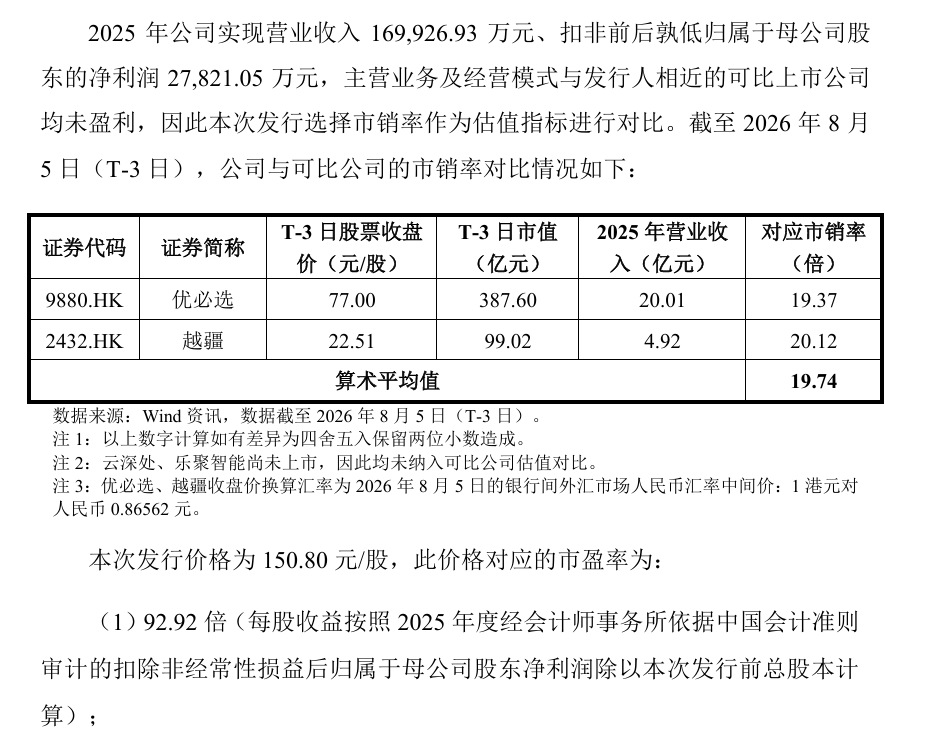
As previously noted in Wall Street News articles, the offering price of 150.80 yuan per share corresponded to a diluted price-to-earnings ratio of 219.23 times and a price-to-sales ratio of 35.89 times, both significantly higher than comparable listed companies.
The prospectus indicates that the arithmetic average price-to-sales ratio for 2025 of comparable companies referenced, namely Ubtech and Dobot, was only about 4.92 times. Unitree Technology's price-to-sales ratio premium exceeded seven times.
This IPO of Unitree Technology involved a public issuance of 40.4464 million shares, accounting for 10% of the total shares after the issuance, raising a total of approximately 6.099 billion yuan. After deducting issuance expenses, the net proceeds were about 5.917 billion yuan.
After the issuance, the total share capital is approximately 404 million shares. Initially, the number of unrestricted circulating shares upon listing is only 30,087,720 shares, representing about 7.44% of the total share capital.
Wang Xingxing, through direct shareholding and the employee持股 platform Shanghai Yuyi (indirect shareholding), holds a combined approximately 31.29% of the company's shares after the issuance. However, benefiting from a special voting rights arrangement (Class A shares carry 10 votes per share), his total controlled voting rights proportion reaches about 65.31%.
The lineup of institutional shareholders prior to the issuance shows that Ningbo Sequoia holds approximately 5.59%, while Astrend IV, Matrix Partners China Fund I, Jinshi Growth, and other institutions hold between 3% to 4% each.