Unitree Technology Soars 630% on Debut Day, with a Single Lottery Draw Profit of Nearly 500k, Market Cap Exceeds 440 Billion

Опубліковано о 2026-08-19Востаннє оновлено о 2026-08-19

Анотація

In this public offering, Unitree Tech issued 40.4464 million shares, accounting for 10% of the total share capital after issuance, with total funds raised of approximately 6.099 billion RMB. The total share capital after issuance is about 404 million shares. In the initial listing period, the number of unrestricted freely tradable shares is only 30,087,720, representing about 7.44% of the total share capital.

On August 19, "the first humanoid robot stock" Unitree Technology landed on the Sci-Tech Innovation Board (STAR Market), opening up nearly 630%, with its share price reported at 1100 yuan, and a total market capitalization exceeding 440 billion yuan. Based on the opening price, the floating profit from winning one lot (500 shares) in the Unitree Technology IPO would reach 474,600 yuan. Unitree Technology's offering price was 150.80 yuan per share.

According to China News Service's financial news outlet, the listing of Unitree Technology, one of the "Six Dragons of Hangzhou", featured a star-studded lineup of backers. Liang Wenfeng's DeepSeek, High-Flyer Quant, and Jiuzhang Asset collectively received allocations of approximately 1.1916 million shares through strategic placement and offline subscriptions. Calculated at the offering price, Liang Wenfeng's floating profit from subscribing to Unitree Technology exceeded 1.1 billion yuan.

Previously, Unitree Technology's IPO garnered significant market attention, receiving active subscription and oversubscription from investors. The online lottery win rate of 0.0181% set a new historical low for the STAR Market, with an effective subscription multiple of 8288 times, attracting participation from 9.7846 million retail investors.

The company's core business is the research and development, production, and sales of humanoid robots and quadruped robots. In the humanoid robot field, the company's 2025 annual shipment volume exceeded 5500 units (pure humanoid, excluding wheeled dual-arm robots), ranking first globally in shipment volume.

The prospectus shows that the company's year-on-year revenue growth rate for the first quarter of 2026 decreased to 68.49%, while net profit after non-recurring gains and losses fell by 52.55% year-on-year; for the full year of 2025, revenue grew by 335.36% year-on-year, with gross profit margin approaching 60%.

Notably, on the eve of the listing, the company released a new humanoid robot product named "Superman" on August 17. A demonstration video showed it jumping 2 meters vertically in place and reaching a top speed of 12.66 m/s, with both indicators breaking human records, further fueling market enthusiasm.

According to trading rules, STAR Market stocks are subject to price fluctuation limits, with a limit of 20%. For the first five trading days after the initial public offering, there are no price fluctuation limits. STAR Market stocks carry the risk of relatively high price volatility.

Unitree Technology's IPO Profile: Low Floating Share Ratio

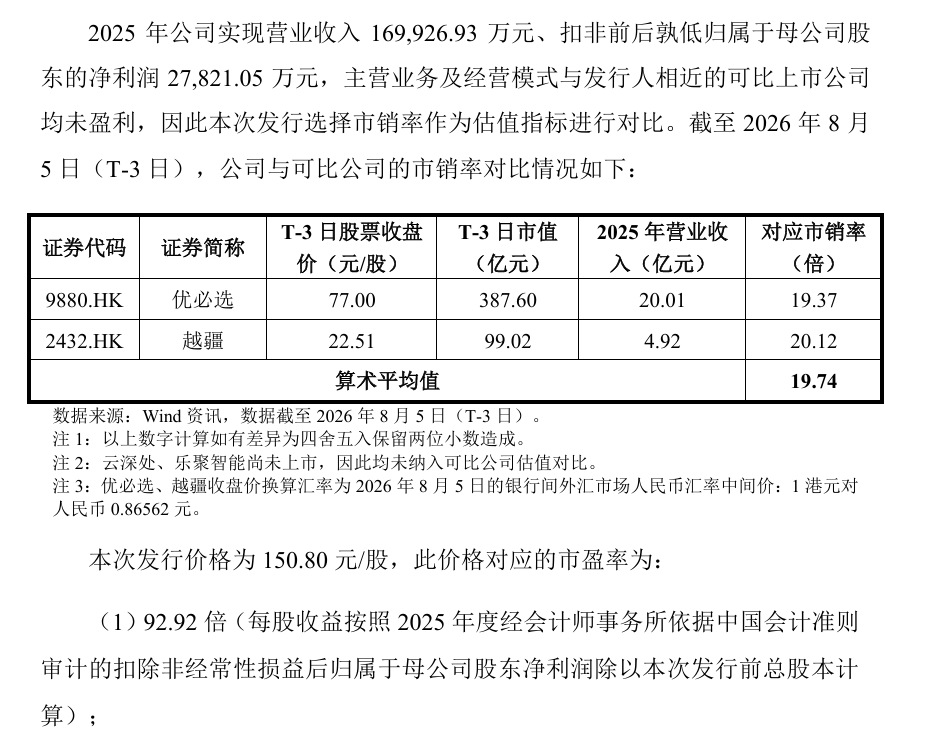
As previously noted in Wall Street News articles, the offering price of 150.80 yuan per share corresponded to a diluted price-to-earnings ratio of 219.23 times and a price-to-sales ratio of 35.89 times, both significantly higher than comparable listed companies.

The prospectus indicates that the arithmetic average price-to-sales ratio for 2025 of comparable companies referenced, namely Ubtech and Dobot, was only about 4.92 times. Unitree Technology's price-to-sales ratio premium exceeded seven times.
This IPO of Unitree Technology involved a public issuance of 40.4464 million shares, accounting for 10% of the total shares after the issuance, raising a total of approximately 6.099 billion yuan. After deducting issuance expenses, the net proceeds were about 5.917 billion yuan.

After the issuance, the total share capital is approximately 404 million shares. Initially, the number of unrestricted circulating shares upon listing is only 30,087,720 shares, representing about 7.44% of the total share capital.

Wang Xingxing, through direct shareholding and the employee持股 platform Shanghai Yuyi (indirect shareholding), holds a combined approximately 31.29% of the company's shares after the issuance. However, benefiting from a special voting rights arrangement (Class A shares carry 10 votes per share), his total controlled voting rights proportion reaches about 65.31%.

The lineup of institutional shareholders prior to the issuance shows that Ningbo Sequoia holds approximately 5.59%, while Astrend IV, Matrix Partners China Fund I, Jinshi Growth, and other institutions hold between 3% to 4% each.

Пов'язані матеріали

Token Economy Surges, Have Ordinary People Got a Slice of the Pie?

Token Frenzy: Is the Average Person Getting a Piece of the Pie? As AI adoption soars in China, daily Token consumption—the basic unit for AI text processing—has skyrocketed, exceeding 140 trillion. This "Token economy" is often measured like GDP, touted as a sign of progress. However, this metric primarily reflects supply-side activities: corporate investment, infrastructure scaling, and platform revenues. The crucial question of whether this growth translates into tangible benefits for ordinary citizens—higher wages, better jobs, improved public services, or increased leisure—remains largely unanswered. The article argues there's a fundamental mismatch. Policy, exemplified by subsidies in Beijing's Yizhuang district, often stimulates "demand" by incentivizing companies to consume more Tokens (an intermediate business cost), rather than by boosting household income or final consumer spending. This creates a closed loop where growth in Token usage justifies further production capacity expansion, without necessarily extending value to the broader population. Several disconnects are highlighted. High Token usage doesn't equal completed tasks, increased profits, or macroeconomic productivity gains. Even when corporate efficiency improves, the benefits may not trickle down due to existing economic structures favoring investment over household consumption. The risk is that AI, a genuinely productive technology, becomes another tool for supply-side expansion within a system adept at measuring output (like server capacity and call volumes) but less focused on distributing the gains widely. Drawing a parallel to Henry Ford's assembly line, the piece notes that Ford's revolution combined ruthless production efficiency with a social compact (higher wages, stability) that enabled mass consumption. Today's "Token economy" narrative enthusiastically champions the first part—process re-engineering and cost reduction—but lacks a credible mechanism for the second: ensuring that productivity gains lead to broader societal welfare. The ultimate challenge is not whether Tokens have value, but whether their economic benefits can escape a system that excels at building supply but struggles to cultivate its own demand.

marsbit7 хв тому

Token Economy Surges, Have Ordinary People Got a Slice of the Pie?

marsbit7 хв тому

Overnight Global Shock: Why Did AI Stocks Plunge Across the Board?

Overnight, U.S. AI-related stocks fell sharply, with the Nasdaq down 1.33% and the Philadelphia Semiconductor Index plunging nearly 5%. Panic spread globally, dragging down Asia-Pacific markets. Key negative drivers included: 1. **Geopolitical Tension & Macro Pressure:** Escalating U.S.-Iran tensions pushed oil prices higher, fueling inflation fears and expectations of prolonged high interest rates. Rising bond yields pressured high-valuation, capital-intensive AI stocks, especially as soaring AI infrastructure financing costs became evident. 2. **AI Commercialization Concerns:** OpenAI's Q2 results showed slowing revenue growth and widening losses, dampening market optimism about near-term AI application profitability. This shifted investor focus from pure capital expenditure narratives to actual commercial returns. 3. **Supply Chain Uncertainty:** U.S.-South Korea semiconductor investment disputes intensified. Market fears that Korean memory giants (Samsung, SK Hynix) face a dilemma—either divert capital to costly U.S. production or risk trade barriers—disrupted the critical HBM memory sector, amplifying sell-offs via leveraged ETFs. While long-term AI demand remains, the market is now scrutinizing real profitability, financing costs, and supply chain stability rather than paying premiums for unchecked growth stories. For markets like China's A-shares, the impact is primarily sentiment-driven, requiring distinction between short-term panic and fundamental deterioration.

marsbit8 хв тому

Overnight Global Shock: Why Did AI Stocks Plunge Across the Board?

marsbit8 хв тому

Q2 Wall Street Institutional Crypto Holdings: Most Institutions Increased Positions Against the Trend, ETH Exposure Outperformed BTC Across the Board

In Q2 2024, despite a roughly 14.2% decline in Bitcoin's price, many Wall Street institutions increased their crypto holdings, revealing a divergence from ETF flow trends. Overall institutional Bitcoin exposure grew by 7.5% to ~536k BTC, while aggregate spot Bitcoin ETF holdings declined. Notably, exposure concentration increased, with fewer reporting institutions holding larger positions. A key trend was the significant outperformance of Ethereum (ETH) exposure growth over Bitcoin (BTC) among major banks. For instance, JPMorgan's ETH exposure surged 67.3% versus 12.2% for BTC, and Morgan Stanley's ETH exposure grew 18.6% versus 3.7%. Individual bank holdings of Ethereum ETFs like ETHA saw dramatic increases, even as the overall Ethereum ETF market experienced net outflows during the quarter. Trading firms like Jane Street significantly rebuilt its iShares Bitcoin Trust (IBIT) position, while several hedge funds, including Brevan Howard and Graham Capital, reduced spot ETF holdings but added substantial option positions (both calls and puts), indicating more complex strategies. Institutions showed diverging views on crypto-related equities: some sold shares of MicroStrategy (MSTR) after its announced Bitcoin sales, while others like Renaissance Technologies and BlackRock were buyers. New entrants like Spain's Santander Bank disclosed initial crypto ETF positions. Meanwhile, long-term holders like Abu Dhabi's sovereign wealth funds paused their accumulation, and Harvard's endowment maintained a flat Bitcoin position. Key signals include the deepening institutionalization of crypto assets, a clear institutional preference for accumulating Ethereum, and growing divergence in views on crypto equities. This institutional buying in Q2 preceded a price recovery and renewed inflows into Ethereum ETFs in July and August.

marsbit27 хв тому

Q2 Wall Street Institutional Crypto Holdings: Most Institutions Increased Positions Against the Trend, ETH Exposure Outperformed BTC Across the Board

marsbit27 хв тому

TSMC, Another Winning Bet

TSMC Gains Another Strategic Advantage as Samsung Delays 1.4nm Process Samsung Foundry has adjusted its advanced process roadmap, postponing the mass production timeline for its 1.4nm process from 2027 to 2029. This two-year delay signals a strategic shift from aggressively pursuing the next node to focusing on maturing and scaling its 2nm platform. Samsung plans to extend the commercial lifespan of its 2nm technology through derivative versions optimized for different applications, including those incorporating backside power delivery for AI and HPC chips. A notable aspect of this shift is Samsung's cautious approach toward High-NA EUV lithography. The company views it as essential for 1nm-class nodes and beyond but not as an immediate necessity for 1.4nm, opting instead to refine its existing Low-NA EUV-based processes. This highlights a broader industry trend where the competition is evolving beyond simply reaching the next node. Success now depends on achieving high yield, managing soaring costs, integrating new transistor architectures like GAA, and delivering a compelling overall package of performance, power efficiency, and area (PPA) at a viable cost. While Samsung consolidates its 2nm efforts, TSMC continues its advance. Its N2 node is in production, and the A16 node (post-2nm, ~1.6nm) is scheduled for mass production in the second half of 2026. A16 introduces TSMC's Super Power Rail backside power delivery technology, which is expected to deliver significant performance and power efficiency gains. TSMC's previously stated cautious stance on High-NA EUV appears validated by Samsung's roadmap adjustment. The delay underscores that the competition in leading-edge semiconductor manufacturing is entering a new phase. It is no longer just a race to smaller node numbers but a multifaceted contest involving process maturity, yield, cost, design-technology co-optimization (DTCO), and advanced packaging. Samsung aims to solidify its 2nm platform over the next three years. However, as it targets 1.4nm for 2029, the industry will be watching how far ahead TSMC and Intel have moved by then.

marsbit32 хв тому

TSMC, Another Winning Bet

marsbit32 хв тому

Торгівля

Спот
活动图片