Uniswap Innocent, Tornado Developer Jailed: Two Verdicts from the Same Judge

比推Опубліковано о 2026-03-03Востаннє оновлено о 2026-03-03

Анотація

In a landmark ruling, a New York federal court dismissed a class-action lawsuit against Uniswap and its founder, Hayden Adams, holding that open-source developers are not liable for fraudulent tokens traded on their decentralized protocols. The judge, Katherine Polk Failla, compared the case to holding a car manufacturer responsible for crimes committed using its vehicles. This decision is seen as a significant victory for DeFi developers. However, the same judge previously presided over the case against Tornado Cash developer Roman Storm, who was convicted for operating an unlicensed money-transmitting business. The contrasting outcomes highlight a key distinction in regulatory attitude: decentralization is tolerated, but privacy tools that enable large-scale money laundering—especially for state actors like North Korean hackers—are not. The article argues that while Uniswap isn’t legally obligated to screen for scam tokens, there is an expectation for major platforms to take proactive measures to protect users. The piece concludes that operating within existing legal frameworks—such as implementing sanctions screening—may be essential for decentralized protocols to survive.

Author: Eric, Foresight News

Original Title: The Same Judge, Different Outcomes for Uniswap and Tornado


At 3 a.m. Beijing time on March 3, the class action lawsuit demanding that Uniswap and its founder Hayden Adams be held responsible for scam tokens on Uniswap was dismissed by the U.S. District Court for the Southern District of New York. Brian Nistler, General Counsel of the Uniswap Foundation, called it a "landmark ruling for DeFi."
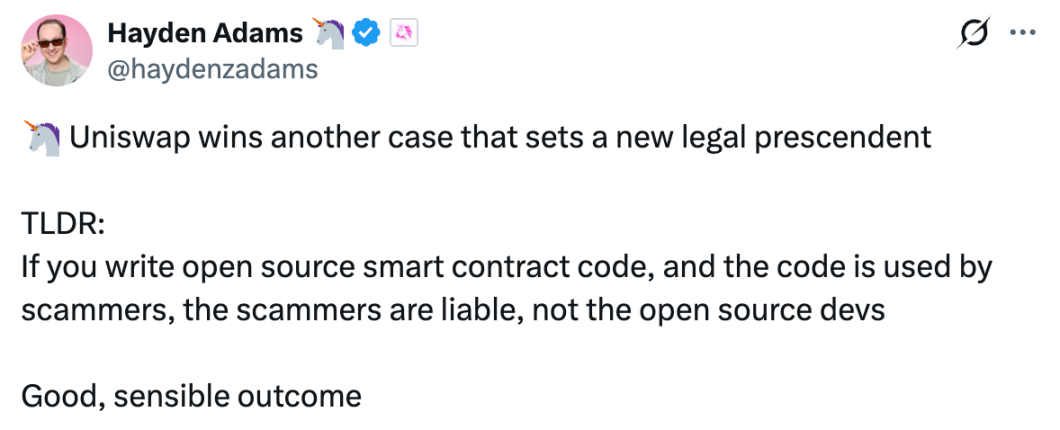
Hayden Adams also tweeted, "If you write open-source smart contract code and that code is used by scammers, the scammers are responsible, not the open-source developers. This is a reasonable and just outcome."

For Web3 developers, this is undoubtedly good news. But little known is that the judge who made this "just ruling" is the same person who, during the tenure of the former SEC chairman, found the developers of the mixer Tornado Cash guilty.

The Final Verdict

Nearly four years have passed since the class action lawsuit against Uniswap was filed and today's final resolution.

In April 2022, Uniswap users, represented by Nessa Risley, filed a class action lawsuit in court, accusing defendants Paradigm, a16z, Uniswap, and its founder Hayden Adams of violating federal securities laws by issuing and selling unregistered securities, including UNI, in the form of tokens on Uniswap. Additionally, the defendants failed to register Uniswap as an exchange or broker-dealer under applicable securities laws and did not provide investors with registration statements for the securities they issued and sold.

This lawsuit was initiated by the law firms Kim&Serritella and Barton, representing users who traded EtherumMax, Bezoge, MatrixSamurai, Alphawolf Finance, RocketBunny, and BoomBaby.io tokens on Uniswap between April 5, 2021, and April 4, 2022.

The phrase "unregistered securities" had extraordinary destructive power in the crypto industry at the time, but this lawsuit unexpectedly and quickly tilted in Uniswap's favor.

Presiding Judge Katherine Polk Failla, while agreeing that the so-called "scam tokens" were indeed securities, ruled that Uniswap did not need to be held responsible. Failla argued that Uniswap's decentralized nature meant the protocol had no control over which tokens were listed on the platform or who could interact with it. "The case is more like holding the developer of an autonomous vehicle responsible for traffic violations or bank robberies committed by third parties using the car."

Based on this, Failla dismissed the federal securities law charges in August 2023. The plaintiffs then appealed, and the Second Circuit Court of Appeals affirmed the dismissal of the federal part in 2025 but remanded the state law part for retrial.

Subsequently, the plaintiffs amended the complaint and sued again. This time, the losing investors accused Uniswap and other defendants of aiding and abetting fraud, making false statements, profiting from transactions involving scam tokens, and violating fraud laws in multiple states.

After another review by the same judge, Failla, the amended claims were dismissed again, with no further amendments allowed, bringing the case to a complete end.

The judge's reasoning this time was largely the same as before: Uniswap was unaware of the scam tokens, and even if it were aware, it did not provide substantial assistance. It also did not meet the definition of fraudulent behavior under any state law. Regarding unjust enrichment, Uniswap did not gain direct benefits, and the speculative indirect benefits from such scam activities expanding the user base were too tenuous.
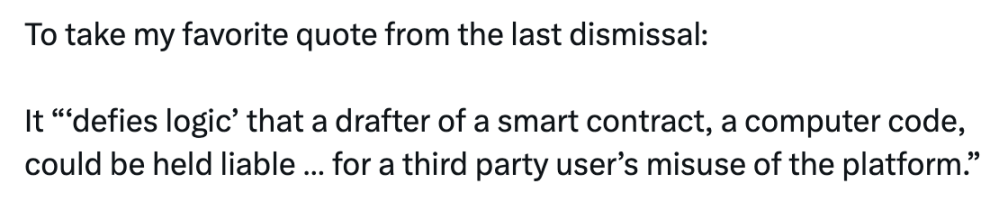
Brian Nistler stated in a tweet, quoting a line from the previous ruling, that it "defies logic" to hold the drafter of a smart contract responsible for the abusive actions of third-party users on the platform.

Tornado Cash's Different Outcome

Facing the same judge, Roman Storm of Tornado Cash met a different fate.

Tornado Cash was first added to the sanctions list by the U.S. Treasury Department's Office of Foreign Assets Control (OFAC) on August 8, 2022, accused of helping criminals, including North Korean hackers, launder over $7 billion. Two days after being added to the sanctions list, Dutch police arrested Alexey Pertsev, one of Tornado Cash's core developers.

On May 14, 2024, a Dutch court found Alexey Pertsev guilty of money laundering and sentenced him to 64 months in prison. The court ruled that Pertsev was aware that the platform he developed and operated was used for crime but did nothing to stop it, subjectively acquiescing to Tornado Cash being used as a money laundering tool. Alexey Pertsev is still appealing, but there have been no recent updates.

Seven months before Alexey Pertsev was found guilty, the U.S. Department of Justice sued two other developers, Roman Storm and Roman Semenov, in the Southern District of New York. Roman Storm was previously arrested in Washington State, while Roman Semenov remains at large.
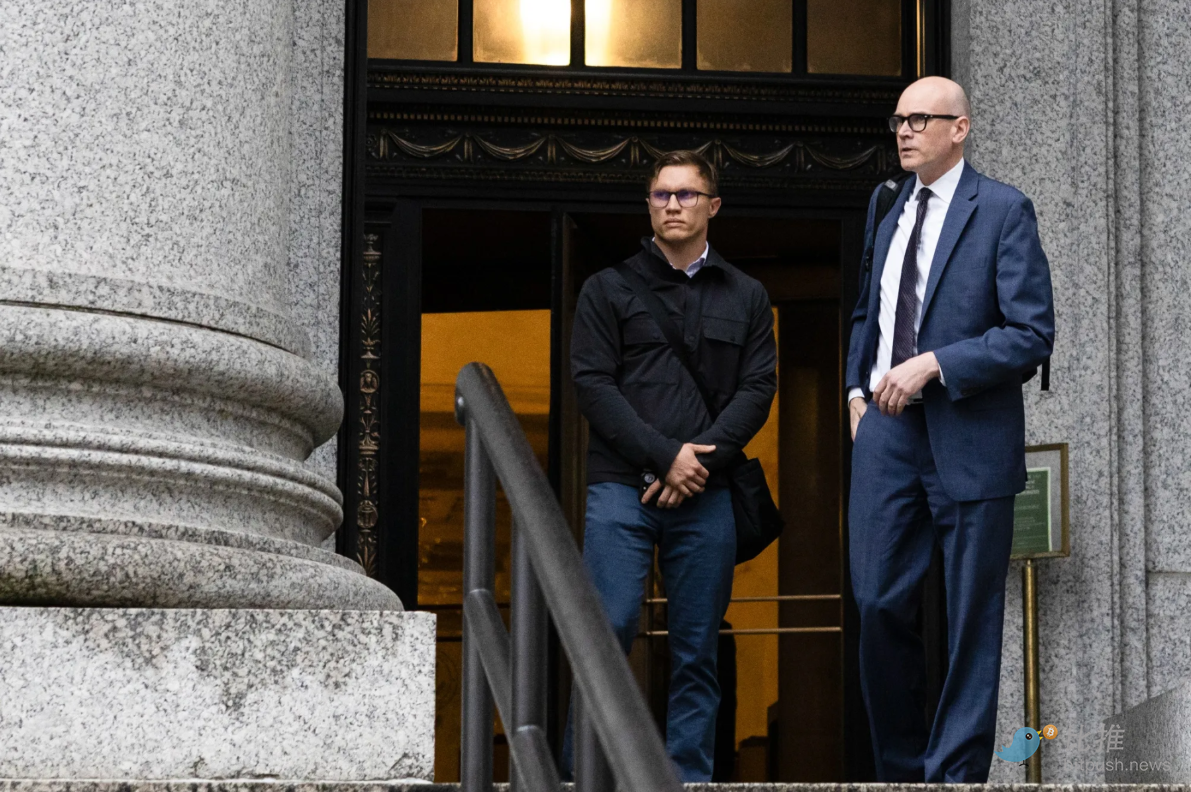
Roman Storm in court

Although an appeal later determined that OFAC's sanctions against Tornado Cash were an overreach and invalid, Roman Storm still found himself in the defendant's seat last July. After a trial presided over by Judge Katherine Polk Failla, the jury found Roman Storm guilty of "conspiracy to operate an unlicensed money transmitting business," though sentencing has not yet been formally announced.
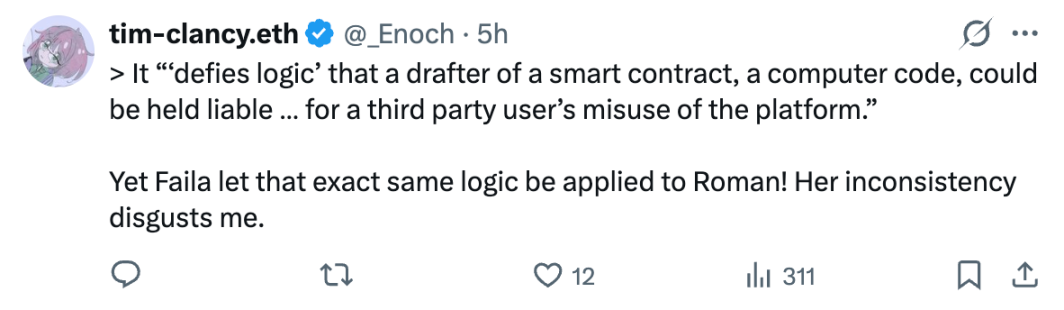
Under Brian Nistler's tweet celebrating Uniswap's victory, a comment by Sigil developer tim-clancy.eth criticizing Failla's contradictory rulings (the verdict against Roman Storm was actually made by a jury) received the most likes among all comments.

Decentralization Is Fine, but Privacy Is Not

I am not a professional lawyer, but setting aside political factors and from a simple emotional perspective, I can roughly understand why Uniswap and Tornado Cash had different outcomes.

The core reason is that Tornado Cash's developers should have been well aware that mixers would inevitably be used for money laundering. This clearly reveals regulators' stance: decentralization is acceptable, but it must be traceable. Tether faced similar challenges, which is why it later began cooperating with money laundering investigations and added freezing capabilities.

Perhaps Roman Storm, behind bars, would feel unjust upon learning of today's ruling. But he should realize that even in a crypto-friendly U.S. under Trump's administration, platforms aiding North Korean state-level hackers in money laundering cannot be tolerated. The power of crypto today is still insufficient to challenge national authority.

Web3 practitioners decry the injustice faced by Tornado Cash's developers while cheering Uniswap's victory. In our eyes, the two protocols are not fundamentally different; in fact, Tornado Cash even excels in privacy protection. Uniswap's addition of front-end blocking for sanctioned addresses in 2022 sparked some debate. Now, it seems that permissionless operation within the existing legal framework may be the only way for decentralized protocols to survive.

But that said, did Uniswap really have no responsibility at all in these scam incidents?

Strictly logically speaking, as the judge's analogy suggests, you cannot hold Mercedes responsible for a bank's losses just because a robber used their car to rob a bank. However, from a business perspective, we tend to believe that giants should provide protection within their capabilities. Current security tools can already identify a large number of potential scam projects in advance. For these established projects that have reaped the benefits of Web3's development, simple screening is not troublesome.

Doing their part to protect investors is not a mandatory obligation, but it is a responsibility that ordinary investors hope Uniswap and others will actively shoulder.


Twitter:https://twitter.com/BitpushNewsCN

Bitpush TG Discussion Group:https://t.me/BitPushCommunity

Bitpush TG Subscription: https://t.me/bitpush

Original link:https://www.bitpush.news/articles/7616264

Пов'язані питання

QWhat was the outcome of the class action lawsuit against Uniswap and its founder Hayden Adams?

AThe class action lawsuit against Uniswap and Hayden Adams was dismissed by the court. The judge ruled that Uniswap, as a decentralized protocol, was not responsible for scam tokens on its platform, comparing it to holding the developer of an autonomous car liable for traffic violations or crimes committed by users.

QWho was the judge presiding over both the Uniswap and Tornado Cash cases, and what were the different outcomes?

AJudge Katherine Polk Failla presided over both cases. She dismissed the lawsuit against Uniswap, ruling the protocol was not liable for third-party misuse. However, in the Tornado Cash case, developer Roman Storm was convicted by a jury for conspiracy to operate an unlicensed money transmitting business.

QWhy did the judge rule that Uniswap was not liable for the scam tokens on its platform?

AThe judge ruled that Uniswap's decentralized nature meant it had no control over which tokens were listed or who interacted with the protocol. She stated that holding the smart contract developers responsible for third-party misuse was 'illogical' and compared it to blaming autonomous car developers for crimes committed using their vehicles.

QWhat was the core reason suggested in the article for the different legal outcomes for Uniswap and Tornado Cash?

AThe article suggests the core reason is that Tornado Cash's developers were aware their mixer would be used for money laundering, particularly by entities like North Korean hackers. The author states that while decentralization is acceptable to regulators, privacy tools that enable untraceable transactions, especially for sanctioned entities, are not tolerated.

QWhat does the article suggest is the 'only way to survive' for decentralized protocols under the current legal framework?

AThe article suggests that 'permissionlessness within the existing legal framework' is the only way for decentralized protocols to survive. This is exemplified by Uniswap's 2022 decision to add front-end blocking of sanctioned addresses, a move that balances decentralization with regulatory compliance.

Пов'язані матеріали

South Korean Exchanges 'Battle' Regulators, Challenging the Boundaries of Enforcement and Legislation

South Korea's cryptocurrency industry is engaged in a rare, direct confrontation with regulators. The Financial Intelligence Unit (FIU), the primary anti-money laundering (AML) watchdog, has recently imposed heavy penalties on major exchanges like Upbit and Bithumb for alleged violations involving unregistered overseas VASPs and AML procedures. However, exchanges are now actively challenging these actions in court and through industry associations. In a significant shift, the Seoul Administrative Court ruled in favor of Upbit's operator, Dunamu, overturning part of an FIU-ordered business suspension. The court found the FIU's penalty criteria and justification insufficiently clear. Similarly, the court suspended the enforcement of a six-month business suspension against Bithumb pending a final ruling, citing potential irreversible harm to the exchange. Beyond legal battles, the industry is contesting proposed legislative amendments. The Digital Asset eXchange Alliance (DAXA) strongly opposes a draft rule that would mandate Suspicious Transaction Reports (STRs) for all crypto transfers over 10 million KRW (~$6,800). DAXA argues this "poison pill" clause violates legal principles and would overwhelm the STR system, increasing reports from 63,000 to an estimated 5.45 million annually for major exchanges, thereby crippling effective AML monitoring. This conflict highlights a structural tension in South Korea's crypto governance: comprehensive digital asset laws are still developing, while regulators rely heavily on AML enforcement. The industry's move from passive compliance to active legal and legislative challenges signifies a new phase, pressing for clearer rules and more proportionate enforcement. While short-term disputes may intensify, this clash could ultimately lead to a more mature and sustainable regulatory framework for South Korea's vibrant crypto market.

marsbit14 хв тому

South Korean Exchanges 'Battle' Regulators, Challenging the Boundaries of Enforcement and Legislation

marsbit14 хв тому

After 50x Storage Surge, Justin Sun Always Looks to the Next Decade

Sun Yuchen, known for his controversial stunts like a $30 million lunch with Warren Buffett (canceled due to a kidney stone) and eating a $6.2 million duct-taped banana, is often overshadowed by a significant fact: his decade-long track record of spotting major investment trends. In 2016, he famously advised young people to invest in Bitcoin, Nvidia, Tesla, and Tencent instead of buying property. A hypothetical $20,000 investment in Nvidia and Tesla from that list would now be worth over 50 million RMB. His latest major call was on November 6, 2025, predicting a "50x storage opportunity" tied to the AI boom, which materialized with Sandisk's stock surging nearly 50-fold by 2026. Looking ahead, Sun now focuses on the next frontier: Physical AI. He identifies four key areas: 1. **Embodied AI/Robotics**: He sees this reaching its "iPhone moment," with companies like UBTech and Galaxy General leading in commercialization. 2. **Drones**: Viewed as the first commercially viable form of Physical AI, revolutionizing sectors from warfare (e.g., AeroVironment's Switchblade) to logistics. 3. **Spatial Computing**: Beyond VR, it's about AI understanding physical space, a foundational technology for robotics and autonomous systems, exemplified by Apple's Vision Pro. 4. **Space Exploration**: After a 2025 suborbital flight with Blue Origin, Sun advocates for space as the ultimate frontier, discussing blockchain's potential role in space asset management and data transactions. His investment philosophy involves betting on entire, inevitable trends rather than single companies. For robotics, he sees Tesla (the body/manufacturer) and Nvidia (the brain/AI platform) as complementary plays. In defense drones, he highlights companies making tanks obsolete (AeroVironment) and those augmenting fighter jets (Kratos). For space, he participated in Blue Origin's flight and anticipates SpaceX's potential IPO to redefine the sector's valuation. Sun Yuchen's vision frames the next two decades not as a revolution in information flow (like the internet), but in the fundamental operation of the physical world through AI-powered robots, autonomous systems, and spatial intelligence, ultimately extending human and AI activity into space. While many still focus on conventional assets, he continues to look toward the next technological horizon.

marsbit1 год тому

After 50x Storage Surge, Justin Sun Always Looks to the Next Decade

marsbit1 год тому

The Billionaires Behind the Most Expensive Midterm Election in History

"The Most Expensive Midterm Elections and Their Billionaire Backers" This analysis details the unprecedented scale of spending in the 2026 midterm elections, highlighting the key billionaire donors shaping the political landscape. Jeff Yass, founder of Susquehanna International Group, has contributed over $81 million, ranking third among individual donors behind George Soros ($102.6M) and Elon Musk ($84.8M). Yass is a major donor to Trump's MAGA Inc. and supports school choice and various candidates. Overall, federal committees have raised over $4.7 billion this cycle, with political ad spending projected to reach $10.8 billion. Republican-aligned groups are significantly out-raising their Democratic counterparts. "Dark money" from undisclosed sources continues to grow. The core stakes involve control of Congress and policy direction for Trump's final term. Donors are also motivated by specific issues: Sergey Brin and Chris Larsen are funding opposition to a proposed California wealth tax and supporting crypto-friendly policies. Other top donors include OpenAI's Greg Brockman and his wife Anna ($50M total to MAGA Inc. and an AI-focused PAC), Richard Uihlein ($45.3M to conservative causes), venture capitalists Marc Andreessen and Ben Horowitz (each over $44M to crypto/AI PACs and MAGA Inc.), Miriam Adelson ($42.6M to GOP leadership PACs), Paul Singer ($33.9M), and Diane Hendricks ($25.8M to MAGA Inc.). The article notes that the peak fundraising period is still ahead, with major primaries approaching.

marsbit1 год тому

The Billionaires Behind the Most Expensive Midterm Election in History

marsbit1 год тому

The Largest IPO in History Is Approaching, Surpassing SpaceX, 28 Years of AI Self-Iteration, Countdown to Intelligence Explosion

"Anthropic Nears Trillion-Dollar IPO, Fueled by Explosive Growth and 2028 'Intelligence Explosion' Warning Anthropic is considering a deal valuing the AI company near $1 trillion, potentially leading to one of the largest IPOs ever and surpassing SpaceX. Its revenue has skyrocketed, with Annual Recurring Revenue (ARR) reaching $45 billion in May 2026—a 500% increase in just five months. This vertical growth curve is attributed to its key products, Claude Code and Cowork, dominating AI coding and enterprise collaboration. Beyond commercial success, co-founder Jack Clark issued a pivotal warning in an interview: there is a greater than 50% chance that by the end of 2028, AI systems will achieve recursive self-improvement—the ability to autonomously build a 'better version' of themselves, initiating an 'intelligence explosion.' This prophecy underpins the company's astronomical valuation, as the market prices in the potential for transformative and disruptive AI. Further signaling its ambition, Anthropic formed a $1.5 billion joint venture with Goldman Sachs and Blackstone, aiming to disrupt traditional consulting firms like McKinsey by deploying Claude AI for complex strategic work. This move tests AI's capacity to replace high-level cognitive labor, a precursor to its predicted autonomous evolution. The narrative presents a dual future: unprecedented economic opportunity alongside significant risks like economic restructuring and security threats. Anthropic's meteoric rise and Clark's 2028 prediction frame the coming years as a countdown to a potential technological singularity."

marsbit1 год тому

The Largest IPO in History Is Approaching, Surpassing SpaceX, 28 Years of AI Self-Iteration, Countdown to Intelligence Explosion

marsbit1 год тому

Торгівля

Спот
Ф'ючерси
活动图片





