
UNI Activates Fee Switch: Uniswap Completes Commercial Debut, Faces First Test in September

marsbitОпубліковано о 2026-07-31Востаннє оновлено о 2026-07-31

Анотація

Uniswap's Fee Switch activation on V4 has driven a surge in protocol revenue, with daily income jumping from $118,000 to $318,000. The newly launched Robinhood Chain has become the primary contributor, accounting for over 52% of total revenue, largely fueled by meme coin trading. This revenue fuels a new tokenomic "flywheel": fees accumulate in a pool, incentivizing arbitrageurs to buy and burn UNI tokens, creating deflationary pressure and boosting the token's price. However, concerns loom beneath the surface. Uniswap's revenue is now highly concentrated and dependent on the speculative, volatile activity on Robinhood Chain, which is currently subsidized by free gas fees. This subsidy is set to expire in late September, posing a significant test for sustained transaction volume and, consequently, protocol revenue. Furthermore, UNI's high valuation faces pressure if growth expectations aren't met. Debate also centers on the Fee Switch's impact. While Uniswap founder Hayden Adams clarified that the protocol fee is an "add-on" for traders and does not cut into Liquidity Providers' (LPs) existing share, questions remain about whether higher overall trading costs could indirectly reduce volume and LP earnings over time. Despite these challenges, Uniswap's Fee Switch marks a major step in protocol monetization, with its long-term success hinging on cultivating more sustainable usage beyond speculative trading.

Author: Jae, PANews

On the evening of July 30th, rallying alongside AI stocks was DEX (decentralized exchange) leader Uniswap. UNI price broke through the $4 mark, surging over 10% for the day and extending its weekly cumulative gains to more than 17%, sweeping away the consolidation gloom of the past three months.
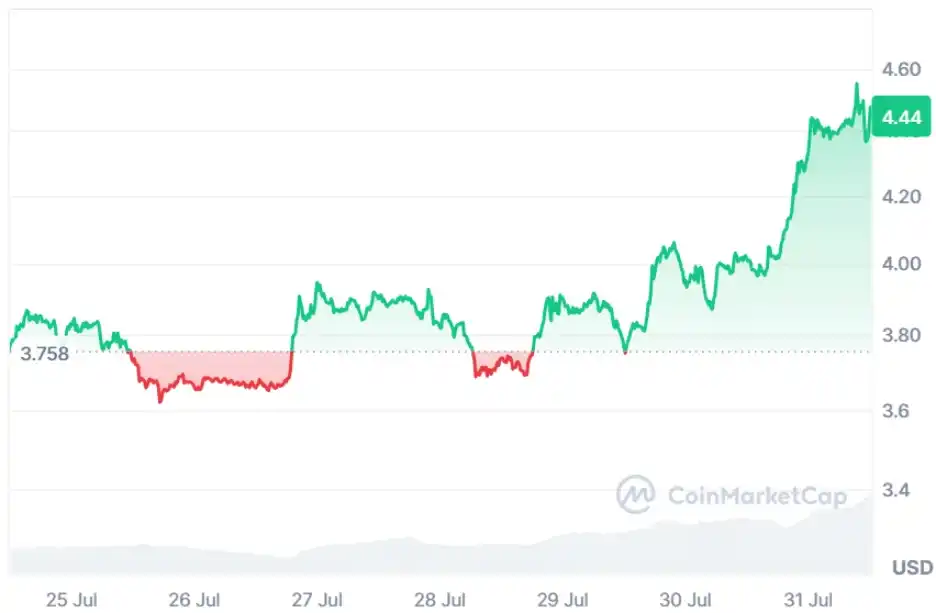
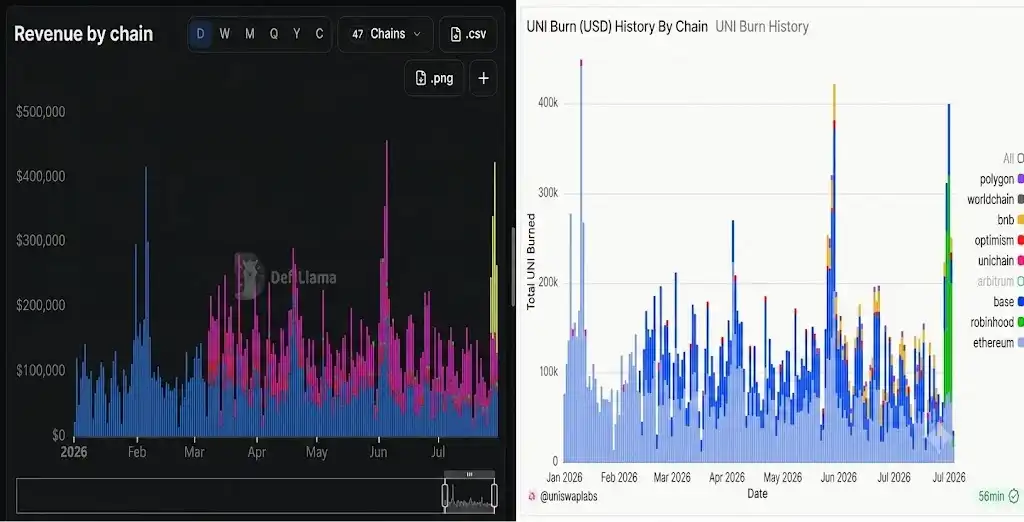
The immediate catalyst was the Fee Switch. On July 27th, the Fee Switch was officially activated on Uniswap V4, leading to an explosive growth in the protocol's network-wide revenue: average daily revenue soared from $118,000 in early July to $318,000, an increase of approximately 2.7 times. Among this, Robinhood Chain alone contributed an average of $168,000 daily, accounting for half of the protocol's total network-wide revenue.

Accompanying the revenue explosion was a strong wave of UNI burning. The daily burn scale of tokens reached 106,000, having previously set a historical record of 186,000. Beneath the surface of this狂欢, debates and concerns regarding the underlying nature of the traffic, sustainable growth, and the interests of LPs (Liquidity Providers) are also fermenting simultaneously.

Flywheel Kicks Off, Robinhood Chain Becomes Uniswap's Biggest 'Money Printer'

In conventional DEX fee mechanisms, transaction fees either flow entirely to LPs or are collected by front-end operators, with the protocol layer capturing almost no value. In late 2025, Uniswap introduced a comprehensive governance proposal, UNIfication, which established a programmatic fee distribution path by introducing the TokenJar fund pool and the Firepit burn contract.

Simply put, TokenJar is like a transparent money pot that only takes in, never pays out. Protocol-collected fees continuously accumulate in it, but no one can directly withdraw funds. The only way to 'open the pot' is to prove to the system that you have burned a corresponding amount of UNI tokens.

This creates an arbitrage opportunity: when the value of fees in the pot is higher than the cost of buying and burning UNI, arbitrageurs (such as MEV bots) will spontaneously buy UNI from the market and burn it to unlock the fees in the pot and profit from the price difference.

The entire process operates without manual intervention, entirely driven by on-chain economic incentives, forming a positive flywheel: transactions generate fees → arbitrageurs buy back and burn UNI → circulating supply decreases → token value increases.

After the Fee Switch was activated, the currently hottest Robinhood Chain has replaced the Ethereum mainnet as the core battleground for Uniswap to capture protocol fees, also becoming the most critical catalyst in the UNI deflationary wave.
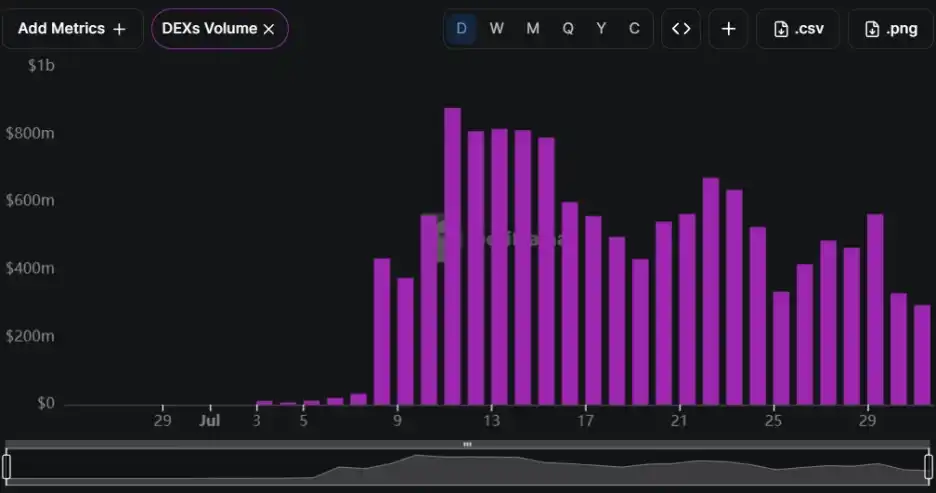
As a Layer2 network built on Arbitrum Orbit, Robinhood Chain has carried the halo of a fintech giant since its mainnet launch on July 1st. Free Gas fee subsidies and deeply integrated Web2 user entry points attracted a massive influx of capital. DeFiLlama data shows that just one week after deploying Uniswap V2, V3, and V4 protocols, the chain's cumulative trading volume rapidly surpassed the $6 billion mark.
When the Fee Switch was activated on Robinhood Chain, massive transactions were converted into tangible protocol revenue, contributing over 52% of Uniswap's daily average network-wide protocol revenue, catapulting it to become Uniswap's largest revenue source and a strong buy-side force for UNI.

Multiple Hidden Concerns Beneath the狂欢: Meme Bubble, Lofty Valuation, and Protocol 'Taxation'

However, Uniswap's highly concentrated revenue structure means the rate of UNI burning will be highly tied to the traffic fluctuations of a single chain.

The 'traffic engine' of Robinhood Chain is far more fragile than it appears on the surface.

According to Oak Research statistics, over 99% of the trading volume generated on Robinhood Chain since its launch has been driven by speculation on Meme coins like CASHCAT.

A greater test will arrive in late September.

Currently, Robinhood Chain's high trading volume is built upon the foundation of official free Gas fee subsidies. Once these subsidy policies expire in late September, and on-chain interactions resume their real cost, Meme coin speculation reliant on automated scripts and high-frequency arbitrage may cool down significantly further.

In simple terms, what currently supports half of Uniswap's revenue is highly speculative, extremely volatile Meme coin trading, not trading of real assets with long-term stability. Although Uniswap announced yesterday (July 30th) the launch of a Launches test version on Robinhood Chain, aiming to aggregate popular token launches and provide them with distribution channels, it does not change the weak underlying structure of the protocol's recent traffic.

Additionally, the market has already priced in extremely high growth expectations for UNI in advance. From a valuation perspective, Uniswap's fully diluted valuation (FDV) is approximately $4 billion, corresponding to an annualized revenue of about $41 million, implying a high P/E (Price-to-Earnings) ratio nearing 100. If revenue growth fails to meet expectations, the high valuation will face downward pressure.

The most intense debate focuses on: Is the protocol 'taxation' achieved at the expense of LP interests?

Direct competitor Aerodrome co-founder Alexander Cutler pointed out that the essence of the Fee Switch is the protocol forcibly carving out a piece of the existing pie. After activating the Fee Switch on Uniswap V2 and V3 concentrated liquidity pools, it effectively cut away up to 25% of the original LP profits; under the V4 architecture, it even imposed an up to 33% 'tax rate' on liquidity interactions.

In response to market doubts, Uniswap founder Hayden Adams posted a clarification, stating that the protocol fee in Uniswap V4 adopts an 'additive' system, not a 'deductive' one. The existing pool fees for LPs are not subject to any deduction; the protocol fee is an incremental fee additionally charged to traders on top of that. LP profits are not harmed.

Mathematically, Adams is correct; but economically, the question remains unresolved: will an increase in the total transaction fee rate raise costs for traders, thereby suppressing trading volume, and ultimately indirectly weaken the actual transaction earnings for LPs? This difficult problem still requires longer-term market data for verification.

Even so, Uniswap has completed an outstanding 'commercial' debut. But whether it can turn this debut into a sustainable norm depends on its ability to expand into application scenarios with more long-term value on-chain.


Пов'язані питання

QWhat triggered the recent surge in UNI price and on-chain fee revenue for Uniswap?

AThe activation of the Fee Switch on Uniswap V4 triggered the surge. It enabled the protocol to capture a share of trading fees, leading to explosive growth in daily protocol revenue, which in turn drove significant UNI token buybacks and burns, creating positive price pressure.

QWhich blockchain has become Uniswap's primary source of protocol fee revenue after the Fee Switch activation, and why?

ARobinhood Chain has become Uniswap's primary source of protocol fee revenue. This is due to its massive transaction volume, driven largely by meme coin trading (e.g., CASHCAT) and bolstered by Robinhood's temporary gas fee subsidy for users, which attracted significant capital and activity to its Uniswap deployments.

QWhat are the main concerns regarding the sustainability of Uniswap's current fee revenue model?

AThe main concerns are: 1) Over-reliance on volatile, speculative meme coin trading on Robinhood Chain for revenue. 2) The impending end of Robinhood Chain's gas fee subsidy in late September, which may drastically reduce trading activity. 3) UNI's high valuation (implied P/E ~100x) pricing in aggressive growth expectations that may not be met.

QHow does the Fee Switch mechanism create a 'flywheel' effect for the UNI token according to the article?

AThe flywheel effect works as follows: Trading generates protocol fees → Fees accumulate in the TokenJar contract → When the value in TokenJar exceeds the cost of buying UNI, arbitrageurs (like MEV bots) buy and burn UNI to claim the fees → This reduces UNI's circulating supply → The reduced supply, coupled with buy pressure, aims to increase the token's value.

QWhat is the debate surrounding the impact of the protocol fee on Liquidity Providers (LPs)?

AThe debate centers on whether the protocol fee harms LP profits. Critics argue it effectively 'taxes' LP revenue by taking a cut (up to 25% in V2/V3, potentially 33% in V4 interactions). Uniswap's founder counters that in V4, the fee is 'additive'—charged to traders on top of the existing pool fee—and does not reduce the LP's designated share. However, the economic concern remains that higher total fees for traders could reduce trading volume and thus indirectly lower LP earnings.

Пов'язані матеріали

Weekly Editor's Picks (0725-0731)

Weekly Editor's Picks (0725-0731) provides a curated selection of deep analysis, filtering out market noise. Key themes from this week include: **Macro & Policy:** The Federal Reserve's upcoming meeting is marked by high uncertainty, balancing cooling inflation data against persistent price pressures. Meanwhile, the U.S. crypto regulatory Clarity Act faces critical political hurdles, with its 2026 passage probability seen as low. **Investing & Crypto:** Analysis suggests long-term crypto success depends on conviction through volatile cycles, focusing on assets like Bitcoin and core smart contract platforms. A trend noted is the increasing similarity between global equity markets (especially tech) and crypto, driven by narrative and leverage. Several major crypto protocols show strong revenue growth, but this isn't always translating to token price appreciation due to sell pressure and structural factors. **AI & Semiconductors:** Nvidia's rising credit default swap rates signal market concern over AI infrastructure financing risks. The storage sector experienced volatility as markets began pricing in potential 2027 oversupply. Despite a record profitable quarter, SK Hynix's results were deemed "below expectations," reflecting heightened investor demands for future growth visibility. **Markets & DeFi:** TradeXYZ demonstrated remarkable accuracy in pre-market pricing for a major A股 listing. The token ONDO saw gains, linked to its growing role in the on-chain tokenized stock ecosystem. **Ethereum:** Post-Pectra upgrade, a major structural shift is underway as Lido begins migrating millions of ETH to new validator architectures designed for capital efficiency. **Also Highlighted:** Butian's bullish stock market move; OpenAI's Altman promising major advances; Samsung and SK Hynix securing large AI chip deals; Apple reaching a $5T market cap; and ongoing discussions around exchange security following Poolin's bankruptcy case.

marsbit5 хв тому

Weekly Editor's Picks (0725-0731)

marsbit5 хв тому

Low Investment Isn't Apple's Immunity Pass

While Meta and Google face investor scrutiny over ballooning AI capital expenditures, Apple's minimal AI investment has paradoxically become a strength. Its market cap recently reclaimed the global top spot, surpassing $5 trillion. The irony is deep: Apple's own AI efforts have lagged, with "Apple Intelligence" delayed and core talent lost, forcing reliance on partners like Google Gemini and Alibaba's Qianwen. Its Q3 FY2026 (Q2 CY) earnings initially seemed stellar. Revenue hit $109.4B (up 16% YoY), with iPhone and Mac sales, growing 22% and 29% respectively, driving most of the growth. However, the stock fell over 8% post-earnings. The primary concern was a weaker Q4 revenue growth forecast of 9-11%, below expectations, due to looming supply chain constraints. Apple is feeling the indirect cost of the AI boom. Soaring memory and chip prices, fueled by massive data center investments from Microsoft, Amazon, and others, are forcing Apple to raise Mac and iPad prices significantly. The upcoming iPhone launch is also expected to see substantial price hikes. Despite avoiding heavy AI infrastructure spending—its capital expenditures are actually down 28%—Apple cannot escape the industry-wide supply and cost pressures. While Apple's operating cash flow remains robust, its substantial R&D spending (up 32% YoY) has yet to yield major AI breakthroughs. As Tim Cook prepares to step down as CEO, Apple faces a challenging transition: balancing its premium hardware success against the strategic and cost pressures of the AI era it has so far cautiously navigated.

marsbit55 хв тому

Low Investment Isn't Apple's Immunity Pass

marsbit55 хв тому

PA Graphics Explanation | One Chart to Understand the Major Web3 Events in August 2026

**PANews Crypto Calendar: Key Web3 Events in August 2026** PANews introduces its revamped crypto calendar, featuring comprehensive coverage, flexible filtering, and easy export options. The market in August will be shaped by multiple key events across macroeconomics, regulation, tokenomics, and project developments: * **Macro & Policy:** Key US economic data releases (July Non-Farm Payrolls, CPI), the Federal Reserve meeting minutes, and the Jackson Hole Economic Symposium will be in focus. On the regulatory front, the US Senate plans to release a new draft of the *CLARITY Act*, while the EU's expanded crypto ban against Belarus comes into effect. * **Token Unlocks:** Significant token unlocks are scheduled for assets including ENA, AVAX, CONX, ZRO, and KAITO, which may influence market volatility. * **Project Updates & Shutdowns:** Several services, including Exchange Art, Ctrl Wallet, Zapper, NFTfi, and Summer.fi, are set to cease operations or undergo major adjustments. Users are advised to manage their assets accordingly. * **Corporate Activity:** Q2 earnings reports from companies like SpaceX, Circle, and Nvidia are due. Unitree Robotics will initiate its IPO subscription on the STAR Market, and Moonshot AI plans to begin a Pre-IPO financing round. * **Industry Events:** Major conferences such as Bitcoin Asia 2026 and the 2026 Digital Expo will take place. The overarching market narrative for August will revolve around macroeconomic expectations, regulatory developments, token unlock schedules, and ongoing industry consolidation.

marsbit1 год тому

PA Graphics Explanation | One Chart to Understand the Major Web3 Events in August 2026

marsbit1 год тому

Wall Street's Most Famous 'Cassandra' Now Has His Sights Set on Nvidia

Michael Burry, the famed "Big Short" investor, has once again captured Wall Street's attention with a series of short positions against major tech and semiconductor stocks, most notably Nvidia. In late June and July, through his "Cassandra Unchained" newsletter, Burry disclosed short bets against Nvidia, Tesla, Applied Materials, Caterpillar, the SOXX semiconductor ETF, and later, Micron Technology. His core thesis revolves around potential distortions in the AI infrastructure boom, specifically questioning whether extended depreciation schedules (e.g., 6 years vs. a realistic 2-3 years for AI chips) by cloud giants like Microsoft and Google artificially inflate profits. He also raises concerns about possible "off-balance-sheet circular financing," where chip demand might be propped up by vendor-backed funding to clients. Nvidia's stock experienced volatility following these disclosures, briefly dipping but largely holding near Burry's reported entry points, leaving his positions roughly flat or slightly underwater as of late July. This move is part of a pattern for Burry, whose track record since his legendary 2008 bet is mixed. He has faced notable losses, such as on Tesla in 2021, while scoring on broader market turns like the 2020 pandemic crash. His methodology focuses intensely on free cash flow and scrutinizing original financial documents to spot overvaluation and structural risks, but it often struggles with timing the market. The article contrasts Burry's stance with other prominent investors. Steve Eisman, another "Big Short" figure, is not shorting Nvidia, citing strong fundamentals but expressing nervousness about sustainability. Jim Chanos agrees with the broad "accounting mismatch" concern—comparing it to the dot-com bubble—but targets financial leverage in private equity firms rather than the chip stocks themselves. While Nvidia's short interest remains relatively low at 1.3-1.4% of float, the massive stock size means absolute short losses have been significant, exceeding $5 billion earlier this year. The piece concludes that for ordinary investors, the key takeaway is not replicating specific short bets but learning from the critical frameworks these investors use: questioning rosy accounting, identifying structural vulnerabilities, and maintaining skepticism during market euphoria, even if pinpointing the exact catalyst for a downturn remains elusive.

marsbit1 год тому

Wall Street's Most Famous 'Cassandra' Now Has His Sights Set on Nvidia

marsbit1 год тому

Weekly Selection丨Epic Stock Market Volatility, Changxin Tech's IPO Reshapes Storage Landscape, Saylor Aims to Re-Anchor STRC Around September 8th

PANews Weekly Digest: Market Turmoil, Tech Breakthroughs, and Crypto Developments. The week saw significant volatility across global markets. South Korea's KOSPI index experienced extreme turbulence, including multiple trading halts, largely driven by sharp declines in AI hardware stocks like SK Hynix. In contrast, China's Changxin Xinqiao (CXC) achieved a landmark IPO with a market cap surpassing 4 trillion yuan, marking a major success for the domestic DRAM industry after a decade of losses. In the crypto and Web3 space, several key narratives emerged. AI is driving demand for new infrastructure, with projects like AI agent wallets and programmable payments gaining traction, attracting interest from firms like Coinbase. The Bitcoin mining sector is pivoting, with companies like MARA focusing on energy management as electricity becomes a core AI-era asset. Meanwhile, the RWA (Real World Assets) sector faces a "utilization puzzle," with hundreds of billions in on-chain assets remaining dormant. Notable market movements included a historic single-day surge of over 17% for the KOSPI index and a significant migration of $16.5 billion in staked ETH within the Lido ecosystem. Michael Saylor announced a target to re-peg the STRC stablecoin around September 8th. Other highlights include discussions on Ethereum's ambitious 2030 roadmap for scaling and privacy, analysis showing high protocol revenues not always translating to token price gains, and warnings from Citi about potential extreme commodity price shocks by late 2026.

marsbit1 год тому

Weekly Selection丨Epic Stock Market Volatility, Changxin Tech's IPO Reshapes Storage Landscape, Saylor Aims to Re-Anchor STRC Around September 8th

marsbit1 год тому

Торгівля

Спот
活动图片