Unexpectedly Negative! US July Retail Sales Drop 0.6% Month-over-Month, Marking the Largest Decline in Over a Year

marsbitОпубліковано о 2026-08-14Востаннє оновлено о 2026-08-14

Анотація

U.S. Retail Sales Unexpectedly Fall Sharply in July U.S. retail sales in July declined by 0.6% month-on-month, marking the largest drop since May 2025 and falling significantly short of the market expectation for a 0.1% gain. The cooling demand, driven by decreases in auto purchases and online sales, has prompted a more cautious outlook on consumer spending resilience for the second half of the year. The closely watched "control group" sales, which exclude autos, gasoline, building materials, and food services and directly feed into GDP calculations, fell 0.4%, missing expectations of a 0.3% increase. Core retail sales (excluding autos and gasoline) also fell 0.2%, against an anticipated 0.3% rise. Economists attribute the weakness to several factors: the fading boost from excess tax refunds earlier in the year, a decline in personal savings rates, and temporary disruptions. These include the shift of major promotional events like Amazon's Prime Day to June, hot weather around the July 4 holiday, and the post-World Cup spending lull. Specific categories like clothing, gasoline, and furniture saw declines. Notably, the consumption slowdown is accompanied by a shift in spending patterns across income groups. Recent data shows spending growth among low-income households has outpaced that of high-income households in recent weeks, even for discretionary goods, suggesting a potential convergence from the previous "K-shaped" economic recovery into a more uniform "C-shaped" patte...

Author: Bu Shuqing, Wall Street News

US consumer demand cooled significantly in July, with retail sales data falling far short of expectations, leading the market to adopt a more cautious stance on consumption resilience in the second half of the year.

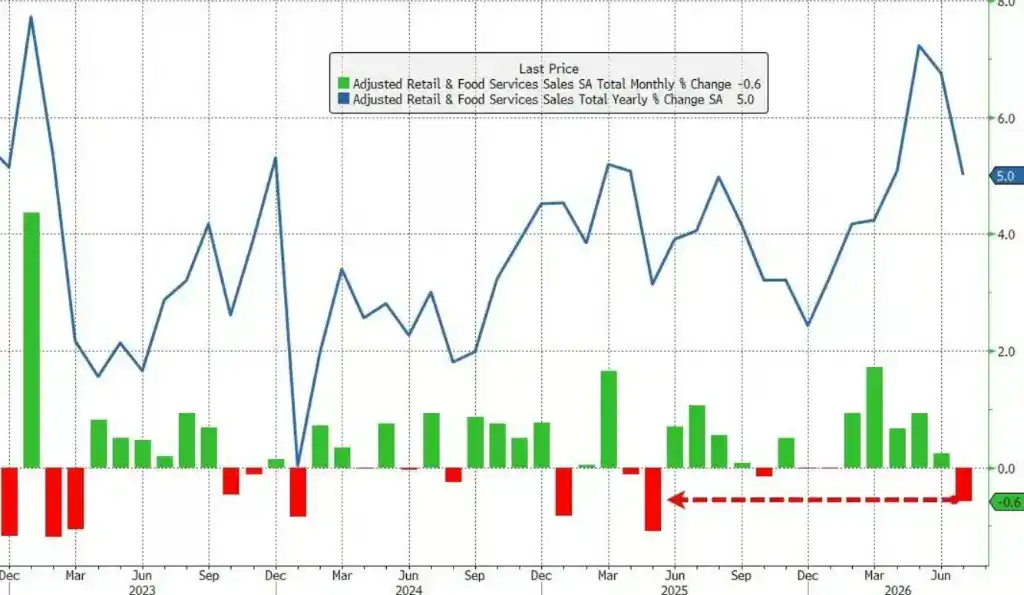
Data released by the US Census Bureau on Friday showed that the monthly retail sales volume in July fell by 0.6%, marking the largest single-month decline since May 2025 and significantly below the market expectation of a 0.1% increase. Reduced car purchases and a pullback in online retail were the main drags.
Excluding automobiles and gasoline, July retail sales fell 0.2% month-over-month, compared to an expected increase of 0.3%.

The core retail sales (the "control group" measure), which is directly related to GDP calculations and seen as a "bellwether" for consumer spending, also fell by 0.4% month-over-month, significantly missing the expected 0.3% gain.

Following the release of this data, market concerns about the outlook for US consumer spending have intensified. Economists widely pointed out that the one-time boost from excess tax refunds in the first half of 2026 has gradually faded, and with the personal savings rate falling to a four-year low in June, the sustained momentum on the consumer side is uncertain.

Analysts believe that the unusual weakness in July's data is partly due to the concentrated release of short-term disruptive factors.

As Bank of America analysts previously predicted, the timing of this year's Prime Day and related promotional events shifted forward from July to June, causing a significant forward shift in online (non-store) retail consumption, which consequently led to a notable decline in online sales for July.

Looking at the breakdown, clothing, gasoline (affected by falling oil prices), and furniture sales all recorded month-over-month declines. Furthermore, the heatwave around the US Independence Day on July 4th and the waning consumer enthusiasm after the end of the World Cup were also considered to have exerted some drag on retail activity for the month.

On a year-over-year basis, July retail sales still grew by 5.0%, with the absolute level remaining relatively robust, but the growth rate has slowed compared to previous periods.

Among all the sub-indicators, the performance of the "control group" sales data is the most closely watched by the market. This measure excludes automobiles, gasoline, building materials, and food services, and is directly used to calculate Personal Consumption Expenditures (PCE), which is then incorporated into GDP calculations, making it a key indicator for gauging the underlying momentum of consumption.

The 0.4% month-over-month decline in control group sales in July, compared to the market expectation of a 0.3% increase, represents a deviation of 0.7 percentage points. This significant miss may put downward pressure on Q3 GDP growth forecasts.
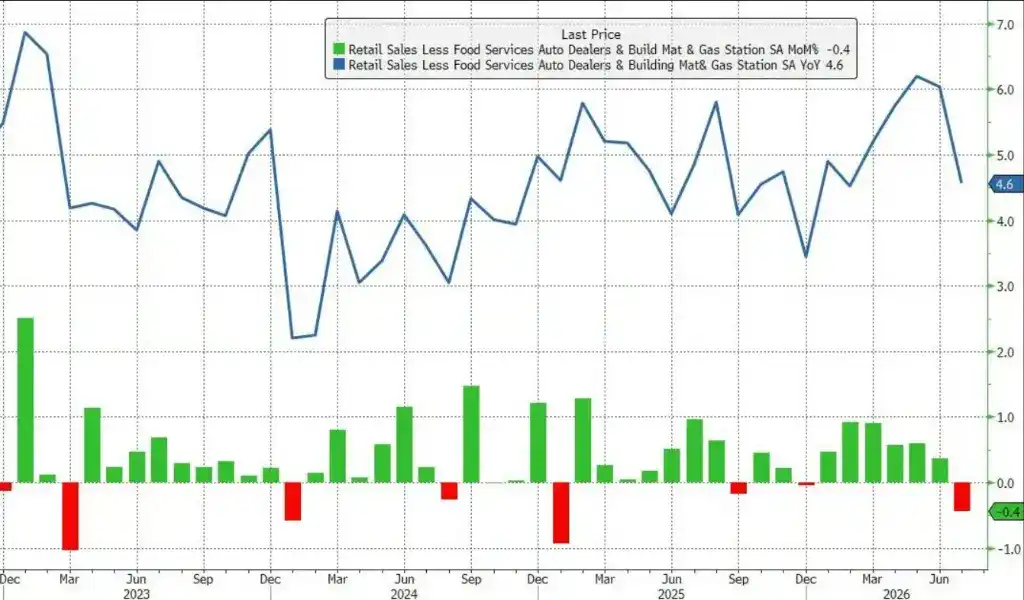
Bank of America data shows that core retail sales excluding automobiles and gasoline fell 0.2% month-over-month, also worse than the expected decline of 0.2%—in summary, all core indicators showed a significantly weaker-than-expected trend.

It's worth noting that this round of consumption cooling is not evenly distributed across income groups, reflecting subtle changes in consumption structure.

The latest Bank of America credit card spending data shows that in the four consecutive weeks ending August 1st, the year-over-year spending growth rate for low-income households has consistently been higher than that for high-income households. This marks a significant reversal from the persistent K-shaped divergence seen in recent years—where high-income group consumption was strong while low-income groups were relatively pressured.

Even within discretionary spending categories, this trend holds true and is not solely driven by gasoline price changes. Low-income groups show robust discretionary spending, while high-income groups show modest cooling. Bank of America believes this indicates that the K-shaped economic pattern is gradually converging towards a "C-shape," meaning consumption trends across income tiers are becoming more aligned.

For the market, this implies that some retail sectors that previously relied on consumption by high-income groups may face some growth pressure.


Пов'язані питання

QWhat was the headline figure for US retail sales in July, and how did it compare to expectations?

AUS retail sales in July fell by 0.6% month-over-month. This was the largest monthly decline since May 2025 and significantly missed market expectations for a 0.1% increase.

QAccording to the article, what are the two main items that dragged down the overall retail sales figure in July?

AThe two main drags on the overall retail sales figure were decreased automobile purchases and a decline in online retail sales.

QWhat is the 'control group' retail sales metric, and why is it important?

AThe 'control group' retail sales metric excludes volatile categories like automobiles, gasoline, building materials, and food services. It is directly used to calculate Personal Consumption Expenditures (PCE), which is a key component of GDP, making it a crucial indicator of underlying consumer spending momentum.

QWhat new trend in consumer spending by income group does the article mention based on Bank of America data?

AAccording to Bank of America's credit card data, consumer spending growth for low-income households has recently been higher than for high-income households. This represents a reversal of the previous 'K-shaped' divergence and suggests a convergence toward a more uniform 'C-shaped' pattern across income levels.

QWhat are some of the temporary factors cited in the article that may have contributed to the weak July retail sales data?

ASeveral temporary factors contributed to the weak data: the shift of Prime Day and related promotions from July to June, which pulled forward online spending; hot weather around the July 4th holiday; a post-World Cup decline in consumer enthusiasm; and lower gasoline prices affecting the gas station sales component.

Пов'язані матеріали

Haiwei Huaxin's Official Seal Seized by Over a Hundred People, High-Stakes Corporate Battle's 'Nuclear Deterrence' in Action Again

On August 18th, Haowei Huaxin, a semiconductor firm specializing in gallium arsenide and gallium nitride wafers, reported that over a hundred individuals forcibly entered its offices and seized the company's official seals from a safe, including the corporate, contract, and party committee seals. The incident is the latest escalation in a protracted control dispute. Haowei Huaxin, established in 2010, was originally a joint venture. Control became contested after 2021 when Zhenwei Financial Holding injected capital, becoming the largest shareholder (34.01%), while former parent Haite High-Tech's stake was diluted to 33.79%. An agreed-upon governance structure collapsed, leading to mutual accusations. Haite claimed it was locked out of the subsidiary's premises, while also alleging improper management like livestock being kept on the chip fabrication site. After state-owned Qingdao Haiyue Holdings took over Zhenwei's stake in 2023, Haite accused it of illegally seizing control. Despite Haite winning several legal battles in 2024-2026, which affirmed its rights to nominate directors and the chairman, it failed to regain physical control or recover the seals. The stakes are high: market valuations for Haite's stake in Haowei Huaxin are estimated between 3.7 to 5 billion USD, yet it is only valued at about 83 million USD on Haite's books. Losing control effectively jeopardizes a significant portion of Haite's value. In response to the seal seizure, Haite framed it as a "shareholder rights protection" action agreed upon by five shareholders. This mirrors a pattern in Chinese corporate disputes where seizing physical seals becomes a tactic to paralyze the opponent's daily operations, seen in past conflicts at companies like Dangdang and Bitmain. However, such actions don't resolve underlying ownership issues; the opposing party can report the seals stolen, declare them void, and apply for new ones, albeit with significant delay. The incident underscores how fragile corporate governance can devolve into physical confrontations over symbols of authority, with control ultimately determined by law and shareholding, not possession of a seal.

marsbit25 хв тому

Haiwei Huaxin's Official Seal Seized by Over a Hundred People, High-Stakes Corporate Battle's 'Nuclear Deterrence' in Action Again

marsbit25 хв тому

Bernstein Interprets MRNA's 177% Surge: What's Fundamentals and What's Hype?

Bernstein's analysis of Moderna's 177% stock surge following positive Phase 3 results for its individualized neoantigen therapy (INT) in melanoma distinguishes fundamental drivers from market speculation. The clinical breakthrough is real: the INTerpath-001 trial met its primary and key secondary endpoints, providing crucial validation for mRNA technology in oncology beyond infectious diseases. However, Bernstein argues the magnitude of the stock move cannot be justified by this single trial's fundamentals alone. The surge was amplified by three key factors: 1) A re-rating of Moderna's mRNA platform potential for expansion into other cancers, 2) A massive short squeeze, given ~15% of shares were sold short pre-announcement, and 3) The compelling "cancer vaccine" narrative that fueled broader investor enthusiasm. While the melanoma success is significant, Bernstein cautions that replication in lung, kidney, and bladder cancers—which have different immunogenicity—is not guaranteed. Furthermore, INT's commercial model faces challenges: it's a personalized treatment, not a mass-market vaccine, implying higher production costs and potential margin pressures despite a projected multi-billion dollar peak sales opportunity. The report also notes sector rotation, with some funds moving from crowded AI/semiconductor trades into defensive healthcare stocks, adding further momentum. In conclusion, Bernstein maintains a "Market-Perform" rating and a $45 price target, far below the post-surge price. It views the current valuation as pricing in an optimistic multi-cancer platform success and efficient commercialization that are yet to be proven. The clinical inflection point is clear, but the earnings inflection point awaits validation across future trials and commercial execution.

marsbit26 хв тому

Bernstein Interprets MRNA's 177% Surge: What's Fundamentals and What's Hype?

marsbit26 хв тому

Торгівля

Спот
活动图片