Understanding Vitalik's Reflection on L2: Farewell to Fragmentation, Rectifying the Course Towards Native Rollup in the New Phase

marsbitОпубліковано о 2026-02-21Востаннє оновлено о 2026-02-21

Анотація

Vitalik Buterin's recent reflections on Ethereum's scaling roadmap signal a significant shift: the original plan prioritizing L2s as the primary scaling solution is now considered outdated. Rather than abandoning L2s entirely, the new strategy refocuses on Ethereum L1 as the most secure settlement layer, while L2s are expected to pursue specialization and differentiation—offering unique features like privacy-focused virtual machines or AI-agent environments—instead of mere scalability. A key issue is the fragmentation caused by numerous L2s, many of which remain centralized (e.g., stuck at "Stage 1" with limited decentralization). This undermines Ethereum’s core values and splits liquidity. The community is now moving toward "Native Rollup" concepts, particularly Based Rollup, which integrates rollup logic directly into L1, using Ethereum validators for sequencing instead of independent, often centralized, sequencers. This enhances security, reduces fragmentation, and enables synchronous composability. To improve user experience, preconfirmations and fast L1 confirmation rules are proposed to reduce finality wait times from ~13 minutes to 15-30 seconds. Looking ahead, Ethereum’s evolution will emphasize account abstraction (simplifying user onboarding), privacy with ZK-EVM, and infrastructure for AI agents operating trustlessly on-chain. Ultimately, Vitalik’s critique is not a rejection of L2s but a correction—away from fragmentation and toward deeper integration with L1, ...

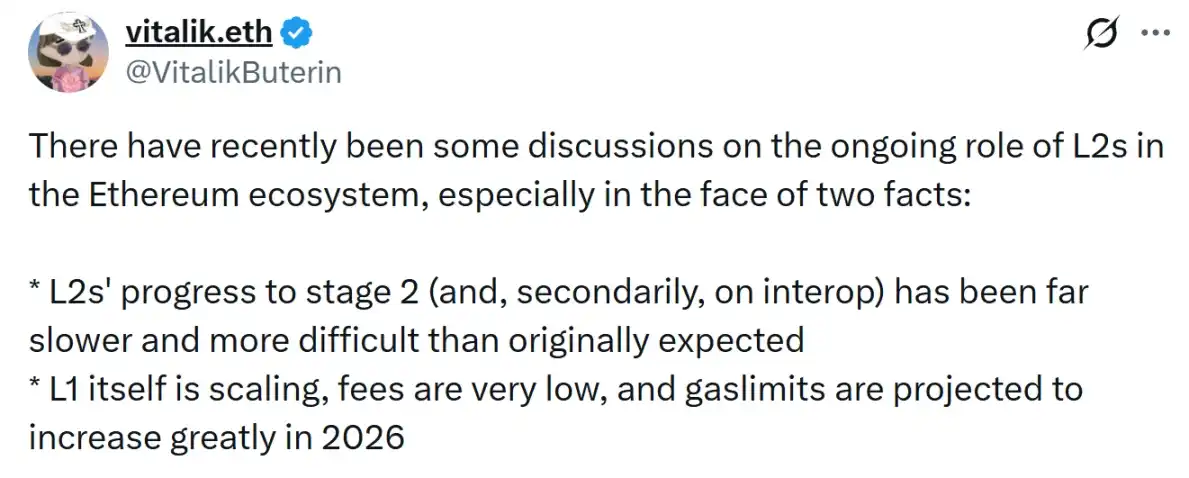
Recently, the most discussed topic in the Ethereum community has undoubtedly been Vitalik Buterin's public reflection on the scaling roadmap.

It can be said that Vitalik's attitude was quite "sharp,"直言随着以太坊主网(L1)自身扩容能力的提升,那个在五年前制定的、将 L2 视为主要扩容手段的路线图,已经失效了。

These remarks were once interpreted negatively by the market as "pessimism" or even "denial" towards L2. However, if one carefully examines Vitalik's core points and considers Ethereum's series of mainnet scaling progress, the decentralization progress evaluation framework, and recent technical discussions around Native/Based Rollup, it becomes clear that Vitalik is not completely negating the value of L2, but rather engaging in a kind of "course correction":

Ethereum is not abandoning L2, but is redefining the division of labor—L1 returns to its role as the most secure settlement layer, while L2 pursues differentiation and specialization, thereby refocusing the strategic emphasis on the mainnet itself.
一、Has L2 Fulfilled Its Historical Mission?

Objectively speaking, in the previous cycle, L2 was indeed once seen as Ethereum's lifeline.

In the initial Rollup-Centric roadmap, the division of labor was also very clear: L1 was responsible for security and data availability, L2 was responsible for extreme scaling and low Gas fees. In an era where Gas fees often reached tens of dollars, this was almost the only feasible answer.

But reality developed in a more complex way than expected.

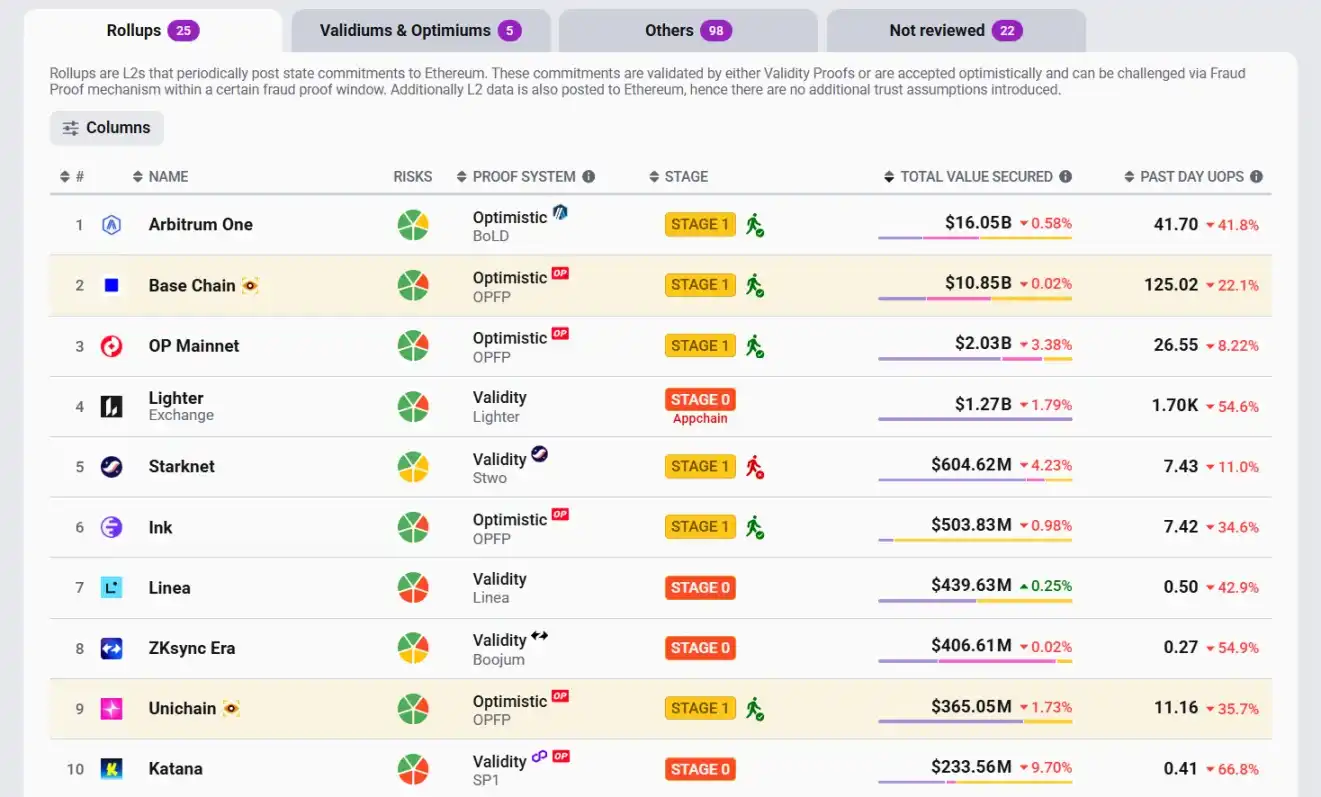
The latest statistics from L2BEAT show that there are now over a hundred L2s in the broad sense, but quantitative膨胀 does not equal structural maturity, with the vast majority making slow progress in decentralization.

Here, some basic knowledge needs to be added. As early as 2022, Vitalik criticized the "Training Wheels" architecture of most Rollups in a blog post,直言其依赖中心化运维、人工干预保障安全. Frequent users of L2Beat should be very familiar with this, as its homepage displays a key related indicator—Stage:

This is an evaluation framework that categorizes Rollups into three stages of decentralization: "Stage 0" which fully depends on centralized control, "Stage 1" with limited dependence, and the fully decentralized "Stage 2". This also reflects the degree of reliance on the artificial intervention of training wheels.

In his recent reflection, Vitalik pointed out that some L2s, possibly due to regulatory or commercial needs, might forever remain at "Stage 1", relying on security councils to control upgradability. This means that such L2s are essentially still a "secondary L1" with cross-chain bridging properties, rather than the "branded shards" initially envisioned.

Or, to put it more bluntly, if the sequencing power, upgrade rights, and final arbitration are concentrated in the hands of a few entities, it not only runs counter to Ethereum's decentralized初衷, but the L2 itself is nothing more than a parasite leaching off the Ethereum mainnet.
At the same time, the proliferation of L2s has brought another structural problem that everyone has felt deeply over the past few years: liquidity fragmentation.

This has caused the流量 originally gathered on Ethereum to be gradually divided, forming一个个被割裂的价值孤岛. As the number of public chains and L2s increases, the degree of liquidity fragmentation will intensify further, which was not the original intention of scaling.

From this perspective, one can understand why Vitalik emphasizes that the next step for L2 is not more chains, but deeper integration. Ultimately, this is actually a timely course correction—through institutionalized scaling and protocol-inherent security mechanisms, strengthening L1's positioning as the world's most trusted settlement layer.

Against this background, scaling is no longer the sole goal; security, neutrality, and predictability have重新成为以太坊的核心资产. The future of L2 lies not in quantity, but in deeper integration with the mainnet and more specialized innovation in细分场景.

For example, providing unique additional functions, such as privacy-specific virtual machines, extreme scaling, or specialized environments designed for non-financial applications like AI agents.

The views of Ethereum Foundation Executive Director Hsiao-Wei Wang at Consensus 2026 coincide with this: L1 should serve as the most secure settlement layer, carrying the most critical activities; while L2 should pursue differentiation and specialization, carrying activities that追求极致用户体验.

二、Native Rollup: Based Rollup + The Future of Preconfirmations?

It is in this wave of reflection on the L2 narrative that the concept of Based Rollup is expected to have its moment of glory in 2026.

Because if the keyword of the past five years was "Rollup-Centric," then the core of the current discussion is shifting to a more specific question: Can Rollups be "grown inside Ethereum" rather than "attached outside Ethereum"?

Therefore, the "Native Rollup" currently hotly debated in the Ethereum community can, to some extent, be understood as an extension of the Based Rollup concept—if Native Rollup is the ultimate ideal, then Based Rollup is currently the most practical path towards that ideal.

As is well known, the biggest difference between Based Rollup and traditional L2s like Arbitrum and Optimism is that it completely抛弃了独立的、甚至是中心化的序列器(Sequencer)层, and instead is directly sequenced by Ethereum L1 nodes. In other words, the Ethereum protocol itself integrates Rollup-like verification logic at the L1 level, thus unifying the extreme performance optimization and protocol-level security that originally belonged to L2 and the Ethereum mainnet separately.

The most intuitive feeling this design gives users is that the Rollup seems to be embedded within Ethereum, inheriting not only L1's censorship resistance and liveness but, more importantly, solving the most headache-inducing problem for L2s—synchronous composability. In a Based Rollup block, you can directly call L1's liquidity, achieving atomic cross-layer transactions.

However, Based Rollup faces a practical challenge: if it completely follows L1's rhythm (one Slot every 12 seconds), the user experience would be cumbersome. After all, under the current Ethereum architecture, even after a transaction is packed into a block, the system still needs to wait about 13 minutes (2 Epochs) to reach finality. This is too slow for financial scenarios.

Interestingly, in the same tweet where Vitalik reflected on L2, he recommended a community proposal from January titled "Combining preconfirmations with based rollups for synchronous composability". The core of this proposal is not simply pushing Based Rollup, but rather proposing a hybrid structure:

Retain low latency sequenced blocks, generate a based block at the end of the slot, submit the based block to L1, and finally combine it with a preconfirmation mechanism to achieve synchronous composability.
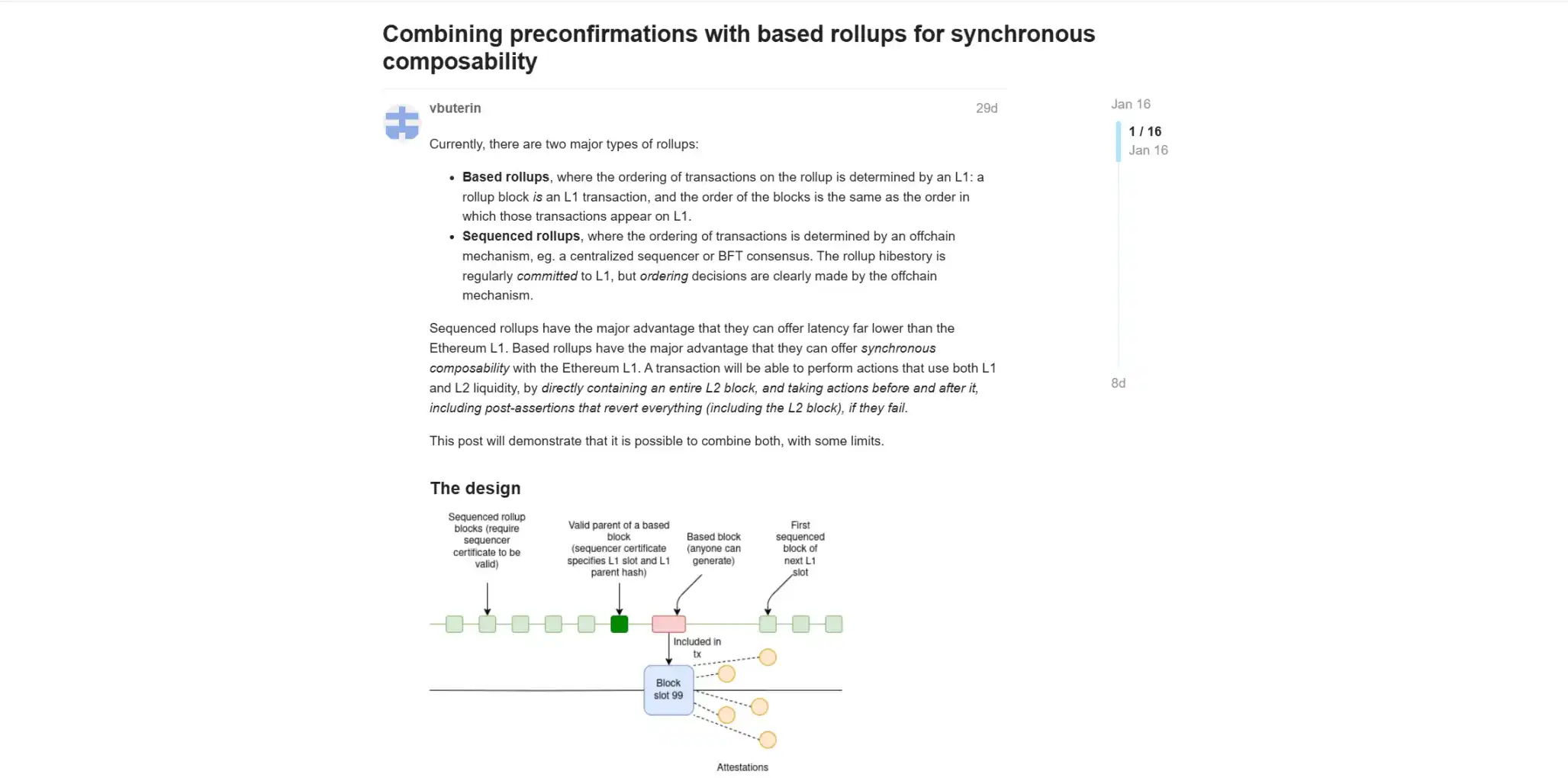
In Based Rollup, a preconfirmation is a commitment made by a specific角色 (like an L1 proposer) that a transaction will be included before it is formally submitted to L1. This is also what Project #4: Fast L1 Confirmation Rule in Ethereum's Interop roadmap explicitly proposes to do.

Its core goal is very direct: to allow applications and cross-chain systems to obtain a "strong and verifiable" L1 confirmation signal within 15–30 seconds, without having to wait the full 13 minutes required for finality.

Mechanically, the fast confirmation rule does not introduce a new consensus process, but rather reutilizes the attester voting that occurs in every slot of Ethereum's PoS system. When a block has accumulated enough, and sufficiently dispersed, validator votes in early slots, even if it has not entered the finalization phase, it can be considered "extremely unlikely to be reverted under a reasonable attack model".

Simply put, this confirmation level does not replace Finality, but provides a strong confirmation explicitly acknowledged by the protocol *before* Finality. For Interop, this is particularly critical: cross-chain systems, Intent Solvers, and wallets no longer need to blindly wait for finality; instead, they can safely advance the next logic within 15–30 seconds based on a protocol-level confirmation signal.

Through this layered confirmation logic, Ethereum finely segments different levels of trust between "security" and "perceived speed,"有望构建出极致丝滑的互操作体验 (extended reading: "Ethereum's 'Second-Level' Evolution: From Fast Confirmations to Settlement Compression, How Interop Eliminates Waiting Time?").

三、What is Ethereum's Future?

Looking back from the vantage point of 2026, Ethereum's main theme is quietly shifting, gradually moving from pursuing extreme "scaling" to pursuing "unification, layering, and inherent security."

Last month, executives from several Ethereum L2 solutions have successively expressed their willingness to explore and embrace the Native Rollup path to enhance the consistency and synergy of the entire network. This attitude itself is an important signal: the Ethereum ecosystem is undergoing a painful but necessary deflation of泡沫, shifting from pursuing "the number of chains" back to pursuing "the unification of the protocol."

However, as Ethereum's underlying roadmap is recalibrated and advanced, especially as L1 continues to strengthen and Based Rollup with preconfirmations are gradually implemented, and底层性能不再是唯一瓶颈时, a more practical problem begins to emerge—the biggest bottleneck is no longer the chain, but the wallet and the entry barrier.

This confirms the insight that imToken repeatedly emphasized in 2025: when infrastructure becomes趋于隐形, what truly determines the limit of scale will be the entry-level interaction experience.

Overall, besides底层扩容, the future breakthrough and规模化发展 of the Ethereum ecosystem will not focus solely on TPS or Blob count, but will revolve around three more structurally significant directions:

  • Account Abstraction and the Erosion of Entry Barriers: Ethereum is promoting native account abstraction (Native AA). Future smart contract wallets will become the default choice, completely replacing obscure seed phrases and EOA addresses. For users of wallets like imToken, this means the barrier to entering the crypto world will become as simple as registering a social media account (extended reading: "From EOA to Account Abstraction: Will Web3's Next Leap Happen in the 'Account System'?");
  • Privacy and ZK-EVM: Privacy features are no longer边缘需求. As ZK-EVM technology matures, Ethereum will provide necessary on-chain privacy protection for commercial applications while maintaining transparency. This will be its core competitive advantage in the public chain competition (extended reading: "The 'Dawn Moment' of the ZK Route: Is Ethereum's Endgame Roadmap Accelerating Comprehensively?");
  • On-Chain Sovereignty of AI Agents: In 2026, the initiator of transactions might not be humans, but AI agents. The future challenge lies in establishing trustless interaction standards: how to ensure that AI agents are executing the user's will, rather than being manipulated by third parties? Ethereum's decentralized settlement layer will become the most reliable rule arbiter for the AI economy (extended reading: "The New Ticket in the Age of AI Agents: What is Ethereum Betting on by Promoting ERC-8004?");

Returning to the initial question, did Vitalik really "deny" L2?

A more accurate understanding is that he denied an overly膨胀、脱离主网、各自为政的碎片化叙事. This is not an endpoint, but a brand new starting point. From the grand illusion of "branded shards" back to the meticulous crafting of Based Rollup and preconfirmations, this本质上反而有助于强化以太坊 L1 作为全球信任底座的绝对地位.

However, this also means that in this return to technological pragmatism, only those innovations that are truly rooted in the underlying principles of Ethereum's new phase and share the same breath and fate as the mainnet will survive and thrive in the next great navigation era.


Пов'язані питання

QWhat is the core argument of Vitalik Buterin's recent reflection on Ethereum's scaling roadmap?

AVitalik Buterin argues that the original five-year-old roadmap, which positioned L2 as the primary scaling solution, is now obsolete. The focus is shifting towards a 'dialectical correction': L1 should return to its role as the most secure settlement layer, while L2s should pursue differentiation and specialization, recentering the strategic focus on the mainnet itself.

QAccording to the article, what is a major structural problem caused by the proliferation of L2s?

AA major structural problem caused by the proliferation of L2s is liquidity fragmentation. The expansion has splintered the traffic originally concentrated on Ethereum, creating isolated value islands and exacerbating the fragmentation of liquidity, which was not the original intention of scaling.

QWhat is the key difference between a Based Rollup and a traditional L2 like Arbitrum?

AThe key difference is that Based Rollups completely abandon an independent, often centralized, sequencer layer. Instead, they are ordered directly by Ethereum L1 nodes. This integrates Rollup-like validation logic at the L1 protocol level, unifying extreme performance optimization with protocol-level security.

QHow does the proposed 'Fast L1 Confirmation Rule' aim to improve user experience on Based Rollups?

AThe 'Fast L1 Confirmation Rule' aims to provide applications and cross-chain systems with a 'strong and verifiable' L1 confirmation signal within 15-30 seconds, without waiting for the full 13-minute Finality. It leverages the existing attester votes in Ethereum's PoS system to create a protocol-level, strong confirmation level before finality is reached.

QWhat are the three key directions identified for Ethereum's future scaling and mass adoption, beyond just底层 (underlying) TPS?

AThe three key directions are: 1) Account Abstraction and lowering the entry barrier, making entering crypto as simple as registering a social account. 2) Privacy and ZK-EVM, providing necessary on-chain privacy for commercial applications. 3) AI Agent on-chain sovereignty, establishing the decentralized settlement layer as the most reliable rule adjudicator for the AI economy.

Пов'язані матеріали

How Many Tokens Away Is Yang Zhilin from the 'Moon Chasing the Light'?

The article explores the intense competition between two leading Chinese AI companies, DeepSeek and Kimi (Moon Dark Side), and the mounting pressure on Yang Zhilin, the founder of Kimi. While DeepSeek re-emerged after 15 months of silence with its powerful V4 model—boasting 1.6 trillion parameters and low-cost, long-context capabilities—Kimi has been focusing on long-context processing and multi-agent systems with its K2.6 model. Yang faces a threefold challenge: technological rivalry, commercialization pressure, and investor expectations. Despite Kimi’s high valuation (reaching $18 billion), its revenue heavily relies on a single product with low paid conversion rates, while DeepSeek’s strategic silence and open-source influence have strengthened its market position and valuation prospects, now targeting over $20 billion. Both companies reflect broader trends in China’s AI ecosystem: Kimi aims for global influence through open-source contributions and agent-based advancements, while DeepSeek prioritizes foundational innovation and hardware independence, notably shifting to Huawei’s chips. Their competition is seen as vital for China’s AI progress, with the gap between top Chinese and U.S. models narrowing to just 2.7% on the Elo rating scale. Ultimately, the article argues that this rivalry, though anxiety-inducing for leaders like Zhilin, is essential for driving innovation and solidifying China’s role in the global AI landscape.

marsbit8 год тому

How Many Tokens Away Is Yang Zhilin from the 'Moon Chasing the Light'?

marsbit8 год тому

Торгівля

Спот
Ф'ючерси

Популярні статті

Що таке ETH 2.0

ETH 2.0: Нова ера для Ethereum Вступ ETH 2.0, широко відомий як Ethereum 2.0, є величезним оновленням для блокчейну Ethereum. Ця трансформація не є лише косметичною зміною; вона має на меті фундаментально покращити масштабованість, безпеку та сталий розвиток мережі. З переходом від енергомісткого механізму консенсусу Proof of Work (PoW) до більш ефективного Proof of Stake (PoS), ETH 2.0 обіцяє трансформаційний підхід до екосистеми блокчейнів. Що таке ETH 2.0? ETH 2.0 — це збірка особливих, взаємопов’язаних оновлень, спрямованих на оптимізацію можливостей та продуктивності Ethereum. Це перетворення розроблене для вирішення критичних викликів, з якими стикалося існуюче механізм Ethereum, зокрема щодо швидкості транзакцій та заторів у мережі. Мета ETH 2.0 Основні цілі ETH 2.0 зосереджені на покращенні трьох ключових аспектів: Масштабованість: Мета — значно підвищити кількість транзакцій, які мережа може обробити за секунду; ETH 2.0 прагне вийти за межі поточного обмеження приблизно в 15 транзакцій на секунду, потенційно досягнувши тисяч. Безпека: Підвищені заходи безпеки є невід’ємною частиною ETH 2.0, зокрема через покращену стійкість до кібератак і збереження децентралізованої етики Ethereum. Сталий розвиток: Новий механізм PoS розроблений не тільки для підвищення ефективності, але й для різкого зменшення споживання енергії, що узгоджує операційну структуру Ethereum з екологічними міркуваннями. Хто є творцем ETH 2.0? Створення ETH 2.0 можна віднести до Ethereum Foundation. Ця неприбуткова організація, яка відіграє важливу роль у підтримці розвитку Ethereum, очолюється відомим співавтором Віталіком Бутеріним. Його бачення більш масштабованого та стійкого Ethereum стало рушійною силою цього оновлення, залучаючи внески зі всього світу від розробників і ентузіастів, які прагнуть покращити протокол. Хто є інвесторами ETH 2.0? Хоча подробиці про інвесторів ETH 2.0 не були оприлюднені, відомо, що Ethereum Foundation отримує підтримку від різних організацій та осіб у сфері блокчейну та технологій. Ці партнери включають венчурні капітальні компанії, технологічні компанії та філантропічні організації, які мають спільний інтерес у підтримці розвитку децентралізованих технологій та інфраструктури блокчейну. Як працює ETH 2.0? ETH 2.0 відзначається введенням низки ключових функцій, які відрізняють його від попередника. Proof of Stake (PoS) Перехід до механізму консенсусу PoS є одним із знакових змін ETH 2.0. На відміну від PoW, який покладається на енергомісткий видобуток для перевірки транзакцій, PoS дозволяє користувачам підтверджувати транзакції та створювати нові блоки відповідно до кількості ETH, яку вони ставлять у мережі. Це призводить до підвищення енергоефективності, зменшуючи споживання приблизно на 99,95%, завдяки чому Ethereum 2.0 стає значно більш екологічною альтернативою. Шардові ланцюги Шардові ланцюги є ще одним ключовим нововведенням ETH 2.0. Ці менші ланцюги працюють паралельно з основним ланцюгом Ethereum, що дозволяє обробляти кілька транзакцій одночасно. Це підходи покращує загальну ємність мережі, усуваючи проблеми масштабованості, які переслідували Ethereum. Beacon Chain У центрі ETH 2.0 знаходиться Beacon Chain, яка координує мережу і управляє протоколом PoS. Вона виконує роль організатора: контролює валідаторів, забезпечує з’єднання шард з мережею і моніторить загальний стан екосистеми блокчейнів. Хронологія ETH 2.0 Шлях ETH 2.0 характеризується кількома ключовими етапами, які відображають еволюцію цього значного оновлення: Грудень 2020: Запуск Beacon Chain ознаменував введення PoS, проклавши шлях до міграції на ETH 2.0. Вересень 2022: Завершення "Злиття" є знаковим моментом, коли мережа Ethereum успішно перейшла з PoW на PoS, відкриваючи нову еру для Ethereum. 2023: Очікуване розгортання шардових ланцюгів має на меті подальше покращення масштабованості мережі Ethereum, закріплюючи ETH 2.0 як надійну платформу для децентралізованих додатків і послуг. Ключові особливості та переваги Покращена масштабованість Однією з найзначніших переваг ETH 2.0 є його покращена масштабованість. Поєднання PoS та шардових ланцюгів дозволяє мережі розширити свою ємність, що дозволяє їй обробляти набагато більший обсяг транзакцій в порівнянні з класичною системою. Енергоефективність Запровадження PoS є величезним кроком до енергоефективності в технології блокчейн. Значно зменшуючи споживання енергії, ETH 2.0 не тільки знижує операційні витрати, але також ближче узгоджується з глобальними цілями сталого розвитку. Підвищена безпека Оновлені механізми ETH 2.0 сприяють підвищенню безпеки по всій мережі. Впровадження PoS, поряд з інноваційними контрольними заходами, встановленими через шардові ланцюги та Beacon Chain, забезпечує вищий рівень захисту від потенційних загроз. Зниження витрат для користувачів З покращенням масштабованості вплив на витрати на транзакції також стане очевидним. Збільшена ємність і зменшені затори, як очікується, призведуть до зниження зборів для користувачів, що зробить Ethereum більш доступним для повсякденних транзакцій. Висновок ETH 2.0 є значною еволюцією в екосистемі блокчейну Ethereum. Оскільки він вирішує важливі питання, такі як масштабованість, споживання енергії, ефективність транзакцій і загальна безпека, важливість цього оновлення не можна недооцінювати. Перехід до Proof of Stake, введення шардових ланцюгів і фундаментальна робота Beacon Chain свідчать про майбутнє, в якому Ethereum може задовольнити зростаючі вимоги децентралізованого ринку. В індустрії, що рухається вперед завдяки інноваціям та прогресу, ETH 2.0 є підтвердженням можливостей технології блокчейн у прокладенні шляху до більш сталого та ефективного цифрового економіки.

168 переглядів усьогоОпубліковано 2024.04.04Оновлено 2024.12.03

Що таке ETH 2.0

Що таке ETH 3.0

ETH3.0 та $eth 3.0: Глибоке дослідження майбутнього Ethereum Вступ У швидко змінюваному світі криптовалют та технології блокчейн, ETH3.0, часто позначуваний як $eth 3.0, став темою значного інтересу та спекуляцій. Цей термін охоплює два основні концепти, які потребують уточнення: Ethereum 3.0: Це потенційне майбутнє оновлення, яке має на меті покращення можливостей існуючого блокчейну Ethereum, зокрема, фокусуючись на поліпшенні масштабованості та продуктивності. ETH3.0 Мем Токен: Цей окремий криптовалютний проект прагне використовувати блокчейн Ethereum для створення екосистеми, орієнтованої на меми, сприяючи залученню до криптовалютної громади. Розуміння цих аспектів ETH3.0 є важливим не лише для криптоентузіастів, але й для тих, хто спостерігає за широкими технологічними тенденціями у цифровому просторі. Що таке ETH3.0? Ethereum 3.0 Ethereum 3.0 пропонується як оновлення вже існуючої мережі Ethereum, яка стала основою багатьох децентралізованих додатків (dApps) та смарт-контрактів з моменту свого виникнення. Передбачувані удосконалення зосереджені в основному на масштабованості — інтегруючи передові технології, такі як шардінг та нульові знання (zk-докази). Ці технологічні нововведення націлені на забезпечення безпрецедентної кількості транзакцій на секунду (TPS), потенційно досягаючи мільйонів, тим самим вирішуючи одну з найзначніших обмежень, з якими стикається сучасна технологія блокчейн. Покращення є не лише технічним, а й стратегічним; воно спрямоване на підготовку мережі Ethereum до широкого прийняття та корисності в майбутньому, позначеному збільшеним попитом на децентралізовані рішення. ETH3.0 Мем Токен На відміну від Ethereum 3.0, ETH3.0 Мем Токен пропонує легшу та грайливішу домену, поєднуючи культуру інтернет-мемів із динамікою криптовалют. Цей проект дозволяє користувачам купувати, продавати та обмінювати меми на блокчейні Ethereum, надаючи платформу, яка сприяє залученню громади через креативність та спільні інтереси. ETH3.0 Мем Токен має на меті продемонструвати, як технологія блокчейн може перетинатися з цифровою культурою, створюючи випадки використання, які є водночас розважальними та фінансово життєздатними. Хто є творцем ETH3.0? Ethereum 3.0 Ініціатива щодо Ethereum 3.0 переважно підтримується консорціумом розробників та дослідників у межах громади Ethereum, зокрема, до складу якого входить Джастін Дрейк. Відомий своїми думками та внеском у розвиток Ethereum, Дрейк є помітною особистістю в обговореннях щодо переходу Ethereum на новий рівень консенсусу, який називається «Beam Chain». Цей колабораційний підхід до розробки свідчить про те, що Ethereum 3.0 не є продуктом єдиного творця, а скоріше втіленням колективної винахідливості, спрямованої на просування технології блокчейн. ETH3.0 Мем Токен Деталі про творця ETH3.0 Мем Токена наразі не відстежуються. Природа мем-токенів часто призводить до більш децентралізованої та громартової структури, що може пояснити відсутність специфічної атрибуції. Це узгоджується з етикою ширшої крипто-спільноти, де інновації часто виникають з колективних, а не індивідуальних зусиль. Хто є інвесторами ETH3.0? Ethereum 3.0 Підтримка Ethereum 3.0 переважно надходить від Фонду Ethereum поряд з ентузіастичною спільнотою розробників та інвесторів. Це базове співробітництво надає значний градус легітимності та підвищує ймовірність успішної реалізації, оскільки воно використовує довіру та авторитет, накопичені за роки роботи мережі. У швидко змінюваному кліматі криптовалют підтримка громади займає важливу роль у розвитку та прийнятті, позиціонуючи Ethereum 3.0 як серйозного конкурента для майбутніх блокчейн-інновацій. ETH3.0 Мем Токен Хоча наразі доступні джерела не надають явної інформації щодо інвестиційних фондів або організацій, що підтримують ETH3.0 Мем Токен, це свідчить про типову модель фінансування для мем-токенів, яка часто спирається на підтримку знизу та залучення громади. Інвестори в такі проекти зазвичай складаються з осіб, які мотивовані потенціалом інновацій, що керуються спільнотою, та духом співпраці, притаманним крипто-спільноті. Як працює ETH3.0? Ethereum 3.0 Відмінні риси Ethereum 3.0 полягають у його запропонованій реалізації технології шардінгу та zk-proof. Шардінг — це метод розподілу блокчейну на менші, керовані частини чи «шарди», які можуть обробляти транзакції одночасно, а не послідовно. Це децентралізоване оброблення допомагає запобігти заторам та забезпечити оперативність мережі навіть під великим навантаженням. Технологія нульових доказів (zk-proof) надає ще один рівень складності, дозволяючи валідацію транзакцій без розкриття підпорядкованих даних. Цей аспект не лише підвищує конфіденційність, а й збільшує загальну ефективність мережі. Також обговорюється включення нульової Ефірної віртуальної машини (zkEVM) в це оновлення, що ще більше підвищить можливості та корисність мережі. ETH3.0 Мем Токен ETH3.0 Мем Токен виділяється завдяки використанню популярності культури мемів. Він створює ринок, на якому користувачі можуть брати участь у торгівлі мемами не лише для розваги, але й для потенційного економічного вигоди. Інтегруючи функції, такі як стейкінг, забезпечення ліквідності та механізми управління, проект сприяє створенню середовища, яке заохочує взаємодію та участь громади. Пропонуючи унікальне поєднання розваг та економічних можливостей, ETH3.0 Мем Токен прагне залучити різну аудиторію, яка охоплює від криптоентузіастів до casual-консумерів мемів. Хронологія ETH3.0 Ethereum 3.0 11 листопада 2024: Джастін Дрейк натякає на майбутнє оновлення ETH 3.0, яке зосереджене на поліпшеннях масштабованості. Це оголошення означає початок формальних обговорень щодо майбутньої архітектури Ethereum. 12 листопада 2024: Очікується, що запропоновану пропозицію для Ethereum 3.0 буде представлено на Devcon у Бангкоку, що готує ґрунт для більш широкого зворотного зв'язку від громади та потенційних наступних кроків у розвитку. ETH3.0 Мем Токен 21 березня 2024: ETH3.0 Мем Токен офіційно потрапляє у список на CoinMarketCap, що означає його дебют у публічному крипто-просторі та підвищує видимість для його меморієнтованої екосистеми. Ключові моменти На завершення, Ethereum 3.0 представляє значну еволюцію в межах мережі Ethereum, зосереджуючись на подоланні обмежень щодо масштабованості та продуктивності через передові технології. Його запропоновані оновлення відображають проактивний підхід до майбутніх вимог і корисності. Натомість ETH3.0 Мем Токен втілює суть культури, керованої громадою, у сфері криптовалют, використовуючи культуру мемів для створення привабливих платформ, які заохочують творчість і участь користувачів. Розуміння окремих цілей і функцій ETH3.0 та $eth 3.0 є надзвичайно важливим для кожного, хто цікавиться поточними подіями в крипто-просторі. З обома ініціативами, які прокладають унікальні шляхи, вони разом підкреслюють динамічну та багатогранну природу інновацій у блокчейн-технологіях.

158 переглядів усьогоОпубліковано 2024.04.04Оновлено 2024.12.03

Що таке ETH 3.0

Як купити ETH

Ласкаво просимо до HTX.com! Ми зробили покупку Ethereum (ETH) простою та зручною. Дотримуйтесь нашої покрокової інструкції, щоб розпочати свою криптовалютну подорож.Крок 1: Створіть обліковий запис на HTXВикористовуйте свою електронну пошту або номер телефону, щоб зареєструвати обліковий запис на HTX безплатно. Пройдіть безпроблемну реєстрацію й отримайте доступ до всіх функцій.ЗареєструватисьКрок 2: Перейдіть до розділу Купити крипту і виберіть спосіб оплатиКредитна/дебетова картка: використовуйте вашу картку Visa або Mastercard, щоб миттєво купити Ethereum (ETH).Баланс: використовуйте кошти з балансу вашого рахунку HTX для безперешкодної торгівлі.Треті особи: ми додали популярні способи оплати, такі як Google Pay та Apple Pay, щоб підвищити зручність.P2P: Торгуйте безпосередньо з іншими користувачами на HTX.Позабіржова торгівля (OTC): ми пропонуємо індивідуальні послуги та конкурентні обмінні курси для трейдерів.Крок 3: Зберігайте свої Ethereum (ETH)Після придбання Ethereum (ETH) збережіть його у своєму обліковому записі на HTX. Крім того, ви можете відправити його в інше місце за допомогою блокчейн-переказу або використовувати його для торгівлі іншими криптовалютами.Крок 4: Торгівля Ethereum (ETH)Легко торгуйте Ethereum (ETH) на спотовому ринку HTX. Просто увійдіть до свого облікового запису, виберіть торгову пару, укладайте угоди та спостерігайте за ними в режимі реального часу. Ми пропонуємо зручний досвід як для початківців, так і для досвідчених трейдерів.

2.7k переглядів усьогоОпубліковано 2024.12.10Оновлено 2025.03.21

Як купити ETH

Обговорення

Ласкаво просимо до спільноти HTX. Тут ви можете бути в курсі останніх подій розвитку платформи та отримати доступ до професійної ринкової інформації. Нижче представлені думки користувачів щодо ціни ETH (ETH).

活动图片













