Under the Curse of TGE Peaking, Which Tokens Defied the Trend and Rose?

比推Опубліковано о 2025-12-31Востаннє оновлено о 2025-12-31

Анотація

Amid the prevailing trend of tokens peaking at their Token Generation Event (TGE) and declining thereafter in 2025, a few exceptions managed to sustain price increases post-launch. Tokens like ASTER, FOLKS, AVICI, and SENTIS demonstrated resilience, driven by genuine buying support rather than temporary spikes. Key factors contributing to their success include fair token distribution (e.g., AVICI with 0% team allocation, SENTIS with activity-based emissions), reasonable initial valuations that allowed for market re-rating, observable product usage or adoption (such as Aster’s Perp volume and Avici’s real-world spending), transparent and linear unlock schedules, and strategic exchange listings that amplified rather than dictated performance. These tokens highlight a market shift towards valuing structural integrity—healthy circulation, fair launches, and tangible utility—over mere narrative potential, emphasizing survival through sound tokenomics and adoption in an increasingly competitive landscape.

Author: Stacy Muur

Compiled by: CryptoLeo

Original title: What Are the Characteristics and Commonalities of Tokens That Performed Well After TGE in 2025?


Last week, I compiled a research post by Solus Group titled "Over 80% of New Tokens Peak at TGE: The Root Cause and Cure for Web3's False Prosperity," which analyzed the post-TGE performance of 113 tokens in 2025. The vast majority of these tokens peaked at TGE, with their prices starting to decline the day after launch, despite having conditions such as high financing, community support, and exchange listings.

Today's shared article is from crypto researcher Stacy Muur, who compiled several tokens from 2025 that showed significant price increases compared to their TGE prices and analyzed what advantages/conditions these projects possessed. In contrast, the previous article presented a statistical result based on data, while this article focuses more on the projects themselves. In summary: In today's overly homogeneous and expanding crypto market, project tokens need to meet multiple conditions to survive/succeed in the market. Odaily Planet Daily has compiled it as follows:

If you've been keen on trading tokens that TGE'd in 2025, the results so far are clear: tokens are hot in the first week after launch, then gradually cool down, and finally, it's tacitly accepted that "the issuance price is the peak." Most newly launched tokens perform poorly, or even plummet, as the market always treats tokenomics and liquidity as fundamentals.
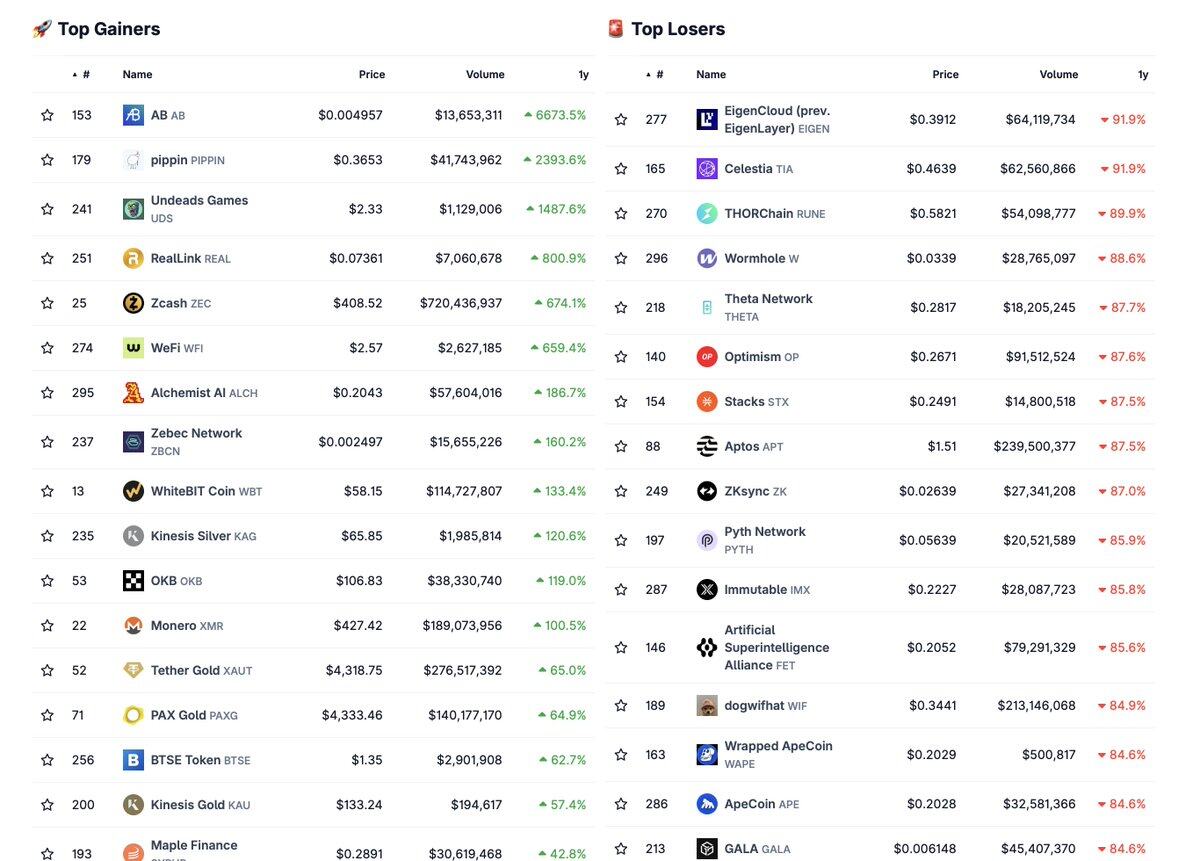
Despite this, a few tokens in 2025 maintained price increases relative to their TGE, not in the sense of "rebounding after a price crash" or "buying at the market bottom," but in a way that indicates genuine buying support.

Here are the truly rising tokens from 2025 TGE that I've compiled: ASTER, FOLKS, AVICI, and SENTIS (there are also some "barely passing" tokens like IRYS/FHE/CORN). They don't look exactly the same, but they all share certain characteristics.

The Best Rising Tokens from 2025 TGE

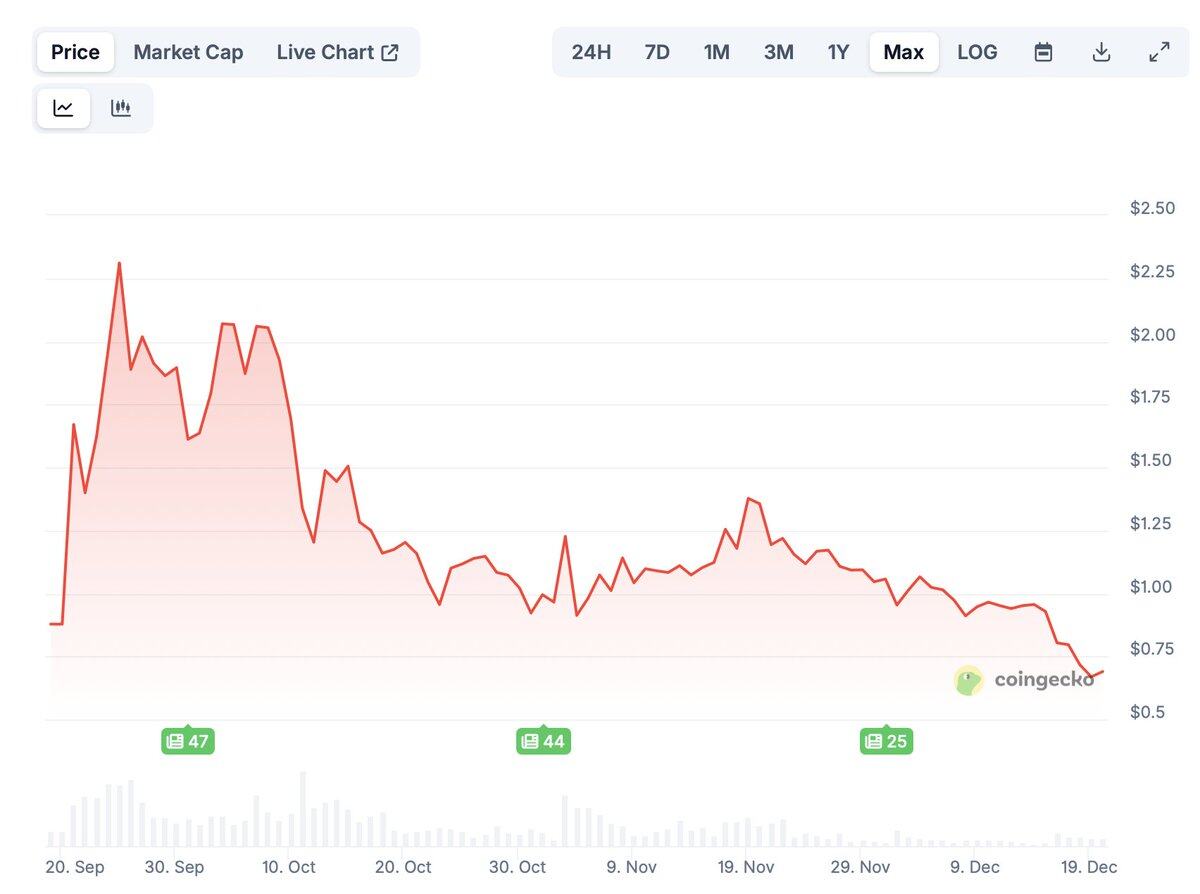
Aster is a typical example. ASTER got everything the project needed on its first day: major exchange listing, deep liquidity, and the widely accepted "Perp DEX" narrative. The story circulating throughout the year was basically: "Binance-backed Perp DEX with privacy features."

ASTER's price action was controversial (you could call it ZK-related, CZ shadow gaming, or simply better execution strategy). But nonetheless, it was one of the few projects that didn't experience an "immediate sell-off" at TGE.
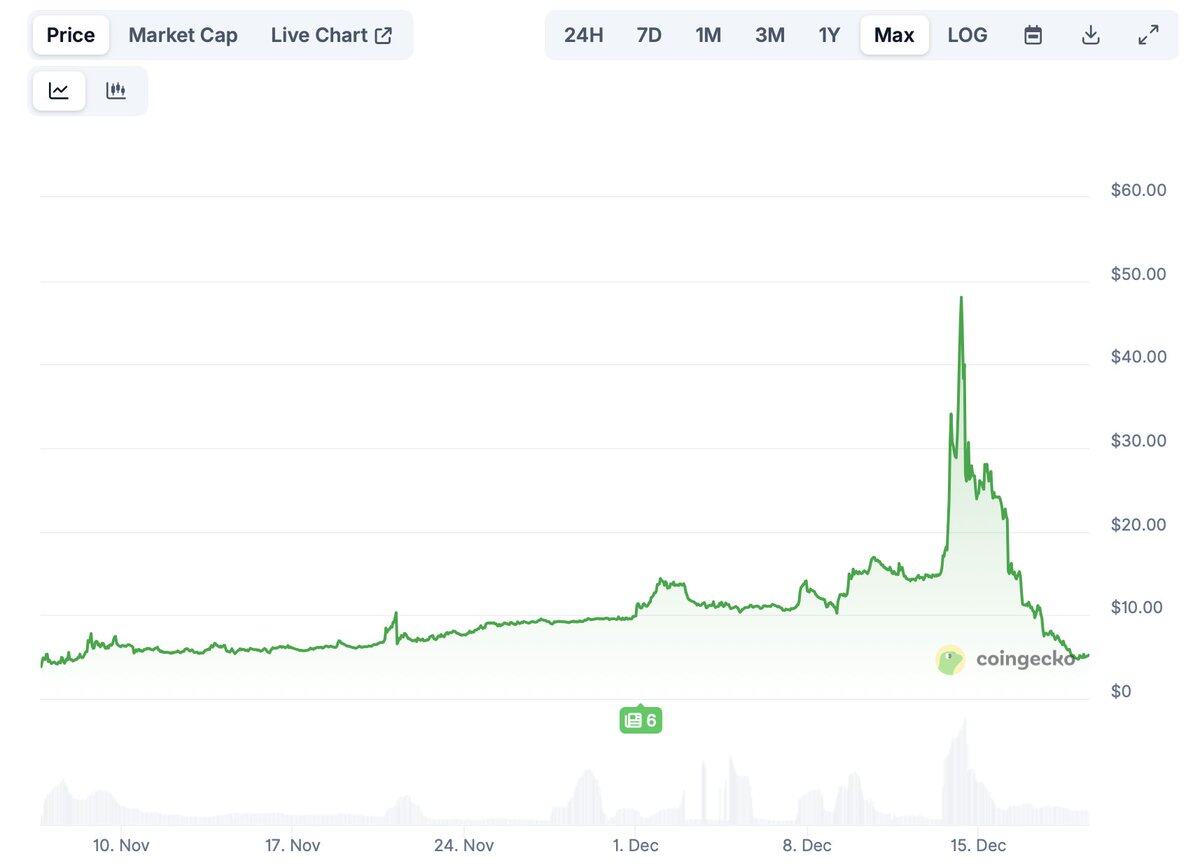
FOLKS is different: it's a lending token, seen as Alpha in "such a garbage year." The formula: "Binance and Kraken showed support from day one, cross-chain pools kept growing, no obvious massive unlock." The last point is very important. It performed well until the token unlock on December 15th.
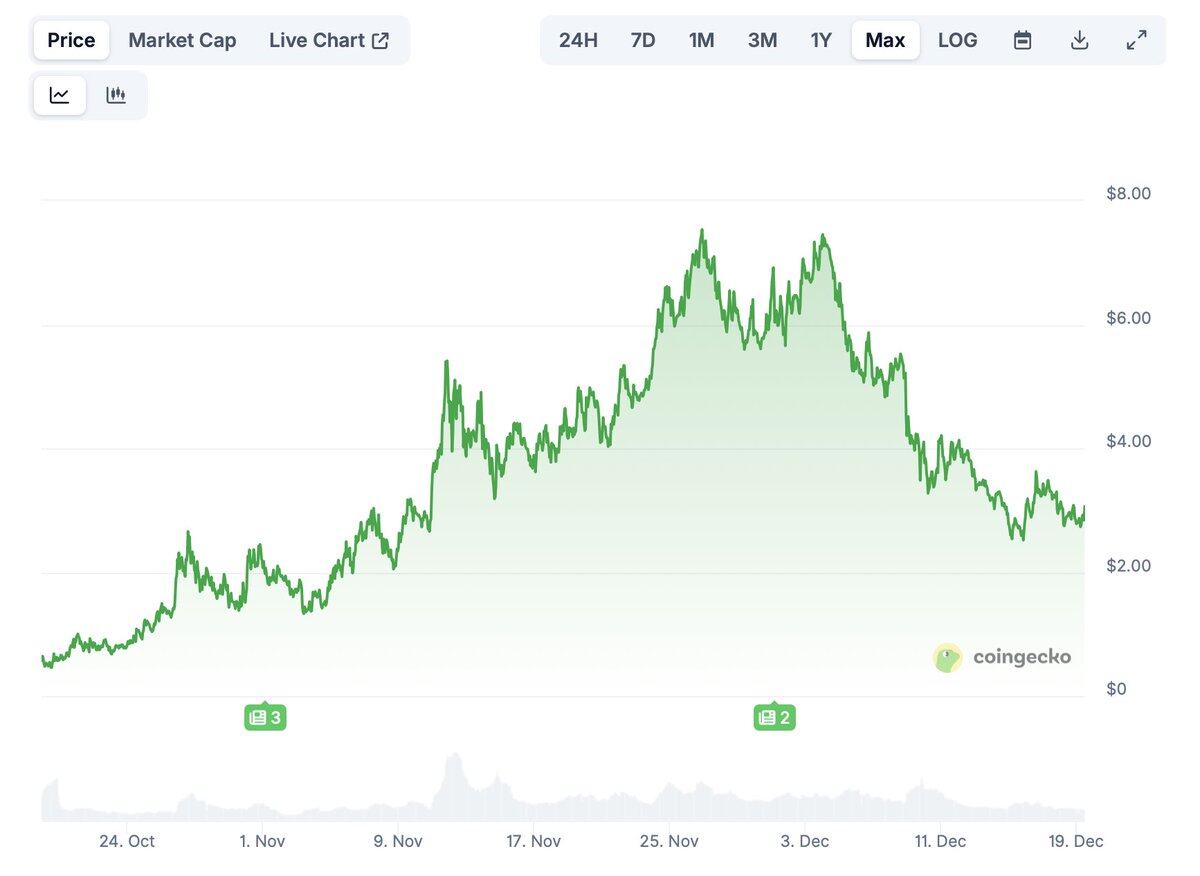
AVICI is different from the first two. AVICI is on this list not because it has the most cutting-edge technology, but because it provided the clearest narrative for CT: "Fair launch, truly usable product." It emphasized not tokenomics but usage: "decent neobank app, Visa card, real spending." In a market flooded with endogenous "utility," AVICI was refreshing, both thinking outside the box and being practical. AVICI might be one of the best TGE tokens of the year.
When Tokens Rise for a Reason, Their Prices Tend to Be More Stable

Looking now, the token with the strongest performance post-TGE is SENTIS. Its support points are simple and clear: AI Agent narrative + continuous incentive distribution + exchange listing. In CT, the dominant framework remains consistent: "AI Agent is the next DeFi automation layer," providing traders with a simple mental model as an anchor.

Mechanically, SENTIS doesn't rely on a one-time listing pump. The token's continuous distribution mechanism (tasks/retrodrop/participation rewards) maintains a steady level of user participation, which often translates into sustained spot demand as participants prepare for future distributions and ecosystem milestones. This dynamic can support the price even before more meaningful on-chain adoption appears.

"Barely Passing" Tokens

IRYS and FHE belong to the "AI infrastructure and private transactions" field: both benefited from the AI boom, stayed above their initial ranges, and both maintained sufficient liquidity to avoid a price crash. If these projects can translate their narratives into on-chain usage, they can survive. Relying solely on narrative support is not enough.

Then there's CORN. CORN isn't very volatile and is relatively stable compared to its peers, but CORN is more of a "structured product." In 2025, that's not a bad thing. When the market "punishes" overdevelopment, survivability becomes important.

What Characteristics Do the Well-Performing Tokens of 2025 Share?

Stripping away the narratives and vibes, some clear structural patterns emerge:

1. Token distribution is more important than hype

The strongest performing projects avoided large internal liquidity at TGE. AVICI (0% team allocation), SENTIS (activity-based emissions).

Lesson: At project launch, who holds the tokens is more important than who invested privately.

2. Reasonable launch valuation beats perfect token launch timing

Many of the best-performing tokens didn't launch at the peak of market hype, but at reasonable valuations, allowing the market to re-rate them upwards.

AVICI launched a working product with an FDV of around $3.5 million, offering asymmetric upside relative to FDV.

Lesson: Tokens that "grow into" their valuation perform better than those that start overvalued.

3. Project usage (or credible near-term usage) is reflected in the price

Aster's Perp trading volume, Folks' lending scale, Avici's credit card spending—these aren't just whitepaper promises but observable signals.

Sentis started early but also linked token emissions to on-chain activity, creating a feedback loop between usage and price.

Lesson: The market is now impatient. Utility > Vision.

4. Unlock structure > Unlock size

Linear and transparent token unlocks matter, as their dilution effect is digested by the market. For example, SENTIS releases tokens gradually through participation mechanisms.

Elsewhere, what destroys user confidence isn't dilution itself, but risky cliff unlocks.

Lesson: Predictable token unlocks are bearable; unexpected ones are not.

5. Exchange listing is necessary, but not sufficient

Almost every token had decent exchange access, but this alone doesn't determine anything. Listings amplify results: they help strong tokens accelerate upward, while weak tokens get sold off faster. AVICI's token performance wasn't that bad even without a Binance listing.

Lesson: Exchange liquidity is an accelerator, not a foundation.

Key Takeaways

Overall, the situation for 2025 TGE tokens marks a shift.

The market no longer rewards "potential" but instead rewards "structure":

- Healthy circulating supply

>- Fair token distribution

>- Reliable adoption

>- Controlled unlock mechanisms

The "rising tokens" of 2025 aren't perfect projects; they were just built to survive their launch. If 2024 was about narrative, then 2025 is about token design under pressure. And this is a lesson most projects haven't yet learned during their TGE.


Twitter:https://twitter.com/BitpushNewsCN

Bitpush TG Discussion Group:https://t.me/BitPushCommunity

Bitpush TG Subscription: https://t.me/bitpush

Original link:https://www.bitpush.news/articles/7599438

Пов'язані питання

QAccording to the article, what are the key characteristics of tokens that maintained a price increase after TGE in 2025?

AThe key characteristics are: healthy token distribution, fair token allocation, verifiable adoption or credible near-term usage, controlled and transparent unlock mechanisms, and reasonable initial valuations that allow for market re-rating.

QWhich token was cited as a prime example of a successful TGE due to its 'Perp DEX' narrative and exchange support?

AASTER was cited as the prime example, benefiting from the 'Binance-backed Perp DEX' narrative with privacy features.

QWhat was the unique approach of the AVICI token that contributed to its post-TGE success?

AAVICI's unique approach was a fair launch (0% team allocation), a focus on a real, usable product (a functional neobank app with a Visa card for real spending), and a low initial FDV that created asymmetric upside potential.

QHow did the token distribution model of SENTIS help support its price stability?

ASENTIS used a continuous distribution mechanism tied to on-chain activities (tasks, retrodrops, participation rewards), which created steady user engagement and translated into consistent spot demand in anticipation of future allocations.

QWhat is the main shift in the market's focus for evaluating new tokens in 2025, as described in the article's conclusion?

AThe market shifted from rewarding 'potential' and narrative' to rewarding 'structure,' which includes healthy circulation, fair distribution, reliable adoption, and controlled unlock mechanisms.

Пов'язані матеріали

After Three Consecutive Quarters of Decline, Can the Crypto Market Find a Window for Stabilization in Q3?

The cryptocurrency market has just concluded its worst-performing quarter since 2022, with total capitalization dropping 12.6% to $2.1 trillion. All core metrics indicate capital is leaving the sector, not just rotating within it. Bitcoin fell 14.2% and Ethereum dropped 25.4% in Q2, breaking their previous correlation with US tech stocks. A key driver is the reversal in US spot Bitcoin ETF flows, which saw a net outflow of approximately $4.67 billion in Q2, including a record monthly outflow near $4.5 billion in June. While recent data suggests long-term holders are accumulating again, sustained ETF outflows mean continued selling pressure. Market focus is now singularly on the Federal Reserve. The upcoming July FOMC meeting is seen as the most critical event for Q3. A dovish signal could support Bitcoin reclaiming a $68,000-$84,000 range, while a hawkish stance might establish a new trading band around $50,000-$56,000. Additionally, regulatory uncertainty persists, with the progress of the crucial *CLARITY Act* stalling in the Senate, reducing its perceived 2026 passage probability to 40-45%. Despite the broad downturn, a few sectors showed growth. Prediction markets saw nominal volume surge 48.7% year-over-year to $113.8 billion, and tokenized collectibles transaction volume rose 143% quarterly to $1.4 billion. The Real-World Asset (RWA) tokenization sector also continued steady growth, now representing ~$28.1 billion in on-chain value. The market's foundation for an extreme crash appears limited, with Bitcoin price hovering near its 200-week moving average. However, the trading paradigm has shifted from narrative-driven speculation to decisions based on price action, policy developments, and interest rate expectations, making a broad sentiment-driven rally unlikely in the near term.

marsbit14 год тому

After Three Consecutive Quarters of Decline, Can the Crypto Market Find a Window for Stabilization in Q3?

marsbit14 год тому

BIT Trading Moment: BTC Still Suppressed by Weekly 200 EMA, Rejection May Restart Decline; Storage and Semiconductors that Surged Last Night Begin Falling in Evening Trading

**Crypto & Stock Market Wrap: Bitcoin Tests Resistance, Stocks Retreat After AI Surge** Bitcoin consolidates around $66,000, facing key resistance near $68,000—an area seen as a major psychological and technical hurdle where previous rallies have failed. Analysts note the cryptocurrency is caught between its 200-week moving average (~$63,333) and 200-week EMA (~$68,328). A clear break above $68k is needed to signal a stronger bullish trend, while a rejection could lead to a retest of $63k support. Market sentiment remains cautious, with low futures open interest pointing to a low-liquidity rebound rather than a full bull market. Bitcoin spot ETFs saw another $203 million inflow. US stock futures pointed lower after a strong Tuesday session led by a massive rebound in semiconductors and memory stocks. The rally was fueled by renewed optimism about AI-driven hardware demand, with Micron, SanDisk, and SK Hynix surging. However, those gains reversed in pre-market trading. Super Micro Computer (SMCI) soared over 20% after hours on strong guidance and a record backlog. Other standouts included Rocket Lab and nuclear energy plays Oklo and X-Energy. Rising oil prices (Brent above $91) and climbing Treasury yields (10-year near 4.64%), however, are reigniting inflation concerns and acting as a headwind for equities. In Asia, markets were mixed. South Korea's KOSPI pared early gains to close slightly higher as semiconductor stocks like SK Hynix gave back initial surges. Japan's Nikkei edged lower as the yen hit a fresh 38-year low against the dollar, raising fears of potential market intervention. Key events to watch include the Samsung Galaxy launch, AMD's AI event, and a slew of major tech earnings from Alphabet, Tesla, and IBM after the close on Wednesday, followed by the ECB meeting and Intel's earnings on Thursday.

marsbit14 год тому

BIT Trading Moment: BTC Still Suppressed by Weekly 200 EMA, Rejection May Restart Decline; Storage and Semiconductors that Surged Last Night Begin Falling in Evening Trading

marsbit14 год тому

Former CFTC Chairman, Circle President Tarbert: Preaching Long-Termism While Cashing Out $30 Million Himself

Former CFTC Chairman and Circle President Heath Tarbert has consistently advocated for a long-term vision in public, urging patience from investors as Circle’s stock price has fallen significantly from its peak. However, it has been revealed that since Circle’s IPO, Tarbert has continuously sold his CRCL shares through pre-arranged trading plans, cashing out approximately $30 million, without making any public market purchases. This contrast between his public messaging and personal actions has drawn criticism. Tarbert joined Circle in July 2023 as Chief Legal Officer, leveraging his regulatory experience to help guide the company through its IPO and expansion. Despite promoting stablecoins as long-term infrastructure, he established a 10b5-1 trading plan just before Circle went public, leading to substantial stock sales over the following year. In March 2026, he initiated another plan to sell more shares. His career trajectory highlights a pattern of moving between high-level regulatory roles and influential positions in the financial sector. After resigning as CFTC Chairman in early 2021, he joined Citadel Securities as Chief Legal Officer just 27 days later, during a period of intense regulatory scrutiny for the firm. He later joined Circle, aiding its efforts to navigate regulatory challenges for its public listing. While Tarbert's expertise in policy and compliance is valuable to companies like Circle, his actions—advocating long-term confidence while personally divesting—raise questions about the alignment between his public statements and his private financial decisions, leaving investors who followed his advice to bear the market risks.

marsbit14 год тому

Former CFTC Chairman, Circle President Tarbert: Preaching Long-Termism While Cashing Out $30 Million Himself

marsbit14 год тому

Gate Research Institute: The 'Wall Street-ization' Wave of Crypto Financial Products – Competition or Integration?

The article titled "Gate Research Institute: Are Crypto Financial Products Sparking a 'Wall Street' Wave—Competition or Convergence?" explores the evolving relationship between the crypto ecosystem and traditional finance (TradFi). The piece begins by reflecting on Bitcoin's original 2009 vision of decentralization, disintermediation, and moving away from banks. It then contrasts this with the 2024 landscape, where key crypto assets like Bitcoin are increasingly held through Wall Street products like ETFs issued by giants like BlackRock. The article questions whether this signifies that TradFi is systematically taking over the rights to issue, price, custody, and distribute crypto financial assets. The core argument is that this is not a zero-sum takeover but rather a bidirectional convergence where each side addresses the other's weaknesses. Crypto offers 24/7 global markets, programmable settlement, and open access but lacks compliant channels, institutional-grade custody, deep fiat liquidity, and mainstream distribution. TradFi possesses these but is constrained by legacy systems, limited operating hours, and slow settlement. Two primary convergence paths are highlighted: * **Path A (CEX to TradFi):** Exemplified by Gate, which has progressed from offering tokenized stocks and CFDs to providing direct, real stock trading (US, Hong Kong, South Korea) within its platform, using USDT. * **Path B (TradFi to Crypto):** Exemplified by Robinhood, which has integrated crypto trading, acquired exchanges like Bitstamp, and is moving traditional assets like stocks onto the blockchain via tokenization and its own Layer 2. Both paths are ultimately competing to become the next-generation, unified financial account—a "super account" where users can seamlessly trade cryptocurrencies, stocks, ETFs, RWA (Real World Assets), and tokenized treasury products in one interface. The growth of RWA and tokenized treasuries (e.g., BlackRock's BUIDL) is presented as the asset-layer fusion, providing stable, yield-bearing assets on-chain and acting as a bridge between the two worlds. In conclusion, the "Wall Street-ization" of crypto is framed as a mutual transformation. Decentralized ideals persist in the protocol layer, while at the application layer, a more efficient, global, and accessible unified capital market is emerging from this convergence. The future competition lies not between crypto exchanges and stockbrokers, but between platforms vying to offer the most comprehensive asset coverage, liquidity, and user experience within a single account.

marsbit14 год тому

Gate Research Institute: The 'Wall Street-ization' Wave of Crypto Financial Products – Competition or Integration?

marsbit14 год тому

Торгівля

Спот
活动图片





