Uncovering the 'God of Investment Research' Behind Citrini: Perpetual Substack Chart-Topper, a Single Report Evaporated Trillions from US Stocks

marsbitОпубліковано о 2026-06-18Востаннє оновлено о 2026-06-18

Анотація

Revealing the "Research God" Behind Citrini: A Non-Finance Founder Shaking Up Markets Citrini, an independent research firm consistently ranked #1 on Substack's finance charts with nearly 250,000 subscribers, has gained significant attention in the current bull market. Its founder, James van Geelen, holds dual degrees in biology and psychology from UCLA, with a background as an emergency medical technician and a healthcare entrepreneur before founding Citrini. The firm is known for its deep, narrative-driven analyses focusing on long-term "super trends" like AI, geopolitics, and macro policy. Citrini made headlines in February with its report "The 2028 Global Intelligence Crisis," a thought experiment on AI's potential societal impact. Despite being labeled a scenario analysis, it triggered a widespread sell-off in software and related stocks, briefly wiping hundreds of billions from the US market. Other notable reports include an on-the-ground analysis of the Strait of Hormuz and accurate calls on the copper foil industry's importance for AI/semiconductors. Geelen champions "second-order thinking," focusing on the indirect consequences of events. His investment style is thematic and often contrarian, seeking opportunities others miss. Citrini operates with a founder-driven, anonymous elite team model, recently adding specialists in macroeconomics and semiconductor analysis. The firm also manages a model portfolio, Citrindex, which has reportedly achieved over 200% cumulat...

Original | Odaily Planet Daily (@OdailyChina)

Author | Wenser(@wenser2010 )
In this bull market for US stocks, besides the white-haired stock god "Serenity" active in public discourse as an individual, another independent investment research firm named Citrini has garnered significant attention—consistently ranking first in Substack's finance category with nearly 250,000 subscribers.

In February of this year, Citrini's publication of "The 2028 Global Intelligence Crisis" once triggered a "sell-off in US software stocks," exacerbating panic psychology surrounding Silicon Valley's unemployment wave. In April, the "Strait of Hormuz Research Report" penned by Citrini's Analyst#3 after an on-site visit generated strong external reactions, cutting through the layers of mist obscuring the true face of this conflict's critical point. Recently, Citrini's semiconductor analyst Jukan accurately highlighted the importance of copper foil in the AI and semiconductor industries, sparking a new wave of investment fervor.

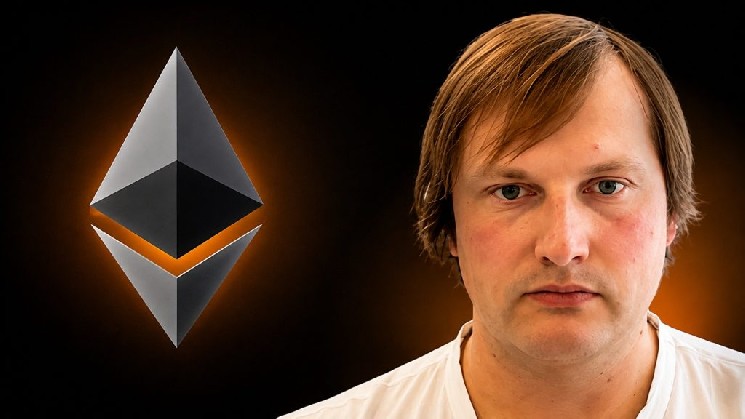
Behind this investment research firm, however, is a founder without a traditional finance background: James van Geelen. Holding dual degrees in Biology and Psychology from UCLA, he has worked as an emergency medical technician, founded a healthcare company, and later ventured into the investment world, now hailed as the "God of Investment Research." In this issue, Odaily Planet Daily will unveil James's cross-border legend.

Citrini Founder: A Narrative Master with "Second-Order Thinking"

Mentioning Citrini, those in the crypto space might have first noticed this research account from a post this May, on the eve of Cerebras (CBRS)'s IPO, where he mentioned "fund managers conducting price discovery in advance on Trade.xyz (within the Hyperliquid ecosystem)." This tweet was later confirmed by a retweet from Trade.xyz founder Shokun.

Citrini: The "Whistleblower to Traditional Finance" for Hyperliquid and Trade.xyz

It is no exaggeration to say that, as a research account that once published the viral article "The 2028 Global Intelligence Crisis," Citrini's radiating influence on traditional financial circles is evident.

Its high regard for the Hyperliquid ecosystem and Trade.xyz's role in pre-market stock pricing has also brought crypto market RWA platforms, pre-market stock contract platforms, and on-chain stock trading platforms into the view of many, to some extent fueling this year's "RWA asset frenzy in US stocks."
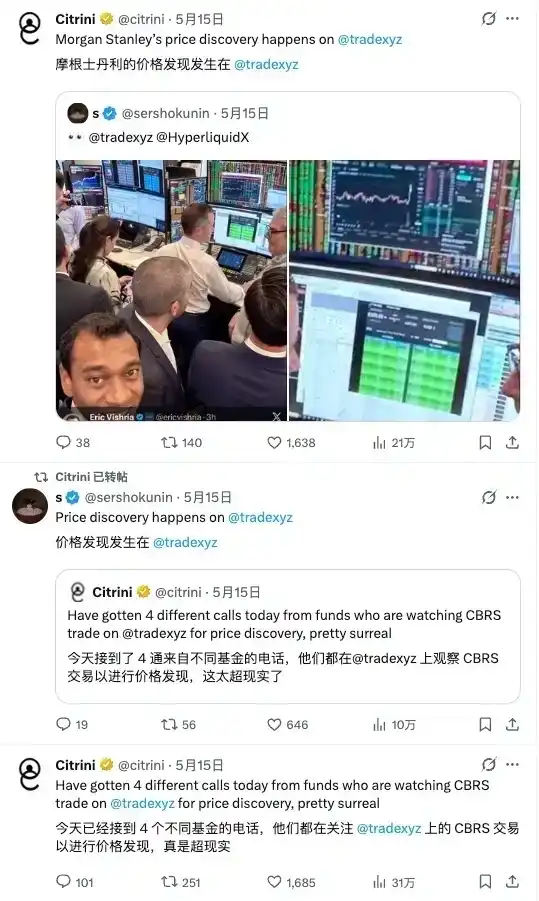
In a sense, Citrini can be considered a bellwether sending "warning signals" to traditional financial circles—it is using accurate information to warn traditional financial markets that previously unnoticed crypto players are setting their sights like barbarians on the "big cake" of traditional finance.

And behind Citrini is a founder who believes in "second-order thinking" and "long-termism"—James van Geelen.

Diverse Persona: Double Major in Biology & Psychology, Emergency Medical Practitioner, "AI Panic Whistleblower"

The 33-year-old James van Geelen (hereinafter Geelen) probably never imagined that an "AI discussion thread" could trigger the rapid evaporation of hundreds of billions of dollars in market value from US stock markets; earlier, his professional resume wasn't even remotely related to AI.

Public information shows Geelen graduated from the prestigious UCLA, earning dual degrees in Biology and Psychology during his studies. He also worked as an Emergency Medical Technician and Paramedic in downtown Los Angeles. Prestigious education and emergency medical experience shaped his character: pursuit of efficiency and adeptness at planning. As he himself said—"If you don't have a plan, you'll have a terrible life." Additionally, he prides himself as a "musical prodigy," though he doesn't have any notable works to show for it.

According to Geelen's original plan, he should have become a life-saving doctor, but by chance, he instead embarked on an entrepreneurial path: first founding a healthcare company and selling it to a private equity fund, successfully breaking free from the "prestigious school-job-professional manager" cycle; then founding the current Citrini.

Another noteworthy point, as mentioned by him in a 2023 Odd Lots podcast, is that he also co-founded one of the earliest medical marijuana dispensaries in Connecticut. From this, one can see he is far from the "proper doctor" perceived as rigid and rule-following.

In 2018, with some startup capital, Geelen began his personal investment career under the name Citrinitas Capital, capturing early opportunities in AI (like Nvidia) and GLP-1 weight-loss drugs (like Ozempic/Wegovy).

In 2023, Geelen formally founded Citrini Research, committed to "cross-asset, multi-dimensional thinking for investment analysis," providing in-depth reports on thematic stock investing and global macro trades. It quickly grew into a top creator in the finance field on the Substack platform. (Odaily Planet Daily Note: It offers both individual and institutional subscription models.)

On May 31, 2023, the model investment portfolio Citrindex, built on personal research, was formally launched with an annual subscription fee of $1250. Statistics show the portfolio has achieved cumulative returns exceeding 200%, with monthly gains repeatedly outperforming the S&P 500.

In March 2024, he boldly predicted Trump would win the election. In July 2025, amid the turmoil over former Fed Chair Powell's departure, he loudly advised over 50,000 subscribers to "buy two-year US Treasuries and short ten-year US Treasuries" to hedge policy risks.

In December 2025, according to PitchBook information, Citrini completed a seed funding round of approximately $5.05 million. With only about 10 employees, the company remains privately held.

Then, in February of this year, he co-authored with Alap Shah, who comes from a traditional finance background, that earth-shaking report for US markets: "The 2028 Global Intelligence Crisis." Although he repeatedly emphasized the report was merely a "thought experiment," a scenario assumption rather than a predictive analysis, the phenomena mentioned—"mass white-collar unemployment, declining consumer spending, economic contraction (Ghost GDP)"—still triggered panic and concern in capital markets, leading to significant declines in delivery, payment, and software stocks. Among them, IBM's stock price on February 23 recorded its largest single-day drop since 2025; American Express and Blackstone Group fell over 8%, the entire software stock sector dropped nearly 5%, while stocks of companies like DoorDash, Uber, Mastercard, Visa, Capital One, and Apollo Global Management Inc. fell up to 3%. Multiple US stock sectors were caught in the selling wave, with the Dow Jones once dropping over 800 points. Alap Shah later publicly stated his investment stance was "talking down while going long," meaning shorting companies they believe will be disrupted by AI while holding semiconductor tech stocks benefiting from AI.

It is no exaggeration to say that Citrini's single report directly caused the US stock market to "bleed profusely" for a time, evaporating hundreds of billions of dollars in market value overnight, triggering follow-up reports from overseas media like Bloomberg and The Wall Street Journal.

On April 6 this year, Citrini team's "Analyst #3" (code name Analyst#3) personally went to the critical strategic point in the US-Iran conflict—the Strait of Hormuz for research, disclosing many little-known frontline observations, revealing on the ground the specific operational model of Iran's "toll booth" in the Strait, and providing a series of counterintuitive conclusions, such as: Regardless of how the situation develops, shipping volume through the Strait will gradually increase; Iran does not wish to close the Strait of Hormuz. First, Strait shipping volume will continue to rise. Second, a diplomatic-style "toll booth"—surprisingly, transit order in the Strait is actually very regulated. Third, the paradox of escalation—even if ground operations commence, shipping volume through the Strait may still continue to increase. Fourth, realignment of power structures, not a decisive victory. This conflict is not a simple "two-party confrontation" but a multi-party game. Geographical disputes within great power games are also key subjects within Citrini's research "range."

When asked why he named the company "citrinitas," Geelen replied:"The naming inspiration comes from financial titan George Soros's 'The Alchemy of Finance.' This is actually a stage in alchemy, but what most people don't know is that in this transitional stage, lead begins to transform into gold, but hasn't fully become gold yet." This is also his favorite time to "make a difference"—seeing the birth of "gold" before others notice the change in lead.

Investment Style: Second-Order Thinking, Narrative-Driven, Reverse Scenario

As for Citrini's investment style, thanks to its cross-border experience and diverse persona, it highly advocates "second-order thinking."

As Geelen himself said:"Most investors only focus on the ball itself, but I focus more on where the ball will bounce next."
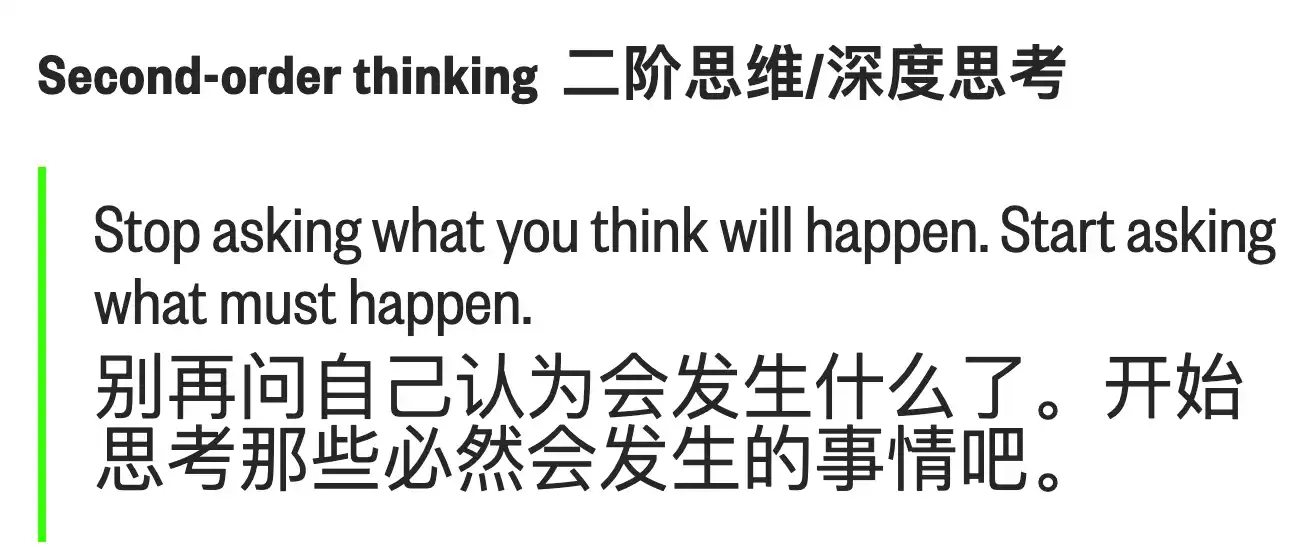
Judging from Citrini's past content and public information, this investment research firm focuses on long-term "super trends," such as AI, robotics, energy demand, fiscal policy, geopolitics, modern warfare, etc. Additionally, the firm is dedicated to providing actionable "bundled investment references" and tactical macro trade ideas, with analysis leaning towards long-term structural changes rather than short-term trades. In its Substack homepage bio, we can see its emphasis on practicality, stating: "You (the reader) will no longer need to ask 'what's the trade?'"
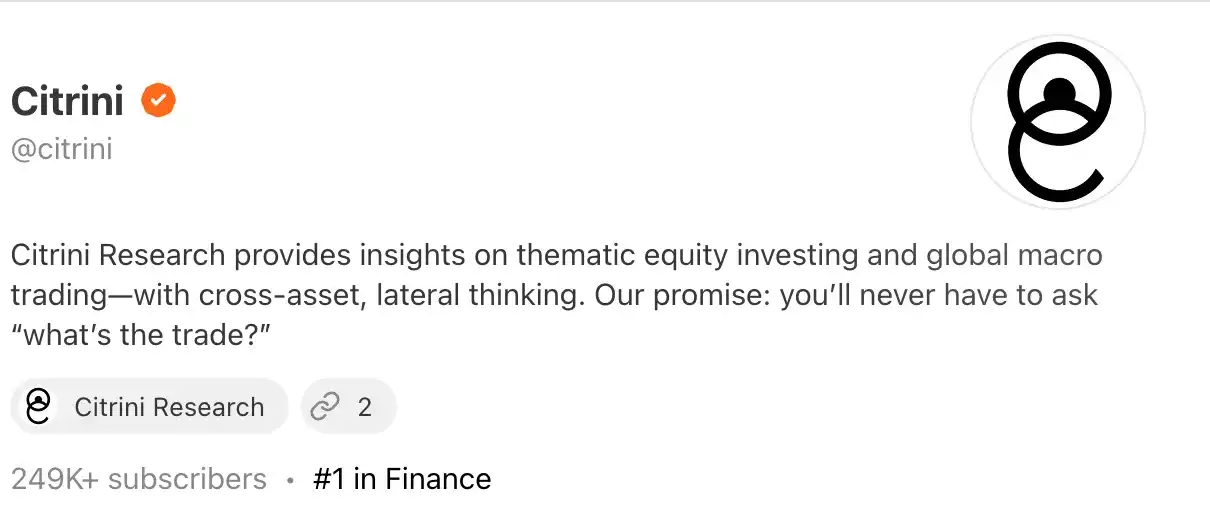
Furthermore, Citrini often uses "scenario assumptions" to help readers understand second/third-order effects. Geelen once mentioned: "Don't always think about what you think will happen. Instead, think about what is bound to happen. How will the market's reaction change the actual situation? What will be the secondary effects? What are the obstacles keeping a certain trend going? Where will capital flow to overcome these obstacles?" Previously, during the collapse of Silicon Valley Bank in March 2023, he boldly purchased overnight funding rate call options, easily reaping nearly 50x returns. Last December, before the US initiated military action in Venezuela, he shared insights on investment opportunities in Venezuelan sovereign bonds.

This year, Citrini has successively absorbed several independent analysts, including macro analyst Nick Reece, South Korean semiconductor industry analyst @jukan05, and AI chip industry analyst @zephyr_z9, to some extent filling gaps in industry details, technical processes, and directional changes.Currently, this investment research firm still maintains a founder-driven + anonymous elite team collaborative production model.


Трендові криптовалюти

Пов'язані питання

QWho is the founder of Citrini Research and what are some key aspects of his background?

AThe founder of Citrini Research is James van Geelen. He holds dual degrees in Biology and Psychology from UCLA. His background includes working as an emergency medical technician, founding a healthcare company, and co-founding one of Connecticut's early medical cannabis dispensaries. He is described as a non-finance professional who entered the investment world later in his career.

QWhat major report did Citrini publish in February that significantly impacted the stock market, and what was its claimed effect?

AIn February, Citrini published a report titled 'The 2028 Global Intelligence Crisis'. While presented as a 'thought experiment', its discussion of potential mass white-collar unemployment and economic contraction triggered a panic sell-off in the US stock market. The report is cited as causing software stocks to fall nearly 5%, leading to a single-day drop of over 800 points in the Dow Jones and evaporating hundreds of billions of dollars in market value.

QAccording to the article, what is a core investment philosophy or style emphasized by James van Geelen and Citrini?

AA core investment philosophy emphasized by James van Geelen and Citrini is 'second-order thinking'. This involves focusing not just on immediate events, but on the subsequent consequences and knock-on effects of those events. Geelen analogizes it to looking not at the ball itself, but where the ball will bounce next.

QWhat was a key finding from Citrini's April 2025 on-the-ground research report regarding the Strait of Hormuz?

AA key finding from Citrini's April 2025 on-the-ground 'Strait of Hormuz Research Report' was that, contrary to common perception, Iran does not wish to close the Strait of Hormuz. The report described Iran's operation there more like a diplomatic 'toll booth', with shipping traffic being orderly and actually expected to increase regardless of geopolitical developments.

QWhat is the origin and meaning behind the name 'Citrini' for the research firm?

AThe name 'Citrini' is inspired by the financial term 'citrinitas' from George Soros's book *The Alchemy of Finance*. In alchemy, 'citrinitas' represents a transitional stage where lead begins to turn into gold but is not fully transformed. Geelen chose it to symbolize the firm's focus on identifying the early transformation of an asset or trend into something valuable ('gold') before others notice the change in the 'lead'.

Пов'язані матеріали

The "Impossible Triad" Is Fundamentally a Pseudo-Problem

The article argues that blockchain's fundamental limitation is not the scalability trilemma (decentralization, scalability, security), which has been largely solved, but the lack of **privacy** and, until recently, clear **legitimacy**. Blockchain is described as a slow, expensive, globally shared computer whose core value is censorship resistance and verifiability. While ideal for native digital assets like money (e.g., stablecoins), its default transparency acts as a **tax**, exposing all transactions and enabling MEV extraction, which deters serious institutional capital. Simultaneously, its permissionless nature created regulatory ambiguity. The piece contends that **privacy** is the missing critical feature. It rejects the false choice between total transparency and complete anonymity. Modern cryptography (like zero-knowledge proofs) enables **compliant privacy**: users can prove facts (solvency, KYC status, compliance) without revealing the underlying sensitive data (specific holdings, identities). This preserves auditability for regulators and eliminates the leak of financial information. With recent regulatory progress (e.g., the GENIUS Act) addressing legitimacy, adding default, provably compliant privacy becomes a pure upgrade. It transforms blockchain from a costly, public ledger into a confidential settlement layer, finally bridging the gap to mainstream institutional and individual adoption of on-chain finance.

链捕手1 год тому

The "Impossible Triad" Is Fundamentally a Pseudo-Problem

链捕手1 год тому

Optical Chips: Collective Capacity Expansion

The global optical chip industry is experiencing a massive wave of expansion driven by surging AI data center demand. Major players across the US, Japan, Europe, and China are aggressively investing to ramp up production capacity. In the US, Coherent is expanding its 6-inch Indium Phosphide (InP) semiconductor fab in Texas, supported by CHIPS Act funding and a $2 billion strategic investment from NVIDIA. Lumentum is building a new factory for InP optical devices, and Nokia is scaling its advanced photonic chip packaging and testing capabilities. NVIDIA's investments aim to secure future supply of critical lasers and optical interconnect products for AI infrastructure. Japan's JX Advanced Metals, a leading InP substrate supplier, plans a multi-billion yen investment to increase its capacity 7-10 times, strengthening its grip on the crucial upstream materials market. In Europe, IQE and Tower Semiconductor settled a patent dispute and signed a multi-year InP epitaxial wafer supply agreement, highlighting that next-generation silicon photonics platforms will integrate high-performance InP components. STMicroelectronics and Sivers Semiconductors are also expanding silicon photonics production and partnerships. China is rapidly building out its domestic supply chain. Dongshan Precision's subsidiary, Source Photonics, announced a $12 billion project to expand optical chip and module production. Companies like Sanan Optoelectronics and Yunnan Germanium are scaling up InP chip manufacturing and substrate production, moving towards vertical integration from materials to modules. While debate continues around the exact future architecture—whether CPO (Co-Packaged Optics), NPO, or pluggables will dominate—analysts like Morgan Stanley argue the underlying driver is unchangeable: the explosive growth in bandwidth demand. This will inevitably increase the volume of optical engines, lasers, and related content per GPU, regardless of the final technical path. The competition for "more light" in the AI era has intensified into a global, full-chain capacity race.

marsbit3 год тому

Optical Chips: Collective Capacity Expansion

marsbit3 год тому

Stablecoins Finally Find Real Yield: An In-Depth Look at On-Chain Reinsurance Re | A Conversation with Re Founder Karan Saroya

Stablecoin Real Yield Found: A Deep Dive into On-Chain Reinsurance with Re's Karan Saroya As stablecoin supply exceeds $170 billion, the search for sustainable, non-speculative yield intensifies. Re, an on-chain reinsurance platform, provides an answer: connecting stablecoin capital to the trillion-dollar traditional reinsurance market. Re operates as a regulated reinsurer, accepting stablecoin deposits as collateral to back US insurance companies. These insurers pay premiums, generating yield that flows back to on-chain depositors. Currently supporting 35 insurers and underwriting $500 million, Re projects scaling to over $1 billion soon. Key insights from a Bankless podcast with founder Karan Saroya and investor Avichal of Electric Capital: 1. **Uncorrelated, Real-World Yield:** Re offers stablecoin holders access to reinsurance returns (targeting 12-14%+), an asset class entirely separate from crypto or equity markets. 2. **Operational Efficiency via Smart Contracts:** Re replaces traditional, labor-intensive capital fundraising with smart contracts, allowing a ~12-person team to compete with industry giants. 3. **Regulatory Leverage:** For every $1 of collateral, regulations allow backing $5-7 in written premiums. This leverage amplifies returns from the underlying risk-free rate. 4. **DeFi Integration:** Depositors receive receipt tokens, which can be used in protocols like Morpho for "looping," potentially pushing yields to 18-20%+. 5. **The "DeFi Mullet" Model:** A compliant front-end (regulated reinsurer) paired with a decentralized back-end (smart contracts, DeFi capital markets). 6. **RE Governance Token:** Modeled on Lloyd's of London, the token governs the central capital pool's allocation, counterparty acceptance, and parameters. 7. **Real Economic Impact:** Capital funds real-world productivity (factories, clinics, businesses) via insurance, moving beyond crypto's internal loops. The discussion highlights a pivotal moment: DeFi's supply-side infrastructure is now met by real demand for productive yield, potentially kickstarting a flywheel where vast on-chain stablecoin capital seeks these real-world returns.

链捕手5 год тому

Stablecoins Finally Find Real Yield: An In-Depth Look at On-Chain Reinsurance Re | A Conversation with Re Founder Karan Saroya

链捕手5 год тому

1996 or 1999? Walsh's First Test is 'How to View AI'

"1996 or 1999? Wall's First Big Test Is 'How to View AI'" Federal Reserve Chairman Wall's initial challenge is not whether to raise or cut rates, but a more fundamental judgment: what kind of boom is the current AI boom? This will determine the Fed's policy path and define his legacy. Economics is split between two opposing views, according to reporter Nick Timiraos. One sees imminent productivity gains that will increase supply and cool inflation, allowing the Fed to hold steady. The other argues that while productivity benefits are distant, demand shocks are here now, and waiting for data confirmation risks missing the intervention window, forcing sharper rate hikes later. Wall has signaled a leaning toward the first view, echoing 1996-era Alan Greenspan, who embraced strong, productivity-driven growth without fear of inflation. However, Wall faces a different macro environment than Greenspan did, with tariff pressures, expanding fiscal deficits, and diminishing globalization benefits, which could force more significant inflation pressures even if AI benefits materialize. Wall's logic, expressed before taking office, is that AI-driven productivity gains won't show in official data for years. If the Fed waits for confirmation, it might mistakenly tighten policy and choke off the very growth that could suppress inflation. This argues for using forward-looking narratives over lagging data. Chicago Fed President Austan Goolsbee presents a key counter-argument. He distinguishes between expected and unexpected productivity booms. A widely anticipated boom, like the current AI wave, can cause people to spend future wealth gains in advance, overheating the economy before productivity actually rises, thus requiring preemptive rate hikes. He cites rising costs for AI data centers as evidence of such overheating. Fed Governor Christopher Waller offers a rebuttal to Goolsbee, noting the "expected spending" mechanism only works if people can borrow against future income, which many households cannot do due to borrowing constraints. Wall also faces a paradox related to his desire to reduce the Fed's use of "forward guidance" (pre-announcing policy moves). This practice was established in 1999 when Greenspan began signaling hikes to avoid market shocks. If the economy follows a less optimistic path, Wall may be forced to choose between using the guidance he wants to abolish or risking market volatility by staying silent. The ultimate question defining Wall's first major test remains: Is this 1996 or 1999?

marsbit6 год тому

1996 or 1999? Walsh's First Test is 'How to View AI'

marsbit6 год тому

Торгівля

Спот
Ф'ючерси

Популярні статті

Як купити T

Ласкаво просимо до HTX.com! Ми зробили покупку Threshold Network Token (T) простою та зручною. Дотримуйтесь нашої покрокової інструкції, щоб розпочати свою криптовалютну подорож.Крок 1: Створіть обліковий запис на HTXВикористовуйте свою електронну пошту або номер телефону, щоб зареєструвати обліковий запис на HTX безплатно. Пройдіть безпроблемну реєстрацію й отримайте доступ до всіх функцій.ЗареєструватисьКрок 2: Перейдіть до розділу Купити крипту і виберіть спосіб оплатиКредитна/дебетова картка: використовуйте вашу картку Visa або Mastercard, щоб миттєво купити Threshold Network Token (T).Баланс: використовуйте кошти з балансу вашого рахунку HTX для безперешкодної торгівлі.Треті особи: ми додали популярні способи оплати, такі як Google Pay та Apple Pay, щоб підвищити зручність.P2P: Торгуйте безпосередньо з іншими користувачами на HTX.Позабіржова торгівля (OTC): ми пропонуємо індивідуальні послуги та конкурентні обмінні курси для трейдерів.Крок 3: Зберігайте свої Threshold Network Token (T)Після придбання Threshold Network Token (T) збережіть його у своєму обліковому записі на HTX. Крім того, ви можете відправити його в інше місце за допомогою блокчейн-переказу або використовувати його для торгівлі іншими криптовалютами.Крок 4: Торгівля Threshold Network Token (T)Легко торгуйте Threshold Network Token (T) на спотовому ринку HTX. Просто увійдіть до свого облікового запису, виберіть торгову пару, укладайте угоди та спостерігайте за ними в режимі реального часу. Ми пропонуємо зручний досвід як для початківців, так і для досвідчених трейдерів.

459 переглядів усьогоОпубліковано 2024.12.10Оновлено 2026.06.02

Як купити T

Обговорення

Ласкаво просимо до спільноти HTX. Тут ви можете бути в курсі останніх подій розвитку платформи та отримати доступ до професійної ринкової інформації. Нижче представлені думки користувачів щодо ціни T (T).

活动图片