UK Moves To Shut Down Crypto Exchange Tied To Iran’s Military

bitcoinistОпубліковано о 2026-03-21Востаннє оновлено о 2026-03-21

Анотація

A UK-registered cryptocurrency exchange, Zedxion, is being shut down after a TRM Labs investigation revealed that nearly 90% of its 2024 transactions, totaling around $1 billion, were linked to Iran’s Islamic Revolutionary Guard Corps (IRGC). The UK’s Companies House initiated a compulsory strike-off after discovering the firm filed false information, including a fictitious director named Elizabeth Newman, whose image was traced to a stock photo. The previous director was linked to Babak Zanjani, an Iranian businessman previously sentenced for corruption. The action follows US sanctions imposed in January against Zedxion and a related platform, Zedcex, for supporting the IRGC.

A blockchain analytics firm found that nearly 90% of money processed by a UK-registered crypto exchange in 2024 was connected to Iran’s most powerful military organization.

A Billion Dollars And A Fake Boss

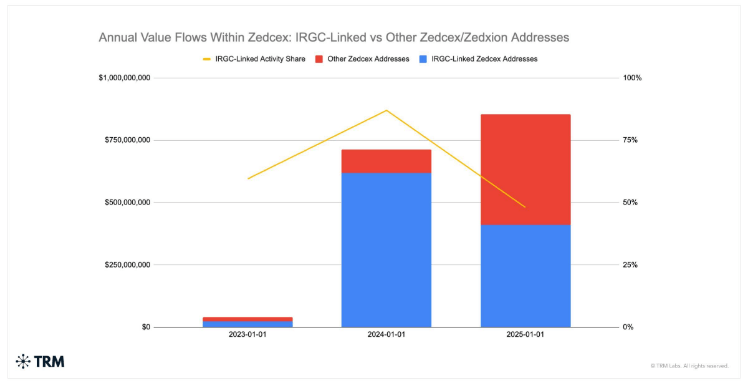
TRM Labs, which tracks cryptocurrency flows, reported that Zedxion Exchange and a related platform called Zedcex moved roughly $1 billion tied to Iran’s Islamic Revolutionary Guard Corps (IRGC).

In 2024, IRGC-linked payments made up about 87% of all transactions the two exchanges handled. Even as that share fell to roughly 48% in 2025, the raw dollar amounts connected to the Iranian military group remained massive.

Now the UK is shutting the exchange down.

Britain’s Companies House — the government body that registers businesses — has started a compulsory strike-off against Zedxion Exchange Ltd. Authorities say the company filed false information, including listing a director who never existed.
Stock Photo, Fake Name, Real Money

The fictitious director was registered under the name Elizabeth Newman, listed as a citizen of the Dominican Republic.

An investigation by the Organized Crime and Corruption Reporting Project (OCCRP) found that the woman behind the name was likely manufactured entirely — her image in company marketing videos traced back to a stock photo.

Babak Zanjani, an Iranian billionaire accused of corruption, previously voiced pride in his role helping Iran sidestep oil sanctions during periods of economic strain. Source: https://www.iranintl.com/

Before Newman appeared in company records, a man named Babak Morteza held the director position. His details matched those of Babak Zanjani, an Iranian businessman who had previously been sentenced to death in Iran for stealing state oil funds.

That sentence was reduced in 2024, and Zanjani resumed business operations. Morteza was listed as director and the person with significant control of Zedxion from October 2021 to August 2022.

Zanjani is also said to head DotOne Holding Group, a conglomerate with operations across cryptocurrency, foreign exchange, logistics, and telecommunications — sectors that have been used in the past to sidestep international sanctions.

Total crypto market cap currently at $2.4 trillion. Chart: TradingView

Washington Acted First

The UK crackdown follows US sanctions imposed in January by the Treasury Department’s Office of Foreign Assets Control (OFAC).

Both Zedxion and Zedcex were named in that action. OFAC said Zanjani helped fund projects supporting the IRGC and the Iranian government more broadly.

Company filings for the two exchanges also showed dormant accounts, a detail that stood in sharp contrast to the enormous transaction volumes blockchain analysts traced through them.

The UK passed the Economic Crime and Corporate Transparency Act in 2023, giving Companies House new authority to verify the identities of directors and check that registered businesses were set up for lawful purposes.

The Zedxion case marks one of the more visible uses of those powers.

Featured image from Unsplash, chart from TradingView

Пов'язані питання

QWhat percentage of transactions processed by Zedxion Exchange in 2024 were linked to Iran's IRGC?

AApproximately 87% of transactions processed by Zedxion Exchange and Zedcex in 2024 were connected to Iran's Islamic Revolutionary Guard Corps (IRGC).

QWhat was the fictitious name of the director listed for Zedxion Exchange Ltd. and what was her alleged citizenship?

AThe fictitious director was registered under the name Elizabeth Newman, who was listed as a citizen of the Dominican Republic.

QWhich US government agency imposed sanctions on Zedxion and Zedcex, and when did this action occur?

AThe US Treasury Department's Office of Foreign Assets Control (OFAC) imposed sanctions on Zedxion and Zedcex in January 2025.

QWhat is the name of the Iranian businessman previously sentenced to death, who was linked to the directorship of Zedxion under an alias?

ABabak Zanjani, an Iranian businessman previously sentenced to death for stealing state oil funds, was linked to the directorship of Zedxion under the alias Babak Morteza.

QWhat new UK legislation gave Companies House enhanced powers to verify company directors and lawful purposes, which was used in the Zedxion case?

AThe Economic Crime and Corporate Transparency Act, passed in 2023, gave Companies House new authority to verify the identities of directors and check that registered businesses were set up for lawful purposes.

Пов'язані матеріали

Gensyn AI: Don't Let AI Repeat the Mistakes of the Internet

In recent months, the rapid growth of the AI industry has attracted significant talent from the crypto sector. A persistent question among researchers intersecting both fields is whether blockchain can become a foundational part of AI infrastructure. While many previous AI and Crypto projects focused on application layers (like AI Agents, on-chain reasoning, data markets, and compute rentals), few achieved viable commercial models. Gensyn differentiates itself by targeting the most critical and expensive layer of AI: model training. Gensyn aims to organize globally distributed GPU resources into an open AI training network. Developers can submit training tasks, nodes provide computational power, and the network verifies results while distributing incentives. The core issue addressed is not decentralization for its own sake, but the increasing centralization of compute power among tech giants. In the era of large models, access to GPUs (like the H100) has become a decisive bottleneck, dictating the pace of AI development. Major AI companies are heavily dependent on large cloud providers for compute resources. Gensyn's approach is significant for several reasons: 1) It operates at the core infrastructure layer (model training), the most resource-intensive and technically demanding part of the AI value chain. 2) It proposes a more open, collaborative model for compute, potentially increasing resource utilization by dynamically pooling idle GPUs, similar to early cloud computing logic. 3) Its technical moat lies in solving complex challenges like verifying training results, ensuring node honesty, and maintaining reliability in a distributed environment—making it more of a deep-tech infrastructure company. 4) It targets a validated, high-growth market with genuine demand, rather than pursuing blockchain integration without purpose. Ultimately, the boundaries between Crypto and AI are blurring. AI requires global resource coordination, incentive mechanisms, and collaborative systems—areas where crypto-native solutions excel. Gensyn represents a step toward making advanced training capabilities more accessible and collaborative, moving beyond a niche controlled by a few giants. If successful, it could evolve into a fundamental piece of AI infrastructure, where the most enduring value in the AI era is often created.

marsbit10 год тому

Gensyn AI: Don't Let AI Repeat the Mistakes of the Internet

marsbit10 год тому

Why is China's AI Developing So Fast? The Answer Lies Inside the Labs

A US researcher's visit to China's top AI labs reveals distinct cultural and organizational factors driving China's rapid AI development. While talent, data, and compute are similar to the West, Chinese labs excel through a pragmatic, execution-focused culture: less emphasis on individual stardom and conceptual debate, and more on teamwork, engineering optimization, and mastering the full tech stack. A key advantage is the integration of young students and researchers who approach model-building with fresh perspectives and low ego, prioritizing collective progress over personal credit. This contrasts with the US culture of self-promotion and "star scientist" narratives. Chinese labs also exhibit a strong "build, don't buy" mentality, preferring to develop core capabilities—like data pipelines and environments—in-house rather than relying on external services. The ecosystem feels more collaborative than tribal, with mutual respect among labs. While government support exists, its scale is unclear, and technical decisions appear driven by labs, not state mandates. Chinese companies across sectors, from platforms to consumer tech, are building their own foundational models to control their tech destiny, reflecting a broader cultural drive for technological sovereignty. Demand for AI is emerging, with spending patterns potentially mirroring cloud infrastructure more than traditional SaaS. Despite challenges like a less mature data industry and GPU shortages, Chinese labs are propelled by vast talent, rapid iteration, and deep integration with the open-source community. The competition is evolving beyond a pure model race into a contest of organizational execution, developer ecosystems, and industrial pragmatism.

marsbit12 год тому

Why is China's AI Developing So Fast? The Answer Lies Inside the Labs

marsbit12 год тому

3 Years, 5 Times: The Rebirth of a Century-Old Glass Factory

Corning, a 175-year-old glass company, is experiencing a dramatic revival as a key player in AI infrastructure, driven by surging demand for high-performance optical fiber in data centers. AI data centers require vastly more fiber than traditional ones—5 to 10 times as much per rack—to handle high-speed data transmission between GPUs. This structural demand shift, coupled with supply constraints from the lengthy expansion cycle for fiber preforms, has created a significant supply-demand gap. Nvidia has invested in Corning, along with Lumentum and Coherent, in a $4.5 billion total commitment to secure the optical supply chain for AI. Corning's competitive edge lies in its expertise in producing ultra-low-loss, high-density, and bend-resistant specialty fiber, which is critical for 800G+ and future 1.6T data rates. Its deep involvement in co-packaged optics (CPO) with partners like Nvidia further solidifies its position. While not the largest fiber manufacturer globally, Corning's revenue from enterprise/data center clients now exceeds 40% of its optical communications sales, and it has secured multi-year supply agreements with major hyperscalers including Meta and Nvidia. Financially, Corning's optical communications revenue has surged, doubling from $1.3 billion in 2023 to over $3 billion in 2025. Its stock price has risen nearly 6-fold since late 2023. Key future catalysts include the rollout of Nvidia's CPO products and the scale of undisclosed customer agreements. However, risks include high current valuations and potential disruption from next-generation technologies like hollow-core fiber. The company's long-term bet on light over electricity, maintained even through the telecom bubble crash, is now being validated by the AI boom.

marsbit12 год тому

3 Years, 5 Times: The Rebirth of a Century-Old Glass Factory

marsbit12 год тому

Торгівля

Спот
Ф'ючерси
活动图片





