UAE Puts Diamonds On The XRP Ledger: $280 Million+ Now On-Chain

bitcoinistОпубліковано о 2026-02-04Востаннє оновлено о 2026-02-04

Анотація

The United Arab Emirates has tokenized over $280 million worth of certified polished diamonds on the XRP Ledger through a partnership between Billiton Diamond and Ctrl Alt. This initiative aims to digitize Dubai's diamond market by providing end-to-end tokenization, enabling verifiable provenance, grading, and ownership history while streamlining traditionally paper-heavy settlement processes. The XRP Ledger was chosen for its fast settlement, low fees, and scalability, with assets secured by Ripple's custody technology. The project, which requires regulatory approval from VARA, is designed to enhance liquidity, reduce operational complexity, and facilitate global investment in diamonds. XRP was trading at $1.60 at the time of the announcement.

Ripple says more than AED 1 billion (over $280 million) of certified polished diamonds held in the United Arab Emirates have been tokenized on the XRP Ledger, in a deal that ties a high-value physical inventory to on-chain issuance, custody, and (eventually) secondary-market rails.

The initiative, announced Tuesday by Billiton Diamond and Ctrl Alt, is pitched as an end-to-end tokenization effort for certified polished diamond inventory in the Dubai market, one that is designed to make provenance, grading, and ownership history verifiable before a transaction, while compressing settlement and operational workflows that have historically relied on offline certification and paper-heavy transfer processes.

XRP Ledger Powers Dubai Tokenization Push

According to the companies’ press release, Ctrl Alt has already tokenized more than AED 1 billion in diamonds, with tokens minted on the XRP Ledger. The partners said the network was selected for “fast settlement, low fees, and scalable architecture,” while the tokenized assets are secured through Ripple’s “enterprise-grade custody technology.”

Reece Merrick framed the move as a proof point that custody and auditability are central to institutional-grade commodity tokenization. “This initiative shows how Ripple’s technology can bridge the gap between physical assets and the digital economy, utilising our enterprise-grade custody solution to secure high-value diamond assets with unrivalled trust and security,” Merrick wrote on X.

He added that the firms were “providing the infrastructure needed to move physical commodities on-chain at scale,” calling it “a significant leap forward for the future of commodities tokenization.” Notably, the firms first announced their partnership in July last year.

Billiton, which the release describes as a leader in rough diamond auctions using a Vickrey auction model, said the collaboration is intended to expand into tokenized polished diamond sales phases. The planned platform would embed real-time inventory management and certification data on-chain, enabling verification of origin, grading, and ownership history before trades.

The firms also pointed to future “secondary market readiness” workstreams: custody, transfer, and market participation, implying the tokens are being structured not just as a digitized record, but as infrastructure for distribution.

The press release said the next stages are subject to regulatory approval by Virtual Assets Regulatory Authority (VARA) prior to launch. That detail matters: the partners are explicitly positioning the effort as compliant market infrastructure, not a one-off proof of concept.

Jamal Akhtar argued the core unlock is liquidity and time-to-cash in a market where diamonds have traditionally been operationally complex to finance and transfer.

“This partnership transforms polished diamonds from a traditionally illiquid asset class into a transparent, investable digital asset that supports manufacturers, brands, and investors alike,” Akhtar said. “Tokenization introduces an unprecedented level of transparency, unlocking the potential for new liquidity, shortening working capital cycles for manufacturers and traders, and opening the door to seamless global participation in Dubai’s growing luxury ecosystem.”

The announcement also credits DMCC with connecting stakeholders and helping build the ecosystem for diamond tokenization, with Ahmed Bin Sulayem describing DMCC as a “bridge between commodities, capital and next-generation digital markets,” and pointing to coordination with VARA as part of the framework underpinning the rollout.

Ctrl Alt’s Robert Farquhar said: “‍Billiton needed robust, institutional-grade infrastructure to handle the complexity and scale of its polished diamond supply. Our proven tokenization expertise and technology provide a clear, secure, and compliant route for diamond ownership to move on-chain, from asset origination to digital market participation. This establishes a more accessible and operationally efficient model for commodity investment in the UAE.”

At press time, XRP traded at $1.60.
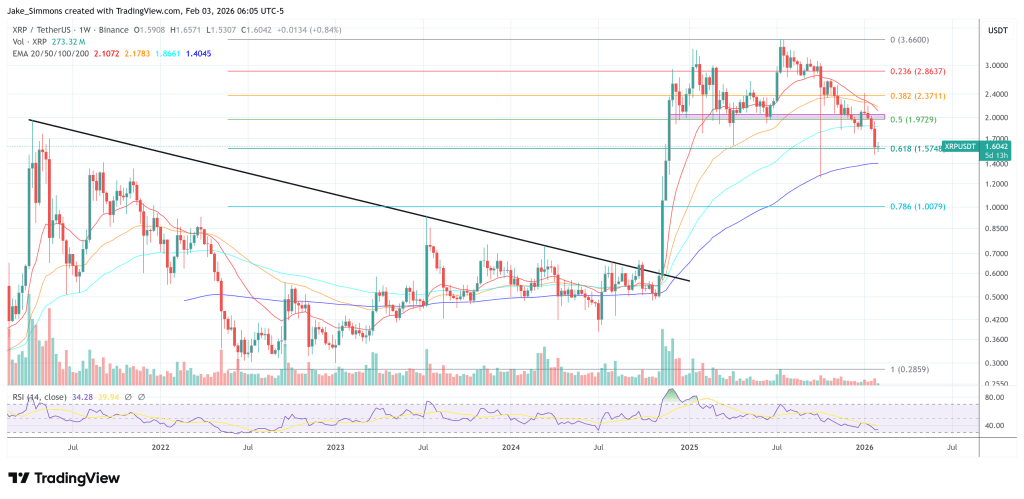
XRP stays above the 0.618 Fib, 1-week chart | Source: XRPUSDT on TradingView.com

Пов'язані питання

QWhat is the total value of diamonds that have been tokenized on the XRP Ledger in this initiative?

AMore than AED 1 billion, which is over $280 million.

QWhich two companies announced the partnership for tokenizing diamonds on the XRP Ledger?

ABilliton Diamond and Ctrl Alt.

QWhat are the three main reasons cited for choosing the XRP Ledger for this tokenization project?

AFast settlement, low fees, and scalable architecture.

QWhat regulatory body must approve the next stages of this project before launch?

AThe Virtual Assets Regulatory Authority (VARA).

QAccording to Jamal Akhtar, how does tokenization transform the diamond market?

AIt transforms polished diamonds from a traditionally illiquid asset class into a transparent, investable digital asset, unlocking new liquidity, shortening working capital cycles, and enabling seamless global participation.

Пов'язані матеріали

The Verdict in Choi Tae-won's Divorce Case: Revealing the Inheritance Undercurrent Behind SK Hynix's Trillion-Won Empire

SK Group Chairman Chey Tae-won's high-profile divorce case, involving a record 1.38 trillion won settlement, has drawn attention to the succession plans for Korea's second-largest conglomerate, especially its crown jewel, SK hynix. Unlike traditional chaebol scripts centered on the eldest son, Chey's three children from his marriage to former President Roh Tae-woo's daughter, Roh Soh-yeong, are carving distinct, non-traditional paths. Eldest daughter Chey Yun-jung (b. 1989) is seen as the most evident successor. With a scientific and consulting background, she holds executive roles at SK bioscience and SK Inc.'s growth support department, focusing on future strategy and biopharma. Her marriage is to an AI infrastructure entrepreneur, not a traditional business alliance. Second daughter Chey Min-jung (b. 1991) took a unique route, voluntarily serving as a South Korean naval officer, including an anti-piracy deployment. She later worked on policy and strategy for SK hynix in Washington D.C. before co-founding an AI-driven healthcare startup. She married a former U.S. Marine Corps officer, connecting her to U.S. defense and policy circles—networks crucial for a global semiconductor giant. The only son, Chey In-geun (b. 1995), who studied physics like his father, worked briefly at SK E&S before joining McKinsey. Despite fitting the traditional "heir" profile as the eldest son, he remains silent and holds no public position or shares in SK, suggesting the old succession playbook is obsolete. As SK hynix's valuation soars, becoming a geopolitical asset in the AI era, the heirs' legitimacy is no longer automatic. They must prove themselves in fields like AI biotech, global policy, and strategic consulting. Their marriages also reflect new elite networks in tech and defense, not old political alliances. Their inheritance is the complex challenge of navigating a globalized, tech-driven world, not just a corporate throne.

marsbit10 год тому

The Verdict in Choi Tae-won's Divorce Case: Revealing the Inheritance Undercurrent Behind SK Hynix's Trillion-Won Empire

marsbit10 год тому

From OpenSea to OpenRouter: Is Alex Atallah Repeating His 'Exit at the Peak' Playbook?

From OpenSea to OpenRouter: Is Alex Atallah Repeating His "Exit at the Peak" Playbook? According to the Wall Street Journal, payments giant Stripe is in talks to acquire the AI model aggregation platform OpenRouter in a potential deal valuing the company near $100 billion. This would mark founder Alex Atallah's second creation of a company reaching a $100 billion valuation, following his co-founding of NFT marketplace OpenSea. OpenRouter, founded just over three years ago, has grown rapidly by acting as a unified gateway for developers to access over 400 AI models. It currently has about 10 million users and processes over 200 trillion tokens monthly. While the platform's annualized revenue is around $50 million, its valuation has skyrocketed from $1.3 billion in March 2026. The potential acquisition by Stripe, a company OpenRouter's founder once likened it to, represents a major expansion into AI infrastructure for the payments leader. This move echoes Atallah's previous timing with OpenSea, where he departed before the NFT market's significant downturn. For OpenRouter, selling now may be strategic. Despite its scale, its business model—charging a 5-5.5% fee on AI inference calls—faces pressure from competition, open-source models, and potential price wars among model providers, limiting its profitability narrative for an IPO. A key asset for potential acquirers like Stripe is OpenRouter's vast repository of real-world AI usage data, which offers unique insights into model performance and developer preferences that are difficult to replicate. Whether this potential deal signifies a new valuation benchmark for AI infrastructure or another market peak signal remains to be seen.

链捕手10 год тому

From OpenSea to OpenRouter: Is Alex Atallah Repeating His 'Exit at the Peak' Playbook?

链捕手10 год тому

Торгівля

Спот
活动图片





