Turning 200,000 into Nearly 100 Million: DeFi Stablecoin Attacked Again

marsbitОпубліковано о 2026-03-22Востаннє оновлено о 2026-03-22

Анотація

DeFi stablecoin protocol Resolv Labs was exploited, resulting in a hacker minting 80 million USR tokens using only 200,000 USDC. The attacker’s address (starting with 0x04A2) first created 50 million USR with 100,000 USDC, and later minted another 30 million with an additional 100,000 USDC. This caused USR to depeg, dropping to around $0.25 before partially recovering to approximately $0.80. The incident also impacted related lending markets on Morpho and Lista DAO, which paused new borrowing requests. Additionally, RLP token holders, including Stream Finance—which holds over 13 million RLP tokens—face significant exposure, with estimated losses around $17 million. Initial analysis by DeFi community YAM suggests the exploit occurred because the protocol’s SERVICE_ROLE, which provides minting parameters, was compromised. The system fully trusted this role’s input without on-chain verification or minting limits, allowing the attacker to manipulate the mint amount. The project’s emergency response was also slow, taking nearly three hours to pause the protocol due to multi-signature delays. This attack highlights critical vulnerabilities in off-chain role trust and emergency mechanisms within DeFi protocols.

Written by: Eric, Foresight News

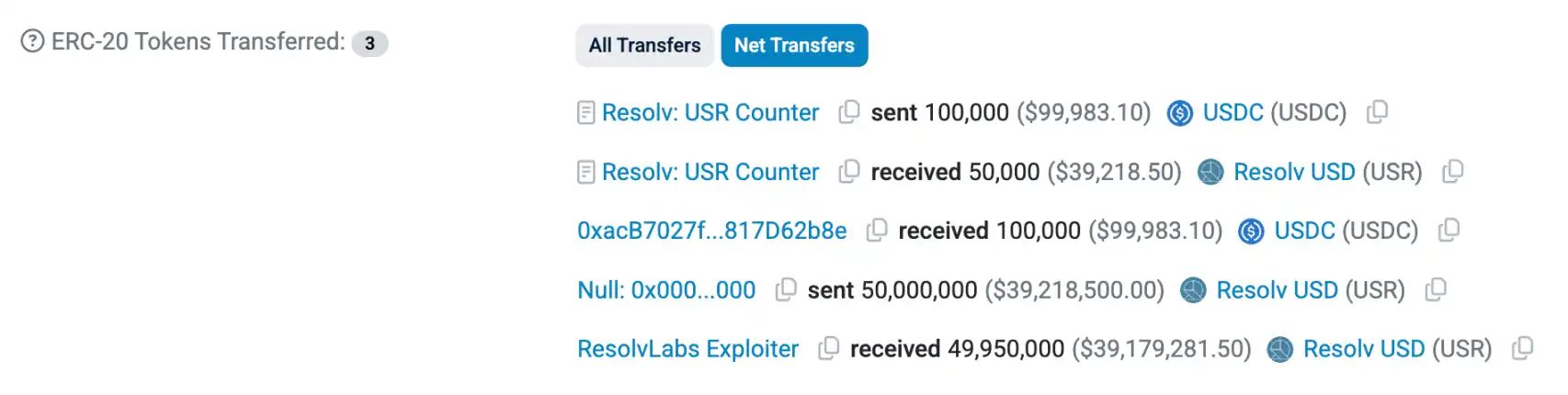
At approximately 10:21 Beijing time today, Resolv Labs, which issues the stablecoin USR using a Delta neutral strategy, was hacked. An address starting with 0x04A2 used 100,000 USDC to mint 50 million USR from the Resolv Labs protocol.
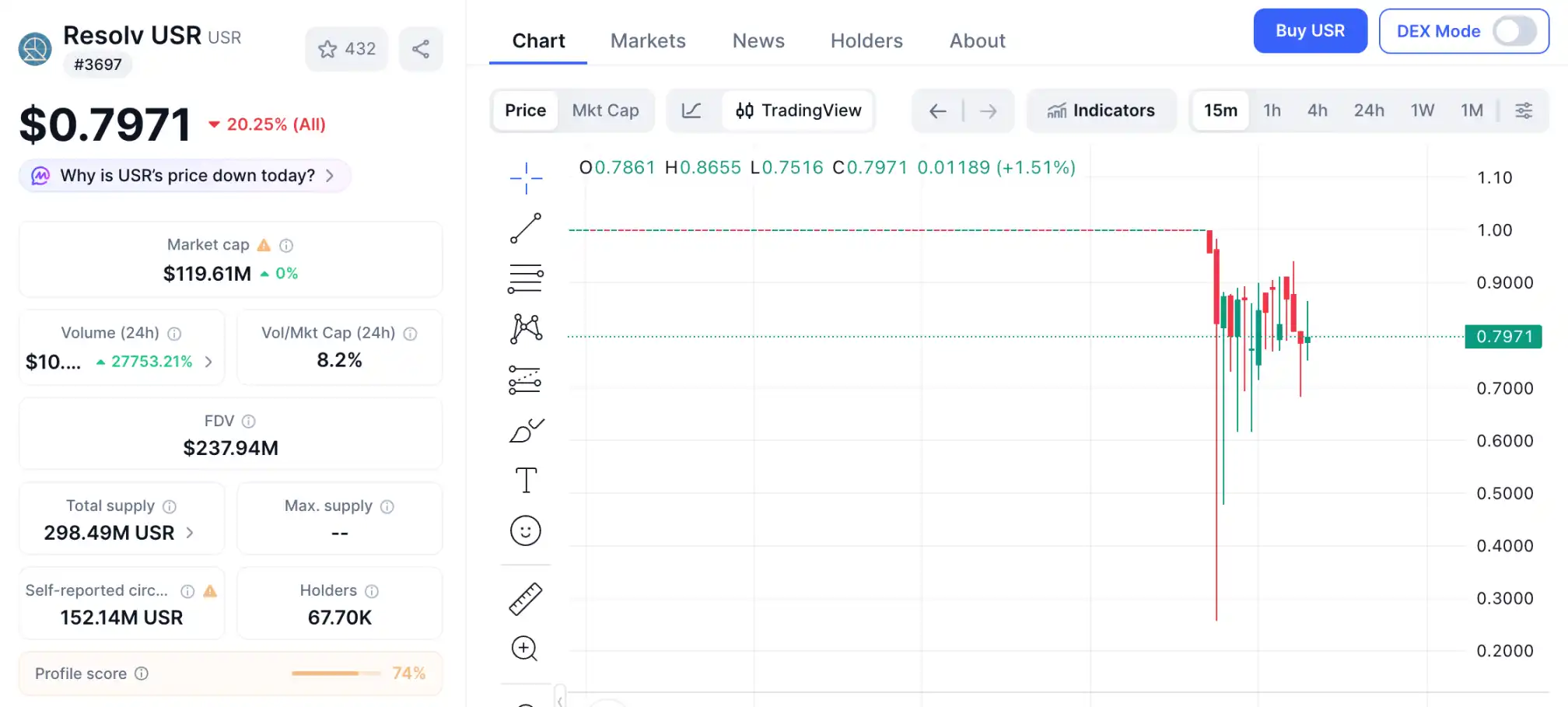
As the incident was exposed, USR plummeted to around $0.25, and as of writing, it has recovered to approximately $0.80. The price of the RESOLV token also saw a short-term drop of nearly 10%.
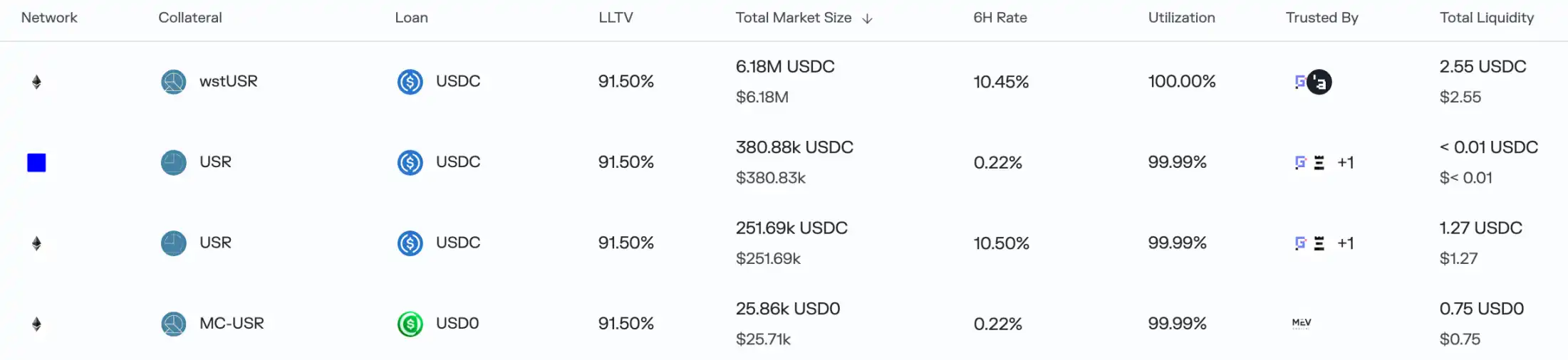
Subsequently, the hacker repeated the same method, using another 100,000 USDC to mint 30 million USR. As USR significantly depegged, arbitrage traders quickly took action. Many lending markets on Morpho that supported USR, wstUSR, and others as collateral were almost drained, and Lista DAO on BNB Chain also suspended new borrowing requests.
The impact was not limited to these lending protocols. In the Resolv Labs protocol design, users can also mint an RLP token, which has greater price volatility and higher returns but requires bearing compensation liability when the protocol incurs losses. Currently, the circulating supply of RLP tokens is nearly 30 million, with the largest holder, Stream Finance, holding over 13 million RLP, representing a net risk exposure of approximately $17 million.

Yes, Stream Finance, which was previously hit by the xUSD incident, may be hit again.

As of writing, the hacker has converted USR into USDC and USDT and continues to buy Ethereum, having purchased over 10,000 ETH so far. Using 200,000 USDC, the hacker extracted over $20 million in assets, finding their "hundred-fold coin" during the bear market.

Another Exploit Due to "Lack of Rigor"

The sharp drop on October 11 last year caused collateral losses for many stablecoins issued using Delta neutral strategies due to ADL (Auto-Deleveraging). Projects using altcoins as assets for strategy execution suffered even more severe losses, with some even directly absconding.

The attacked Resolv Labs also uses a similar mechanism to issue USR. The project announced in April 2025 that it had completed a $10 million seed round led by Cyber.Fund and Maven11, with participation from Coinbase Ventures, and launched the RESOLV token at the end of May/early June.

However, the reason for the attack on Resolv Labs was not extreme market conditions but rather a "lack of rigor" in the design of the USR minting mechanism.

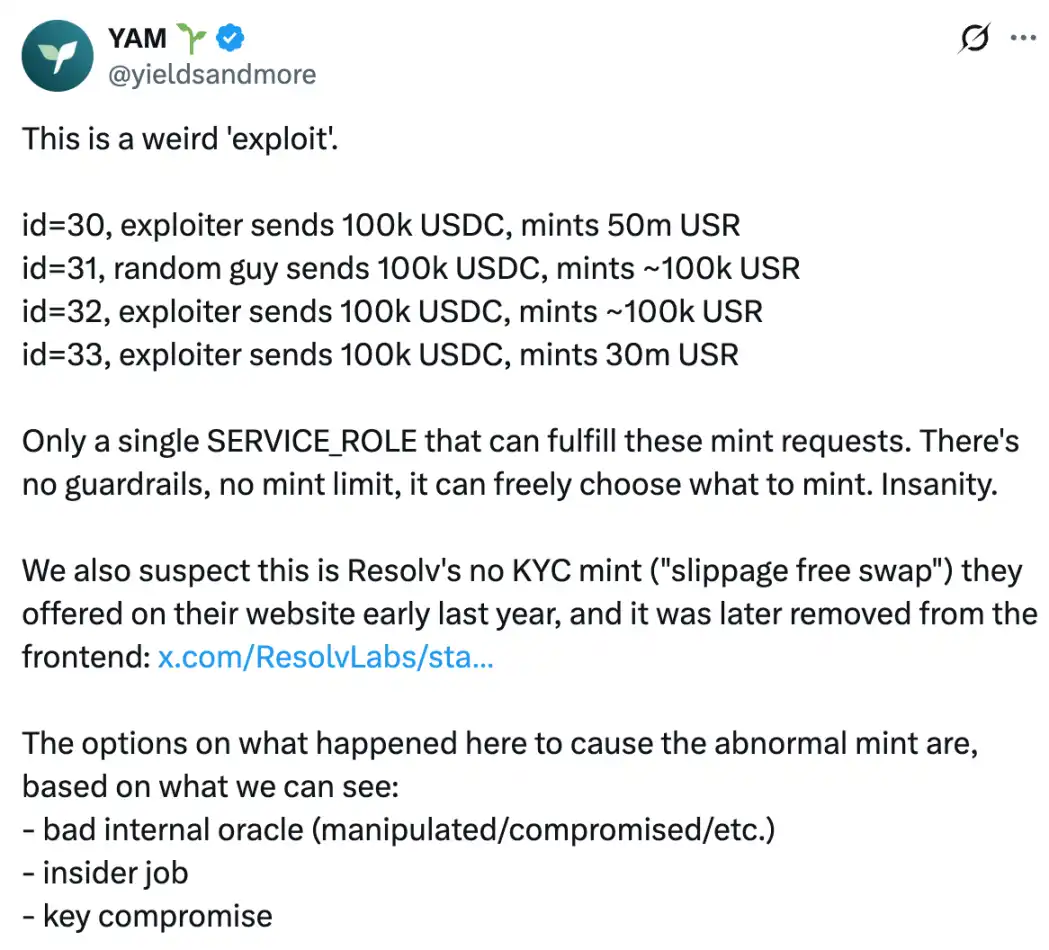
No security firm or official has yet analyzed the cause of this hack. The DeFi community YAM preliminarily concluded through analysis that the attack was likely caused by the SERVICE_ROLE, used by the protocol's backend to provide parameters to the minting contract, being compromised by the hacker.
According to Grok's analysis, when a user mints USR, they initiate a request on-chain and call the contract's requestMint function, with parameters including:

_depositTokenAddress: the address of the deposited token;

_amount: the amount deposited;

_minMintAmount: the minimum expected amount of USR to receive (slippage protection).

Subsequently, the user deposits USDC or USDT into the contract. The project's backend SERVICE_ROLE monitors the request, uses the Pyth oracle to check the value of the deposited assets, and then calls the completeMint or completeSwap function to determine the actual amount of USR to mint.

The problem lies in the fact that the minting contract fully trusts the _mintAmount provided by the SERVICE_ROLE, assuming this number was verified off-chain by Pyth. Therefore, it did not set an upper limit restriction, nor did it perform on-chain oracle verification, and directly executed mint(_mintAmount).

Based on this, YAM suspects that the hacker gained control of the SERVICE_ROLE, which should have been controlled by the project team (possibly due to internal oracle failure, insider theft, or key compromise), and directly set the _mintAmount to 50 million during the minting process, achieving the attack of minting 50 million USR with 100,000 USDC.

In conclusion, Grok's assessment is that Resolv did not consider the possibility that the address (or contract) receiving user minting requests could be compromised by hackers when designing the protocol. When the USR minting request was submitted to the final USR minting contract, no maximum minting amount was set, nor did the minting contract perform secondary verification using an on-chain oracle; it simply trusted all parameters provided by the SERVICE_ROLE.

Inadequate Prevention

In addition to speculating on the cause of the hack, YAM also pointed out the project's lack of preparedness in crisis response.

YAM stated on X that Resolv Labs only paused the protocol 3 hours after the hacker's first attack was completed, with about 1 hour of delay coming from collecting the 4 signatures required for the multisig transaction. YAM believes that an emergency pause should require only one signature, and the authority should be assigned to team members as much as possible, or to trusted external operators, to increase attention to on-chain anomalies, improve the possibility of quick pauses, and better cover different time zones.

Although the suggestion of requiring only a single signature to pause the protocol is somewhat radical,确实 requiring multiple signatures across different time zones to pause the protocol can indeed cause significant delays when emergencies occur. Introducing trusted third parties who continuously monitor on-chain behavior, or using monitoring tools with emergency protocol pause permissions, are lessons learned from this incident.

Hacker attacks on DeFi protocols have long gone beyond contract vulnerabilities. The Resolv Labs incident serves as a warning to project teams: the assumption in protocol security should be to trust no single link; all parameter-related links must undergo at least secondary verification, even if it's the project's own operational backend.


Пов'язані питання

QWhat was the main reason behind the Resolv Labs hack according to the DeFi community YAM's analysis?

AThe hack was likely due to the SERVICE_ROLE, which provides parameters to the minting contract, being controlled by the hacker. The minting contract fully trusted the _mintAmount parameter provided by SERVICE_ROLE without setting a maximum limit or performing a secondary on-chain oracle verification.

QHow much initial capital did the hacker use, and what was the approximate value of the assets they obtained?

AThe hacker used 200,000 USDC to mint a large amount of USR and subsequently obtained assets worth over 20 million US dollars.

QWhich protocols or platforms were affected beyond Resolv Labs itself due to this attack?

AMorpho's lending markets that accepted USR and wstUSR as collateral were almost drained, and Lista DAO on BNB Chain paused new borrowing requests. Additionally, RLP token holders, like Stream Finance, faced significant risk exposure.

QWhat specific flaw in the protocol's design allowed the hacker to mint an excessive amount of USR?

AThe protocol's design did not consider the possibility that the address (or contract) receiving user minting requests could be compromised. The minting contract lacked a maximum mint amount limit and did not use an on-chain oracle for secondary verification, blindly trusting all parameters from the SERVICE_ROLE.

QWhat criticism did YAM level against Resolv Labs' emergency response measures?

AYAM criticized that it took Resolv Labs 3 hours to pause the protocol after the first attack, with about an hour of that delay attributed to collecting 4 signatures required for the multisig transaction. They suggested emergency pauses should require only one signature and be assigned to team members or trusted external operators for faster response.

Пов'язані матеріали

Agent Race Ends, Super Workbench Takes Over

The era of fragmented AI agents is ending. Over the past month, China's tech giants—Tencent, Alibaba, and ByteDance—have simultaneously shifted strategy: instead of launching new, standalone AI agents, they are consolidating their various agent projects into unified "super workbenches." Tencent integrated its QClaw teams into WorkBuddy, a strategic product hailed as a potential third flagship after QQ and WeChat. Alibaba is merging its QoderWork, Wukong, and MuleRun agents into a new "Qianwen Office" platform under DingTalk's leadership. ByteDance rebranded its TRAE SOLO coding agent to TRAE Work, signaling a broader focus on workflow collaboration. This convergence marks a pivotal industry consensus. The initial exploration phase, where companies rapidly built numerous overlapping agents for different scenarios, proved costly and inefficient. With open-source tools eroding technical barriers, competition has shifted from agent creation to resource consolidation and cost control. Historically, platform wars are won not by creating more products, but by simplifying them—as seen with browsers unifying web access and super-apps consolidating services. Now, the "super workbench" aims to become the unified AI entry point for work. This reflects a deeper market realization: the primary audience for AI is no longer just programmers (a market in the tens of millions) but all knowledge workers (a market of billions). The real opportunity lies in augmenting everyday tasks—managing emails, documents, data, and meetings—across the entire workday. The core battleground is becoming control over the primary AI entry point that employees use daily. Tencent's WorkBuddy leverages WeChat and Tencent Docs; Alibaba's Qianwen Office taps into DingTalk's organizational data; ByteDance's TRAE Work integrates with Feishu's workflows. Whoever owns this "super workbench" gains strategic control over orchestrating enterprise data and APIs. This shift is redefining enterprise software. Traditional SaaS applications, valued for their user interfaces, will recede into the background. Their core functionalities will be exposed as standardized "Skills" or APIs for the super workbench's agents to invoke. Software value will shift from selling user seats to charging based on API calls and outcomes delivered. The evolution of agents is moving through clear stages: first as novel standalone products, then as consolidated primary work entry points, and finally as pervasive, invisible capabilities embedded into the digital fabric. The recent moves by major tech firms signal the transition from the first stage into the second, accelerating toward the third. In the end, the most successful agent technology may become invisible—like electricity or the HTTP protocol—a fundamental, unnamed infrastructure powering work itself.

marsbit9 хв тому

Agent Race Ends, Super Workbench Takes Over

marsbit9 хв тому

Michael Saylor: 110 Reasons to Oppose BIP-110

Michael Saylor presents 110 arguments against Bitcoin Improvement Proposal (BIP) 110, a soft fork aimed at restricting certain non-monetary data storage uses (like inscriptions) on the Bitcoin blockchain. He acknowledges the proponents' valid concerns—such as node costs, fee pressure, and preserving Bitcoin's monetary focus—but fundamentally disagrees with the proposed solution. Saylor argues that BIP 110 represents a dangerous precedent of using consensus rules to enforce value judgments on transaction validity, moving away from Bitcoin's core principles of neutrality and permissionless innovation. His key objections are organized into eleven categories: 1) It violates neutrality and hard consensus by banning currently valid transactions. 2) It fails to meet the high burden of proof required for a consensus change, lacking concrete data on the alleged crisis. 3) Its seven bundled technical restrictions are overly broad, targeting generic script functionalities and blocking future upgrade paths. 4) It sacrifices compatibility and future optionality by closing off designed upgrade hooks. 5) Its temporary rules add significant complexity (grandfathering, expiry states) without sufficient justification. 6) The economic and security impacts, particularly on miner revenue and fee markets, are uncertain and unmodeled. 7) Superior, market-based tools (fee markets, relay/mining policies) already exist to manage blockchain load. 8) It stifles innovation by creating a chilling effect for developers. 9) Its modified activation mechanism (55% threshold, forced signaling) is aggressive and risks network splits. 10) The precedent it sets—using consensus to suppress disliked but legal uses—is more dangerous than the problem it aims to solve. 11) A better path exists: improving measurements, refining resource-based policies, and allowing market forces to work. Saylor concludes that Bitcoin's strength lies in its neutral rules, open markets, and hard consensus. Changing these foundational elements to target specific use cases is an unnecessary and risky "iatrogenic" intervention. He advocates for guarding Bitcoin's neutrality rather than acting as its redeemer.

marsbit25 хв тому

Michael Saylor: 110 Reasons to Oppose BIP-110

marsbit25 хв тому

Торгівля

Спот
活动图片




