Tsinghua '00s Alumnus Wang Guan's New Work: Disrupting Transformer Pretraining Models with 1/900 Tokens, 1/432 Compute Power

marsbitОпубліковано о 2026-05-26Востаннє оновлено о 2026-05-26

Анотація

Tsinghua alumnus Wang Guan's team proposes HRM-Text, a novel pre-training paradigm using a Hierarchical Recurrent Model to replace standard Transformers. With just 1B parameters and 40B unique tokens trained at a cost of ~$1500, HRM-Text achieves performance comparable to 2B-7B open-source models, using up to 900x fewer tokens and 432x less estimated compute. Key innovations include a dual-timescale recurrent architecture for greater effective depth, a task-completion objective training only on answer tokens with PrefixLM masking, and techniques like MagicNorm and Warmup Deep Credit Assignment for stability. Evaluations show strong results on benchmarks like MMLU (60.7%) and GSM8K (84.5%). The work highlights how architectural priors and targeted objectives can lower pre-training barriers, though limitations include knowledge-reasoning coupling, fixed compute per token, and scalability beyond 3B parameters.

Breaking the traditional paradigm of large model pretraining, Tsinghua '00s alumnus Wang Guan's team has released a new work:

They used a Hierarchical Recurrent Model (HRM) to replace the standard Transformer, proposing HRM-Text, an efficient pretraining method that goes beyond Scaling.
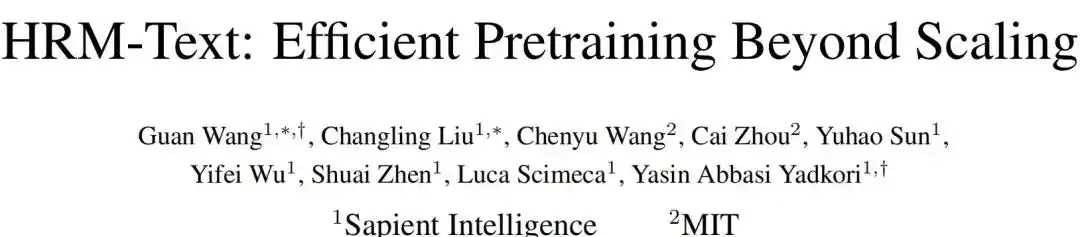
Paper link: https://arxiv.org/abs/2605.20613

While using approximately 100-900x fewer training tokens and 96-432x less estimated compute compared to the standard baseline model, HRM-Text still achieved performance comparable to open-source models with 2B to 7B parameters.

Furthermore, using 1B parameters, 40B non-repeating tokens, and a training cost of about $1500, HRM-Text achieved the following scores on mainstream benchmarks: MMLU 60.7%, ARC-C 81.9%, DROP 82.2%, GSM8K 84.5%, MATH 56.2%.
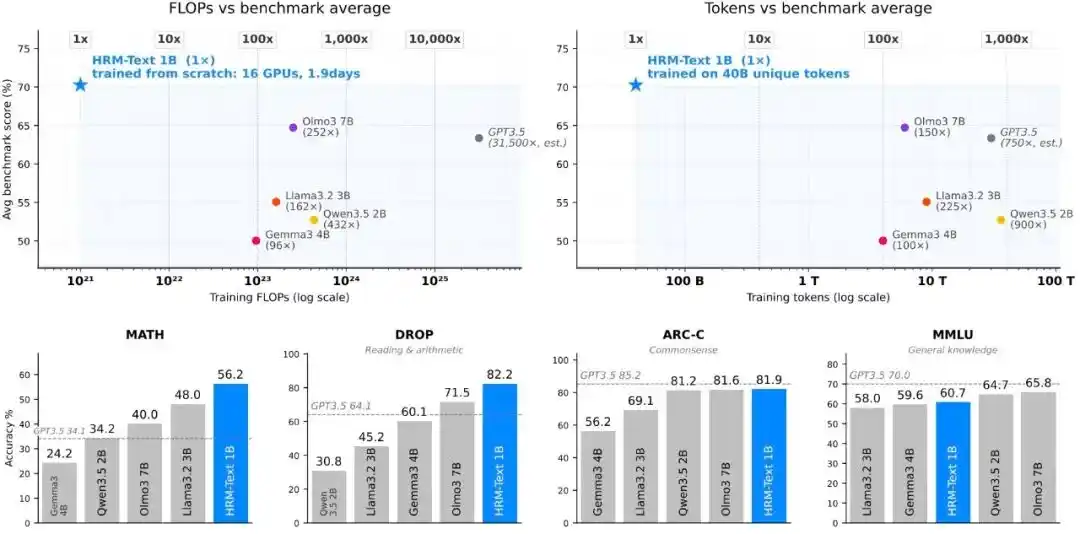
Figure|Pretraining efficiency.

Based on this, they clearly propose: Structural priors and targeted training objectives can significantly lower the barrier to pretraining. This training approach makes training a foundational model from scratch feasible.

How is HRM-Text designed?

Large Language Model (LLM) pretraining is increasingly reliant on a few institutions with ample computing and data resources. Training a competitive foundational model often requires trillions of tokens, thousands of GPUs, and even tens of millions of dollars in compute investment.

However, the current training paradigm is inefficient. A large amount of computation is consumed on irrelevant tokens such as prompts, formatting padding, and web noise, resulting in a significant portion of training compute not directly serving inference.

In this work, the research team redesigned the architecture and training objective, making the pretraining of HRM-Text relatively more efficient.

Architecture: Employs a Hierarchical Recurrent Model with dual timescales, splitting computation into a slow H module and a fast L module. While a standard Transformer performs one forward pass per token, HRM performs multiple rounds of recursive updates on the same token. The H and L modules each account for only half of the recursive core parameters. The overall computational load is roughly equivalent to performing 4 recursive unrolls on the same set of parameters, increasing computational depth without adding more parameters.

Training Objective: Abandons the standard full-text autoregressive pretraining. Instead, training is performed directly on instruction-answer pairs, with loss calculated only on the answer part, combined with PrefixLM masking, allowing bidirectional attention on the instruction part and causal masked generation for the answer part.
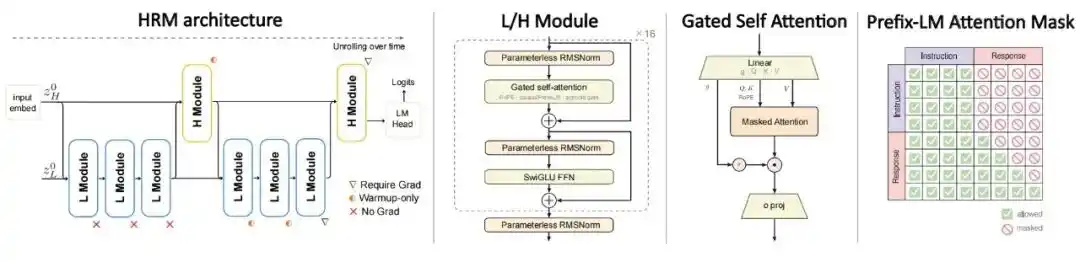
Figure|HRM-Text architecture.

To enhance the stability of recursive training, the research team introduced MagicNorm and Warmup Deep Credit Assignment.

MagicNorm is a hybrid normalization strategy that leverages the asymmetry between forward and backward computation depths under Truncated Backpropagation Through Time (Truncated BPTT). It uses PreNorm internally within modules and adds an extra normalization layer at the module exit, thereby improving the stability of deep recursive training.

Warmup Deep Credit Assignment, on the other hand, only backpropagates gradients from the last 2 recursive steps during the initial training phase, then linearly extends to the last 5 steps. This training mechanism allows the model to converge stably on shorter credit assignment paths before gradually introducing longer dependencies.

How effective is it?

Experimental results show that HRM-Text demonstrates clear advantages in architecture efficiency, training objectives, and overall performance.

1. Under fixed training compute, is the recurrent architecture more effective?

Results show that under FLOPs-aligned conditions, HRM 1B outperforms Transformer 1B, Transformer 3B, Looped Transformer 1B, and RINS 1B on most benchmarks; comparison with TRM also indicates that HRM training is more stable.
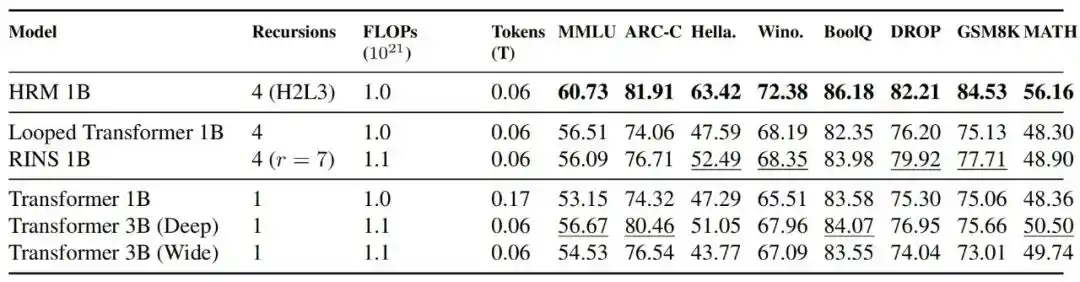
Figure|Comparison of performance and stability with Transformer models. HRM maintained stable training dynamics across all scales, while Transformer models exhibited severe instability at the 1-billion-parameter scale. Furthermore, at the 0.6B scale, HRM achieved competitive performance on most benchmarks using only 2x less computation than Transformer models.

2. Does the task completion objective and PrefixLM help?

Ablation studies show that under FLOPs-aligned conditions, the MMLU score for a 1B Transformer increased from 40.55 with standard autoregressive training, to 47.72 after introducing the task completion objective, to 53.15 after adding PrefixLM, and finally to 60.73 after switching to the HRM architecture.
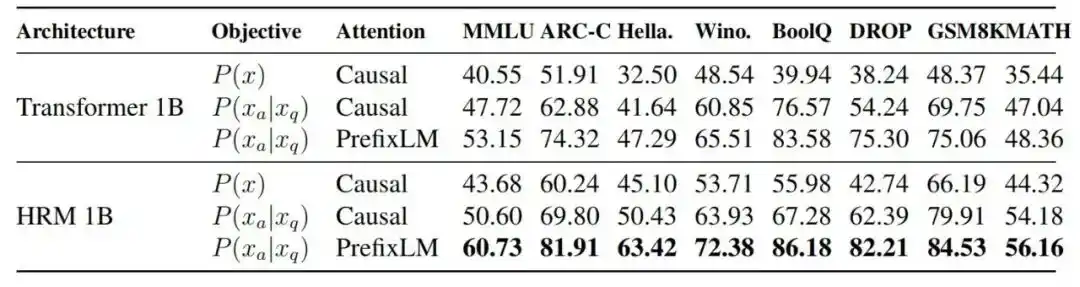
Figure|Performance comparison between different model architectures and training objectives

3. How does HRM-Text's efficiency compare to contemporary open models?

HRM-Text 1B achieved scores of 60.7, 81.9, 82.2, 84.5, and 56.2 on MMLU, ARC-C, DROP, GSM8K, and MATH respectively. Compared to open models that generally have larger training budgets, it entered the performance range of 2B to 7B open-source models using only 40B unique tokens and 1B parameters; training required up to 900x fewer tokens and up to 432x less compute.
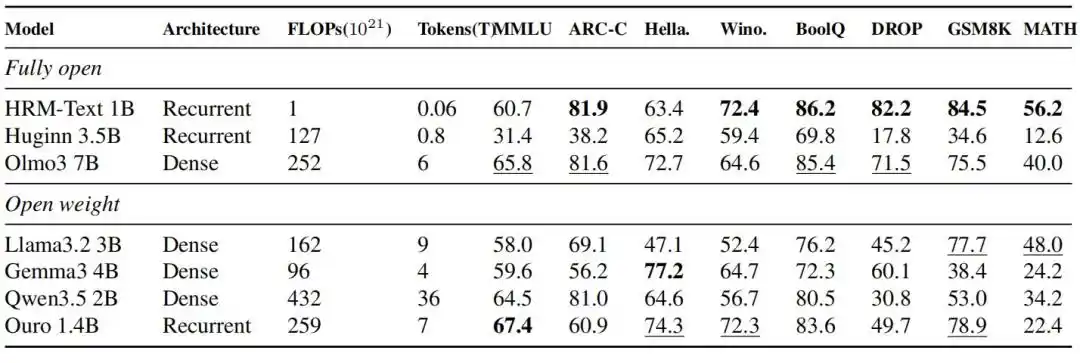
Figure|Evaluation results of HRM-Text 1B compared with contemporary fully open-source models and open-weight models

4. Does the recurrent structure bring greater effective depth?

Results show that the standard Transformer and Looped Transformer stabilize at shallower depths, while HRM maintains more pronounced inter-block representation changes, lower cosine similarity, and higher logit lens KL values even at deeper layers.
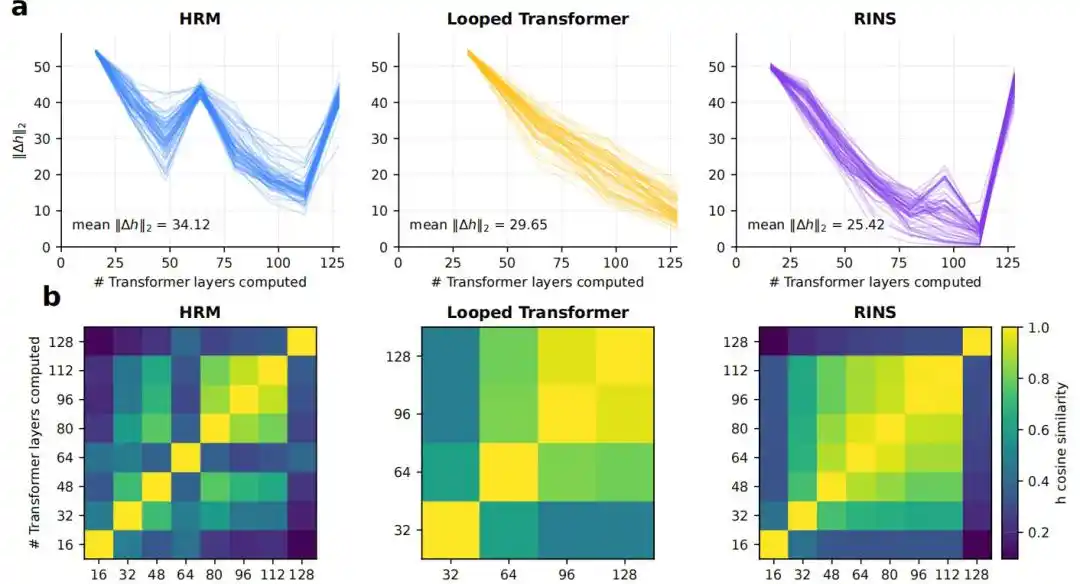
Figure|Effective depth analysis.
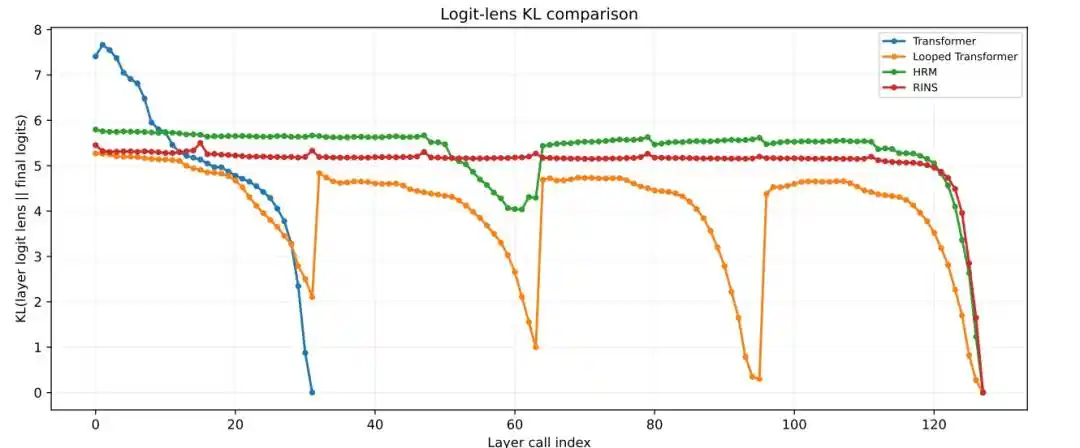
Figure|Layer-wise Logit Lens KL analysis.

Limitations and Future Directions

Although HRM-Text demonstrates strong performance on inference-intensive tasks, this method still has limitations, and future research directions are proposed.

1. Towards Decoupling "Knowledge" and "Reasoning"

Currently, broader factual knowledge coverage still depends more on model scale and data breadth. HRM-Text was only trained on 40B unique tokens, and explicit knowledge sources constitute only part of the task-formatted mixed data. In the future, researchers need to design a compact reasoning core separately from external fact storage, delegating knowledge breadth to curated corpora, retrieval-augmented modules, or learnable memory.

2. Adaptive Computation Time

The recurrent scheduling of HRM-Text brings greater effective serial depth, but this also means the model must execute a fixed number of recursive steps during inference. A promising future direction is to introduce an adaptive computation time mechanism, allowing simple samples to stop computation earlier and reserving the full recursive budget for difficult samples, thereby reducing inference cost.

3. Current Scaling Validation Scope Remains Limited

The current scaling experiments only cover up to the 3B parameter Transformer control group and the 1B parameter HRM-Text. The research team states that it remains to be verified by subsequent work whether similar efficiency advantages can be maintained at larger model scales.

4. PrefixLM and Inference Frameworks

Currently, PrefixLM still faces certain engineering implementation constraints in practical deployment. Although it can run on standard text generation inference frameworks like vLLM, this requires the framework to support custom attention masks during the prefill stage. Extending it to multi-turn dialogue scenarios further requires designing a KV-cache mechanism that ensures bidirectional visibility within user segments while maintaining causal constraints for the assistant's generation process.

For more technical details, please refer to the original paper.

This article comes from the WeChat public account "Academic Headlines" (ID: SciTouTiao), author: Xia Qiansi


Пов'язані питання

QWhat is HRM-Text and how does it differ from the standard Transformer architecture for pre-training large language models?

AHRM-Text is an efficient pre-training model proposed by a Tsinghua University research team. It uses a Hierarchical Recurrent Model (HRM) instead of the standard Transformer. The key difference is that HRM employs a two-timescale hierarchical recurrence, where each token undergoes multiple recursive updates (via slow 'H' and fast 'L' modules), increasing computational depth without adding parameters. This contrasts with the Transformer's single forward pass per token.

QAccording to the article, what are the key efficiency claims of HRM-Text in terms of training tokens and computational cost?

AThe article claims HRM-Text achieves performance comparable to 2B to 7B parameter open-source models while using approximately 100-900 times fewer training tokens and 96-432 times less estimated computational power compared to standard baseline models. A specific example is a 1B parameter model trained on 40B unique tokens at a cost of around $1,500.

QWhat are the two main design choices in HRM-Text's training objective that contribute to its efficiency?

AThe two main design choices in the training objective are: 1) Training directly on instruction-answer pairs and computing the loss only on the answer part, rather than using standard full-sequence autoregressive pre-training. 2) Employing PrefixLM masking, which allows bidirectional attention on the instruction (prefix) part and causal masking for generating the answer.

QWhat techniques did the researchers introduce to improve the stability of deep recurrent training in HRM-Text?

ATo improve stability for deep recurrent training, the researchers introduced two techniques: 1) MagicNorm, a hybrid normalization strategy using PreNorm inside modules and an extra normalization at the module output, leveraging asymmetry in forward/backward depths under Truncated BPTT. 2) Warmup Deep Credit Assignment, which initially backpropagates gradients only from the last 2 recursion steps and linearly extends to the last 5 steps during training.

QWhat are some of the limitations and future research directions mentioned for HRM-Text?

AThe mentioned limitations and future directions include: 1) Decoupling 'knowledge' and 'reasoning', suggesting a need to combine the compact reasoning core with external factual storage (e.g., curated corpora, retrieval-augmented modules). 2) Exploring Adaptive Computation Time to reduce inference cost for easier samples. 3) Validating the efficiency advantage at larger model scales beyond the current 3B/1B experiments. 4) Addressing engineering challenges for deploying PrefixLM in multi-turn dialogue, such as designing a suitable KV-cache mechanism.

Пов'язані матеріали

BTC Thrice Rejected at $80,000 Threshold, HYPE Reaches New Highs Signaling Opportunity | Guest Analysis

**Bitcoin (BTC) Struggles at $80k; HYPE Reaches New Highs | Key Analysis & Strategy** Bitcoin faces continued resistance in the $78.5k - $79.5k zone after failing to sustain a break above its daily chart rising channel. It has retreated to the channel's midline. A failure to hold here could see a test of the $73.5k - $75k support area. The 4-hour chart shows a complex corrective structure. The strategy is neutral for mid-term positions. For short-term trading, two scenarios are outlined: **A)** Selling on a failed rally into the $78.5k-$79.5k resistance, and **B)** Selling on a confirmed breakdown below the $73.5k-$75k support, both with tight risk management. Meanwhile, **HYPE** has posted consecutive highs. The 4-hour chart indicates its current uptrend may be weakening near $65, with models showing potential bearish divergence. The view is that a short-term top could be forming. The strategy advises against chasing the rally and instead looking for a potential long entry on a pullback to the $47.5 - $50 support zone, provided clear reversal signals appear. Last week, a disciplined short BTC trade based on model signals yielded a 2.78% profit. The article emphasizes that all analysis is for informational purposes only and not investment advice, highlighting the importance of strict stop-loss discipline and dynamic position management in a volatile market. *(Note: The text references proprietary models like the "Price Difference Trading Model" and "Momentum Quantification Model" for generating trade signals.)*

marsbit51 хв тому

BTC Thrice Rejected at $80,000 Threshold, HYPE Reaches New Highs Signaling Opportunity | Guest Analysis

marsbit51 хв тому

Tether's New Business: Helping Small Countries Issue Stablecoins

Tether has announced a partnership with the Georgian government to issue GEL₮, a Lari-pegged stablecoin, aiming to reduce costs, accelerate settlements, and promote cross-border payments. This move is part of Tether's broader strategy to establish a replicable, standardized business of issuing sovereign currency-backed stablecoins for smaller nations, alongside its flagship USDT and other regional offerings like MXNT (Mexican Peso) and CNHT (Offshore Yuan). Georgia represents an ideal test case due to its high reliance on remittances (~15% of GDP), established digital asset regulatory framework aligned with U.S. standards, and prior engagement with Tether. The country gains accelerated internationalization of its currency by accessing Tether's global distribution network and liquidity pools, where GEL₮ can be swapped directly with assets like USDT. For Tether, the immediate financial gain from Georgia's small market is minimal. The true value lies in creating a template. Successfully navigating the compliance, reserve, and redemption processes for GEL₮ allows Tether to replicate this model swiftly for other nations with similar profiles, such as Azerbaijan or Nigeria. The deeper strategy involves subtly integrating these national currencies into an informal USDT-anchored dollar system, positioning Tether as the essential routing infrastructure. This partnership highlights a potential new model: the outsourcing of sovereign currency globalization to private stablecoin issuers. It offers smaller states a faster path to digital currency integration than developing a Central Bank Digital Currency (CBDC). However, it raises significant questions about monetary sovereignty, financial stability risks, and increased dependency on a private entity. If more countries adopt this model in the coming year, Tether could evolve from a stablecoin issuer into a unique, cross-sovereign financial infrastructure service provider.

marsbit55 хв тому

Tether's New Business: Helping Small Countries Issue Stablecoins

marsbit55 хв тому

Notion CEO: AI companies should be a 'Jazz Band,' and I am a 'Refounder'

Notion CEO Ivan Zhao, in a recent podcast, shared his journey of twice rebuilding the company from near-collapse and now applying the same "Refounder" mindset to reshape the 1000-person organization in the AI era. He argues that AI has commoditized technical capability (Capability). True talent now hinges on Taste (judgment/values) and Agency (proactive drive), necessitating a shift in hiring—e.g., hiring more juniors for curiosity and having sales candidates demonstrate work upfront. Zhao envisions the company as a "Jazz Band"—agile and improvisational—versus a rigid "Marching Band." This is reflected in an engineering "dumbbell" structure (super juniors + top-tier seniors, with middle layers compressed), dissolving the CMO role to let teams operate directly, and integrating entrepreneurs via acquisitions to lead their expertise areas. Notion has abandoned traditional long-term product roadmaps, planning only conservatively for finances while adopting a week-by-week, improvisational approach to product strategy, as longer plans proved futile during rapid AI shifts. He concludes that while human nature and roles remain constants, companies must rewrite their approaches to hiring (valuing Taste/Agency over Capability), organizational design (reducing roles focused on coordination/execution), and planning (embracing flexibility). Modern knowledge work, being only ~150 years old, is ripe for reinvention.

marsbit56 хв тому

Notion CEO: AI companies should be a 'Jazz Band,' and I am a 'Refounder'

marsbit56 хв тому

BTC Faces Triple Resistance at $80,000 Milestone, HYPE Hits New Highs Signaling Potential | Invited Analysis

This weekly analysis maintains a structured framework, focusing on Bitcoin (BTC) and HYPE, dissecting their multi-timeframe price action to identify key support and resistance zones and formulate actionable trading plans. The previous week's short position on BTC yielded a 2.78% gain, reinforcing the "signal-driven, disciplined" approach. For Bitcoin, the core scenario revolves around the battle between the 78,500–79,500 USD resistance zone and the 73,500–75,000 USD support area. The daily chart shows BTC within a rising channel; a failure to hold support at the channel's midline could lead to a test of the lower boundary. The 4-hour chart details an 8-segment corrective structure from the 82,850 USD high. Two short-term strategies are proposed: (A) Selling on a failed rally into the 78.5k-79.5k zone, with a stop above 80,600, or (B) Selling a confirmed breakdown below the 73.5k-75k support, with a stop above 76,500. Medium-term positioning remains neutral. For HYPE, the 4-hour chart indicates a five-wave advance from the May 14th low, now showing potential exhaustion and a top warning signal near 65 USD. The core view is to watch for a potential short-term peak formation. The recommended strategy is to avoid chasing the rally and instead look for a long setup upon a pullback to the 47.5–50 USD support zone, provided clear stabilization and model confirmation signals appear. The report concludes with a detailed review of the prior BTC short trade, executed based on model signals and candlestick patterns, and reiterates strict risk management rules, including immediate stop-loss placement and trailing stops to protect profits. All analysis is presented as a personal trading log, not investment advice.

Odaily星球日报1 год тому

BTC Faces Triple Resistance at $80,000 Milestone, HYPE Hits New Highs Signaling Potential | Invited Analysis

Odaily星球日报1 год тому

Торгівля

Спот
Ф'ючерси

Популярні статті

Що таке $S$

Розуміння SPERO: Комплексний огляд Вступ до SPERO Оскільки ландшафт інновацій продовжує еволюціонувати, виникнення технологій web3 та криптовалютних проектів відіграє ключову роль у формуванні цифрового майбутнього. Один з проектів, який привернув увагу в цій динамічній сфері, — це SPERO, позначений як SPERO,$$s$. Ця стаття має на меті зібрати та представити детальну інформацію про SPERO, щоб допомогти ентузіастам та інвесторам зрозуміти його основи, цілі та інновації в рамках web3 та крипто-сектору. Що таке SPERO,$$s$? SPERO,$$s$ — це унікальний проект у криптопросторі, який прагне використати принципи децентралізації та технології блокчейн для створення екосистеми, що сприяє залученню, корисності та фінансовій інклюзії. Проект розроблений для полегшення взаємодії між користувачами новими способами, надаючи їм інноваційні фінансові рішення та послуги. У своїй основі SPERO,$$s$ прагне надати можливості індивідам, забезпечуючи інструменти та платформи, які покращують користувацький досвід у криптовалютному просторі. Це включає в себе можливість більш гнучких методів транзакцій, сприяння ініціативам, що підтримуються спільнотою, та створення шляхів для фінансових можливостей через децентралізовані додатки (dApps). Основна концепція SPERO,$$s$ обертається навколо інклюзивності, прагнучи зменшити розриви в традиційній фінансовій системі, використовуючи переваги технології блокчейн. Хто є творцем SPERO,$$s$? Особистість творця SPERO,$$s$ залишається дещо невідомою, оскільки є обмежені публічно доступні ресурси, що надають детальну інформацію про його засновників. Ця відсутність прозорості може бути наслідком зобов'язання проекту до децентралізації — етики, яку багато проектів web3 поділяють, ставлячи колективні внески вище за індивідуальне визнання. Зосереджуючи обговорення навколо спільноти та її колективних цілей, SPERO,$$s$ втілює суть наділення без виділення конкретних осіб. Таким чином, розуміння етики та місії SPERO є більш важливим, ніж ідентифікація єдиного творця. Хто є інвесторами SPERO,$$s$? SPERO,$$s$ підтримується різноманітними інвесторами, починаючи від венчурних капіталістів до ангельських інвесторів, які прагнуть сприяти інноваціям у крипто-секторі. Зосередження цих інвесторів зазвичай узгоджується з місією SPERO — пріоритет надається проектам, які обіцяють технологічний прогрес у суспільстві, фінансову інклюзію та децентралізоване управління. Ці інвесторські фонди зазвичай зацікавлені в проектах, які не лише пропонують інноваційні продукти, але й позитивно впливають на спільноту блокчейн та її екосистеми. Підтримка з боку цих інвесторів підкріплює SPERO,$$s$ як значного конкурента в швидко змінюваній сфері крипто-проектів. Як працює SPERO,$$s$? SPERO,$$s$ використовує багатогранну структуру, яка відрізняє його від традиційних криптовалютних проектів. Ось деякі ключові особливості, які підкреслюють його унікальність та інноваційність: Децентралізоване управління: SPERO,$$s$ інтегрує моделі децентралізованого управління, надаючи користувачам можливість активно брати участь у процесах прийняття рішень щодо майбутнього проекту. Цей підхід сприяє відчуттю власності та відповідальності серед членів спільноти. Корисність токена: SPERO,$$s$ використовує свій власний криптовалютний токен, розроблений для виконання різних функцій в екосистемі. Ці токени дозволяють здійснювати транзакції, отримувати винагороди та полегшувати послуги, що пропонуються на платформі, підвищуючи загальну залученість та корисність. Шарова архітектура: Технічна архітектура SPERO,$$s$ підтримує модульність та масштабованість, що дозволяє безперешкодно інтегрувати додаткові функції та додатки в міру розвитку проекту. Ця адаптивність є надзвичайно важливою для збереження актуальності в постійно змінюваному крипто-ландшафті. Залучення спільноти: Проект підкреслює ініціативи, що підтримуються спільнотою, використовуючи механізми, які стимулюють співпрацю та зворотний зв'язок. Підтримуючи сильну спільноту, SPERO,$$s$ може краще задовольняти потреби користувачів та адаптуватися до ринкових тенденцій. Фокус на інклюзію: Пропонуючи низькі комісії за транзакції та зручні інтерфейси, SPERO,$$s$ прагне залучити різноманітну базу користувачів, включаючи осіб, які раніше не брали участі в крипто-просторі. Це зобов'язання до інклюзії узгоджується з його загальною місією наділення через доступність. Хронологія SPERO,$$s$ Розуміння історії проекту надає важливі уявлення про його розвиток та етапи. Нижче наведено пропоновану хронологію, що відображає значні події в еволюції SPERO,$$s$: Етап концептуалізації та ідеації: Початкові ідеї, що стали основою SPERO,$$s$, були сформовані, тісно пов'язані з принципами децентралізації та фокусом на спільноті в індустрії блокчейн. Запуск білого паперу проекту: Після концептуального етапу був випущений комплексний білий папір, що детально описує бачення, цілі та технологічну інфраструктуру SPERO,$$s$, щоб залучити інтерес та зворотний зв'язок від спільноти. Створення спільноти та ранні залучення: Активні зусилля були спрямовані на створення спільноти ранніх прихильників та потенційних інвесторів, що полегшило обговорення цілей проекту та отримання підтримки. Подія генерації токенів: SPERO,$$s$ провів подію генерації токенів (TGE) для розподілу своїх рідних токенів серед ранніх прихильників та встановлення початкової ліквідності в екосистемі. Запуск початкового dApp: Перший децентралізований додаток (dApp), пов'язаний з SPERO,$$s$, став доступним, дозволяючи користувачам взаємодіяти з основними функціями платформи. Постійний розвиток та партнерства: Безперервні оновлення та вдосконалення пропозицій проекту, включаючи стратегічні партнерства з іншими учасниками блокчейн-простору, сформували SPERO,$$s$ у конкурентоспроможного та еволюціонуючого гравця на крипто-ринку. Висновок SPERO,$$s$ є свідченням потенціалу web3 та криптовалют для революціонізації фінансових систем та наділення індивідів. Завдяки зобов'язанню до децентралізованого управління, залучення спільноти та інноваційно спроектованих функцій, він прокладає шлях до більш інклюзивного фінансового ландшафту. Як і з будь-якими інвестиціями в швидко змінюваному крипто-просторі, потенційним інвесторам та користувачам рекомендується ретельно досліджувати та обдумано взаємодіяти з поточними подіями в SPERO,$$s$. Проект демонструє інноваційний дух крипто-індустрії, запрошуючи до подальшого дослідження його численних можливостей. Хоча подорож SPERO,$$s$ ще триває, його основні принципи можуть справді вплинути на майбутнє того, як ми взаємодіємо з технологією, фінансами та один з одним у взаємопов'язаних цифрових екосистемах.

73 переглядів усьогоОпубліковано 2024.12.17Оновлено 2024.12.17

Що таке $S$

Що таке AGENT S

Агент S: Майбутнє автономної взаємодії в Web3 Вступ У постійно змінюваному ландшафті Web3 та криптовалюти інновації постійно переосмислюють, як люди взаємодіють з цифровими платформами. Один з таких новаторських проектів, Агент S, обіцяє революціонізувати взаємодію людини з комп'ютером через свою відкриту агентну структуру. Прокладаючи шлях для автономних взаємодій, Агент S прагне спростити складні завдання, пропонуючи трансформаційні застосування в штучному інтелекті (ШІ). Це детальне дослідження заглиблюється в складності проекту, його унікальні особливості та наслідки для сфери криптовалюти. Що таке Агент S? Агент S є революційною відкритою агентною структурою, спеціально розробленою для вирішення трьох основних викликів в автоматизації комп'ютерних завдань: Набуття специфічних знань у галузі: Структура інтелектуально навчається з різних зовнішніх джерел знань та внутрішнього досвіду. Цей подвійний підхід дозволяє їй створити багатий репозиторій специфічних знань у галузі, покращуючи її продуктивність у виконанні завдань. Планування на довгих горизонтах завдань: Агент S використовує планування з підкріпленням досвіду, стратегічний підхід, який полегшує ефективний розподіл та виконання складних завдань. Ця функція значно підвищує її здатність ефективно та результативно управляти кількома підзавданнями. Обробка динамічних, неоднорідних інтерфейсів: Проект представляє Інтерфейс Агент-Комп'ютер (ACI), інноваційне рішення, яке покращує взаємодію між агентами та користувачами. Використовуючи багатомодальні великі мовні моделі (MLLMs), Агент S може безперешкодно орієнтуватися та маніпулювати різноманітними графічними інтерфейсами користувача. Завдяки цим новаторським функціям Агент S надає надійну структуру, яка вирішує складнощі, пов'язані з автоматизацією людської взаємодії з машинами, прокладаючи шлях для численних застосувань у ШІ та за його межами. Хто є творцем Агент S? Хоча концепція Агент S є фундаментально новаторською, конкретна інформація про його творця залишається невідомою. Творець наразі невідомий, що підкреслює або початкову стадію проекту, або стратегічний вибір зберегти засновників у таємниці. Незважаючи на анонімність, акцент залишається на можливостях та потенціалі структури. Хто є інвесторами Агент S? Оскільки Агент S є відносно новим у криптографічній екосистемі, детальна інформація про його інвесторів та фінансових спонсорів не задокументована. Відсутність публічно доступних відомостей про інвестиційні фонди або організації, що підтримують проект, викликає питання щодо його фінансової структури та дорожньої карти розвитку. Розуміння підтримки є критично важливим для оцінки стійкості проекту та потенційного впливу на ринок. Як працює Агент S? В основі Агент S лежить передова технологія, яка дозволяє йому ефективно функціонувати в різних умовах. Його операційна модель побудована навколо кількох ключових функцій: Взаємодія з комп'ютером, подібна до людської: Структура пропонує розширене планування ШІ, прагнучи зробити взаємодії з комп'ютерами більш інтуїтивними. Імітуючи людську поведінку при виконанні завдань, вона обіцяє підвищити досвід користувачів. Наративна пам'ять: Використовується для використання високорівневого досвіду, Агент S використовує наративну пам'ять для відстеження історій завдань, тим самим покращуючи свої процеси прийняття рішень. Епізодична пам'ять: Ця функція надає користувачам покрокові інструкції, дозволяючи структурі пропонувати контекстуальну підтримку в міру виконання завдань. Підтримка OpenACI: Завдяки можливості працювати локально, Агент S дозволяє користувачам зберігати контроль над своїми взаємодіями та робочими процесами, узгоджуючи з децентралізованою етикою Web3. Легка інтеграція з зовнішніми API: Його універсальність і сумісність з різними платформами ШІ забезпечують те, що Агент S може безперешкодно вписатися в існуючі технологічні екосистеми, роблячи його привабливим вибором для розробників та організацій. Ці функціональні можливості колективно сприяють унікальному положенню Агент S у крипто-просторі, оскільки він автоматизує складні, багатоступеневі завдання з мінімальним втручанням людини. У міру розвитку проекту його потенційні застосування в Web3 можуть переосмислити, як відбуваються цифрові взаємодії. Хронологія Агент S Розробка та етапи Агент S можуть бути узагальнені в хронології, яка підкреслює його значні події: 27 вересня 2024 року: Концепція Агент S була представлена в комплексній науковій статті під назвою “Відкрита агентна структура, яка використовує комп'ютери як людина”, що демонструє основи проекту. 10 жовтня 2024 року: Наукова стаття була опублікована на arXiv, пропонуючи детальне дослідження структури та її оцінки продуктивності на основі бенчмарку OSWorld. 12 жовтня 2024 року: Було випущено відеопрезентацію, що надає візуальне уявлення про можливості та особливості Агент S, ще більше залучаючи потенційних користувачів та інвесторів. Ці маркери в хронології не лише ілюструють прогрес Агент S, але й вказують на його прихильність до прозорості та залучення громади. Ключові моменти про Агент S У міру розвитку структури Агент S кілька ключових характеристик виділяються, підкреслюючи її новаторський характер та потенціал: Інноваційна структура: Розроблена для забезпечення інтуїтивного використання комп'ютерів, подібного до людської взаємодії, Агент S пропонує новий підхід до автоматизації завдань. Автономна взаємодія: Здатність автономно взаємодіяти з комп'ютерами через GUI означає стрибок до більш інтелектуальних та ефективних обчислювальних рішень. Автоматизація складних завдань: Завдяки своїй надійній методології він може автоматизувати складні, багатоступеневі завдання, роблячи процеси швидшими та менш схильними до помилок. Безперервне вдосконалення: Механізми навчання дозволяють Агенту S покращуватися на основі минулого досвіду, постійно підвищуючи свою продуктивність та ефективність. Універсальність: Його адаптивність до різних операційних середовищ, таких як OSWorld та WindowsAgentArena, забезпечує його здатність служити широкому спектру застосувань. Оскільки Агент S займає своє місце в ландшафті Web3 та криптовалюти, його потенціал покращити можливості взаємодії та автоматизувати процеси означає значний прогрес у технологіях ШІ. Завдяки своїй інноваційній структурі Агент S є прикладом майбутнього цифрових взаємодій, обіцяючи більш безперешкодний та ефективний досвід для користувачів у різних галузях. Висновок Агент S представляє собою сміливий крок вперед у поєднанні ШІ та Web3, з можливістю переосмислити, як ми взаємодіємо з технологією. Хоча проект все ще на ранніх стадіях, можливості для його застосування є величезними та переконливими. Завдяки своїй комплексній структурі, що вирішує критичні виклики, Агент S прагне вивести автономні взаємодії на передній план цифрового досвіду. У міру того, як ми заглиблюємося в сфери криптовалюти та децентралізації, проекти, подібні до Агент S, безсумнівно, відіграватимуть ключову роль у формуванні майбутнього технологій та співпраці людини з комп'ютером.

657 переглядів усьогоОпубліковано 2025.01.14Оновлено 2025.01.14

Що таке AGENT S

Як купити S

Ласкаво просимо до HTX.com! Ми зробили покупку Sonic (S) простою та зручною. Дотримуйтесь нашої покрокової інструкції, щоб розпочати свою криптовалютну подорож.Крок 1: Створіть обліковий запис на HTXВикористовуйте свою електронну пошту або номер телефону, щоб зареєструвати обліковий запис на HTX безплатно. Пройдіть безпроблемну реєстрацію й отримайте доступ до всіх функцій.ЗареєструватисьКрок 2: Перейдіть до розділу Купити крипту і виберіть спосіб оплатиКредитна/дебетова картка: використовуйте вашу картку Visa або Mastercard, щоб миттєво купити Sonic (S).Баланс: використовуйте кошти з балансу вашого рахунку HTX для безперешкодної торгівлі.Треті особи: ми додали популярні способи оплати, такі як Google Pay та Apple Pay, щоб підвищити зручність.P2P: Торгуйте безпосередньо з іншими користувачами на HTX.Позабіржова торгівля (OTC): ми пропонуємо індивідуальні послуги та конкурентні обмінні курси для трейдерів.Крок 3: Зберігайте свої Sonic (S)Після придбання Sonic (S) збережіть його у своєму обліковому записі на HTX. Крім того, ви можете відправити його в інше місце за допомогою блокчейн-переказу або використовувати його для торгівлі іншими криптовалютами.Крок 4: Торгівля Sonic (S)Легко торгуйте Sonic (S) на спотовому ринку HTX. Просто увійдіть до свого облікового запису, виберіть торгову пару, укладайте угоди та спостерігайте за ними в режимі реального часу. Ми пропонуємо зручний досвід як для початківців, так і для досвідчених трейдерів.

1.5k переглядів усьогоОпубліковано 2025.01.15Оновлено 2025.03.21

Як купити S

Обговорення

Ласкаво просимо до спільноти HTX. Тут ви можете бути в курсі останніх подій розвитку платформи та отримати доступ до професійної ринкової інформації. Нижче представлені думки користувачів щодо ціни S (S).

活动图片