Trump to begin interviews with Fed chair finalists this week: FT

cointelegraphОпубліковано о 2025-12-10Востаннє оновлено о 2025-12-10

Анотація

President Trump is set to interview finalists for the next Federal Reserve chair this week, with a decision expected in January. Treasury Secretary Scott Bessent has presented a shortlist of four candidates, including former Fed governor Kevin Warsh and National Economic Council director Kevin Hassett, who is considered the frontrunner. Other potential candidates include Fed governors Christopher Waller and Michelle Bowman, and BlackRock’s Rick Rieder. Trump has hinted he already has a preferred candidate in mind. Prediction markets currently give Hassett around a 73% chance of being selected. The appointment is expected to influence crypto markets, and Hassett has stated he would maintain an apolitical approach if chosen.

The race for the new US Federal Reserve chair is nearing the finish line, with US President Donald Trump reportedly set to begin interviewing finalists for the top job this week.

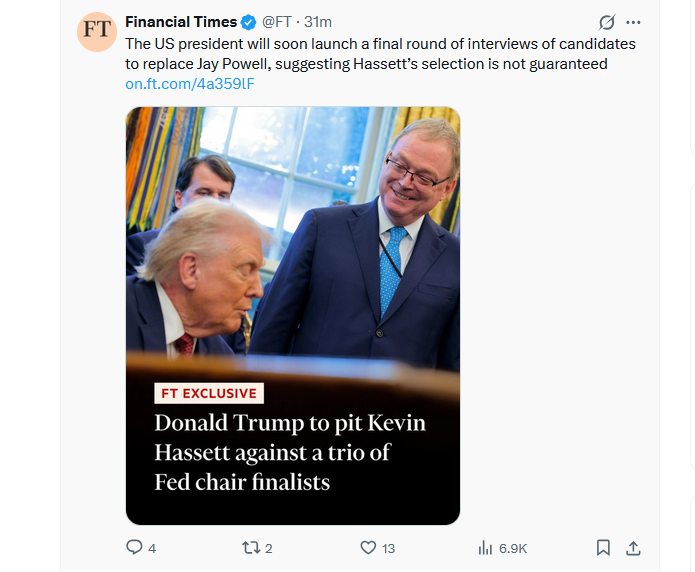
According to a report from the Financial Times (FT) on Tuesday, Treasury Secretary Scott Bessent has presented a list of four names to the White House.

One of these is former Fed governor Kevin Warsh, whom Bessent is scheduled to meet with on Wednesday. Another is National Economic Council director Kevin Hassett, who is seen as the frontrunner for the role.

Another two names would be picked from a list of other finalists, which includes Fed governors Christopher Waller and Michelle Bowman, and BlackRock chief investment officer Rick Rieder.
Source: Financial Times

Trump and Bessent are expected to hold at least one interview next week, as a decision looks likely to be announced in January.

However, Trump has revealed he already has his eye on one particular candidate.

“We’re going to be looking at a couple different people, but I have a pretty good idea of who I want,” Trump said to journalists on Air Force One on Tuesday.

Kevin Hassett is a frontrunner for Fed chair role

The upcoming round of interviews suggests that Hassett may not be the clear lock in for the role as previously thought, though he is seen as the favorite.

Earlier this month, prediction market odds on Kalshi and Polymarket shot up for Hassett significantly following comments from Trump at the White House on Dec. 2.

While welcoming guests, Trump labeled Hassett as “potential Fed chair” leading many to assume the president had let a major hint slip.

Related: Trump’s national security strategy is silent on crypto, blockchain

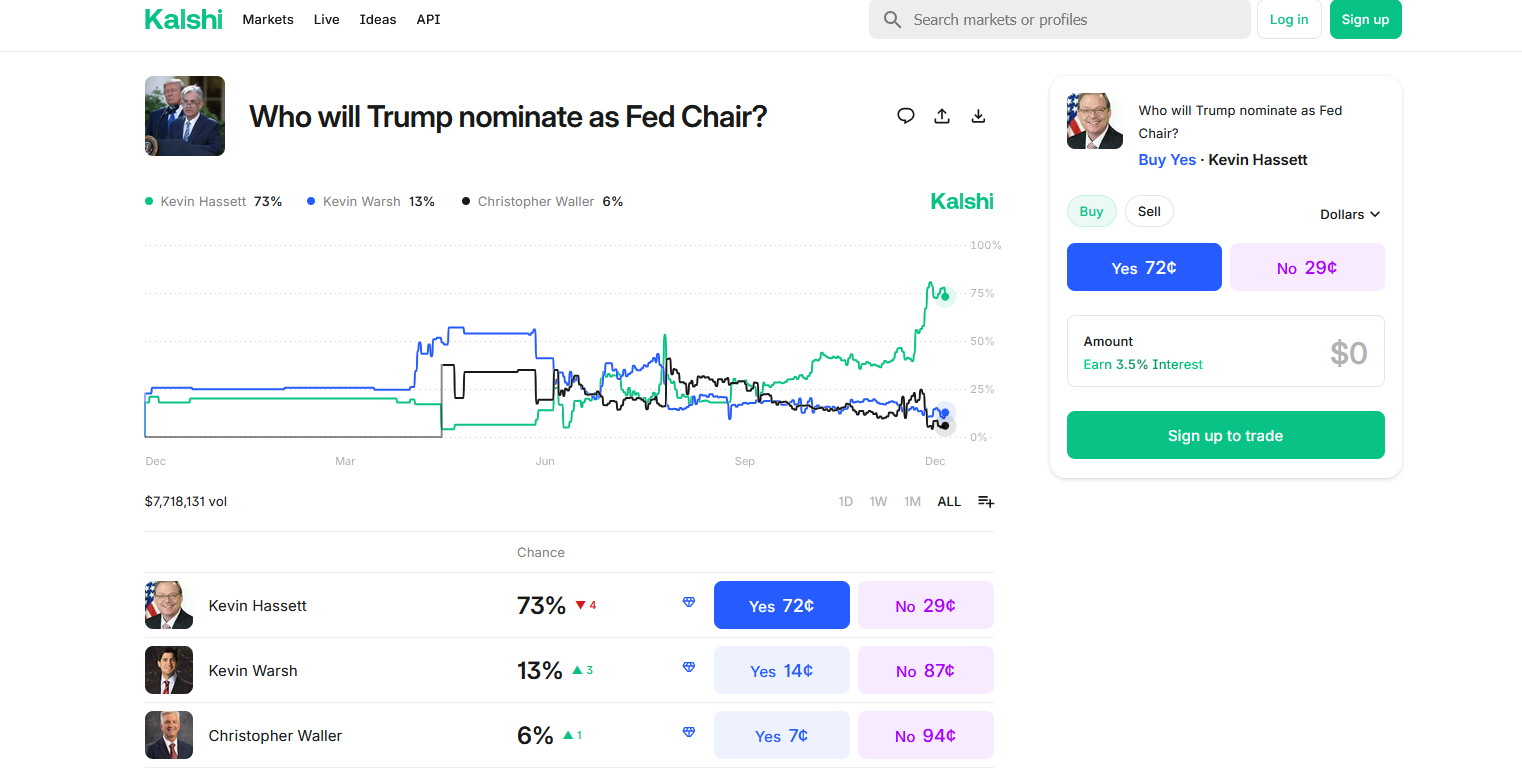
With Hassett’s odds spiking to 85% after Trump’s comments last week, they have since declined to around 73% for Hassett, while Warsh’s odds sit at 13% on Kalshi at the time of writing, which has floated around this range over December.
Odds for next Fed chair. Source: Kalshi

Regardless of who ends up taking over as chair, the move is bound to impact crypto markets under the new leadership.

If elected, Hassett has asserted that he will be apolitical in terms of running the Fed, despite his close ties to Trump. Speaking with The Wall Street Journal this week, Hassett said that “You just do the right thing” when asked if he would blindly follow orders from Trump.

“Suppose that inflation has gotten from, say, 2.5% to 4%. You can’t cut,” Hassett said, adding that he would rely on his own “judgment, which I think the president trusts.”

Magazine: The one thing these 6 global crypto hubs all have in common...
Пов'язані матеріали

a16z: AI's 'Amnesia', Can Continuous Learning Cure It?

The article "a16z: AI's 'Amnesia' – Can Continual Learning Cure It?" explores the limitations of current large language models (LLMs), which, like the protagonist in the film *Memento*, are trapped in a perpetual present—unable to form new memories after training. While methods like in-context learning (ICL), retrieval-augmented generation (RAG), and external scaffolding (e.g., chat history, prompts) provide temporary solutions, they fail to enable true internalization of new knowledge. The authors argue that compression—the core of learning during training—is halted at deployment, preventing models from generalizing, discovering novel solutions (e.g., mathematical proofs), or handling adversarial scenarios. The piece introduces *continual learning* as a critical research direction to address this, categorizing approaches into three paths: 1. **Context**: Scaling external memory via longer context windows, multi-agent systems, and smarter retrieval. 2. **Modules**: Using pluggable adapters or external memory layers for specialization without full retraining. 3. **Weights**: Enabling parameter updates through sparse training, test-time training, meta-learning, distillation, and reinforcement learning from feedback. Challenges include catastrophic forgetting, safety risks, and auditability, but overcoming these could unlock models that learn iteratively from experience. The conclusion emphasizes that while context-based methods are effective, true breakthroughs require models to compress new information into weights post-deployment, moving from mere retrieval to genuine learning.

marsbit40 хв тому

a16z: AI's 'Amnesia', Can Continuous Learning Cure It?

marsbit40 хв тому

Can a Hair Dryer Earn $34,000? Deciphering the Reflexivity Paradox in Prediction Markets

An individual manipulated a weather sensor at Paris Charles de Gaulle Airport with a portable heat source, causing a Polymarket weather market to settle at 22°C and earning $34,000. This incident highlights a fundamental issue in prediction markets: when a market aims to reflect reality, it also incentivizes participants to influence that reality. Prediction markets operate on two layers: platform rules (what outcome counts as a win) and data sources (what actually happened). While most focus on rules, the real vulnerability lies in the data source. If reality is recorded through a specific source, influencing that source directly affects market settlement. The article categorizes markets by their vulnerability: 1. **Single-point physical data sources** (e.g., weather stations): Easily manipulated through physical interference. 2. **Insider information markets** (e.g., MrBeast video details): Insiders like team members use non-public information to trade. Kalshi fined a剪辑师 $20,000 for insider trading. 3. **Actor-manipulated markets** (e.g., Andrew Tate’s tweet counts): The subject of the market can control the outcome. Evidence suggests Tate’sociated accounts coordinated to profit. 4. **Individual-action markets** (e.g., WNBA disruptions): A single person can execute an event to profit from their pre-placed bets. Kalshi and Polymarket handle these issues differently. Kalshi enforces strict KYC, publicly penalizes insider trading, and reports to regulators. Polymarket, with its anonymous wallet-based system, has historically been more permissive, arguing that insider information improves market accuracy. However, it cooperated with authorities in the "Van Dyke case," where a user traded on classified government information. The core paradox is reflexivity: prediction markets are designed to discover truth, but their financial incentives can distort reality. The more valuable a prediction becomes, the more likely participants are to influence the event itself. The market ceases to be a mirror of reality and instead shapes it.

marsbit1 год тому

Can a Hair Dryer Earn $34,000? Deciphering the Reflexivity Paradox in Prediction Markets

marsbit1 год тому

Торгівля

Спот
Ф'ючерси
活动图片