Trump Steps Into Web3 Gaming – But Will It Endure? New Mine-to-Earn Project Says It Holds the Genuine Long-Term Model

bitcoinistОпубліковано о 2025-12-12Востаннє оновлено о 2025-12-12

Анотація

A recently launched crypto game using Donald Trump's name has drawn attention but appears to be a traditional Web2-style game with optional Web3 elements, raising questions about its legitimacy as a true blockchain-based GameFi project. In contrast, PepeNode (PEPENODE) is introduced as a fully Web3-native "mine-to-earn" game designed for long-term sustainability. It turns crypto mining into a virtual simulation where players build and optimize server setups using PEPENODE tokens for upgrades—70% of which are permanently burned to reduce supply and increase scarcity. The project aims to avoid the pitfalls of earlier Play-to-Earn models by creating a deflationary economy tied to real gameplay consequences. The PepeNode presale is currently active for 27 days, offering tokens at $0.0011873 each, with purchases available via crypto or credit cards. The smart contract has been audited by Coinsult for security assurance.

Thursday 11 December 2025 – A recently launched crypto game using the name of U.S. President Donald Trump has drawn attention across the Web3 space, but a closer look shows an approach that feels atypical for a blockchain-based release. Players are reportedly able to bypass the crypto elements altogether, giving the impression of a traditional Web2 game wrapped in Web3 branding rather than a product built fully around blockchain technology.

PepeNode (PEPENODE) positions itself at the other end of that spectrum. The project is designed as a fully Web3-native game, with blockchain mechanics forming the core of its system rather than an optional add-on. Instead of repeating Play-to-Earn models that struggled or collapsed, such as Axie Infinity, StepN and last year’s wave of Telegram-based games, PepeNode is rolling out what it describes as crypto’s first mine-to-earn meme coin structure aimed at long-term viability.

While many GameFi projects are still testing the waters, PepeNode is taking a more committed stance, arguing that meaningful progress in GameFi requires a complete rethink rather than incremental experiments.

For investors interested in a model that claims to support a sustainable crypto gaming economy, the PepeNode presale is currently live, with PEPENODE priced at $0.0011873 per token. The opportunity is time-limited, however, as the team has announced that the presale will conclude in 27 days. After that point, PEPENODE is expected to be available only through exchanges, where prices may not revisit presale levels.

When Blockchain Is Optional, Does It Still Qualify as GameFi?

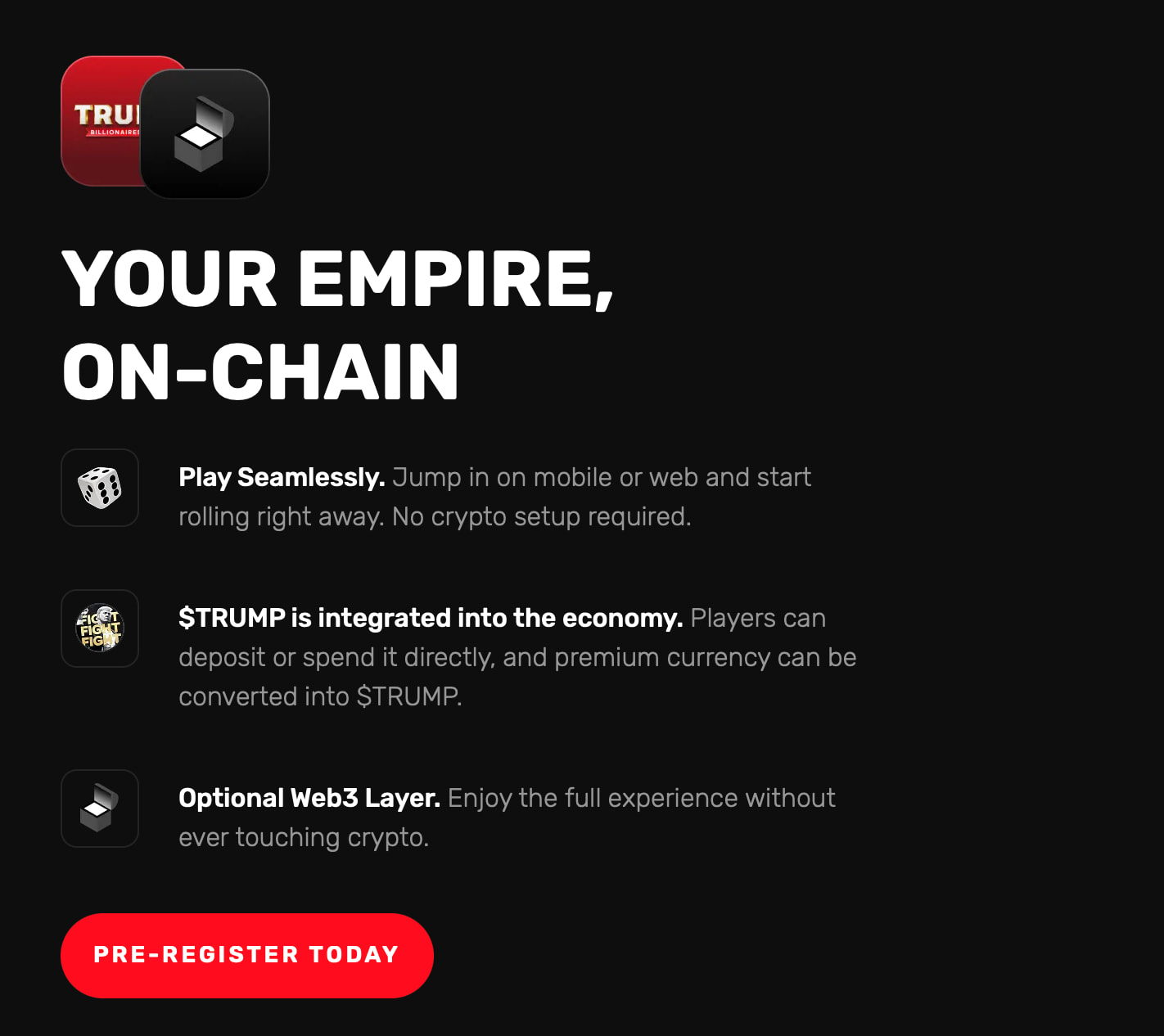
A recent post from the TrumpMeme account on X announced the opening of pre-registration for a licensed game built around the Trump brand. The project, titled Trump Billionaires Club, presents Trump in an Apprentice-style role, with gameplay centred on dice rolls, buying up properties, limited stock market activity notably without any direct crypto element and progressing through a glossy “high-roller” ranking ladder.

Players are being lured with the promise to “Live the High-Roller Lifestyle as you race to become the Ultimate TRUMP Billionaire,” with the main draw being a share of $1 million worth of Official Trump (TRUMP) tokens. Beyond that incentive, the game leans on familiar mechanics, integrating Open Loot to distribute digital collectibles an approach many long-time crypto users would recognise as Web2.5 dressed up in Web3 language.

A closer look at the website highlights a key detail: the game runs smoothly even without any blockchain involvement. Web3 features are clearly optional, and players can make purchases using traditional, non-crypto currencies. That raises an obvious question when the project promotes the idea of “Your empire, on-chain” if everything functions off-chain, where does that empire actually exist?
This suggests that while the game may appeal to casual players, it isn’t trying to address the deeper, long-standing problems GameFi has faced. Those same issues once brought millions of newcomers into crypto through gaming, only to see them leave just as quickly when fragile token economies collapsed.

For blockchain gaming to genuinely move forward, those challenges need proper solutions. And at the moment, the project positioning itself as an attempt to tackle them isn’t a familiar board-game-style remake, but the mine-to-earn ecosystem that PepeNode is building.

The First GameFi Economy Built to Grow Stronger Over Time

PepeNode keeps the concept simple on the surface: it turns crypto mining into a virtual game. But once you look a little deeper, it becomes clear the goal is to quietly strip away what never worked in earlier GameFi models. Rather than leaning on hype or shallow mechanics, the project is structured around systems that are meant to hold up over time.

Instead of pushing players into repetitive tapping, endless clicking, or mindless loops, PepeNode drops them into an empty, lifeless server room with a clear message build something that actually functions. Progress isn’t cosmetic. Every action, from buying nodes to upgrading facilities, is paid for using PEPENODE, and every decision carries real consequences.

Put the wrong components together and the system slows down, becoming inefficient and unstable. Combine the right ones and performance improves, with token output increasing like a properly tuned mining operation. The experience feels closer to solving an engineering problem than “playing” a traditional game, and that distinction is very much intentional.
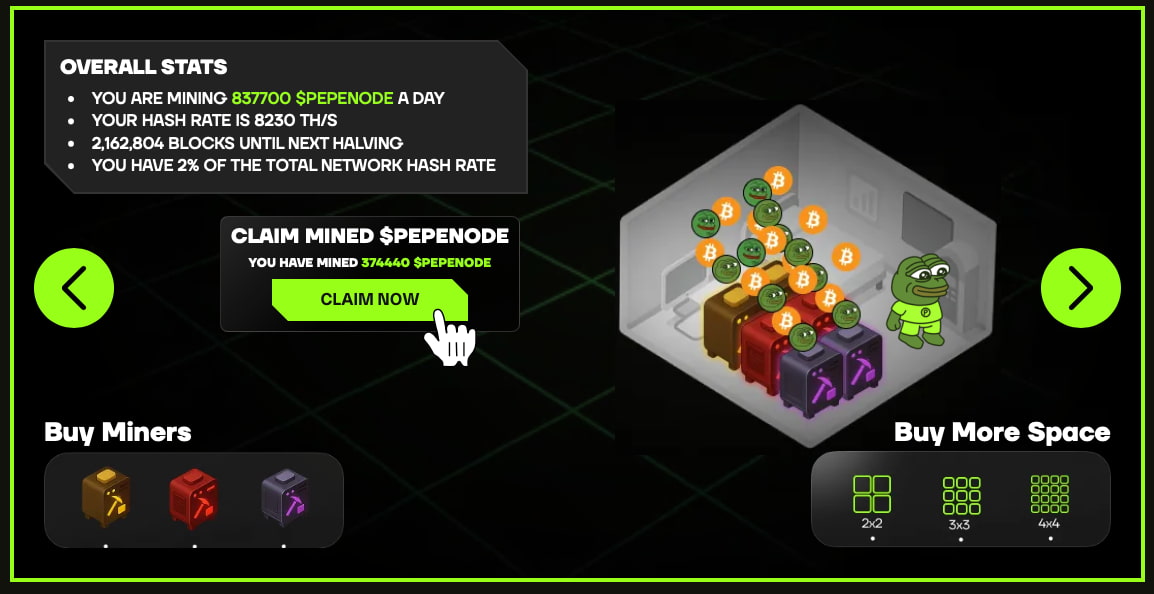
And unlike games that rely on a thin “Web3” label and a familiar brand costume, PepeNode treats simulation as more than a buzzword. When the project talks about simulation, it means it in a literal sense. The team has already hinted at systems that reflect the real-world problems miners deal with every day, from heat surges and power consumption to overall system stability the full set of operational headaches, minus the real electricity bill.

Players do earn PEPENODE from their setups, but the token isn’t just a reward. Its role runs much deeper. The more PEPENODE is spent in-game to fine-tune and optimise a rig, the greater the chance of unlocking higher-tier payouts, including major meme coin rewards such as Pepe (PEPE) and Fartcoin (FARTCOIN).

What really sets the model apart is how upgrades are handled. Every improvement consumes PEPENODE, and 70% of the tokens used are permanently removed from circulation. Progression, therefore, doesn’t expand supply it reduces it. As activity in the game increases, PEPENODE becomes increasingly scarce.

That combination of strategic building, deliberate token spending and access to desirable crypto rewards is why PepeNode is being highlighted as a serious candidate for one of the first GameFi economies designed to hold up over the long term.

Presale Nears Its End as PepeNode Enters Final 27-Day Window

With the presale window still open, early supporters have a chance to secure PEPENODE while directly backing the game’s ongoing development. Tokens are available through the official PepeNode presale site and can be purchased using ETH, BNB, USDT on both ERC-20 and BEP-20 networks, as well as standard credit or debit cards.

Buyers can connect using most major wallets, including Best Wallet, which is often cited as one of the leading crypto and Bitcoin wallets in use today. PepeNode is already listed in Best Wallet’s Upcoming Tokens discovery section, making it possible to buy, monitor, and later claim tokens directly inside the app.

To add another layer of reassurance, the project’s smart contract has undergone a full audit by Coinsult, providing early participants with added confidence in the security and structure of the code.

Those looking to stay informed can follow PepeNode on X and Telegram, or visit the PepeNode website to take part in the presale while it remains open.

Visit PepeNode to join the presale.

Пов'язані матеріали

This Week's Key Events Preview | U.S. to Release April CPI Data; U.S. Senate Banking Committee to Review "Digital Asset Market Structure Act of 2025"

Weekly News Preview: Key events for May 12-16 include major economic and crypto industry developments. On Tuesday, May 12, the U.S. will release its April CPI data. Additionally, the gaming blockchain Ronin will begin a 10-hour migration to an Ethereum Layer 2, built on OP Stack with EigenDA for data availability. This aims to leverage Ethereum's security and settle RON's annual inflation below 1%. Base's first independent network upgrade, "Base Azul," is scheduled for mainnet activation on Wednesday, May 13, focusing on security, performance, and developer experience enhancements. Thursday, May 14, sees the U.S. Senate Banking Committee voting on the "Digital Asset Market Structure Act of 2025." In other news, Solana DeFi protocol Carrot will shut down, setting a final withdrawal deadline due to impacts from the Drift exploit. The Moscow Exchange will launch futures trading for Solana, Ripple, and Tron indices (RUB-settled) for qualified investors. Multiple service closures are scheduled for Friday, May 15. Dmail Network will begin winding down due to unsustainable infrastructure costs and failed commercialization. Users must export data before this date. Separately, the Cosmos-based lending blockchain UX Chain will fully shut down. Finally, on Saturday, May 16, gaming infrastructure provider Lattice will wind down operations, with its Redstone Layer 2 network ceasing. Users are urged to withdraw assets, especially from contracts like Uniswap pools, before the shutdown.

链捕手6 хв тому

This Week's Key Events Preview | U.S. to Release April CPI Data; U.S. Senate Banking Committee to Review "Digital Asset Market Structure Act of 2025"

链捕手6 хв тому

Morning Post | Trump Media Group Releases Q1 Financial Report; Top Three DeFi Applications Return Nearly $100 Million in Revenue to Token Holders in 30 Days; Michael Saylor Shares Bitcoin Tracker Info Again

**Title: Daily Briefing | Trump Media Group Releases Q1 Report; Top 3 DeFi Apps Return Nearly $100M to Token Holders; Michael Saylor Signals Potential Bitcoin Buy** **Summary:** Key developments in the past 24 hours include: * **Economic Outlook:** Goldman Sachs has pushed back its forecast for the next two Federal Reserve interest rate cuts to December 2026 and March 2027, citing persistent inflationary pressures from energy costs. This delayed timeline is expected to tighten liquidity flow into risk assets, including cryptocurrencies. * **DeFi & Revenue:** Data from DefiLlama shows that three leading DeFi applications—Hyperliquid, Pump.fun, and EdgeX—collectively distributed $96.3 million in revenue to their token holders over the last 30 days. This trend highlights a shift in the crypto community's focus towards real protocol earnings and sustainable economic models. * **Corporate Bitcoin Moves:** Michael Saylor, founder of MicroStrategy (note: referred to as 'Strategy' in the text, likely a typographical error), has signaled potential upcoming Bitcoin purchases by posting a "Bitcoin Tracker" update, following a pattern that typically precedes the company's official disclosure of new acquisitions. * **Market Integrity:** Prediction market platform Polymarket announced updates to address platform issues, including identifying and banning clusters of accounts involved in "ghost-fill" activities and implementing measures to prevent bulk account creation. * **Regulation:** The Bank of England Governor warned that stablecoin regulation could lead to tensions between US and international regulators. In South Korea, the National Tax Service has launched a pilot program to entrust seized virtual assets to private custody firms for management. * **Meme Token Trends:** GMGN data lists the top trending meme tokens on Ethereum (e.g., HEX, SHIB), Solana (e.g., FWOG, TROLL), and Base (e.g., SKITTEN, PEPE) over the past day. **Financial Note:** Trump Media & Technology Group reported a Q1 loss of approximately $4 billion, primarily attributed to unrealized losses on its Bitcoin and other digital asset holdings.

链捕手37 хв тому

Morning Post | Trump Media Group Releases Q1 Financial Report; Top Three DeFi Applications Return Nearly $100 Million in Revenue to Token Holders in 30 Days; Michael Saylor Shares Bitcoin Tracker Info Again

链捕手37 хв тому

Telegram Takes Direct Control of TON, Social Traffic Rewrites the Public Chain Narrative

Telegram founder Pavel Durov announced that Telegram will replace the TON Foundation as the core driver and largest validator of The Open Network (TON). Key initiatives include a sixfold reduction in transaction fees, performance upgrades, and improved developer tools within the next few weeks. This marks a strategic shift from Telegram merely providing user access to deeply integrating TON into its platform's core infrastructure. The goal is to transform Telegram's massive social traffic into sustainable on-chain activity. While viral mini-apps like Notcoin have demonstrated Telegram's ability to drive user adoption, TON aims to support frequent, low-value transactions inherent to social platforms—such as tipping, in-app payments, and game rewards. Ultra-low fees and sub-second finality (0.6 seconds) are crucial to making blockchain interactions seamless and nearly invisible within the Telegram user experience. However, Telegram's increased central role raises questions about network decentralization. Durov argues that Telegram's participation will attract more large validators, thereby enhancing decentralization. TON also offers high annual staking rewards (18.8%), aiming to retain capital within its ecosystem. The fundamental challenge for TON is no longer leveraging Telegram's user base, but becoming an indispensable, seamless infrastructure layer for Telegram's everyday applications—moving from an adjacent chain to an embedded utility.

marsbit38 хв тому

Telegram Takes Direct Control of TON, Social Traffic Rewrites the Public Chain Narrative

marsbit38 хв тому

Telegram Takes Direct Control of TON, Social Traffic Reshapes Public Chain Narrative

Telegram's founder, Pavel Durov, has announced a major shift in the development of The Open Network (TON). Telegram will now become the core driver of TON, replacing the TON Foundation and becoming its largest validator. The focus will be on technical upgrades over the next few weeks, including slashing network fees by six times to near-zero and improving finality time to 0.6 seconds. This move signifies a deeper integration between Telegram and TON, moving beyond just providing a user base. The goal is to transform Telegram's vast social traffic and built-in features—like Mini Apps, payments, and bots—into sustainable, on-chain usage scenarios. The reduced fees and faster speeds are crucial for enabling the small, frequent transactions typical of social interactions. While this promises stronger execution and product alignment, it raises questions about centralization. Durov argues Telegram's involvement will attract more validators, enhancing decentralization, but the outcome remains to be seen. Additionally, TON's high annual staking reward of 18.8% aims to retain capital within the ecosystem. The key challenge for TON is no longer just leveraging Telegram's entry point, but becoming an invisible, seamless infrastructure layer within Telegram's daily use. Its success hinges on converting viral attention into lasting, embedded utility.

Odaily星球日报48 хв тому

Telegram Takes Direct Control of TON, Social Traffic Reshapes Public Chain Narrative

Odaily星球日报48 хв тому

Торгівля

Спот
Ф'ючерси
活动图片




