Trump Steps Into Web3 Gaming – But Will It Endure? New Mine-to-Earn Project Says It Holds the Genuine Long-Term Model

bitcoinistОпубліковано о 2025-12-12Востаннє оновлено о 2025-12-12

Анотація

A recently launched crypto game using Donald Trump's name has drawn attention but appears to be a traditional Web2-style game with optional Web3 elements, raising questions about its legitimacy as a true blockchain-based GameFi project. In contrast, PepeNode (PEPENODE) is introduced as a fully Web3-native "mine-to-earn" game designed for long-term sustainability. It turns crypto mining into a virtual simulation where players build and optimize server setups using PEPENODE tokens for upgrades—70% of which are permanently burned to reduce supply and increase scarcity. The project aims to avoid the pitfalls of earlier Play-to-Earn models by creating a deflationary economy tied to real gameplay consequences. The PepeNode presale is currently active for 27 days, offering tokens at $0.0011873 each, with purchases available via crypto or credit cards. The smart contract has been audited by Coinsult for security assurance.

Thursday 11 December 2025 – A recently launched crypto game using the name of U.S. President Donald Trump has drawn attention across the Web3 space, but a closer look shows an approach that feels atypical for a blockchain-based release. Players are reportedly able to bypass the crypto elements altogether, giving the impression of a traditional Web2 game wrapped in Web3 branding rather than a product built fully around blockchain technology.

PepeNode (PEPENODE) positions itself at the other end of that spectrum. The project is designed as a fully Web3-native game, with blockchain mechanics forming the core of its system rather than an optional add-on. Instead of repeating Play-to-Earn models that struggled or collapsed, such as Axie Infinity, StepN and last year’s wave of Telegram-based games, PepeNode is rolling out what it describes as crypto’s first mine-to-earn meme coin structure aimed at long-term viability.

While many GameFi projects are still testing the waters, PepeNode is taking a more committed stance, arguing that meaningful progress in GameFi requires a complete rethink rather than incremental experiments.

For investors interested in a model that claims to support a sustainable crypto gaming economy, the PepeNode presale is currently live, with PEPENODE priced at $0.0011873 per token. The opportunity is time-limited, however, as the team has announced that the presale will conclude in 27 days. After that point, PEPENODE is expected to be available only through exchanges, where prices may not revisit presale levels.

When Blockchain Is Optional, Does It Still Qualify as GameFi?

A recent post from the TrumpMeme account on X announced the opening of pre-registration for a licensed game built around the Trump brand. The project, titled Trump Billionaires Club, presents Trump in an Apprentice-style role, with gameplay centred on dice rolls, buying up properties, limited stock market activity notably without any direct crypto element and progressing through a glossy “high-roller” ranking ladder.

Players are being lured with the promise to “Live the High-Roller Lifestyle as you race to become the Ultimate TRUMP Billionaire,” with the main draw being a share of $1 million worth of Official Trump (TRUMP) tokens. Beyond that incentive, the game leans on familiar mechanics, integrating Open Loot to distribute digital collectibles an approach many long-time crypto users would recognise as Web2.5 dressed up in Web3 language.

A closer look at the website highlights a key detail: the game runs smoothly even without any blockchain involvement. Web3 features are clearly optional, and players can make purchases using traditional, non-crypto currencies. That raises an obvious question when the project promotes the idea of “Your empire, on-chain” if everything functions off-chain, where does that empire actually exist?
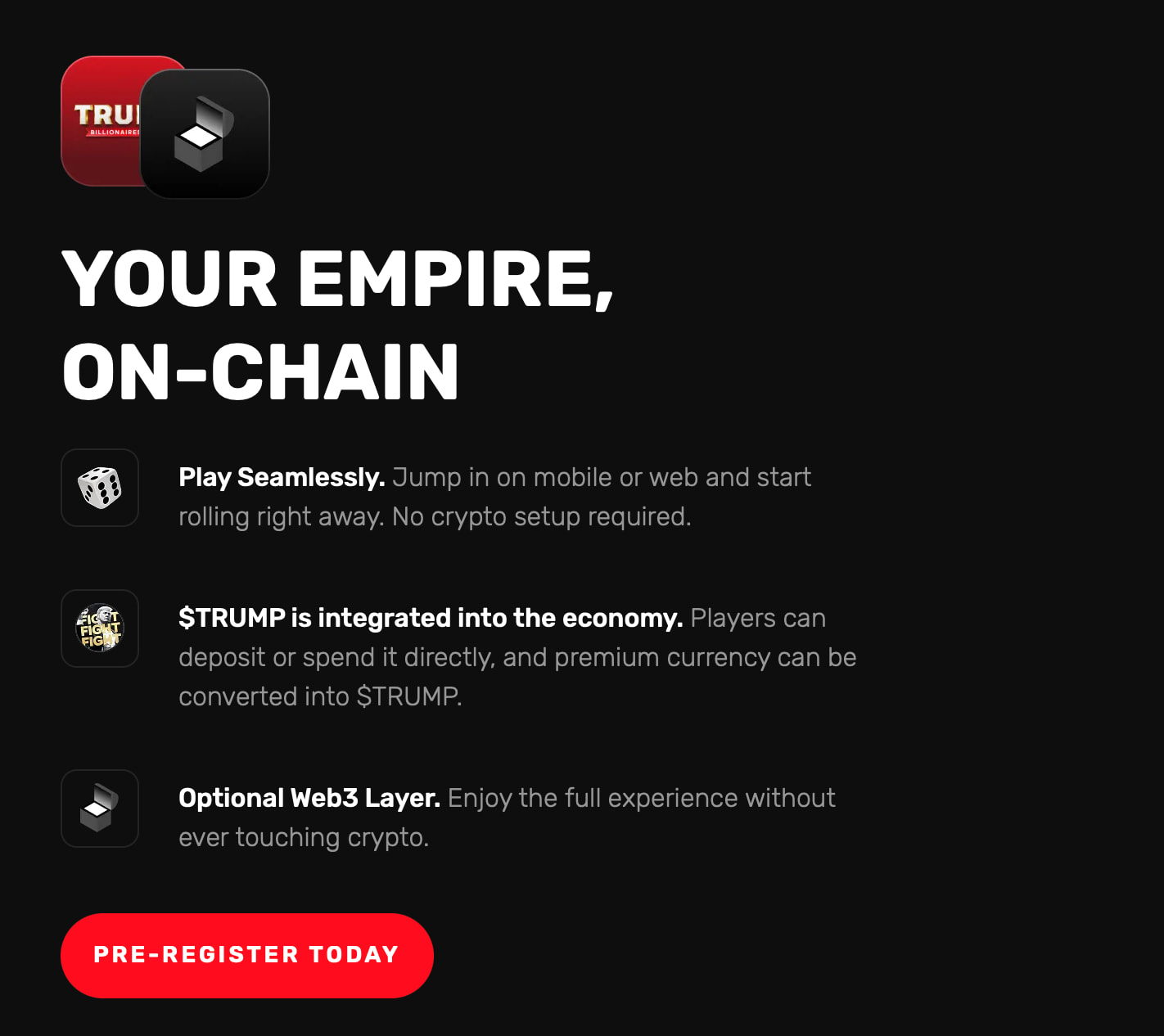
This suggests that while the game may appeal to casual players, it isn’t trying to address the deeper, long-standing problems GameFi has faced. Those same issues once brought millions of newcomers into crypto through gaming, only to see them leave just as quickly when fragile token economies collapsed.

For blockchain gaming to genuinely move forward, those challenges need proper solutions. And at the moment, the project positioning itself as an attempt to tackle them isn’t a familiar board-game-style remake, but the mine-to-earn ecosystem that PepeNode is building.

The First GameFi Economy Built to Grow Stronger Over Time

PepeNode keeps the concept simple on the surface: it turns crypto mining into a virtual game. But once you look a little deeper, it becomes clear the goal is to quietly strip away what never worked in earlier GameFi models. Rather than leaning on hype or shallow mechanics, the project is structured around systems that are meant to hold up over time.

Instead of pushing players into repetitive tapping, endless clicking, or mindless loops, PepeNode drops them into an empty, lifeless server room with a clear message build something that actually functions. Progress isn’t cosmetic. Every action, from buying nodes to upgrading facilities, is paid for using PEPENODE, and every decision carries real consequences.

Put the wrong components together and the system slows down, becoming inefficient and unstable. Combine the right ones and performance improves, with token output increasing like a properly tuned mining operation. The experience feels closer to solving an engineering problem than “playing” a traditional game, and that distinction is very much intentional.
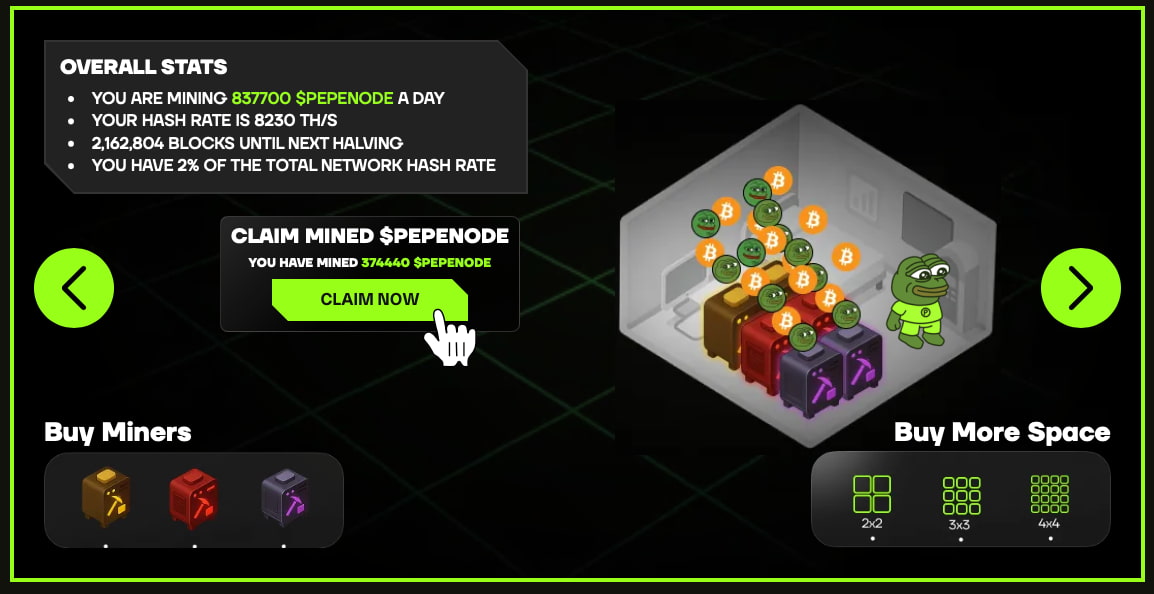
And unlike games that rely on a thin “Web3” label and a familiar brand costume, PepeNode treats simulation as more than a buzzword. When the project talks about simulation, it means it in a literal sense. The team has already hinted at systems that reflect the real-world problems miners deal with every day, from heat surges and power consumption to overall system stability the full set of operational headaches, minus the real electricity bill.

Players do earn PEPENODE from their setups, but the token isn’t just a reward. Its role runs much deeper. The more PEPENODE is spent in-game to fine-tune and optimise a rig, the greater the chance of unlocking higher-tier payouts, including major meme coin rewards such as Pepe (PEPE) and Fartcoin (FARTCOIN).

What really sets the model apart is how upgrades are handled. Every improvement consumes PEPENODE, and 70% of the tokens used are permanently removed from circulation. Progression, therefore, doesn’t expand supply it reduces it. As activity in the game increases, PEPENODE becomes increasingly scarce.

That combination of strategic building, deliberate token spending and access to desirable crypto rewards is why PepeNode is being highlighted as a serious candidate for one of the first GameFi economies designed to hold up over the long term.

Presale Nears Its End as PepeNode Enters Final 27-Day Window

With the presale window still open, early supporters have a chance to secure PEPENODE while directly backing the game’s ongoing development. Tokens are available through the official PepeNode presale site and can be purchased using ETH, BNB, USDT on both ERC-20 and BEP-20 networks, as well as standard credit or debit cards.

Buyers can connect using most major wallets, including Best Wallet, which is often cited as one of the leading crypto and Bitcoin wallets in use today. PepeNode is already listed in Best Wallet’s Upcoming Tokens discovery section, making it possible to buy, monitor, and later claim tokens directly inside the app.

To add another layer of reassurance, the project’s smart contract has undergone a full audit by Coinsult, providing early participants with added confidence in the security and structure of the code.

Those looking to stay informed can follow PepeNode on X and Telegram, or visit the PepeNode website to take part in the presale while it remains open.

Visit PepeNode to join the presale.

Пов'язані матеріали

SpaceX IPO Rush: A Capital Feast That Could Reshape the Landscape of AI and Crypto

SpaceX's potential IPO is emerging as a pivotal event that could reshape the landscape for both AI and Crypto markets. Far more than a traditional aerospace offering, SpaceX represents the core of Musk's future-tech ecosystem, with its Starlink satellite network positioning it as a global digital infrastructure company. This shift could redefine the foundational layers of the internet, communication, and data flow. Historically, major tech capital market movements, like AI booms or Bitcoin ETF approvals, have profoundly influenced crypto cycles. The SpaceX IPO could trigger a similar "super-narrative" fusion, boosting investor sentiment toward future digital infrastructure. This is particularly relevant for Crypto, which aims to build decentralized versions of such global systems. Key crypto sectors likely to benefit include: * **DePIN (Decentralized Physical Infrastructure Networks):** Projects like Render, Filecoin, and Helium, which incentivize real-world infrastructure for compute, storage, and connectivity. * **AI Crypto:** Platforms such as Bittensor and Fetch.ai, which leverage blockchain for decentralized AI computation, data markets, and agent economies. * **On-chain Payments & SocialFi:** Ecosystems like Solana and Ton, which could gain traction if Musk's X platform integrates digital payments and stablecoins. Ultimately, the IPO symbolizes a broader capital re-evaluation of core digital-age assets—networks, AI, data, and decentralized systems—aligning closely with crypto's long-term vision. It may act as a catalyst, redirecting global tech investment flows toward the crypto space as the next chapter in digital infrastructure unfolds.

marsbit20 хв тому

SpaceX IPO Rush: A Capital Feast That Could Reshape the Landscape of AI and Crypto

marsbit20 хв тому

KUN and Pharos Network Forge Strategic Partnership to Jointly Drive Innovation in RealFi, RWA, and Cross-Border Payment Infrastructure

Hong Kong. Layer 1 infrastructure Pharos Network and licensed digital payment expert KUN have signed a strategic MoU. They will integrate Pharos's institutional blockchain with KUN's licensed global payment rails to drive the tokenization of supply chain credit assets and enable more efficient global settlement on-chain. **Background:** Emerging market SMEs face severe working capital challenges due to slow, costly traditional trade finance, often waiting 30-90 days for payment after delivery. While RWA tokenization is a focus, few projects effectively connect underlying infrastructure to real commerce and licensed payment networks. **Collaboration Focus:** The partnership aims to bridge this gap by bringing supply chain credit and B2B cross-border payments on-chain compliantly. Initial priorities include: * Tokenizing supply chain credit assets to unlock liquidity. * Enabling native on-chain settlement of digital assets. * Exploring enterprise virtual card solutions. * Providing compliant on-chain financial services for verticals like commodities, trade, B2B e-commerce, and Web3. **Executive Quotes:** * Wish Wu, Co-founder & CEO of Pharos Network, highlighted KUN's trusted, licensed payment network as a perfect fit for bringing supply chain assets and cross-border capital flows on-chain accessibly. * Dr. Louis Liu, Founder & CEO of KUN, stated that settlement certainty is RealFi's final hurdle. Bridging KUN's payment rails with Pharos's infrastructure will help convert on-chain assets into real-world liquidity with institutional-grade trust. They will also explore AI-driven optimization for global capital flows. Pharos mainnet is live with over 50 dApps. This partnership strengthens its position as RealFi infrastructure by linking licensed payment systems with on-chain finance.

marsbit20 хв тому

KUN and Pharos Network Forge Strategic Partnership to Jointly Drive Innovation in RealFi, RWA, and Cross-Border Payment Infrastructure

marsbit20 хв тому

Deconstructing Anthropic: The Best AI Company May Also Be an Organizational Invention

Anthropic has emerged as one of the most notable AI companies, distinguished by its strategic focus and unique organizational culture. Strategically, Anthropic demonstrated exceptional foresight by prioritizing coding early on, recognizing it as a critical path for model learning, commercial value, and accelerating AGI research. Unlike OpenAI's expansive, multi-front approach, Anthropic maintained rigorous focus on scaling language models and the coding vertical, avoiding distractions like multimodal development. This discipline stemmed partly from resource constraints but also from the conviction of its leadership, particularly co-founder Dario Amodei, who exhibits a strong, independent strategic vision. Organizationally, Anthropic’s culture is its “secret sauce.” It is characterized by a strong, mission-oriented focus on AI safety, high trust, low ego among employees, and a distinct humanistic ethos. This culture has resulted in remarkably low talent attrition and high retention rates. Key practices sustaining this culture include stringent cultural screening in hiring, high-context transparency and writing practices led by leadership, a founding structure of seven co-founders with equal equity to diffuse values, and a deliberate “one team” approach that minimizes internal silos and hierarchy. This culture is both a reaction to the political dynamics its founders experienced at previous companies and a functional necessity for the data-intensive, collaborative “dirty work” required to excel in coding and agentic AI. While OpenAI remains a formidable competitor with greater resources and exploration, Anthropic’s success illustrates how focus, cultural cohesion, and a steadfast mission can be powerful drivers in the AI race.

marsbit46 хв тому

Deconstructing Anthropic: The Best AI Company May Also Be an Organizational Invention

marsbit46 хв тому

Why Are the Most Believers in AGI Buying NVIDIA Put Options?

The article analyzes the significant, market-moving 13F filing for Q1 2026 by Situational Awareness LP (SALP), a fund managed by former OpenAI researcher Leopold Aschenbrenner. While Aschenbrenner is a prominent believer in the accelerated arrival of AGI and has built the fund as a focused bet on AI infrastructure, the filing revealed large new put option positions (totaling billions in notional value) on key AI/semiconductor names like Nvidia, SMH ETF, Broadcom, and AMD. The article argues this is not a bearish turn on AI but a sophisticated hedging strategy. Given the macro backdrop in late March (rising oil prices, inflation concerns, higher-for-longer interest rates), the fund is managing volatility in its high-beta, high-valuation portfolio of AI infrastructure plays (like Bloom Energy, CoreWeave, Core Scientific). The puts act as "insurance" against a potential systemic pullback in the AI trade. Simultaneously, SALP maintained or added to core long positions in companies tied to power, data centers, compute, and storage—the "bottlenecks" expected to capture AI capital spending. It trimmed or exited some Q1 winners (e.g., Lumentum) and reduced leverage (e.g., selling CoreWeave calls), suggesting a rotation from crowded, high-momentum trades towards assets with clearer long-term fundamental pathways. The key takeaway is an evolution in the AI investment theme: from a broad, linear rally to a more discerning, "show-me-the-money" phase. The focus shifts from simply buying the AI narrative to identifying companies that can convert capex into tangible revenue, while actively managing portfolio risk in a volatile macro environment. The strategy reflects a move from unilateral bullishness to "offense with defense."

marsbit1 год тому

Why Are the Most Believers in AGI Buying NVIDIA Put Options?

marsbit1 год тому

Торгівля

Спот
Ф'ючерси
活动图片