Trump Relents on Ethics Provisions, 《CLARITY Act》 Makes Final Push Before Senate Recess

Foresight NewsОпубліковано о 2026-07-21Востаннє оновлено о 2026-07-21

Анотація

U.S. President Donald Trump has reportedly agreed to include ethics provisions in the *CLARITY Act*, a major digital asset market structure bill, resolving a key negotiation obstacle. This paves the way for the bill's text release and a critical Senate vote before the August recess. The legislation aims to establish comprehensive federal digital asset regulation and clarify the regulatory roles of the SEC and CFTC. The ethics clause is designed to restrict federal officials, including the President and Congress members, from profiting from digital assets while in office. A central point of contention involved Trump's own significant crypto holdings. Following this development, prediction market odds for the bill's passage in 2026 saw an uptick. The bill faces a tight timeline for Senate passage before the August 7th recess, with subsequent steps required in the House before reaching the President's desk. Industry lobbyists have emphasized prioritizing the bill's core regulatory framework over the political details of the ethics rules, while some Democratic senators have called for even stronger provisions. Concurrently, market data shows significant Bitcoin accumulation by large holders ("whales") in recent weeks, and a reversal to net inflows for U.S. spot Bitcoin and Ethereum ETFs after an extended period of outflows.


By: Sanqing, Foresight News


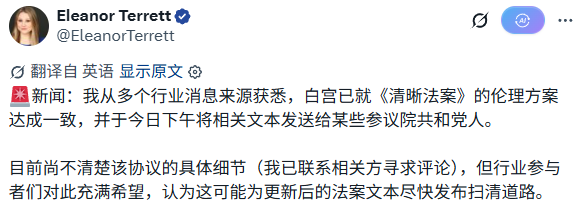
July 21 - According to a report by crypto journalist Eleanor Terrett citing sources, U.S. President Donald Trump has agreed to include ethics provisions in the "CLARITY Act" (Digital Asset Market Structure Act). The White House has reached a consensus on the ethics framework for the "CLARITY Act," clearing the last major hurdle for this crypto regulatory legislation that has been debated for months. The bill text could be released as soon as the same day, though it may be slightly delayed; as of the time of reporting, the Democratic side had not yet seen the specific text.


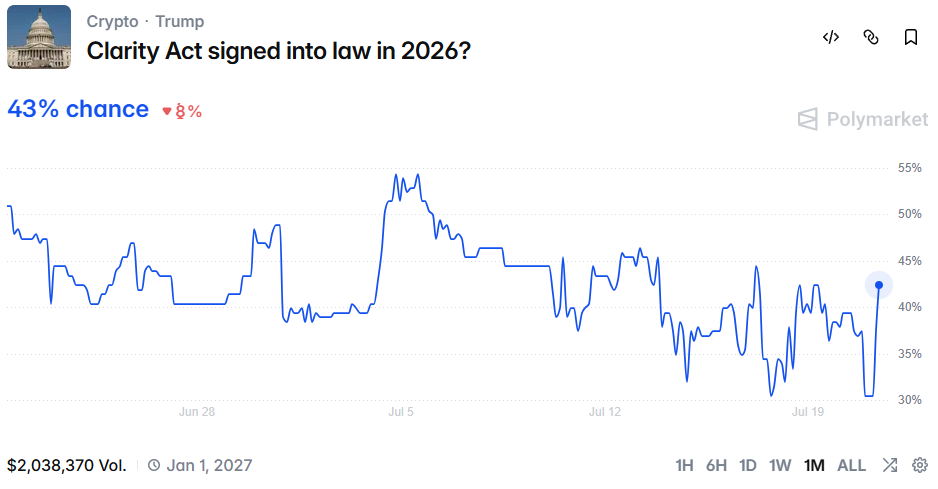
Following the news, the probability of "the 'CLARITY Act' being signed into law in 2026" on Polymarket rebounded to 43%. Research firm Galaxy Research had previously assessed the probability of it passing within 2026 at roughly fifty-fifty.


Previously, on July 16, during a meeting with Republican Senators Bernie Moreno, Cynthia Lummis, and White House crypto advisor Patrick Witt, Trump did not immediately agree. However, the deal was finalized by the President himself on Monday evening. This provision aims to restrict the President, Vice President, members of Congress, and other federal officials from profiting from digital assets during their terms. The core controversy has centered on the Trump family's Meme tokens and World Liberty Financial. Financial documents disclosed last month showed Trump's crypto income was as high as approximately $14 billion, which had once brought negotiations to a standstill.


The Final Stretch Before the August Recess


If ultimately enacted, the "CLARITY Act" would provide the first comprehensive federal-level regulation for the digital asset industry, clarifying the jurisdictional division between the SEC and CFTC.


The U.S. House of Representatives previously passed the bill with bipartisan majority support in 2025 by a vote of 294 to 134. The Senate Banking Committee greenlit it on May 14 this year with a vote of 15 to 9. It is currently stalled in final negotiations before a full Senate vote.


The bill text is expected to be released in the coming days, followed by a full Senate vote. The window only lasts until the recess in the first week of August (the Senate will go into recess on August 7 and return on September 14). If passed, it would need to go back to the House for reconsideration, text reconciliation, etc., before finally reaching the President's desk for signature.


The vote count in the Senate tightened in mid-July. Republican Senator Lindsey Graham of South Carolina died unexpectedly at the age of 71 on the night of July 11 from an aortic dissection after returning from a trip to Ukraine. This temporarily reduced the Republican Senate seats from 53 to 52.


According to the Associated Press, the state's Governor Henry McMaster appointed Graham's sister, Darline Graham Nordone, to succeed him two days later. She was sworn in on July 14, immediately restoring the seat.


However, Republican Senator Mitch McConnell has been absent from votes since being hospitalized on June 14. As of July 12, he himself stated he was not ready to return to the Senate, and there have been no further updates on his potential return since.


According to the cloture procedure under Senate Rule XXII, if Mitch McConnell remains absent at that time, the bill would need at least 8 additional Democratic votes beyond the actual number of Republican votes present to pass.


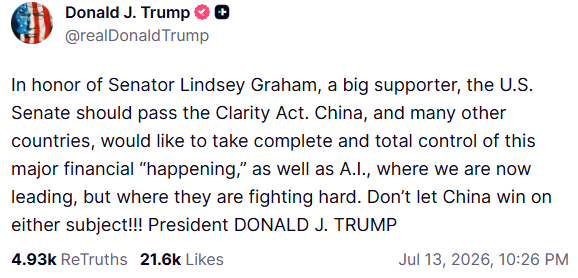
Trump previously posted on Truth Social, urging the Senate to pass the "CLARITY Act" quickly, calling it a tribute to the late Senator Lindsey Graham and emphasizing that it also concerns preventing China from gaining dominance in digital finance and artificial intelligence.


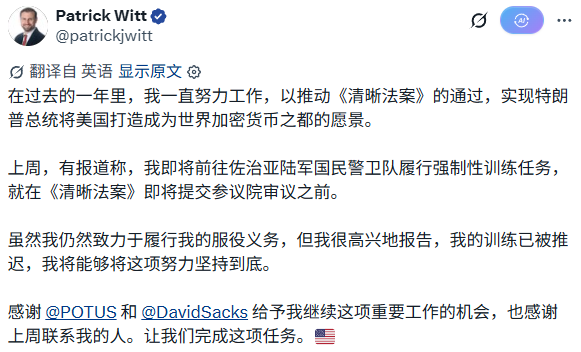
Personnel changes at the White House level also reflect the urgency of the push. Crypto advisor Patrick Witt was originally scheduled to be absent this week due to mandatory training with the Georgia Army National Guard. The training has been postponed, and he will remain in place to advance the legislation. His deputy, Harry Jung, announced his departure in two weeks.


"The Goal Line" or "The Elephant in the Room"?


The stance from industry lobbyists is straightforward. Blockchain Association CEO and former CFTC Commissioner Summer Mersinger said at the Injective Summit in Washington D.C. on July 16 that the core provisions of the bill "are very close to agreement, with only a few details left to iron out." She called the ethics issue "the elephant in the room" and the biggest current obstacle.
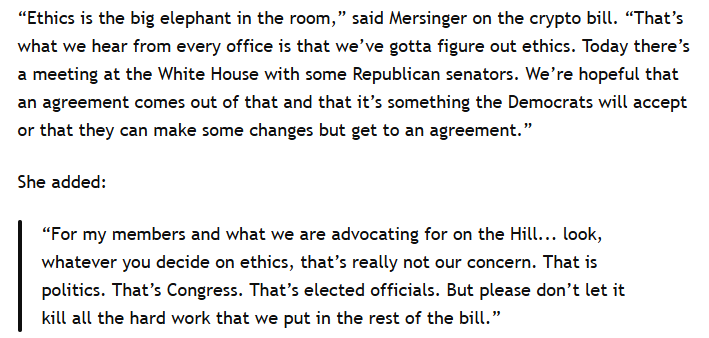


She urged Congress: "Whatever you decide on the ethics provision, that's really not our concern; that's politics, that's Congress, that's elected officials. But please don't let it ruin all the work we've put into the rest of the bill."


Coinbase Vice Chairman and former SEC official Ryan VanGrack was more blunt in a statement on CNBC in mid-July: "The 'CLARITY Act' is at the goal line. The momentum for passage is clear." Senate Majority Leader John Thune offered a more cautious assessment: "There is certainly a path to a deal, but time is running out."


These statements essentially convey the same message: we don't care how the ethics clause is written, just don't let it hinder the rest of the bill.


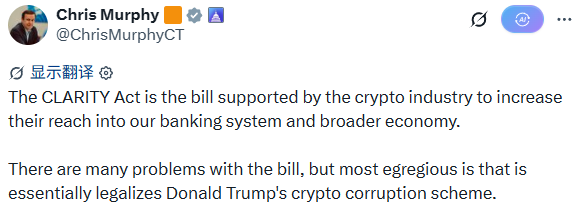
Skepticism comes primarily from the Democratic side and directly targets the inadequacy of the ethics provisions themselves. Senator Chris Murphy criticized in a Facebook post on July 14 that the "CLARITY Act" "is a crypto industry-backed bill designed to expand its influence over the banking system and the broader economy." He explicitly demanded that "the bill must have provisions prohibiting the President and his family members from issuing cryptocurrencies during his term, whether Meme tokens or stablecoins... The ethics provisions must cover the President and his immediate family members."


Senators Warren, Jack Reed, Chris Van Hollen, and others also issued a joint statement in mid-July, stating they "cannot support the current version of the 'CLARITY Act'," citing reasons including the need for stronger consumer protections, stricter conflict-of-interest and ethics rules, and more safeguards against crypto fraud and market manipulation. Senator Mark Warner bluntly said: "I am very pessimistic about the progress."


Whales, ETFs & Crypto Treasury Movements


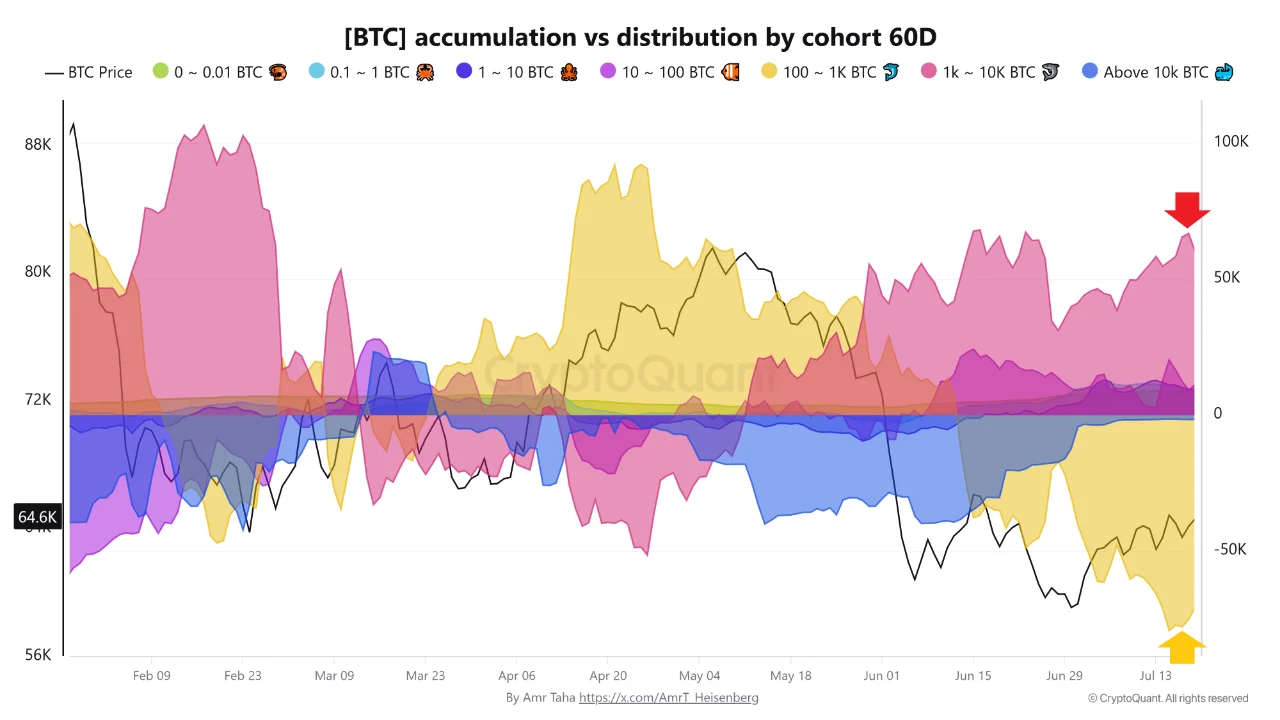
On-Chain Whales: According to CryptoQuant data from July 20, addresses holding 1,000 to 10,000 BTC saw a net increase of approximately 66,700 BTC over 60 days, the strongest wave of buying since mid-February. Meanwhile, addresses holding 100 to 1,000 BTC (medium holdings) sold about 77,800 BTC in the same period. Data provided by Bitfinex analysts to CoinDesk shows that whale addresses collectively added over 270,000 BTC in the first two weeks of July, worth about $16.7 billion.


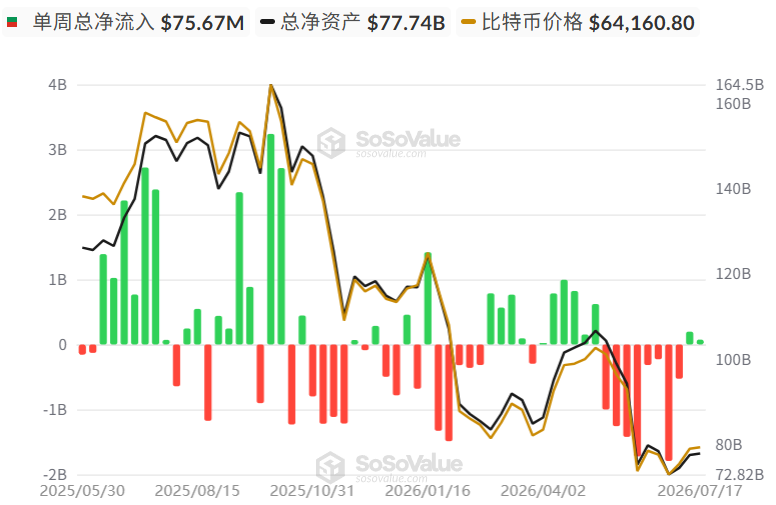
Spot ETFs: According to weekly data from SoSoValue, U.S. spot Bitcoin ETFs saw net outflows for 8 consecutive weeks starting the week of May 15, with the most severe outflow of $1.79 billion occurring the week of June 26. It wasn't until the week of July 10 that flows turned positive with a net inflow of $197 million, followed by another net inflow of $75.67 million the week of July 17.


The trend for spot Ethereum ETFs was almost identical: also 8 consecutive weeks of net outflows from May 15 to July 2, turning to net inflows in the weeks of July 10 and July 17, with $84.42 million and $105 million, respectively.
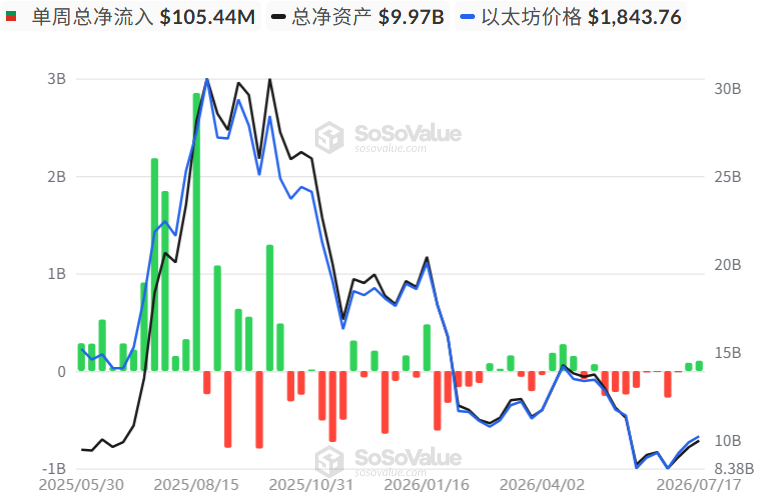


Crypto Treasuries: MicroStrategy's holdings remained at approximately 844,000 BTC, with no Bitcoin purchases for two consecutive weeks. In mid-July, it raised $263.5 million in cash through a stock offering but did not immediately add to its position, instead holding it as a buffer for preferred stock dividends and interest. Japanese-listed company Metaplanet increased its holdings by 2,823 BTC in Q2, bringing its total holdings to 43,000 BTC, ranking third globally among publicly traded companies. Its subsidiary also completed a convertible bond financing of approximately $59.5 million on July 21, with plans to continue buying.


BitMine increased its holdings by 7,430 ETH last week, bringing its total to 5,777,468 ETH, accounting for approximately 4.8% of the total ETH supply. Of this, 85% is staked, with an estimated annual staking yield of about $247 million. The company simultaneously repurchased approximately 5.5 million shares of common stock at an average price of $15.62. Tom Lee stated that the buying pace has slowed due to this, but weekly accumulation has never been interrupted since the reserve strategy was launched on June 30, 2025.


Arthur Hayes: According to monitoring by Yu Jin, BitMEX co-founder Arthur Hayes spent 2.5 million USDC to buy 1,293 ETH at $1,933 on July 15, chasing the rally. On July 20, he bought another 2.5 million USDC worth of ETH via FalconX and Cumberland OTC at $1,876. The two transactions totaled 5 million USDC, purchasing 2,625.7 ETH at an average cost of $1,904. Hayes previously wrote that the AI sector is absorbing market liquidity, putting short-term pressure on BTC, but once liquidity returns, the crypto market still has room for a rebound.


Трендові криптовалюти

Пов'язані питання

QWhat was the main hurdle for the CLARITY Act that President Trump's agreement on an ethics clause helped to clear?

AThe main hurdle was the inclusion and agreement on an ethics clause. This clause aims to restrict federal officials, including the President, Vice President, and members of Congress, from profiting from digital assets during their terms. A key point of contention was the Trump family's involvement with Meme coins and World Liberty Financial, which had stalled negotiations.

QWhat are the key regulatory roles defined for the SEC and CFTC under the proposed CLARITY Act?

AThe CLARITY Act, if passed, would establish the first comprehensive federal regulatory framework for the digital asset industry. A key provision is to clearly define the jurisdictional division of responsibilities between the Securities and Exchange Commission (SEC) and the Commodity Futures Trading Commission (CFTC).

QWhat challenge does Mitch McConnell's potential continued absence pose for the CLARITY Act's passage in the Senate?

AIf Senator Mitch McConnell remains absent from voting, it affects the procedural math. According to Senate Rule 22 for ending debate (cloture), the bill would need to secure at least 8 additional Democratic votes beyond the number of Republicans present and voting to overcome a filibuster and proceed to a final vote.

QAccording to industry lobbyists, what was the primary concern regarding the ethics clause during the final negotiations?

AIndustry lobbyists, represented by figures like Summer Mersinger of the Blockchain Association, expressed that while they were not directly concerned with the specifics of the ethics clause (calling it 'politics'), their primary worry was that the contentious debate over this clause could jeopardize or 'destroy' the entire broader legislative effort of the CLARITY Act.

QWhat criticism did Democratic Senators level against the ethics provisions in the CLARITY Act?

ADemocratic Senators, such as Chris Murphy, Elizabeth Warren, and others, criticized the ethics provisions as insufficient. They demanded stronger rules, specifically calling for clauses that would prohibit the President and their immediate family members from issuing cryptocurrencies (like Meme tokens or stablecoins) while in office. They also cited a need for stronger consumer protections and safeguards against fraud and market manipulation.

Пов'язані матеріали

Must-Watch Events Next Week|CLARITY Act Could Face Senate Vote; SpaceX, Circle to Report Earnings (8.3-8.9)

**Summary: Key Events and Developments to Watch (August 3-9)** The upcoming week is marked by significant financial disclosures, key legislative deadlines, and notable product updates. **Major Financial Events:** Several companies are scheduled to release their Q2 2026 earnings. American Bitcoin (ABTC) will report on August 3, followed by SpaceX and Hut 8 Mining Corp. on August 4, and Circle on August 5. Notably, a significant portion of SpaceX shares (up to 12% of total shares) will be unlocked on August 6 following their earnings release. **Key Legislative Deadline:** The U.S. Senate faces an August 7 deadline to secure 60 votes for the CLARITY Act, a bipartisan bill aiming to establish a federal regulatory framework for cryptocurrencies. The Senate may hold a full vote on the bill during the week. **Economic Data:** The U.S. July Non-Farm Payrolls report will be released on August 7, providing crucial labor market data. **Technology & Product Updates:** * **Shutdowns:** DeFi portfolio tracker Zapper and wallet app Ctrl Wallet will cease operations on August 3. * **Upgrades:** LayerZero will deprecate its v1 relayers on August 3. XRP Ledger's new version 3.3.0, featuring five new functions, is expected next week. * **AI:** Elon Musk announced that the advanced Grok 4.6 AI model is set for release around August 7. * **Bitcoin:** The BIP-110 forced signaling for a potential Bitcoin network change is scheduled to begin around August 8. **Other Notable Events:** Chinese robotics firm Unitree Tech has set its preliminary price inquiry for its IPO for August 5. South Korean exchange Upbit will delist AQT and AERGO tokens on August 3.

marsbit1 год тому

Must-Watch Events Next Week|CLARITY Act Could Face Senate Vote; SpaceX, Circle to Report Earnings (8.3-8.9)

marsbit1 год тому

Stocks Are Plummeting More Sharply Than Cryptocurrencies. Where Has the Money Gone?

Stock Markets Plunge Deeper Than Cryptocurrencies: Where Did the Money Go? In late July, Seoul's Kospi index triggered circuit breakers for two consecutive days, plummeting over 40% from its June high. The collapse was led by heavyweight stocks like SK Hynix, whose record profits still disappointed investors, and devastating leveraged ETFs, with one major product losing over 83% of its value. This signaled a global, forced deleveraging targeting the most crowded trades. Interestingly, while stocks exhibited extreme volatility akin to crypto markets, Bitcoin rose nearly 15% in July after a prior steep drop. Analysis shows the money fleeing equities did not flow into Bitcoin. Instead, Bitcoin had already absorbed its sell-off in May-June, when U.S. spot Bitcoin ETFs saw historic outflows. The true safe-haven beneficiary was gold, whose price rose over 20% year-on-year, highlighting a decoupling between Bitcoin and gold as "digital gold." The sell-off was a targeted unwinding of leveraged positions in tech and semiconductors, accelerated by broker-dealer risk management and shifts in the AI narrative, including new competition from Chinese memory chipmakers. The retreat path was clear: from high-valuation tech stocks to cash and U.S. Treasuries, then to gold. For Bitcoin to attract sustained institutional inflows, conditions like eased global liquidity pressure, a "soft-landing" Fed rate cut, and U.S. regulatory clarity via legislation like the stalled CLARITY Act are needed. Currently, Bitcoin is not a safe haven but an already-cleared asset. Its low correlation with tech stocks, however, makes it a potential diversification play for institutional portfolios once the storm passes. The money isn't here yet, but the positioning is underway.

marsbit1 год тому

Stocks Are Plummeting More Sharply Than Cryptocurrencies. Where Has the Money Gone?

marsbit1 год тому

In Conversation with Ray Dalio: We Are Currently in an AI Bubble, with 1% of My Portfolio in Bitcoin

Ray Dalio, founder of Bridgewater Associates, warns in an interview that the current AI boom shows classic bubble characteristics, which could lead to significant economic downturns as seen in past cycles like 1929 or 2000. He explains that speculative enthusiasm, fueled by debt and overvaluation, often precedes a crash when rising rates or taxation force asset sales, causing widespread losses and recession. Dalio also outlines his "Big Cycle" theory, describing an approximate 80-year pattern where widening wealth gaps, massive government deficits, and shifting geopolitical power (like China's rise) create internal conflict and global instability. He emphasizes that we are in a late-cycle, transitional phase where traditional powers like the US and UK face decline. For personal wealth protection, Dalio advises diversification beyond cash into assets like stocks, bonds, real estate, and particularly gold, which he prefers over Bitcoin. While he holds about 1% of his portfolio in Bitcoin as a non-printable hard asset, he views gold as more secure from technological or governmental threats. Regarding AI's impact, Dalio believes it will disproportionately benefit capital owners, worsening inequality by replacing both physical and cognitive labor. He suggests that human intuition and emotional intelligence, combined with AI, will be key for future workers. On taxation, Dalio argues that wealth taxes are impractical and risk triggering asset sell-offs, reducing productive investment. He points to the UK as a cautionary example of debt, low productivity, and political strife. Geopolitically, Dalio foresees a more regionalized world, with the US showing weakness in prolonged conflicts like with Iran, akin to past imperial declines. The ideal outcome, he suggests, is coexisting powerful blocs (e.g., Americas, China-Asia Pacific) without major war.

marsbit5 год тому

In Conversation with Ray Dalio: We Are Currently in an AI Bubble, with 1% of My Portfolio in Bitcoin

marsbit5 год тому

Торгівля

Спот

Популярні статті

Як купити PUSH

Ласкаво просимо до HTX.com! Ми зробили покупку Push Protocol (PUSH) простою та зручною. Дотримуйтесь нашої покрокової інструкції, щоб розпочати свою криптовалютну подорож.Крок 1: Створіть обліковий запис на HTXВикористовуйте свою електронну пошту або номер телефону, щоб зареєструвати обліковий запис на HTX безплатно. Пройдіть безпроблемну реєстрацію й отримайте доступ до всіх функцій.ЗареєструватисьКрок 2: Перейдіть до розділу Купити крипту і виберіть спосіб оплатиКредитна/дебетова картка: використовуйте вашу картку Visa або Mastercard, щоб миттєво купити Push Protocol (PUSH).Баланс: використовуйте кошти з балансу вашого рахунку HTX для безперешкодної торгівлі.Треті особи: ми додали популярні способи оплати, такі як Google Pay та Apple Pay, щоб підвищити зручність.P2P: Торгуйте безпосередньо з іншими користувачами на HTX.Позабіржова торгівля (OTC): ми пропонуємо індивідуальні послуги та конкурентні обмінні курси для трейдерів.Крок 3: Зберігайте свої Push Protocol (PUSH)Після придбання Push Protocol (PUSH) збережіть його у своєму обліковому записі на HTX. Крім того, ви можете відправити його в інше місце за допомогою блокчейн-переказу або використовувати його для торгівлі іншими криптовалютами.Крок 4: Торгівля Push Protocol (PUSH)Легко торгуйте Push Protocol (PUSH) на спотовому ринку HTX. Просто увійдіть до свого облікового запису, виберіть торгову пару, укладайте угоди та спостерігайте за ними в режимі реального часу. Ми пропонуємо зручний досвід як для початківців, так і для досвідчених трейдерів.

627 переглядів усьогоОпубліковано 2024.12.13Оновлено 2026.06.02

Як купити PUSH

Обговорення

Ласкаво просимо до спільноти HTX. Тут ви можете бути в курсі останніх подій розвитку платформи та отримати доступ до професійної ринкової інформації. Нижче представлені думки користувачів щодо ціни PUSH (PUSH).

活动图片












