Trump Rejects Iran Peace Proposal — Bitcoin Breaks $82,000

bitcoinistОпубліковано о 2026-05-12Востаннє оновлено о 2026-05-12

Анотація

Bitcoin has surged nearly 30% since the US-Iran war began on February 28, outpacing gold and the S&P 500 despite ongoing market turmoil. The rally faces potential catalysts this week, including a Senate vote on the hawkish Kevin Warsh for Fed chair and markup of the significant CLARITY Act, both viewed as bullish for Bitcoin. The conflict, triggered by a US airstrike killing Iran's Supreme Leader, continues with no near-term resolution. After former President Trump rejected Iran's peace proposal demanding reparations and asset unfreezing, Bitcoin initially dipped but quickly rebounded, breaking above $82,000 and liquidating over $60 million in shorts. With Israeli PM Netanyahu insisting on dismantling Iran's uranium sites, hopes for a quick ceasefire have faded, underscoring Bitcoin's divergent performance amid deepening geopolitical strain and rising oil prices.

Bitcoin has now climbed nearly 30% since the US-Iran war began on February 28 — a run that has outpaced both gold and the S&P 500 even as the conflict continues to shake global markets.

A Week Of Potential Catalysts

Two events in the US Senate this week could add more fuel to that rally, according to 10x Research CEO Markus Thielen.

The first is a Monday vote on Kevin Warsh’s nomination as Federal Reserve chair. The second is a Thursday markup session for the CLARITY Act in the Senate Banking Committee.

Thielen described the crypto legislation as the most significant of its kind in years, one that could bring long-awaited regulatory certainty to digital assets.

As for Warsh — widely seen as more hawkish on inflation than current Fed chair Jerome Powell — Thielen said his confirmation would clear away uncertainty rather than create it. Both events, he said, lean bullish for Bitcoin.

The backdrop to all this is a conflict that shows no sign of ending soon. The US-Iran war, which started after a US airstrike killed Iranian Supreme Leader Ayatollah Ali Khamenei, has rattled financial markets for the past 10 weeks.
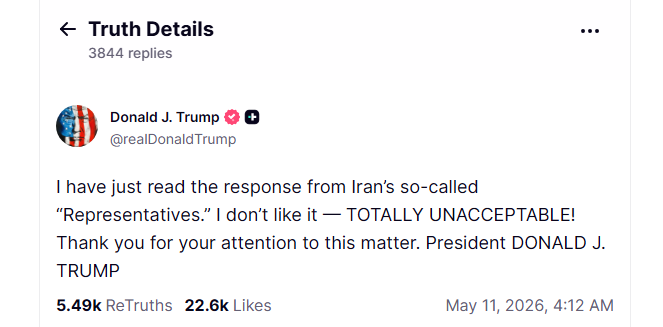
Source: Truth Social

One of the central flashpoints is the Strait of Hormuz, a chokepoint through which roughly one-fifth of global oil trade passes.

Oil climbed another 4.5% to $98.68 per barrel after Trump’s latest statement, adding pressure to an already strained economic picture.

Bitcoin’s Swing After Trump’s Post

On Sunday, Trump took to Truth Social to reject Iran’s counteroffer to a peace deal. Iran had been pushing for war reparations and the unfreezing of blocked financial assets — conditions Trump flatly dismissed.

BTCUSD now trading at $81,013. Chart: TradingView

Bitcoin initially slid on the news, dropping from $81,400 to $80,500 within 45 minutes of the post. But it didn’t stay down. Within three hours, the price had swung back above $82,000, breaking $81,000 on the way up and settling near $82,350.

Data shows that move wiped out over $60 million in short positions over a four-hour window.

Israeli Prime Minister Benjamin Netanyahu added that the war won’t conclude until Iran’s uranium sites are fully dismantled, further dimming prospects of a near-term resolution.

Hopes Fade For Early End To The Conflict

Peace talks had been expected to make progress by Wednesday. Trump’s rejection of Iran’s proposal ended that possibility for now.

The conflict, which began 10 weeks ago, has shown Bitcoin behaving differently from traditional assets — rising even as geopolitical tension deepens, oil surges, and ceasefire talks collapse.

Featured image from The Leaflet, chart from TradingView

Пов'язані питання

QWhat two U.S. Senate events does Markus Thielen identify as potential catalysts for Bitcoin this week?

AThe two events are a Monday vote on Kevin Warsh's nomination as Federal Reserve chair and a Thursday markup session for the CLARITY Act in the Senate Banking Committee.

QHow did Bitcoin's price react in the immediate aftermath of Donald Trump's post rejecting Iran's peace proposal?

ABitcoin's price initially dropped from $81,400 to $80,500 within 45 minutes. However, it then recovered, swinging back above $82,000 within three hours and settling near $82,350.

QAccording to the article, what is the Strait of Hormuz and why is it significant in the current conflict?

AThe Strait of Hormuz is a geographic chokepoint through which roughly one-fifth of global oil trade passes. It is a central flashpoint in the US-Iran conflict, and disruptions there impact global oil prices and markets.

QWhat condition did Israeli Prime Minister Benjamin Netanyahu set for the conclusion of the war?

ABenjamin Netanyahu stated that the war will not conclude until Iran's uranium sites are fully dismantled.

QHow has Bitcoin's performance since the war began compared to gold and the S&P 500?

ABitcoin has climbed nearly 30% since the war began, a run that has outpaced the performance of both gold and the S&P 500 during the same period.

Пов'язані матеріали

Who Funds the Agents?

**Summary: Who Funds AI Agents?** OpenAI recently shut down a feature allowing AI agents to shop for users, highlighting the challenge of creating a secure and regulated environment for agent-driven transactions. While payment infrastructure exists, a crucial governance layer—defining spending limits, fraud detection, tax handling, and return policies—is largely missing. The potential is enormous: AI agents already processed $73M across 176M transactions last year, with McKinsey forecasting this could grow to $3-5T in global consumer commerce by 2030. The core competition isn't just about processing payments, which can be very cheap (especially with crypto-based settlement), but about controlling the rules that govern agent spending. Key players like Stripe and Coinbase are racing to dominate this governance layer. Stripe's acquisition of wallet provider Privy allows it to set spending policies, identity checks, and human-in-the-loop approvals directly at the wallet level. Similarly, Coinbase's stack, including its x402 protocol and AgentKit, embeds governance rules. This vertical integration across settlement, wallet, and governance layers is becoming the dominant strategy. Control over the governance layer is where significant future value lies. If agents handle trillions in transactions, even a small fee for managing compliance, fraud prevention, and policy enforcement could generate billions in annual revenue. The companies that successfully integrate across the payment stack will capture value from idle agent balances, transaction fees, and governance services, positioning themselves as the foundational banks of the AI agent economy.

marsbit23 хв тому

Who Funds the Agents?

marsbit23 хв тому

A Nation Blocks Chips, a Giant Buys a Nuclear Power Plant: Why It's Time to Seriously Consider DeAI

**Title: Great Powers Blockade Chips, Giants Buy Nuclear Plants: Why It's Time to Seriously Consider DeAI** In May 2026, the US closed loopholes for Chinese firms to acquire advanced NVIDIA chips via overseas subsidiaries. That same month, Kenya halted a $1B geothermal data center project involving Microsoft, fearing its immense energy consumption. Meanwhile, Huawei announced mass production of its Ascend AI chip. These disparate events underscore a new reality: the competition for computing power ("compute") has escalated beyond the tech industry, becoming a geopolitical and infrastructural battleground. A new era of oligopoly is forming, with control over the AI stack—from GPU chips (NVIDIA) and cloud platforms (AWS, Azure, Google Cloud) to foundational models (OpenAI, Anthropic)—concentrating in a few Western "AI Octopus" corporations. This centralization creates systemic risks: pricing power and platform lock-in for users, infrastructure fragility, and a widening "compute divide" that threatens to marginalize nations without independent AI capacity. An "AI Iron Curtain" is deepening through export controls. In response, some nations like Saudi Arabia and the UAE are investing heavily to buy compute power, aiming to transition from oil to AI economies. The EU seeks to triple its compute capacity by 2030 to reduce dependency. However, the spending gap is vast, with four US tech giants alone planning ~$750B in AI capex for 2026. The race is increasingly constrained by energy, with AI tasks consuming up to 1000x more power than web searches, pushing firms to even acquire nuclear plants. This landscape is fueling interest in Decentralized AI (DeAI). It proposes a third way: using open protocols to coordinate a global network of idle GPUs, independent developers, and data centers, creating an AI infrastructure without a single controlling entity. Leveraging blockchain and cryptographic verification, DeAI aims to break market concentration, disperse energy demands, reduce geopolitical dependencies, and enhance transparency. While still nascent in performance and stability, DeAI's core promise is not immediate superiority but providing a crucial alternative architecture to resist monopoly, censorship, and centralized power. As specialized AI hardware costs fall and open-source models flourish, the window to build this foundation is open. The very existence of such competition serves as a vital check against the inevitable abuse of concentrated power.

marsbit1 год тому

A Nation Blocks Chips, a Giant Buys a Nuclear Power Plant: Why It's Time to Seriously Consider DeAI

marsbit1 год тому

Торгівля

Спот
Ф'ючерси
活动图片