Trump Rejects Iran Peace Proposal — Bitcoin Breaks $82,000

bitcoinistОпубліковано о 2026-05-12Востаннє оновлено о 2026-05-12

Анотація

Bitcoin has surged nearly 30% since the US-Iran war began on February 28, outpacing gold and the S&P 500 despite ongoing market turmoil. The rally faces potential catalysts this week, including a Senate vote on the hawkish Kevin Warsh for Fed chair and markup of the significant CLARITY Act, both viewed as bullish for Bitcoin. The conflict, triggered by a US airstrike killing Iran's Supreme Leader, continues with no near-term resolution. After former President Trump rejected Iran's peace proposal demanding reparations and asset unfreezing, Bitcoin initially dipped but quickly rebounded, breaking above $82,000 and liquidating over $60 million in shorts. With Israeli PM Netanyahu insisting on dismantling Iran's uranium sites, hopes for a quick ceasefire have faded, underscoring Bitcoin's divergent performance amid deepening geopolitical strain and rising oil prices.

Bitcoin has now climbed nearly 30% since the US-Iran war began on February 28 — a run that has outpaced both gold and the S&P 500 even as the conflict continues to shake global markets.

A Week Of Potential Catalysts

Two events in the US Senate this week could add more fuel to that rally, according to 10x Research CEO Markus Thielen.

The first is a Monday vote on Kevin Warsh’s nomination as Federal Reserve chair. The second is a Thursday markup session for the CLARITY Act in the Senate Banking Committee.

Thielen described the crypto legislation as the most significant of its kind in years, one that could bring long-awaited regulatory certainty to digital assets.

As for Warsh — widely seen as more hawkish on inflation than current Fed chair Jerome Powell — Thielen said his confirmation would clear away uncertainty rather than create it. Both events, he said, lean bullish for Bitcoin.

The backdrop to all this is a conflict that shows no sign of ending soon. The US-Iran war, which started after a US airstrike killed Iranian Supreme Leader Ayatollah Ali Khamenei, has rattled financial markets for the past 10 weeks.
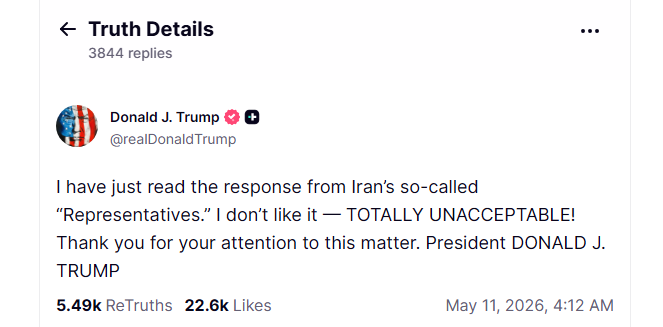
Source: Truth Social

One of the central flashpoints is the Strait of Hormuz, a chokepoint through which roughly one-fifth of global oil trade passes.

Oil climbed another 4.5% to $98.68 per barrel after Trump’s latest statement, adding pressure to an already strained economic picture.

Bitcoin’s Swing After Trump’s Post

On Sunday, Trump took to Truth Social to reject Iran’s counteroffer to a peace deal. Iran had been pushing for war reparations and the unfreezing of blocked financial assets — conditions Trump flatly dismissed.

BTCUSD now trading at $81,013. Chart: TradingView

Bitcoin initially slid on the news, dropping from $81,400 to $80,500 within 45 minutes of the post. But it didn’t stay down. Within three hours, the price had swung back above $82,000, breaking $81,000 on the way up and settling near $82,350.

Data shows that move wiped out over $60 million in short positions over a four-hour window.

Israeli Prime Minister Benjamin Netanyahu added that the war won’t conclude until Iran’s uranium sites are fully dismantled, further dimming prospects of a near-term resolution.

Hopes Fade For Early End To The Conflict

Peace talks had been expected to make progress by Wednesday. Trump’s rejection of Iran’s proposal ended that possibility for now.

The conflict, which began 10 weeks ago, has shown Bitcoin behaving differently from traditional assets — rising even as geopolitical tension deepens, oil surges, and ceasefire talks collapse.

Featured image from The Leaflet, chart from TradingView

Пов'язані питання

QWhat two U.S. Senate events does Markus Thielen identify as potential catalysts for Bitcoin this week?

AThe two events are a Monday vote on Kevin Warsh's nomination as Federal Reserve chair and a Thursday markup session for the CLARITY Act in the Senate Banking Committee.

QHow did Bitcoin's price react in the immediate aftermath of Donald Trump's post rejecting Iran's peace proposal?

ABitcoin's price initially dropped from $81,400 to $80,500 within 45 minutes. However, it then recovered, swinging back above $82,000 within three hours and settling near $82,350.

QAccording to the article, what is the Strait of Hormuz and why is it significant in the current conflict?

AThe Strait of Hormuz is a geographic chokepoint through which roughly one-fifth of global oil trade passes. It is a central flashpoint in the US-Iran conflict, and disruptions there impact global oil prices and markets.

QWhat condition did Israeli Prime Minister Benjamin Netanyahu set for the conclusion of the war?

ABenjamin Netanyahu stated that the war will not conclude until Iran's uranium sites are fully dismantled.

QHow has Bitcoin's performance since the war began compared to gold and the S&P 500?

ABitcoin has climbed nearly 30% since the war began, a run that has outpaced the performance of both gold and the S&P 500 during the same period.

Пов'язані матеріали

Why Did Zhipu Surge Nearly 30% in a Single Day?

"Global AI Model Unicorn" Zhipu's stock surged nearly 30% in a single day, reaching a new market cap high. The catalyst was the launch of its GLM-5.1-highspeed API, boasting a generation speed of **400 tokens per second**, setting a new global benchmark. This speed, roughly 3-5 times faster than industry leaders like OpenAI's GPT-4o and Anthropic's Claude, is achieved **without compromising the full-scale model's capabilities**. In the era of AI Agents requiring dozens of self-calls, such latency reduction is critical, transforming speed from a system metric into a determinant of intelligence limits. The breakthrough stems from a three-layer technical overhaul: 1. **TileRT Inference Engine**: Compiles the entire model into a continuous, always-on computation pipeline using "Warp Specialization," minimizing GPU idle time by having different processor groups handle data loading, computation, and communication in parallel. 2. **Heterogeneous Parallelism for MLA**: To efficiently run the GLM-5.1 model using the MLA attention mechanism, TileRT employs a heterogeneous strategy. One GPU handles sparse indexing/routing, while the others perform dense computation, optimizing for MLA's unique workflow. 3. **ZCube Network Architecture**: Replaces the standard Spine-Leaf (ROFT) network topology with a flat, dual-group interconnect. This design creates a single optimal path between any two GPUs, eliminating network congestion at scale and reducing latency. The business impact is significant: a 15% increase in cluster throughput (free extra capacity), a 40.6% reduction in tail latency (improved stability), and a one-third cut in networking hardware costs. Long-term, this innovation challenges the dominance of NVIDIA's integrated hardware-software stack (GPU+NVLink+InfiniBand), potentially benefiting manufacturers of high-density Leaf switches and optical modules while lowering the software barrier for domestic AI chips like Huawei's Ascend. The innovation proves that more can be achieved with the same compute, reshaping the infrastructure beyond just GPUs.

marsbit34 хв тому

Why Did Zhipu Surge Nearly 30% in a Single Day?

marsbit34 хв тому

Bidding Farewell to the 'Gray Gambling Game'! Polymarket Charges into the Compliance Track—How Will This Impact the Entire Crypto Industry?

From Gray to Regulated: How Polymarket’s Compliance Journey Reshapes Crypto The evolution of Polymarket, a decentralized prediction market platform, illustrates a critical trend in crypto: innovative, high-value sectors ultimately integrate into regulatory frameworks. Founded in 2020, Polymarket quickly gained traction by leveraging low-cost Layer 2 blockchain technology for event-based trading, notably during the 2024 US presidential election where its markets outperformed traditional polls. However, its "build first, comply later" approach led to a 2022 CFTC enforcement action, resulting in a $1.4 million fine and a ban from the US market. A pivotal shift occurred in 2025 under a new US administration. Polymarket strategically acquired CFTC-licensed derivatives exchange QCX for $112 million, securing a regulated pathway back into the US. This move coincided with a regulatory reversal, as the CFTC withdrew a prior proposal to ban political event contracts. The platform’s successful "regulatory acquisition" strategy, avoiding a lengthy independent licensing process, highlights a viable compliance path for crypto-native projects. Its journey from regulatory target to a CFTC-recognized entity—bolstered by a major data partnership and investment from Intercontinental Exchange (ICE)—signals the maturation of prediction markets from a "crypto novelty" into acknowledged financial infrastructure. The story underscores that genuine utility provides negotiating power with regulators and that embracing compliance does not necessarily mean sacrificing core technological advantages.

marsbit51 хв тому

Bidding Farewell to the 'Gray Gambling Game'! Polymarket Charges into the Compliance Track—How Will This Impact the Entire Crypto Industry?

marsbit51 хв тому

Торгівля

Спот
Ф'ючерси
活动图片





