Trump Rejects Iran Peace Proposal — Bitcoin Breaks $82,000

bitcoinistОпубліковано о 2026-05-12Востаннє оновлено о 2026-05-12

Анотація

Bitcoin has surged nearly 30% since the US-Iran war began on February 28, outpacing gold and the S&P 500 despite ongoing market turmoil. The rally faces potential catalysts this week, including a Senate vote on the hawkish Kevin Warsh for Fed chair and markup of the significant CLARITY Act, both viewed as bullish for Bitcoin. The conflict, triggered by a US airstrike killing Iran's Supreme Leader, continues with no near-term resolution. After former President Trump rejected Iran's peace proposal demanding reparations and asset unfreezing, Bitcoin initially dipped but quickly rebounded, breaking above $82,000 and liquidating over $60 million in shorts. With Israeli PM Netanyahu insisting on dismantling Iran's uranium sites, hopes for a quick ceasefire have faded, underscoring Bitcoin's divergent performance amid deepening geopolitical strain and rising oil prices.

Bitcoin has now climbed nearly 30% since the US-Iran war began on February 28 — a run that has outpaced both gold and the S&P 500 even as the conflict continues to shake global markets.

A Week Of Potential Catalysts

Two events in the US Senate this week could add more fuel to that rally, according to 10x Research CEO Markus Thielen.

The first is a Monday vote on Kevin Warsh’s nomination as Federal Reserve chair. The second is a Thursday markup session for the CLARITY Act in the Senate Banking Committee.

Thielen described the crypto legislation as the most significant of its kind in years, one that could bring long-awaited regulatory certainty to digital assets.

As for Warsh — widely seen as more hawkish on inflation than current Fed chair Jerome Powell — Thielen said his confirmation would clear away uncertainty rather than create it. Both events, he said, lean bullish for Bitcoin.

The backdrop to all this is a conflict that shows no sign of ending soon. The US-Iran war, which started after a US airstrike killed Iranian Supreme Leader Ayatollah Ali Khamenei, has rattled financial markets for the past 10 weeks.
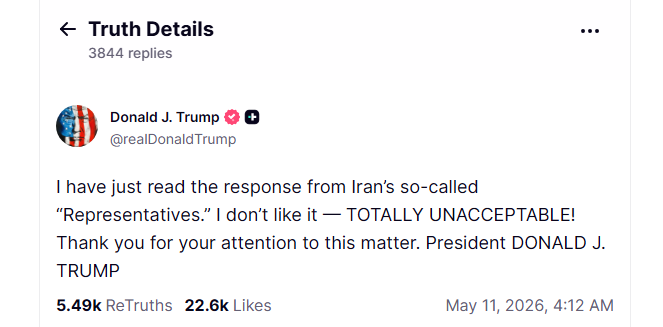
Source: Truth Social

One of the central flashpoints is the Strait of Hormuz, a chokepoint through which roughly one-fifth of global oil trade passes.

Oil climbed another 4.5% to $98.68 per barrel after Trump’s latest statement, adding pressure to an already strained economic picture.

Bitcoin’s Swing After Trump’s Post

On Sunday, Trump took to Truth Social to reject Iran’s counteroffer to a peace deal. Iran had been pushing for war reparations and the unfreezing of blocked financial assets — conditions Trump flatly dismissed.

BTCUSD now trading at $81,013. Chart: TradingView

Bitcoin initially slid on the news, dropping from $81,400 to $80,500 within 45 minutes of the post. But it didn’t stay down. Within three hours, the price had swung back above $82,000, breaking $81,000 on the way up and settling near $82,350.

Data shows that move wiped out over $60 million in short positions over a four-hour window.

Israeli Prime Minister Benjamin Netanyahu added that the war won’t conclude until Iran’s uranium sites are fully dismantled, further dimming prospects of a near-term resolution.

Hopes Fade For Early End To The Conflict

Peace talks had been expected to make progress by Wednesday. Trump’s rejection of Iran’s proposal ended that possibility for now.

The conflict, which began 10 weeks ago, has shown Bitcoin behaving differently from traditional assets — rising even as geopolitical tension deepens, oil surges, and ceasefire talks collapse.

Featured image from The Leaflet, chart from TradingView

Пов'язані питання

QWhat two U.S. Senate events does Markus Thielen identify as potential catalysts for Bitcoin this week?

AThe two events are a Monday vote on Kevin Warsh's nomination as Federal Reserve chair and a Thursday markup session for the CLARITY Act in the Senate Banking Committee.

QHow did Bitcoin's price react in the immediate aftermath of Donald Trump's post rejecting Iran's peace proposal?

ABitcoin's price initially dropped from $81,400 to $80,500 within 45 minutes. However, it then recovered, swinging back above $82,000 within three hours and settling near $82,350.

QAccording to the article, what is the Strait of Hormuz and why is it significant in the current conflict?

AThe Strait of Hormuz is a geographic chokepoint through which roughly one-fifth of global oil trade passes. It is a central flashpoint in the US-Iran conflict, and disruptions there impact global oil prices and markets.

QWhat condition did Israeli Prime Minister Benjamin Netanyahu set for the conclusion of the war?

ABenjamin Netanyahu stated that the war will not conclude until Iran's uranium sites are fully dismantled.

QHow has Bitcoin's performance since the war began compared to gold and the S&P 500?

ABitcoin has climbed nearly 30% since the war began, a run that has outpaced the performance of both gold and the S&P 500 during the same period.

Пов'язані матеріали

Why Bitcoin Holds Above $64,000 After Fed's Hard Pause

**Bitcoin Stabilizes Near $64,000 Following Hawkish Fed Pause** The cryptocurrency market, led by Bitcoin, remained stable around $64,000 despite a volatile reaction to the latest U.S. Federal Reserve meeting. The Fed paused interest rates but signaled a hawkish stance, with three committee members voting for an increase—the highest dissent since 2016. This limits risk appetite but hasn't triggered panic selling. Key market highlights include Bitcoin ETFs seeing a net inflow of $32.1 million, breaking a streak of outflows, while Ethereum ETFs experienced outflows of $18.65 million. Liquidations affected about 90,000 traders. Technically, Bitcoin finds support around $63,000-$63,500, with major resistance near $66,000. While its price is about 49% below its all-time high, institutional demand via ETFs and the absence of mass capitulation support a potential recovery scenario in the second half of the year. Major altcoins showed mixed movements, with Solana attracting capital while Ethereum faced selling pressure despite strong on-chain metrics like a growing staking queue. Regulatory news took a pause as the U.S. Senate delayed the CLARITY Act vote until at least autumn. For the final trading day of July, U.S. inflation and consumer spending data will be crucial. Bitcoin's key levels to watch are $63,000 support and $66,000 resistance. Sustained ETF inflows and Bitcoin holding above $63,000 are seen as positive signs for a potential market recovery later in the year.

cryptonews.ru3 год тому

Why Bitcoin Holds Above $64,000 After Fed's Hard Pause

cryptonews.ru3 год тому

Торгівля

Спот
活动图片





