Trump-Era CFTC Rescinds Biden-Era Crackdown on Sports and Election Wagering: $MAXI Set to Dominate

bitcoinistОпубліковано о 2026-02-05Востаннє оновлено о 2026-02-05

Анотація

The CFTC has rescinded a Biden-era proposal to ban event contracts, including political and sports betting, shifting the regulatory landscape toward free markets. This move is seen as a green light for risk assets and speculative trading, creating a liquidity vacuum that benefits platforms like prediction markets. The decision validates high-stakes crypto trading culture, fueling interest in volatile assets. Maxi Doge ($MAXI) is positioned to capitalize on this shift, offering a gamified trading ecosystem with competitions and staking rewards. The project has raised over $4.5M in presale and attracted significant whale investments, aligning with the new deregulatory environment. It aims to serve as a leverage-focused economy for traders embracing high-risk strategies.

The regulatory pendulum in Washington hasn’t just swung; it snapped back toward free markets.

By officially rescinding the Biden-era proposal to ban contracts involving political contests, gaming, and war, the Commodity Futures Trading Commission (CFTC) has fundamentally altered the landscape for high-risk derivatives. This withdrawal, originally spearheaded by former Chair Rostin Behnam, marks a hard stop to the aggressive ‘nanny state’ oversight that characterized the previous administration’s approach to event contracts.

This creates a massive liquidity vacuum. Previously, platforms like Kalshi and Polymarket faced existential threats just for listing congressional control contracts. Now? The rescission (frankly, a surprise to many legal observers) effectively legalizes the financialization of real-world outcomes.

Markets aren’t just seeing this as a win for election betting; they’re interpreting it as a green light for risk assets across the board. When the regulator steps back, volatility steps up.
The psychological impact on retail traders is immediate.

Removing these barriers validates the ‘high-stakes’ culture that crypto natives have been building for years. Capital previously sidelined by regulatory fear is now hunting for assets that embody this renewed spirit of conviction and leverage.

As the traditional financial guardrails come down, traders are rotating into projects that gamify volatility rather than run from it. That is the exact macro environment fueling the rise of Maxi Doge ($MAXI).

Unleashing The Leverage Economy With Gym-Bro Precision

The CFTC’s retreat creates a specific narrative opening: the normalization of ‘degen’ trading culture. While traditional finance builds products for safety, the current crypto zeitgeist demands products for amplification.

Maxi Doge sits right at that intersection. Unlike typical meme coins that rely solely on passive holding, this project identifies as a ‘trading community’ built for the 1000X mindset. The branding isn’t about cuteness.

With a 240-lb canine juggernaut mascot, it’s about the ‘heavy lifting’ required to survive a volatile bull market.
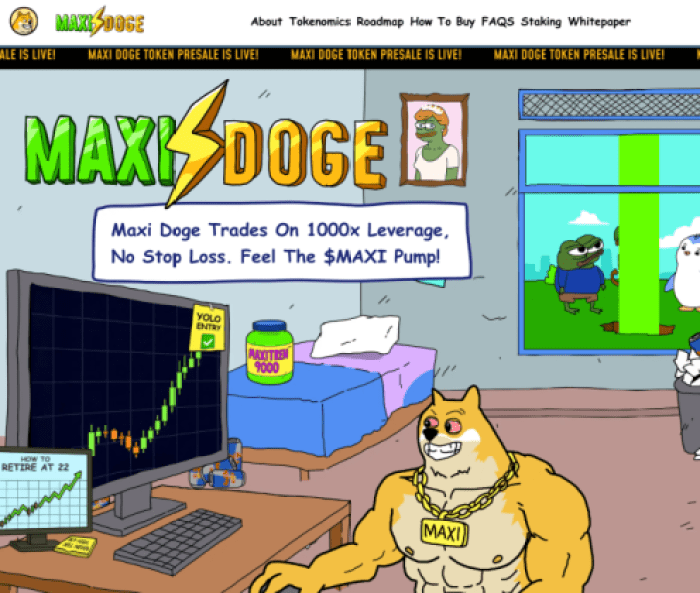

Why does this matter to the post-CFTC news cycle? It comes down to utility. As prediction markets open up, retail traders are looking for arenas to prove their edge. $MAXI plans to integrate ‘Holder-Only Trading Competitions’ directly into its ecosystem, gamifying the very activity regulators tried to suppress.

By offering leaderboard rewards to top ROI hunters, the project creates a synergy with the broader market’s shift toward speculative freedom.

Plus, the ‘Maxi Fund’ treasury introduces a layer of strategic capital management often missing in this sector. (The risk here is usually treasury mismanagement, but the project’s smart contract governance aims to mitigate that).

Rather than just a token, it hopes to function as a localized economy for traders who believe leverage is a feature, not a bug. In an environment where the government has stopped trying to protect traders from themselves, tools empowering aggressive strategies are primed to capture market share.

FIND OUT MORE ABOUT $MAXI

Smart Money Rotates Into High-Octane Assets

While headlines focus on the CFTC’s legal maneuvering, on-chain data suggests institutional capital is already front-running the expected surge in risk appetite. Smart money is moving.

Etherscan data reveals high-net-worth wallets buying $MAXI, up to sums as large as $314K . This specific timing, aligning with the shifting regulatory rumors, suggests sophisticated actors are positioning for a breakout in ‘culture coins’ offering leverage-like returns.

The financial metrics of the Maxi Doge presale back this up. According to the official presale page, the project has already raised over $4.5M, with tokens currently priced at $0.0002802. That level of capital injection during a presale phase indicates a conviction that extends well beyond simple retail FOMO.

Investors are also looking at yield sustainability. The project offers staking rewards with daily automatic distribution, but unlike static yield farms, the dynamic APY is designed to reward long-term conviction. Think of it as the ‘never skip leg day’ philosophy applied to your portfolio.

For traders watching the CFTC clear the runway for speculative markets, the combination of a $4.5M+ raise and significant whale accumulation signals that $MAXI is positioning itself as a primary vehicle for this new, deregulated cycle.

GET YOUR $MAXI BEFORE THE NEXT PRICE INCREASE

This article is for informational purposes only and does not constitute financial advice. Cryptocurrencies are high-risk assets, and presale tokens carry significant volatility. Always conduct your own due diligence before investing.


Пов'язані матеріали

The AI Investment Landscape Is Being Reshaped: Beyond the 'Magnificent Seven', What Opportunities Lie in the Semiconductor Supply Chain?

AI Investment Map is Reshaping: Opportunities Beyond the 'Magnificent Seven' Since ChatGPT ignited the AI wave, investment initially focused on the "Magnificent Seven" tech giants dominating cloud infrastructure. However, the rise of DeepSeek and debates on AI capital expenditure effectiveness are shifting this dynamic. Investors now recognize opportunities deeper in the supply chain—the companies providing the essential "picks and shovels." Early concerns about an AI investment "arms race" and potential low returns were partly alleviated by strong Q1 earnings from cloud providers, validating robust compute demand. This has highlighted a more certain investment thesis: regardless of which AI applications ultimately win, massive capital expenditure will first fuel demand for semiconductors and related components. This "pick-and-shovel" logic has driven semiconductor ETFs to record highs. Key beneficiaries include: * **Memory Chipmakers (e.g., SK Hynix, Samsung, Micron)**: High Bandwidth Memory (HBM) is a critical bottleneck for AI training. * **Photonics Companies**: Crucial for high-speed data transfer within AI data centers. * **The Broader "AI-11" Semiconductor Ecosystem**: This encompasses foundries & lithography (TSMC, ASML), logic & custom chips (AMD, Broadcom, Intel, Marvell), and enterprise storage (SanDisk, Western Digital). Every dollar of AI infrastructure spending flows through this chain. While the "Magnificent Seven" remain dominant in market size, their earnings growth premium over the rest of the S&P 500 ("S&P 493") is narrowing. Market attention and marginal investment are shifting towards the expanding semiconductor supply chain. The investment narrative is evolving from "betting on the ultimate AI winner" to "investing in the certainty of the infrastructure build-out." Understanding this shift from the demand side to the supply side is key to identifying future AI investment opportunities.

marsbit3 хв тому

The AI Investment Landscape Is Being Reshaped: Beyond the 'Magnificent Seven', What Opportunities Lie in the Semiconductor Supply Chain?

marsbit3 хв тому

600 People, $66 Billion: The First Major Cash-Out in the Era of Large Models

The first systematic "big cash-out" of the AI era occurred in October 2025, when over 600 current and former OpenAI employees sold a total of $6.6 billion in shares via a secondary market. Approximately 75 individuals maxed out a $30 million per-person sale limit, while around 525 others cashed out an average of $8.3 million each. This event, exceeding the scale of any 2024 US IPO, functioned as a "shadow IPO." It marked a radical departure from the traditional Silicon Valley path of waiting for a public listing, instead allowing employees to convert equity to cash after just two years of tenure—a direct retention tool in a fiercely competitive talent market where rivals like Meta have offered packages worth hundreds of millions. This massive liquidity event presents a dual-edged sword for OpenAI. While it helps retain talent, it also risks triggering a brain drain as newly wealthy employees may depart. Furthermore, it creates a dilemma for those who sold: they forfeited potential future gains as the company's valuation soared from $400 billion to $852 billion within months. In stark contrast, employees at rival Anthropic demonstrated greater reluctance to sell during their own secondary offering. The financial narratives of the two labs also diverge sharply. OpenAI, while achieving over $20 billion in annualized revenue by 2025, faces massive projected losses (up to $14 billion in 2026), a long path to cash flow positivity, and significant revenue-sharing payments to Microsoft. Anthropic reports rapid revenue growth, improving gross margins, and a faster path to profitability. OpenAI's trajectory is thus balanced precariously between skyrocketing valuation based on funding narratives and the pressures of sustained financial losses post-cash-out. The event underscores that the AI race has evolved into a capital and human experiment, where immense wealth crystallizes the complex calculations of greed, fear, and ambition within the industry.

marsbit22 хв тому

600 People, $66 Billion: The First Major Cash-Out in the Era of Large Models

marsbit22 хв тому

NVIDIA Begins Adding Soap to the Bubble

NVIDIA is taking on a dual role: not just as a leading chip supplier, but as a massive capital allocator across the entire AI supply chain. In 2026, the company has committed over $40 billion in investments within five months, targeting everything from optical fiber manufacturing and data center operations to foundational AI model development. This investment spree, described as a systematic "sprinkler" approach, primarily funds companies that are major buyers of NVIDIA's own GPUs. Critics, including analysts from Goldman Sachs, label this a "circular revenue" loop—comparable to a supplier financing a customer to buy more of its products. A prominent example is NVIDIA's investment in OpenAI, which is expected to generate around $13 billion in revenue for NVIDIA, much of which may be reinvested back into OpenAI. While CEO Jensen Huang dismisses the "circular financing" critique as "absurd," arguing the investments are confidence votes in long-term generational shifts, some analysts express discomfort. They note that while investments in critical supply chain components like optics are strategically sound, funding new cloud providers like CoreWeave feels like "pre-paying for your own GPUs." The strategy carries significant risks. If the AI investment cycle turns, the market may question how much demand is genuine versus artificially sustained by NVIDIA's own balance sheet. Despite posting record-breaking earnings—$215.9 billion in annual revenue and $120 billion in net profit for FY2026—NVIDIA's stock fell after its report, signaling that "beating expectations" may no longer be enough to assure investors about the duration of the AI spending boom. The article concludes that while a bubble isn't necessarily a fraud, NVIDIA's actions resemble adding soap to a bubble—making it appear more robust and durable. This creates a complex scenario requiring extreme冷静 from investors to distinguish between real structural growth and financial engineering.

marsbit39 хв тому

NVIDIA Begins Adding Soap to the Bubble

marsbit39 хв тому

Short Positions Have Been Squeezed Out: Will the Next Leg of the U.S. Stock AI Rally Continue in Seoul?

"Short Squeeze Exhausted: Will the Next Leg of the AI Rally Continue in Seoul?" A Nomura report suggests the US AI stock rally, which saw the S&P 500 rise ~16.6% in 28 days largely driven by 10 key stocks, may be pausing. The fuel from short covering, CTA fund positioning, and volatility-control strategies is nearing its limit. For the rally to continue, new momentum from retail and sentiment-driven FOMO (Fear Of Missing Out) is needed. South Korea's market provided a potential answer on the very day the report was published. The KOSPI index surged 4.32%, triggering a buy-side circuit breaker, led by massive gains in chip giants SK Hynix (+11.98%) and Samsung. This surge is characterized by retail "hynix FOMO" and overseas funds precisely buying into AI themes via chip-focused ETFs, shifting from broad Korean market ETFs. The Korean rally is a high-beta extension of the US AI capital expenditure story, as major cloud providers plan massive infrastructure spending, directly benefiting memory chip leaders. However, this linkage also implies vulnerability. The sustainability of this next leg depends on whether US tech stocks correct, the trajectory of US inflation (with upcoming CPI data key), and geopolitical tensions around the Strait of Hormuz. Seoul has emerged as the new epicenter of the AI trade, but its fate remains tied to these broader macro and market dynamics.

marsbit44 хв тому

Short Positions Have Been Squeezed Out: Will the Next Leg of the U.S. Stock AI Rally Continue in Seoul?

marsbit44 хв тому

Торгівля

Спот
Ф'ючерси

Популярні статті

Як купити ERA

Ласкаво просимо до HTX.com! Ми зробили покупку Caldera (ERA) простою та зручною. Дотримуйтесь нашої покрокової інструкції, щоб розпочати свою криптовалютну подорож.Крок 1: Створіть обліковий запис на HTXВикористовуйте свою електронну пошту або номер телефону, щоб зареєструвати обліковий запис на HTX безплатно. Пройдіть безпроблемну реєстрацію й отримайте доступ до всіх функцій.ЗареєструватисьКрок 2: Перейдіть до розділу Купити крипту і виберіть спосіб оплатиКредитна/дебетова картка: використовуйте вашу картку Visa або Mastercard, щоб миттєво купити Caldera (ERA).Баланс: використовуйте кошти з балансу вашого рахунку HTX для безперешкодної торгівлі.Треті особи: ми додали популярні способи оплати, такі як Google Pay та Apple Pay, щоб підвищити зручність.P2P: Торгуйте безпосередньо з іншими користувачами на HTX.Позабіржова торгівля (OTC): ми пропонуємо індивідуальні послуги та конкурентні обмінні курси для трейдерів.Крок 3: Зберігайте свої Caldera (ERA)Після придбання Caldera (ERA) збережіть його у своєму обліковому записі на HTX. Крім того, ви можете відправити його в інше місце за допомогою блокчейн-переказу або використовувати його для торгівлі іншими криптовалютами.Крок 4: Торгівля Caldera (ERA)Легко торгуйте Caldera (ERA) на спотовому ринку HTX. Просто увійдіть до свого облікового запису, виберіть торгову пару, укладайте угоди та спостерігайте за ними в режимі реального часу. Ми пропонуємо зручний досвід як для початківців, так і для досвідчених трейдерів.

435 переглядів усьогоОпубліковано 2025.07.17Оновлено 2025.07.17

Як купити ERA

Обговорення

Ласкаво просимо до спільноти HTX. Тут ви можете бути в курсі останніх подій розвитку платформи та отримати доступ до професійної ринкової інформації. Нижче представлені думки користувачів щодо ціни ERA (ERA).

活动图片








