Trump Administration Backs Kalshi and Polymarket as Nevada Moves to Enforce Ban

bitcoinistОпубліковано о 2026-02-19Востаннє оновлено о 2026-02-19

Анотація

A legal battle over prediction markets is intensifying in the U.S. as federal regulators, backed by the Trump administration, support operators Kalshi and Polymarket, while Nevada moves to enforce a ban. The dispute centers on whether prediction markets are financial products under federal oversight or a form of gambling subject to state regulation. Nevada’s Gaming Control Board filed a lawsuit to block Kalshi from offering sports-related event contracts, arguing they constitute unlicensed gambling. Kalshi contends its contracts are financial derivatives regulated by the CFTC, which has filed a brief supporting federal jurisdiction. The outcome could define the regulatory boundary between financial markets and gambling nationwide.

A growing legal clash over prediction markets in the United States is intensifying after federal regulators aligned with the Trump administration stepped in to support industry operators Kalshi and Polymarket, even as Nevada moves forward with enforcement action to shut down parts of their businesses.

The dispute raises a broader question facing courts and regulators: whether prediction markets are financial products governed by federal law or a form of online gambling subject to state control.

The latest developments came after the U.S. Court of Appeals for the Ninth Circuit rejected Kalshi’s request to pause enforcement actions by Nevada regulators. Within hours of the decision, the Nevada Gaming Control Board filed a civil lawsuit seeking to block the platform from offering sports-related event contracts to state residents.
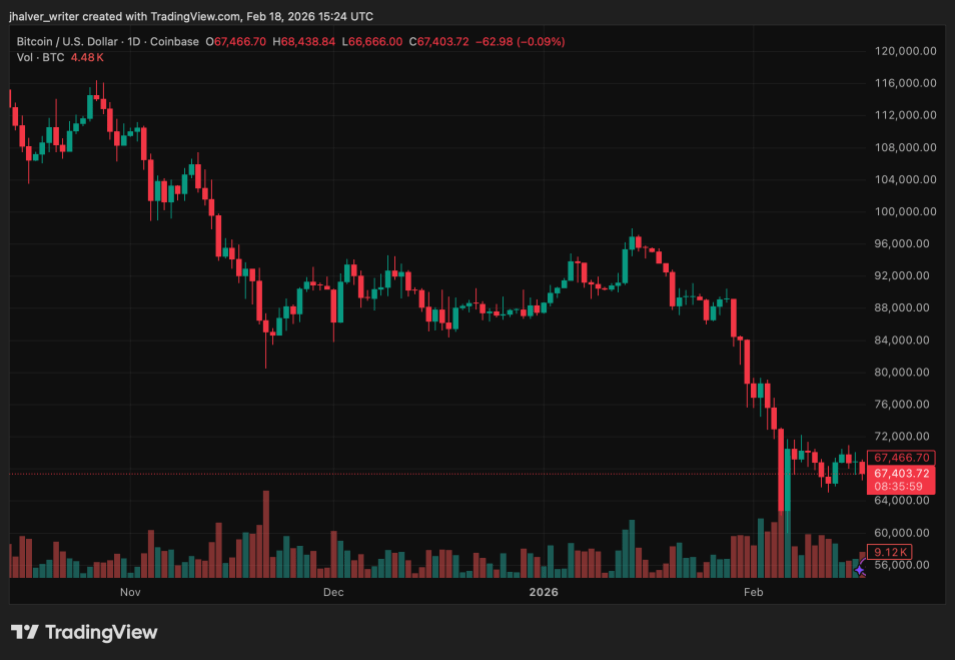
BTC's price trends to the downside on the daily chart. Source: BTCUSD on Tradingview 

Nevada Pushes Gambling Enforcement

Nevada regulators argue that Kalshi’s event contracts, which allow users to trade on outcomes such as sports results, function similarly to traditional sports betting and therefore require a state gaming license.

Officials say the company is offering unlicensed wagering that violates Nevada’s gaming laws and undermines the state’s tightly regulated betting market.

The lawsuit seeks an injunction that could force Kalshi to halt its local operations while litigation continues. The state has taken similar action against other platforms, reflecting a wider effort by multiple jurisdictions to limit prediction markets they view as gambling products.

Kalshi disputes that characterization, maintaining that its contracts are financial derivatives, not bets. The company operates as a federally regulated exchange and has moved to have the case transferred to federal court, arguing that state laws are preempted by federal oversight.

Federal Regulators Enter the Fight

At the center of the dispute is the Commodity Futures Trading Commission (CFTC), which, under Chairman Michael Selig, has taken a more active stance in defending prediction markets. The agency filed an amicus brief supporting federal jurisdiction, arguing that states cannot reclassify federally regulated derivatives trading as illegal gambling.

The Trump administration’s backing of Kalshi and Polymarket shows a broader policy shift toward treating prediction markets as part of the financial system rather than the gambling industry. Federal officials argue that allowing individual states to impose bans could create fragmented regulation and undermine national derivatives markets.

Prediction platforms allow participants to buy contracts priced between one and 99 cents based on the probability of real-world events occurring. While markets cover politics, economics, and weather outcomes, sports-related contracts account for the majority of trading volume.

What Comes Next for Prediction Markets

The legal battle is unfolding across several courts and could ultimately determine who regulates prediction markets nationwide. States, including Massachusetts, Tennessee, and others, have issued lawsuits or cease-and-desist orders, while operators continue to argue for federal protection.

Nevada’s enforcement action increases immediate pressure on Kalshi, though appeals, including a potential emergency request to the U.S. Supreme Court, remain possible.

The outcome could reshape how Americans participate in event-based trading and define the boundary between financial speculation and online gambling for years to come.

Cover image from ChatGPT, BTCUSD chart from Tradingview

Пов'язані питання

QWhat is the core legal dispute surrounding prediction markets like Kalshi and Polymarket in the United States?

AThe core legal dispute is whether prediction markets are financial products governed by federal law (specifically, as derivatives regulated by the CFTC) or a form of online gambling subject to state control and licensing.

QWhich federal agency has intervened to support Kalshi and Polymarket, and what is its argument?

AThe Commodity Futures Trading Commission (CFTC), under Chairman Michael Selig, has intervened. It filed an amicus brief arguing that states cannot reclassify federally regulated derivatives trading as illegal gambling, as this would undermine national derivatives markets and create fragmented regulation.

QWhat specific action did Nevada regulators take against Kalshi, and what is their justification?

ANevada regulators filed a civil lawsuit seeking an injunction to block Kalshi from offering sports-related event contracts to state residents. They argue these contracts function like traditional sports betting and therefore require a state gaming license, making their current operation unlicensed wagering that violates state law.

QHow does Kalshi define its own event contracts, and what action has it taken in response to Nevada's lawsuit?

AKalshi defines its event contracts as financial derivatives, not bets. In response to Nevada's lawsuit, the company has moved to have the case transferred to federal court, arguing that state laws are preempted by federal oversight.

QWhat broader policy shift does the Trump administration's backing of these prediction markets represent?

AIt represents a policy shift toward treating prediction markets as part of the financial system rather than the gambling industry, aiming to prevent fragmented state-level regulation that could undermine the national derivatives market.

Пов'язані матеріали

Promised Year of Crypto IPOs? Only One Went Public in Six Months, Down 70%

The much-anticipated wave of crypto IPOs in 2026 has failed to materialize, with market conditions worsening dramatically. While SpaceX prepares for the largest IPO in history, raising $75 billion at a $1.75 trillion valuation, the crypto sector faces a frozen pipeline. The sole crypto IPO success this year, BitGo, serves as a cautionary tale. After launching on the NYSE in January at $18, its stock has plummeted approximately 70%. Other major contenders have stalled or delayed. Kraken, which secretly filed in late 2025, has put its plans on ice, seeing its valuation drop 33% to $13.3 billion. Consensys has postponed its filing until autumn at the earliest, and Bitpanda is poised to miss its self-imposed H1 deadline for a Frankfurt listing. This widespread retreat is driven by a severe liquidity crunch. Bitcoin has fallen below $60,000, with capital being diverted to AI stocks and the massive SpaceX offering. The poor performance of earlier crypto listings like Gemini and the stagnant price of Coinbase further dampen investor appetite. A key underlying pressure is the impending US midterm elections in November, which could alter the currently favorable regulatory landscape. Companies had hoped to go public during this window of policy certainty, but challenging market dynamics have overridden those plans. The transparency that comes with being a public company is now seen as a potential liability rather than a benefit in a down market. The industry's fate now hinges on a few critical watchpoints: whether Kraken restarts its process in H2, if Consensys files in the fall, and if SpaceX's debut can revitalize market liquidity. Otherwise, the promised "crypto IPO year" will likely be pushed beyond the election.

marsbit12 хв тому

Promised Year of Crypto IPOs? Only One Went Public in Six Months, Down 70%

marsbit12 хв тому

Behind Musk and Huang Jen-hsun's 'AI Factories', an Unseen Battle for Freshwater Has Begun

Behind the "AI factories" of Elon Musk and Jensen Huang lies a hidden battle for a critical resource: fresh water. As AI models like ChatGPT and Claude process billions of prompts daily, they consume vast amounts of water for cooling. By 2030, global AI infrastructure is projected to use 9.3 trillion liters annually—enough to meet the basic needs of 1.3 billion people. This "water grab" stems from the massive heat generated by high-powered GPUs. Over 70% of data centers use evaporative cooling systems, where water absorbs heat and evaporates into the atmosphere, depleting local groundwater. Training models like GPT-4 can consume over 600 million liters of water. Tech giants like Google and Microsoft report skyrocketing water usage, sparking conflicts with local communities over resources. A flashpoint occurred in Memphis, Tennessee, where Musk's xAI built the Colossus supercomputer. It draws nearly 3.8 million liters of drinking water daily from local aquifers, leading to public outrage and legal action. In response, xAI is building an $80 million water recycling plant to use treated wastewater instead. Facing pressure, companies like Microsoft promote "waterless" closed-loop cooling systems. However, these systems increase electricity consumption by 20-30%, shifting the water burden to power plants, which require immense cooling water themselves—a case of indirect water footprint transfer. For China's AI industry, this crisis offers a strategic warning and opportunity. Instead of replicating the West's resource-intensive model, China can leverage its "East Data, West Computing" policy to locate data centers in cooler, water-rich regions like Guizhou. Furthermore, developing lightweight edge computing for smart homes and embodied AI robots can drastically reduce the need for constant cloud queries, cutting both water and energy consumption at the source. The freshwater war underscores a fundamental question: Will AI be a tool for human advancement or a silicon-based monster competing for our planet's last drops of clean water? The answer is becoming clearer as the water vapor rises.

marsbit58 хв тому

Behind Musk and Huang Jen-hsun's 'AI Factories', an Unseen Battle for Freshwater Has Begun

marsbit58 хв тому

AGI is Just One Step Away

The article discusses Anthropic's release of the Fable 5 model, a heavily restricted version of its powerful Mythos model. Initially unveiled in April, Mythos reportedly identified over 10,000 high-risk vulnerabilities for 50 enterprise clients, causing significant concern. Due to its dangerous capabilities in areas like autonomous cyber-attacks and biochemical weapons design guidance (classified as CB-1 level), the unaltered Mythos 5 remains limited to about 200 vetted entities like government agencies. Fable 5, released with a safety classifier, demonstrates extraordinary performance, leading benchmarks in coding (SWE-Bench Pro), software engineering, and research. It exhibits true "long-horizon agency," autonomously planning and executing complex, multi-step tasks like migrating 50 million lines of code in a day, moving beyond simple question-answering. The article positions Fable 5 at OpenAI's Level 3 ("Agent") and progressing toward Level 4 ("Innovator"), suggesting AGI (Artificial General Intelligence) is within reach, potentially 18-24 months away. To mitigate risks, Anthropic implemented a two-layer safety "cage": a silent routing system that redirects dangerous queries to a weaker model, and a mandatory 30-day data retention policy for all Mythos traffic to detect patterns of malicious use. Despite its high cost ($10/$50 per million input/output tokens), the model targets the enterprise market, where its unparalleled productivity and defensive capabilities against AI-powered cyber threats justify the premium. This signals a market maturation where top-tier AI becomes a strategic, high-value tool for businesses, potentially widening the gap with consumer-focused models and accelerating the rise of "one-person companies" while disrupting labor markets.

marsbit1 год тому

AGI is Just One Step Away

marsbit1 год тому

Торгівля

Спот
Ф'ючерси

Популярні статті

Як купити BAN

Ласкаво просимо до HTX.com! Ми зробили покупку Comedian (BAN) простою та зручною. Дотримуйтесь нашої покрокової інструкції, щоб розпочати свою криптовалютну подорож.Крок 1: Створіть обліковий запис на HTXВикористовуйте свою електронну пошту або номер телефону, щоб зареєструвати обліковий запис на HTX безплатно. Пройдіть безпроблемну реєстрацію й отримайте доступ до всіх функцій.ЗареєструватисьКрок 2: Перейдіть до розділу Купити крипту і виберіть спосіб оплатиКредитна/дебетова картка: використовуйте вашу картку Visa або Mastercard, щоб миттєво купити Comedian (BAN).Баланс: використовуйте кошти з балансу вашого рахунку HTX для безперешкодної торгівлі.Треті особи: ми додали популярні способи оплати, такі як Google Pay та Apple Pay, щоб підвищити зручність.P2P: Торгуйте безпосередньо з іншими користувачами на HTX.Позабіржова торгівля (OTC): ми пропонуємо індивідуальні послуги та конкурентні обмінні курси для трейдерів.Крок 3: Зберігайте свої Comedian (BAN)Після придбання Comedian (BAN) збережіть його у своєму обліковому записі на HTX. Крім того, ви можете відправити його в інше місце за допомогою блокчейн-переказу або використовувати його для торгівлі іншими криптовалютами.Крок 4: Торгівля Comedian (BAN)Легко торгуйте Comedian (BAN) на спотовому ринку HTX. Просто увійдіть до свого облікового запису, виберіть торгову пару, укладайте угоди та спостерігайте за ними в режимі реального часу. Ми пропонуємо зручний досвід як для початківців, так і для досвідчених трейдерів.

489 переглядів усьогоОпубліковано 2024.12.11Оновлено 2026.06.02

Як купити BAN

Обговорення

Ласкаво просимо до спільноти HTX. Тут ви можете бути в курсі останніх подій розвитку платформи та отримати доступ до професійної ринкової інформації. Нижче представлені думки користувачів щодо ціни BAN (BAN).

活动图片













